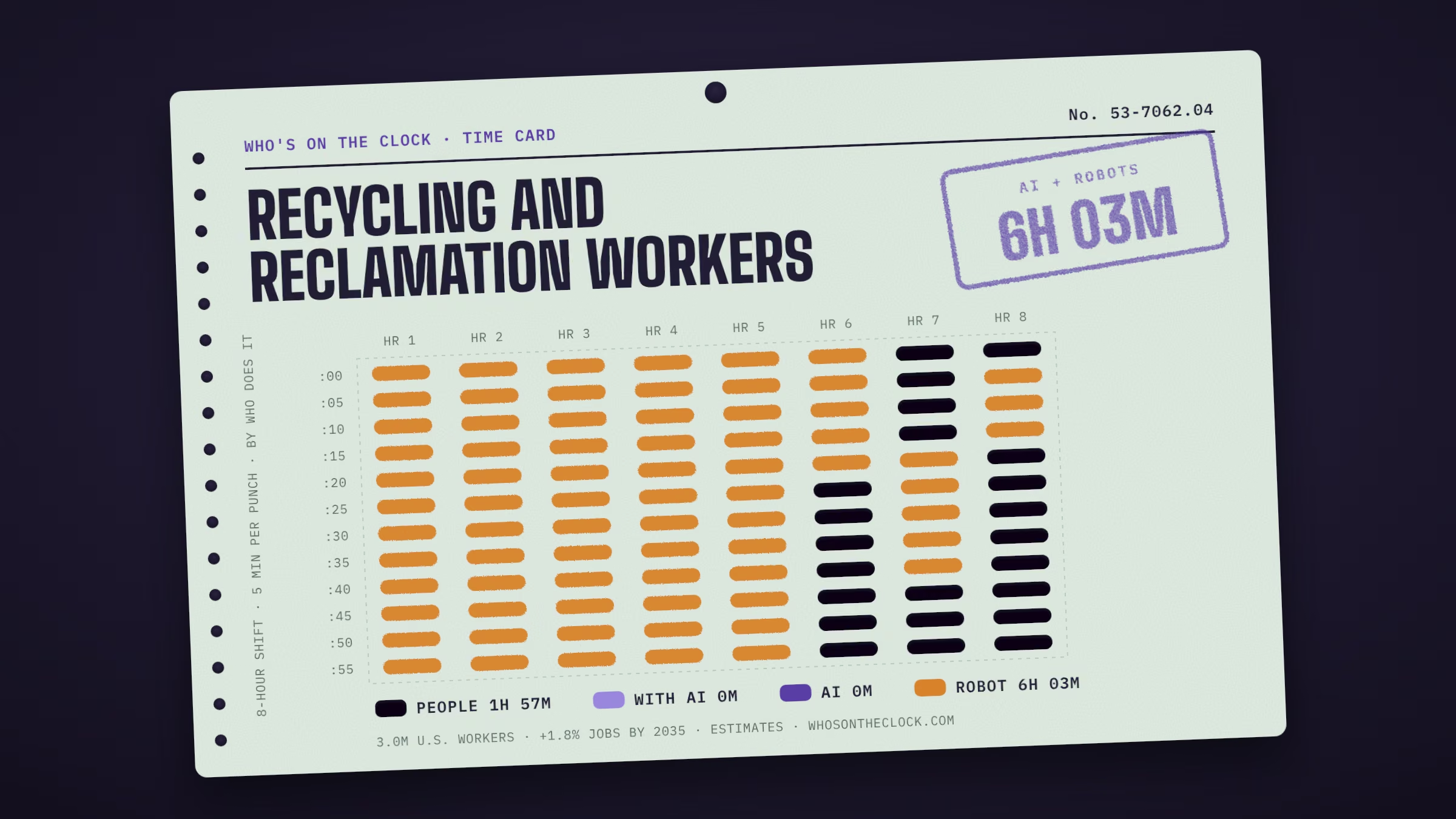
Prepare and sort materials or products for recycling. Identify and remove hazardous substances. Dismantle components of products such as appliances.
Time card
Untick tasks you don't do, or set your own times.
| Mine | Task, by time spent | Human | With AI | AI | Robot |
|---|---|---|---|---|---|
Sort materials, such as metals, glass, wood, paper or plastics, into appropriate containers for recycling.2h 52m a shift · Robots deployed · e.g. AMP Cortex / Amp AI sortationWhy this label?Marked Robot because AMP Cortex / Amp AI sortation (in real use) has done this task in a real workplace. It shows a robot can do it somewhere, not that most recycling and reclamation workers work alongside one. How labels work | |||||
Operate forklifts, pallet jacks, power lifts, or front-end loaders to load bales, bundles, or other heavy items onto trucks for shipping to smelters or other recycled materials processing facilities.43m a shift · Robots deployed · e.g. FoxBot autonomous forkliftWhy this label?Marked Robot because FoxBot autonomous forklift (in real use) has done this task in a real workplace. It shows a robot can do it somewhere, not that most recycling and reclamation workers work alongside one. How labels work | |||||
Clean recycling yard by sweeping, raking, picking up broken glass and loose paper debris, or moving barrels and bins.37m a shift · Robots deployed · e.g. Trombia Free autonomous sweeperWhy this label?Marked Robot because Trombia Free autonomous sweeper (in real use) has done this task in a real workplace. It shows a robot can do it somewhere, not that most recycling and reclamation workers work alongside one. How labels work | |||||
Sort metals to separate high-grade metals, such as copper, brass, and aluminum, for recycling.37m a shift · Robots deployed · e.g. ZenRobotics Heavy Picker (integrated with USConveyor systems)Why this label?Marked Robot because ZenRobotics Heavy Picker (integrated with USConveyor systems) (in real use) has done this task in a real workplace. It shows a robot can do it somewhere, not that most recycling and reclamation workers work alongside one. How labels work | |||||
Deposit recoverable materials into chutes or place materials on conveyor belts.37m a shift · Robots deployed · e.g. AMP Cortex (Amp Sortation / AMP Robotics)Why this label?Marked Robot because AMP Cortex (Amp Sortation / AMP Robotics) (in real use) has done this task in a real workplace. It shows a robot can do it somewhere, not that most recycling and reclamation workers work alongside one. How labels work | |||||
Operate balers to compress recyclable materials into bundles or bales.31m a shift · Robots only in factory cellsWhy this label?Robots have done this only in factory setups built around the machine, so it stays Human for recycling and reclamation workers. How labels work | |||||
Clean, inspect, or lubricate recyclable collection equipment or perform routine maintenance or minor repairs on recycling equipment, such as star gears, finger sorters, destoners, belts, and grinders.25m a shift · No AI or robot evidence foundWhy this label?This is physical work, and no robot has been shown doing it yet. How labels work | |||||
Operate processing equipment, such as fiber-sorters and grinders, to sort, crush, or grind recyclable materials.25m a shift · Robots deployed · e.g. AMP ONE (AMP / Amp Sortation)Why this label?Marked Robot because AMP ONE (AMP / Amp Sortation) (in real use) has done this task in a real workplace. It shows a robot can do it somewhere, not that most recycling and reclamation workers work alongside one. How labels work | |||||
Collect recyclable materials from curbside for delivery to designated facilities.18m a shift · Robots only in factory cellsWhy this label?Robots have done this only in factory setups built around the machine, so it stays Human for recycling and reclamation workers. How labels work | |||||
Collect and sort recyclable construction materials, such as concrete, drywall, plastics, or wood, into containers.12m a shift · Robots deployed · e.g. ZenRobotics Heavy Picker (ZenBrain AI)Why this label?Marked Robot because ZenRobotics Heavy Picker (ZenBrain AI) (in real use) has done this task in a real workplace. It shows a robot can do it somewhere, not that most recycling and reclamation workers work alongside one. How labels work | |||||
Clean materials, such as metals, according to recycling requirements.12m a shift · Robots only in factory cellsWhy this label?Robots have done this only in factory setups built around the machine, so it stays Human for recycling and reclamation workers. How labels work | |||||
Record logs of recycled materials or waste chemicals removed from products.12m a shift · No AI or robot evidence foundWhy this label?No AI use or robot deployment showed up for this task in our data. That isn't proof it's safe; it may just be rare in the data. How labels work | |||||
Operate automated refuse or manual recycling collection vehicles.12m a shift · Robots only in factory cellsWhy this label?Robots have done this only in factory setups built around the machine, so it stays Human for recycling and reclamation workers. How labels work | |||||
Extract chemicals from discarded appliances, such as air conditioners or refrigerators, using specialized machinery, such as refrigerant recovery equipment.6m a shift · Robots only in factory cellsWhy this label?Robots have done this only in factory setups built around the machine, so it stays Human for recycling and reclamation workers. How labels work |