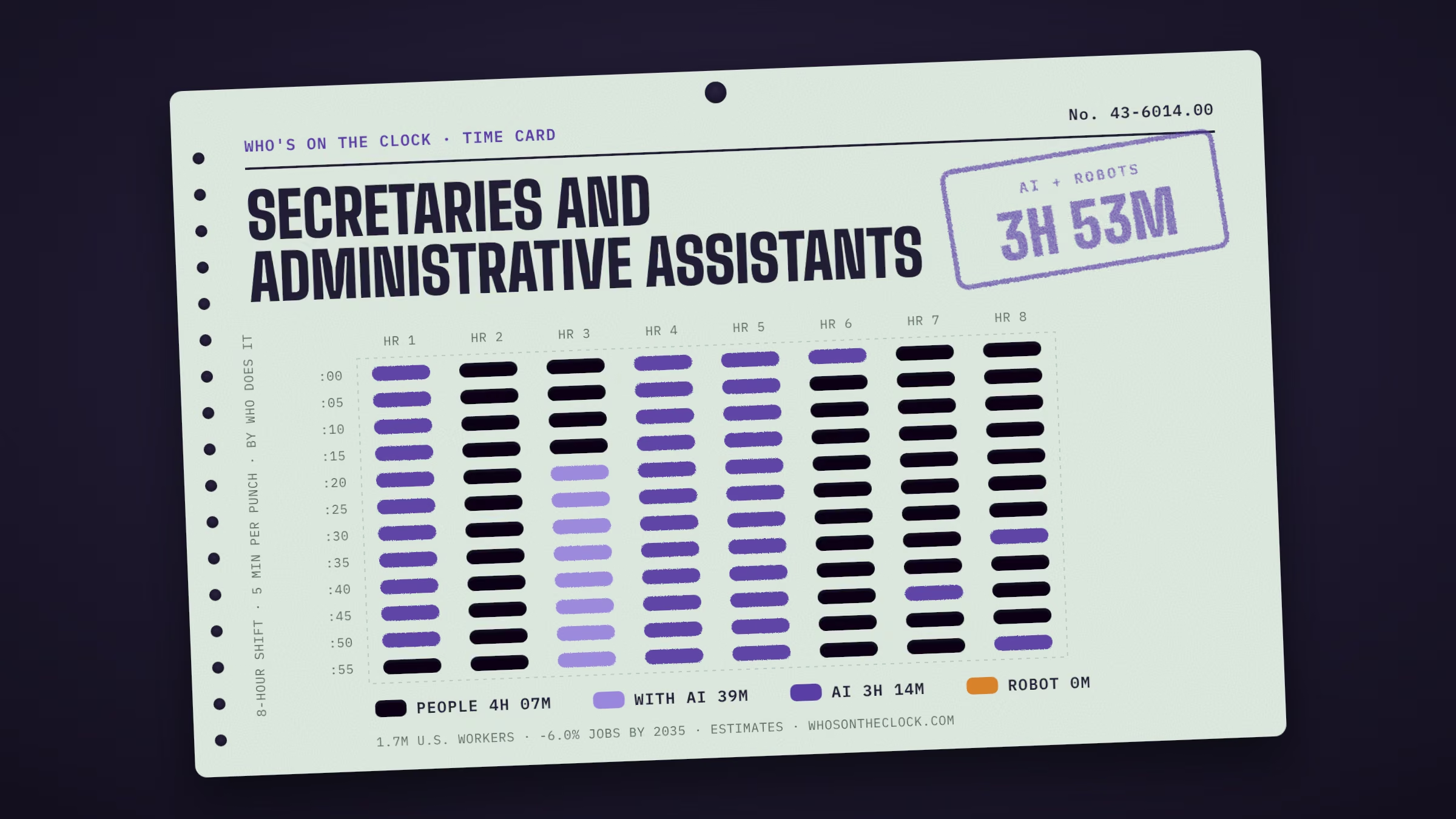
Perform routine administrative functions such as drafting correspondence, scheduling appointments, organizing and maintaining paper and electronic files, or providing information to callers.
Time card
Untick tasks you don't do, or set your own times.
| Mine | Task, by time spent | Human | With AI | AI | Robot |
|---|---|---|---|---|---|
Answer telephones and give information to callers, take messages, or transfer calls to appropriate individuals.52m a shift · Observed in AI useWhy this label?Marked AI because this task shows up regularly in real AI conversations (Anthropic Economic Index, 2025 usage), and in most of them AI does the task on its own rather than helping a person. Many workplaces may not use AI for it at all. How labels work | |||||
Set up and manage paper or electronic filing systems, recording information, updating paperwork, or maintaining documents, such as attendance records, correspondence, or other material.45m a shift · Robots only in factory cellsWhy this label?Robots have done this only in factory setups built around the machine, so it stays Human for secretaries and administrative assistants. How labels work | |||||
Operate electronic mail systems and coordinate the flow of information, internally or with other organizations.39m a shift · No AI or robot evidence foundWhy this label?No AI use or robot deployment showed up for this task in our data. That isn't proof it's safe; it may just be rare in the data. How labels work | |||||
Compose, type, and distribute meeting notes, routine correspondence, or reports, such as presentations or expense, statistical, or monthly reports.39m a shift · Observed in AI useTypical AI request: about 1h 59m alone, 16m with AIWhy this label?Marked With AI because people regularly use AI to help with this task in real conversations (Anthropic Economic Index, 2025 usage), but AI doesn't usually finish it alone. How labels work | |||||
Create, maintain, and enter information into databases.32m a shift · Observed in AI useTypical AI request: about 3h 49m alone, 20m with AIWhy this label?Marked AI because this task shows up regularly in real AI conversations (Anthropic Economic Index, 2025 usage), and in most of them AI does the task on its own rather than helping a person. Many workplaces may not use AI for it at all. How labels work | |||||
Greet visitors or callers and handle their inquiries or direct them to the appropriate persons according to their needs.26m a shift · Observed in AI useWhy this label?Marked AI because this task shows up regularly in real AI conversations (Anthropic Economic Index, 2025 usage), and in most of them AI does the task on its own rather than helping a person. Many workplaces may not use AI for it at all. How labels work | |||||
Use computers for various applications, such as database management or word processing.26m a shift · Observed in AI useTypical AI request: about 1h 22m alone, 11m with AIWhy this label?Marked AI because this task shows up regularly in real AI conversations (Anthropic Economic Index, 2025 usage), and in most of them AI does the task on its own rather than helping a person. Many workplaces may not use AI for it at all. How labels work | |||||
Schedule and confirm appointments for clients, customers, or supervisors.19m a shift · Observed in AI useTypical AI request: about 1h 22m alone, 20m with AIWhy this label?Marked AI because this task shows up regularly in real AI conversations (Anthropic Economic Index, 2025 usage), and in most of them AI does the task on its own rather than helping a person. Many workplaces may not use AI for it at all. How labels work | |||||
Provide services to customers, such as order placement or account information.19m a shift · Observed in AI useWhy this label?Marked AI because this task shows up regularly in real AI conversations (Anthropic Economic Index, 2025 usage), and in most of them AI does the task on its own rather than helping a person. Many workplaces may not use AI for it at all. How labels work | |||||
Operate office equipment, such as fax machines, copiers, or phone systems and arrange for repairs when equipment malfunctions.13m a shift · Robots only in factory cellsWhy this label?Robots have done this only in factory setups built around the machine, so it stays Human for secretaries and administrative assistants. How labels work | |||||
Maintain scheduling and event calendars.13m a shift · No AI or robot evidence foundWhy this label?No AI use or robot deployment showed up for this task in our data. That isn't proof it's safe; it may just be rare in the data. How labels work | |||||
Complete forms in accordance with company procedures.13m a shift · No AI or robot evidence foundWhy this label?No AI use or robot deployment showed up for this task in our data. That isn't proof it's safe; it may just be rare in the data. How labels work | |||||
Open, read, route, and distribute incoming mail or other materials and answer routine letters.13m a shift · Robots only in factory cellsWhy this label?Robots have done this only in factory setups built around the machine, so it stays Human for secretaries and administrative assistants. How labels work | |||||
Perform payroll functions, such as maintaining timekeeping information and processing and submitting payroll.13m a shift · No AI or robot evidence foundWhy this label?No AI use or robot deployment showed up for this task in our data. That isn't proof it's safe; it may just be rare in the data. How labels work | |||||
Manage projects or contribute to committee or team work.13m a shift · No AI or robot evidence foundWhy this label?No AI use or robot deployment showed up for this task in our data. That isn't proof it's safe; it may just be rare in the data. How labels work | |||||
Locate and attach appropriate files to incoming correspondence requiring replies.6m a shift · No AI or robot evidence foundWhy this label?No AI use or robot deployment showed up for this task in our data. That isn't proof it's safe; it may just be rare in the data. How labels work | |||||
Conduct searches to find needed information, using such sources as the Internet.6m a shift · Observed in AI useTypical AI request: about 3h 50m alone, 22m with AIWhy this label?Marked AI because this task shows up regularly in real AI conversations (Anthropic Economic Index, 2025 usage), and in most of them AI does the task on its own rather than helping a person. Many workplaces may not use AI for it at all. How labels work | |||||
Review work done by others to check for correct spelling and grammar, ensure that company format policies are followed, and recommend revisions.6m a shift · No AI or robot evidence foundWhy this label?No AI use or robot deployment showed up for this task in our data. That isn't proof it's safe; it may just be rare in the data. How labels work | |||||
Make copies of correspondence or other printed material.6m a shift · Robots only in factory cellsWhy this label?Robots have done this only in factory setups built around the machine, so it stays Human for secretaries and administrative assistants. How labels work | |||||
Learn to operate new office technologies as they are developed and implemented.6m a shift · No AI or robot evidence foundWhy this label?No AI use or robot deployment showed up for this task in our data. That isn't proof it's safe; it may just be rare in the data. How labels work | |||||
Train and assist staff with computer usage.6m a shift · No AI or robot evidence foundWhy this label?No AI use or robot deployment showed up for this task in our data. That isn't proof it's safe; it may just be rare in the data. How labels work | |||||
Order and dispense supplies.6m a shift · Robots only in factory cellsWhy this label?Robots have done this only in factory setups built around the machine, so it stays Human for secretaries and administrative assistants. How labels work | |||||
Prepare conference or event materials, such as flyers or invitations.6m a shift · No AI or robot evidence foundWhy this label?No AI use or robot deployment showed up for this task in our data. That isn't proof it's safe; it may just be rare in the data. How labels work | |||||
Collect and deposit money into accounts, disburse funds from cash accounts to pay bills or invoices, keep records of collections and disbursements, and ensure accounts are balanced.6m a shift · Robots only in factory cellsWhy this label?Robots have done this only in factory setups built around the machine, so it stays Human for secretaries and administrative assistants. How labels work | |||||
Establish work procedures or schedules and keep track of the daily work of clerical staff.6m a shift · No AI or robot evidence foundWhy this label?No AI use or robot deployment showed up for this task in our data. That isn't proof it's safe; it may just be rare in the data. How labels work | |||||
Prepare and mail checks.6m a shift · Robots only in factory cellsWhy this label?Robots have done this only in factory setups built around the machine, so it stays Human for secretaries and administrative assistants. How labels work | |||||
Arrange conference, meeting, or travel reservations for office personnel.6m a shift · Observed in AI useWhy this label?Marked AI because this task shows up regularly in real AI conversations (Anthropic Economic Index, 2025 usage), and in most of them AI does the task on its own rather than helping a person. Many workplaces may not use AI for it at all. How labels work | |||||
Supervise other clerical staff and provide training and orientation to new staff.6m a shift · No AI or robot evidence foundWhy this label?No AI use or robot deployment showed up for this task in our data. That isn't proof it's safe; it may just be rare in the data. How labels work | |||||
Coordinate conferences, meetings, or special events, such as luncheons or graduation ceremonies.6m a shift · No AI or robot evidence foundWhy this label?No AI use or robot deployment showed up for this task in our data. That isn't proof it's safe; it may just be rare in the data. How labels work | |||||
Mail newsletters, promotional material, or other information.6m a shift · Robots only in factory cellsWhy this label?Robots have done this only in factory setups built around the machine, so it stays Human for secretaries and administrative assistants. How labels work | |||||
Develop or maintain internal or external company Web sites.6m a shift · Observed in AI useTypical AI request: about 15h 14m alone, 1h 15m with AIWhy this label?Marked AI because this task shows up regularly in real AI conversations (Anthropic Economic Index, 2025 usage), and in most of them AI does the task on its own rather than helping a person. Many workplaces may not use AI for it at all. How labels work |