Will AI replace court, municipal, and license clerks?

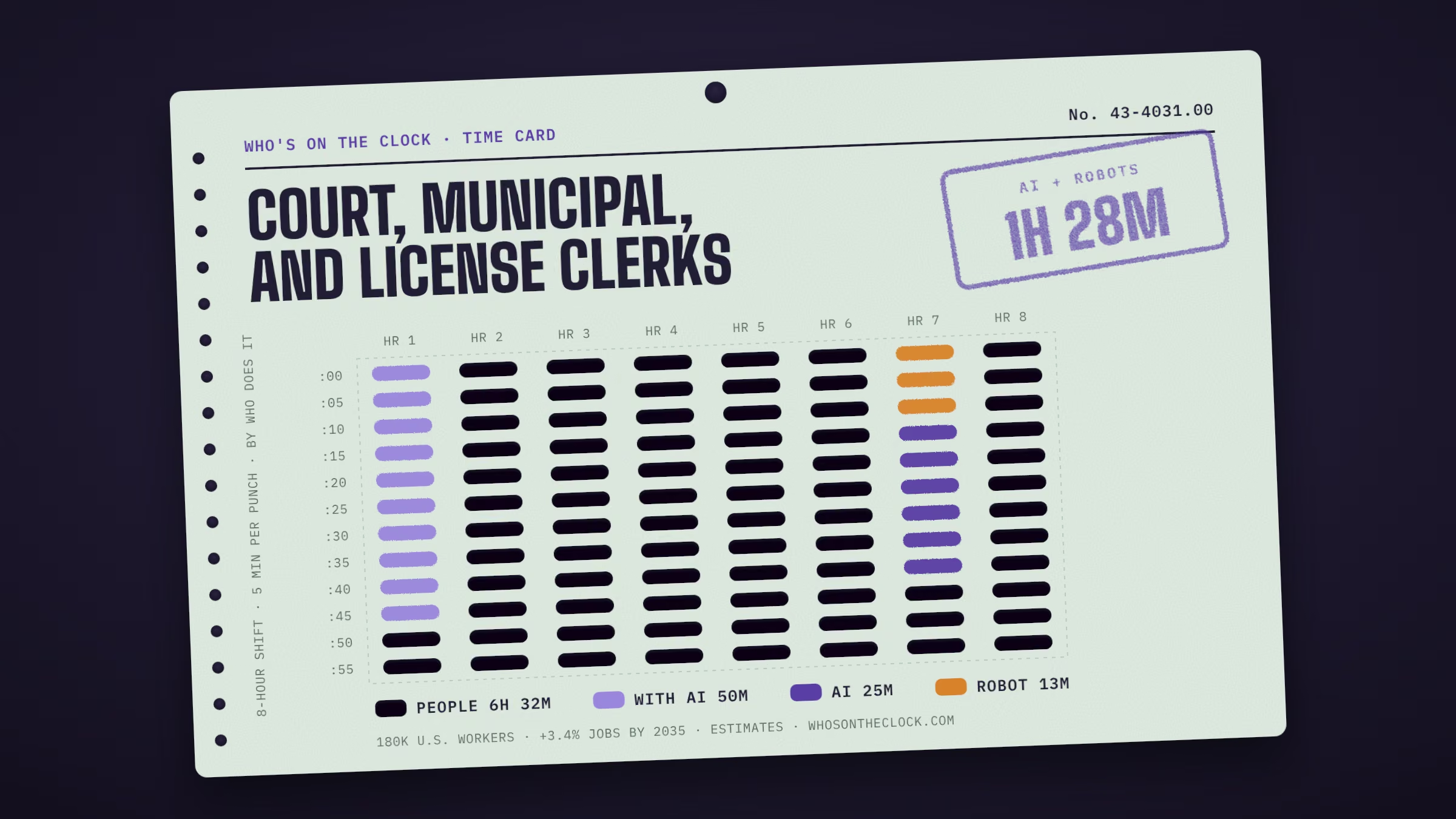
Unlikely, though parts of the work are changing. About 1h 28m of an 8-hour shift goes to tasks touched by AI that people use as a helper. The breakdown: 50m done by people with AI help, 25m that AI mostly does alone, 13m that robots have done in real workplaces. The other 6h 32m (82%) stays with people. Separately, BLS expects about 3.4% more of these jobs by 2035 (all jobs: +3.5%).

Time card for court, municipal, and license clerks showing a typical 8-hour shift: 6h 32m done by people, 50m done by people with AI, 25m by AI, 13m by robots.
Each mark is 5 minutes of a typical shift for court, municipal, and license clerks, colored by who does that task today. Estimates from O*NET tasks and Anthropic Economic Index data. How it's made

Home / Office & admin / Court, Municipal, and License Clerks

Perform clerical duties for courts of law, municipalities, or governmental licensing agencies and bureaus. May prepare docket of cases to be called; secure information for judges and court; prepare draft agendas or bylaws for town or city council; answer official correspondence; keep fiscal records and accounts; issue licenses or permits; and record data, administer tests, or collect fees.

Time card

Untick tasks you don't do, or set your own times.
MineTask, by time spentHumanWith AIAIRobot
Perform administrative tasks, such as answering telephone calls, filing court documents, or maintaining office supplies or equipment.51m a shift · Observed in AI use
Record case dispositions, court orders, or arrangements made for payment of court fees.32m a shift · No AI or robot evidence found
Answer inquiries from the general public regarding judicial procedures, court appearances, trial dates, adjournments, outstanding warrants, summonses, subpoenas, witness fees, or payment of fines.32m a shift · No AI or robot evidence found
Evaluate information on applications to verify completeness and accuracy and to determine whether applicants are qualified to obtain desired licenses.25m a shift · No AI or robot evidence found
Question applicants to obtain required information, such as name, address, or age, and record data on prescribed forms.25m a shift · No AI or robot evidence found
Answer questions or provide advice to the public regarding licensing policies, procedures, or regulations.25m a shift · No AI or robot evidence found
Perform general office duties, such as taking or transcribing dictation, typing or proofreading correspondence, distributing or filing official forms, or scheduling appointments.25m a shift · Robots only in factory cells
Issue various permits and licenses, such as marriage, fishing, hunting, and dog licenses, and collect appropriate fees.25m a shift · No AI or robot evidence found
Record and maintain all vital and fiscal records and accounts.19m a shift · No AI or robot evidence found
Examine legal documents submitted to courts for adherence to laws or court procedures.19m a shift · No AI or robot evidence found
Code information on license applications for entry into computers.19m a shift · No AI or robot evidence found
Prepare documents recording the outcomes of court proceedings.19m a shift · No AI or robot evidence found
Prepare and issue orders of the court, such as probation orders, release documentation, sentencing information, or summonses.19m a shift · No AI or robot evidence found
Prepare dockets or calendars of cases to be called.19m a shift · No AI or robot evidence found
Verify the authenticity of documents, such as foreign identification or immigration documents.13m a shift · Robots deployed · e.g. Credential Authentication Technology (CAT-2)
Record and edit the minutes of meetings and distribute to appropriate officials or staff members.13m a shift · Observed in AI useTypical AI request: about 3h 11m alone, 19m with AI
Prepare meeting agendas or packets of related information.13m a shift · Observed in AI useTypical AI request: about 5h 4m alone, 30m with AI
Respond to requests for information from the public, other municipalities, state officials, or state and federal legislative offices.13m a shift · No AI or robot evidence found
Issue public notification of all official activities or meetings.6m a shift · No AI or robot evidence found
Prepare ordinances, resolutions, or proclamations so that they can be executed, recorded, archived, or distributed.6m a shift · No AI or robot evidence found
Perform budgeting duties, such as assisting in budget preparation, expenditure review, or budget administration.6m a shift · No AI or robot evidence found
Perform record checks on past or current licensees, as required by investigations.6m a shift · No AI or robot evidence found
Instruct parties about timing of court appearances.6m a shift · No AI or robot evidence found
Coordinate or maintain office tracking systems for correspondence or follow-up actions.6m a shift · No AI or robot evidence found
Train other workers or coordinate their work, as necessary.6m a shift · No AI or robot evidence found
Research information in the municipal archives upon request of public officials or private citizens.6m a shift · No AI or robot evidence found
Perform contract administration duties, assisting with bid openings or the awarding of contracts.6m a shift · No AI or robot evidence found
Participate in the administration of municipal elections, such as preparation or distribution of ballots, appointment or training of election officers, or tabulation or certification of results.6m a shift · No AI or robot evidence found
Search files and contact witnesses, attorneys, or litigants to obtain information for the court.6m a shift · No AI or robot evidence found
Plan or direct the maintenance, filing, safekeeping, or computerization of all municipal documents.6m a shift · No AI or robot evidence found

On the floor

  1. Rolling outHawaii State Judiciary
    Hawaii courts launch AI chatbot for court users

    The Hawaii State Judiciary launched KolokoloChat, an AI chatbot giving court users 24/7 access to FAQs, online forms and self-help resources. It was built with the University of Hawaii at Manoa.

    University of Hawaii News

Ask the clock

Will AI replace court, municipal, and license clerks?

Unlikely, though parts of the work are changing. About 1h 28m of an 8-hour shift goes to tasks touched by AI that people use as a helper. The breakdown: 50m done by people with AI help, 25m that AI mostly does alone, 13m that robots have done in real workplaces. The other 6h 32m (82%) stays with people. Separately, BLS expects about 3.4% more of these jobs by 2035 (all jobs: +3.5%).

What can AI already do for court, municipal, and license clerks?

AI shows up regularly in 3 of 30 tasks, about 1h 16m of a typical shift. The biggest ones:

  • Record and edit the minutes of meetings and distribute to appropriate officials or staff members. (13m a shift, AI mostly does it alone)
  • Prepare meeting agendas or packets of related information. (13m a shift, AI mostly does it alone)
  • Perform administrative tasks, such as answering telephone calls, filing court documents, or maintaining office supplies or equipment. (51m a shift, people use AI to help)
Where do robots fit in?

For some tasks, yes. Robots have done 1 of this job's tasks in workplaces like this one, about 13m of a typical shift. 2 more tasks have only been done in factory setups built around the machine, so they stay with people here. For 1 physical task, no robot has shown it can do the work yet.

  • Verify the authenticity of documents, such as foreign identification or immigration documents. (13m a shift; e.g. Credential Authentication Technology (CAT-2), in use)
What still needs a person?

6h 32m of a typical shift, or 82%, goes to tasks with no AI or robot evidence yet. No AI usage or robot deployment has shown up for these so far. The biggest:

  • Record case dispositions, court orders, or arrangements made for payment of court fees. (32m a shift)
  • Answer inquiries from the general public regarding judicial procedures, court appearances, trial dates, adjournments, outstanding warrants, summonses, subpoenas, witness fees, or payment of fines. (32m a shift)
  • Evaluate information on applications to verify completeness and accuracy and to determine whether applicants are qualified to obtain desired licenses. (25m a shift)
  • Question applicants to obtain required information, such as name, address, or age, and record data on prescribed forms. (25m a shift)
  • Answer questions or provide advice to the public regarding licensing policies, procedures, or regulations. (25m a shift)
Why is that work hard to automate?

Much of it comes down to where and how the work happens. In-person, hands-on and high-stakes work is where AI and robots have made the least headway so far. In the official O*NET survey of people in this job:

  • 90% say dealing with the public is very or extremely important
  • 83% talk face to face with others every day
  • 82% are in constant contact with other people
What are companies actually doing?

We track 1 sourced company move that affects this job. Most recent:

  • May 2, 2025: Hawaii courts launch AI chatbot for court users (Rolling out)
How much time does AI save on these tasks?

For the 2 tasks in this job where AI shows up and timing data exists, a typical request takes about 4h 7m for a person alone and about 24m with AI. These are Claude's own estimates from real conversations in April and May 2026 (Anthropic Economic Index). They describe single requests, not whole workdays, and time saved on a task doesn't mean jobs are cut. The biggest gaps:

  • Prepare meeting agendas or packets of related information (about 5h 4m alone, 30m with AI)
  • Record and edit the minutes of meetings and distribute to appropriate officials or staff members (about 3h 11m alone, 19m with AI)
Are employers still hiring court, municipal, and license clerks?

On Indeed, job postings in the Customer Service sector are at 87% of their February 2020 level (all U.S. postings: 104%), down 1.5% from a year earlier, as of Oct 9, 2026. BLS separately expects about 17,000 openings a year in this job through 2035. Across all U.S. postings, 7.3% now mention AI skills. Sector postings cover more than this one job and move for many reasons besides AI.

How much do court, municipal, and license clerks make?

The median pay is about $48,700 a year ($23.41 an hour), 4% below the median for all U.S. jobs ($50,980). Most people in this job earn between $36,300 and $73,820 a year; that range covers the middle 80%. Pay figures are from BLS, May 2025, and vary a lot by state and employer. Pick a state to compare:

Is this job growing or shrinking?

BLS projects growth of 3.4% from 2025 to 2035, compared with 3.5% growth for all jobs. That's about 193,000 jobs in 2035. It expects about 17,000 openings a year, mostly from people retiring or changing careers. These projections don't single out AI as a cause.

How many court, municipal, and license clerks are there in the U.S.?

About 180,000 people in the U.S., roughly 0.12% of all workers (BLS, May 2025). That makes it the 184th largest of the 796 jobs on this site. BLS expects about 193,000 in 2035.

What training do court, municipal, and license clerks need?

The most common requirement is a high school diploma: about 50% of people in the job said so in the official O*NET survey. O*NET rates the job at level 2 of 5 for preparation, which usually means: high school diploma, some training. Requirements vary by state and employer, especially for licensed work.

What should I learn to stay ahead of AI?

These come from the job's official skill ratings and from the tasks that AI and robots touch least today. Building them keeps you strong in the parts of the work that still need a person:

  • Skills that matter more here than in most jobs: Service Orientation, Writing, Social Perceptiveness, Speaking
  • Get strong at the parts of the job that stay with people (listed above), which take 6h 32m of a typical shift
  • Tools employers list: Microsoft Word, Microsoft Outlook, Microsoft Office software, Microsoft Excel, Adobe Acrobat
  • Learn to use AI well on the tasks where it already shows up in this job (listed above)
What other jobs could court, municipal, and license clerks move into?

These use similar skills, with less of a typical shift touched by AI or robots. Matches come from 109 official ratings of skills, knowledge and work activities, and each needs the same or less preparation unless the official list relates the jobs directly:

  • Paralegals and Legal Assistants (48m touched, $63k median pay)
  • Legal Secretaries and Administrative Assistants (42m touched, $56k median pay)
How solid are these numbers?

Each task carries its own evidence label. For this job: 3 observed in real AI use, 1 with robots in real deployments, 26 with no AI or robot evidence found. The minutes per task are estimates, not measured hours, and "no evidence" doesn't prove a task is safe.

Tools in demand

  • Microsoft Word
  • Microsoft Outlook
  • Microsoft Office software
  • Microsoft Excel
  • Adobe Acrobat
  • Microsoft Access
  • Microsoft PowerPoint
  • Zoom

Also called

Agent Licensing Clerk, Animal Control Licensing Worker, Appeals Clerk, Appellate Court Clerk, Basic Traffic Minute Clerk, Birth Certification Clerk, Calendar Clerk, Case Clerk, Circuit Clerk, Circuit Court Clerk, City Clerk, City Recorder, City Secretary, Civil Clerk