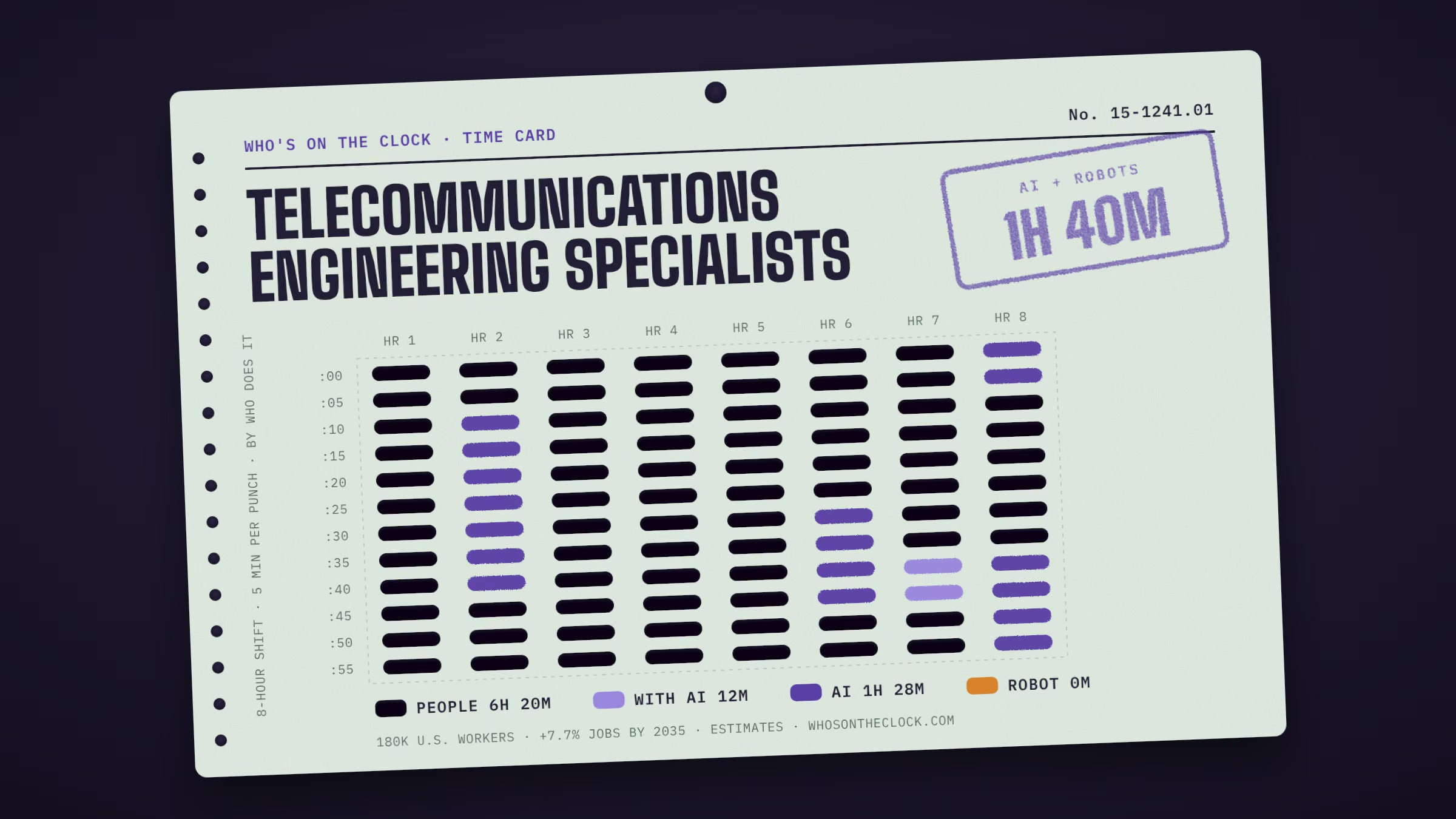
Design or configure wired, wireless, and satellite communications systems for voice, video, and data services. Supervise installation, service, and maintenance.
Time card
Untick tasks you don't do, or set your own times.
| Mine | Task, by time spent | Human | With AI | AI | Robot |
|---|---|---|---|---|---|
Consult with users, administrators, and engineers to identify business and technical requirements for proposed system modifications or technology purchases.35m a shift · No AI or robot evidence foundWhy this label?No AI use or robot deployment showed up for this task in our data. That isn't proof it's safe; it may just be rare in the data. How labels work | |||||
Implement system renovation projects in collaboration with technical staff, engineering consultants, installers, and vendors.35m a shift · No AI or robot evidence foundWhy this label?No AI use or robot deployment showed up for this task in our data. That isn't proof it's safe; it may just be rare in the data. How labels work | |||||
Provide user support by diagnosing network and device problems and implementing technical or procedural solutions.35m a shift · Observed in AI useTypical AI request: about 1h 46m alone, 59m with AIWhy this label?Marked AI because this task shows up regularly in real AI conversations (Anthropic Economic Index, 2025 usage), and in most of them AI does the task on its own rather than helping a person. Many workplaces may not use AI for it at all. How labels work | |||||
Install, or coordinate installation of, new or modified hardware, software, or programming modules of telecommunications systems.29m a shift · No AI or robot evidence foundWhy this label?No AI use or robot deployment showed up for this task in our data. That isn't proof it's safe; it may just be rare in the data. How labels work | |||||
Monitor and analyze system performance, such as network traffic, security, and capacity.29m a shift · No AI or robot evidence foundWhy this label?No AI use or robot deployment showed up for this task in our data. That isn't proof it's safe; it may just be rare in the data. How labels work | |||||
Implement or perform preventive maintenance, backup, or recovery procedures.23m a shift · No AI or robot evidence foundWhy this label?No AI use or robot deployment showed up for this task in our data. That isn't proof it's safe; it may just be rare in the data. How labels work | |||||
Keep abreast of changes in industry practices and emerging telecommunications technology by reviewing current literature, talking with colleagues, participating in educational programs, attending meetings or workshops, or participating in professional organizations or conferences.18m a shift · No AI or robot evidence foundWhy this label?No AI use or robot deployment showed up for this task in our data. That isn't proof it's safe; it may just be rare in the data. How labels work | |||||
Review and evaluate requests from engineers, managers, and technicians for system modifications.18m a shift · No AI or robot evidence foundWhy this label?No AI use or robot deployment showed up for this task in our data. That isn't proof it's safe; it may just be rare in the data. How labels work | |||||
Assess existing facilities' needs for new or modified telecommunications systems.18m a shift · No AI or robot evidence foundWhy this label?No AI use or robot deployment showed up for this task in our data. That isn't proof it's safe; it may just be rare in the data. How labels work | |||||
Communicate with telecommunications vendors to obtain pricing and technical specifications for available hardware, software, or services.18m a shift · No AI or robot evidence foundWhy this label?No AI use or robot deployment showed up for this task in our data. That isn't proof it's safe; it may just be rare in the data. How labels work | |||||
Inspect sites to determine physical configuration, such as device locations and conduit pathways.18m a shift · Robots only in factory cellsWhy this label?Robots have done this only in factory setups built around the machine, so it stays Human for telecommunications engineering specialists. How labels work | |||||
Document user support activity, such as system problems, corrective actions, resolution status, and completed equipment installations.18m a shift · No AI or robot evidence foundWhy this label?No AI use or robot deployment showed up for this task in our data. That isn't proof it's safe; it may just be rare in the data. How labels work | |||||
Work with personnel and facilities management staff to install, remove, or relocate user connectivity equipment and devices.18m a shift · Robots only in factory cellsWhy this label?Robots have done this only in factory setups built around the machine, so it stays Human for telecommunications engineering specialists. How labels work | |||||
Implement controls to provide security for operating systems, software, and data.18m a shift · Observed in AI useTypical AI request: about 4h 56m alone, 55m with AIWhy this label?Marked AI because this task shows up regularly in real AI conversations (Anthropic Economic Index, 2025 usage), and in most of them AI does the task on its own rather than helping a person. Many workplaces may not use AI for it at all. How labels work | |||||
Test and evaluate hardware and software to determine efficiency, reliability, or compatibility with existing systems.18m a shift · No AI or robot evidence foundWhy this label?No AI use or robot deployment showed up for this task in our data. That isn't proof it's safe; it may just be rare in the data. How labels work | |||||
Supervise maintenance of telecommunications equipment.18m a shift · No AI or robot evidence foundWhy this label?No AI use or robot deployment showed up for this task in our data. That isn't proof it's safe; it may just be rare in the data. How labels work | |||||
Develop, maintain, or implement telecommunications disaster recovery plans to ensure business continuity.12m a shift · No AI or robot evidence foundWhy this label?No AI use or robot deployment showed up for this task in our data. That isn't proof it's safe; it may just be rare in the data. How labels work | |||||
Document procedures for hardware and software installation and use.12m a shift · No AI or robot evidence foundWhy this label?No AI use or robot deployment showed up for this task in our data. That isn't proof it's safe; it may just be rare in the data. How labels work | |||||
Instruct in use of voice, video, and data communications systems.12m a shift · Observed in AI useWhy this label?Marked With AI because people regularly use AI to help with this task in real conversations (Anthropic Economic Index, 2025 usage), but AI doesn't usually finish it alone. How labels work | |||||
Prepare purchase requisitions for computer hardware and software, networking and telecommunications equipment, test equipment, cabling, or tools.12m a shift · No AI or robot evidence foundWhy this label?No AI use or robot deployment showed up for this task in our data. That isn't proof it's safe; it may just be rare in the data. How labels work | |||||
Document technical specifications and operating standards for telecommunications equipment.12m a shift · Observed in AI useTypical AI request: about 10h 30m alone, 35m with AIWhy this label?Marked AI because this task shows up regularly in real AI conversations (Anthropic Economic Index, 2025 usage), and in most of them AI does the task on its own rather than helping a person. Many workplaces may not use AI for it at all. How labels work | |||||
Estimate costs for system or component implementation and operation.12m a shift · No AI or robot evidence foundWhy this label?No AI use or robot deployment showed up for this task in our data. That isn't proof it's safe; it may just be rare in the data. How labels work | |||||
Order or maintain inventory of telecommunications equipment for customer premises equipment (CPE), facilities, access networks, or backbone networks.12m a shift · No AI or robot evidence foundWhy this label?No AI use or robot deployment showed up for this task in our data. That isn't proof it's safe; it may just be rare in the data. How labels work | |||||
Use computer-aided design (CAD) software to prepare or evaluate network diagrams, floor plans, or site configurations for existing facilities, renovations, or new systems.12m a shift · No AI or robot evidence foundWhy this label?No AI use or robot deployment showed up for this task in our data. That isn't proof it's safe; it may just be rare in the data. How labels work | |||||
Prepare system activity and performance reports.12m a shift · Observed in AI useWhy this label?Marked AI because this task shows up regularly in real AI conversations (Anthropic Economic Index, 2025 usage), and in most of them AI does the task on its own rather than helping a person. Many workplaces may not use AI for it at all. How labels work | |||||
Manage user access to systems and equipment through account management and password administration.12m a shift · Observed in AI useTypical AI request: about 2h 53m alone, 37m with AIWhy this label?Marked AI because this task shows up regularly in real AI conversations (Anthropic Economic Index, 2025 usage), and in most of them AI does the task on its own rather than helping a person. Many workplaces may not use AI for it at all. How labels work |