Will AI replace electronics engineers?

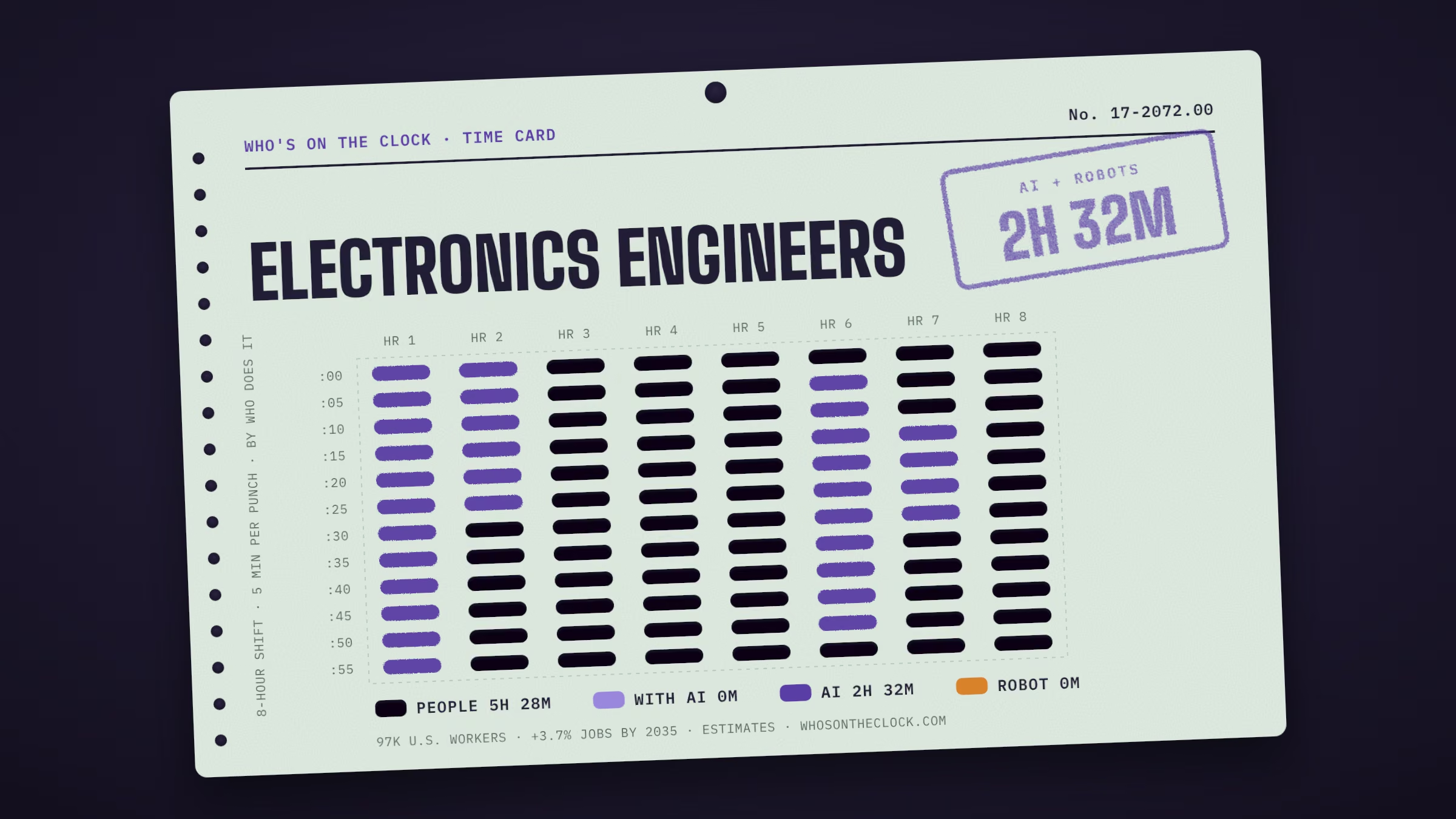
Some tasks are already handled by AI or machines; the rest still needs a person. About 2h 32m of an 8-hour shift goes to tasks that AI or robots largely take over. The other 5h 28m (68%) stays with people. Separately, BLS expects about 3.7% more of these jobs by 2035 (all jobs: +3.5%).

Time card for electronics engineers showing a typical 8-hour shift: 5h 28m done by people, 2h 32m by AI.
Each mark is 5 minutes of a typical shift for electronics engineers, colored by who does that task today. Estimates from O*NET tasks and Anthropic Economic Index data. How it's made

Home / Engineering & architecture / Electronics Engineers

Research, design, develop, or test electronic components and systems for commercial, industrial, military, or scientific use employing knowledge of electronic theory and materials properties. Design electronic circuits and components for use in fields such as telecommunications, aerospace guidance and propulsion control, acoustics, or instruments and controls.

Time card

Untick tasks you don't do, or set your own times.
MineTask, by time spentHumanWith AIAIRobot
Design electronic components, software, products, or systems for commercial, industrial, medical, military, or scientific applications.1h 28m a shift · Observed in AI useTypical AI request: about 6h 4m alone, 1h 6m with AI
Operate computer-assisted engineering or design software or equipment to perform electronics engineering tasks.59m a shift · No AI or robot evidence found
Confer with engineers, customers, vendors, or others to discuss existing or potential electronics engineering projects or products.53m a shift · No AI or robot evidence found
Develop or perform operational, maintenance, or testing procedures for electronic products, components, equipment, or systems.41m a shift · Robots only in factory cells
Evaluate project work to ensure effectiveness, technical adequacy, or compatibility in the resolution of complex electronics engineering problems.35m a shift · No AI or robot evidence found
Prepare documentation containing information such as confidential descriptions or specifications of proprietary hardware or software, product development or introduction schedules, product costs, or information about product performance weaknesses.23m a shift · No AI or robot evidence found
Analyze electronics system requirements, capacity, cost, or customer needs to determine project feasibility.23m a shift · Observed in AI useTypical AI request: about 5h 37m alone, 37m with AI
Prepare, review, or maintain maintenance schedules, design documentation, or operational reports or charts.23m a shift · Observed in AI useTypical AI request: about 9h 8m alone, 43m with AI
Direct or coordinate activities concerned with manufacture, construction, installation, maintenance, operation, or modification of electronic equipment, products, or systems.18m a shift · No AI or robot evidence found
Provide technical support or instruction to staff or customers regarding electronics equipment standards.18m a shift · Observed in AI useTypical AI request: about 1h 58m alone, 32m with AI
Recommend repair or design modifications of electronics components or systems, based on factors such as environment, service, cost, or system capabilities.18m a shift · No AI or robot evidence found
Determine project material or equipment needs.12m a shift · No AI or robot evidence found
Prepare necessary criteria, procedures, reports, or plans for successful conduct of the project with consideration given to site preparation, facility validation, installation, quality assurance, or testing.12m a shift · No AI or robot evidence found
Plan or develop applications or modifications for electronic properties used in components, products, or systems to improve technical performance.12m a shift · No AI or robot evidence found
Prepare engineering sketches or specifications for construction, relocation, or installation of equipment, facilities, products, or systems.12m a shift · No AI or robot evidence found
Represent employer at conferences, meetings, boards, panels, committees, or working groups to present, explain, or defend findings or recommendations, negotiate compromises or agreements, or exchange information.12m a shift · No AI or robot evidence found
Inspect electronic equipment, instruments, products, or systems to ensure conformance to specifications, safety standards, or applicable codes or regulations.6m a shift · Robots only in factory cells
Prepare budget or cost estimates for equipment, construction, or installation projects or control expenditures.6m a shift · No AI or robot evidence found
Investigate green consumer electronics applications for consumer electronic devices, power saving devices for computers or televisions, or energy efficient power chargers.6m a shift · No AI or robot evidence found
Research or develop new green electronics technologies, such as lighting, optical data storage devices, or energy efficient televisions.6m a shift · No AI or robot evidence found

On the floor

No company news tracked for this job yet. New stories are added as they happen.

Ask the clock

Will AI replace electronics engineers?

Some tasks are already handled by AI or machines; the rest still needs a person. About 2h 32m of an 8-hour shift goes to tasks that AI or robots largely take over. The other 5h 28m (68%) stays with people. Separately, BLS expects about 3.7% more of these jobs by 2035 (all jobs: +3.5%).

What can AI already do for electronics engineers?

AI shows up regularly in 4 of 20 tasks, about 2h 32m of a typical shift. The biggest ones:

  • Design electronic components, software, products, or systems for commercial, industrial, medical, military, or scientific applications. (1h 28m a shift, AI mostly does it alone)
  • Analyze electronics system requirements, capacity, cost, or customer needs to determine project feasibility. (23m a shift, AI mostly does it alone)
  • Prepare, review, or maintain maintenance schedules, design documentation, or operational reports or charts. (23m a shift, AI mostly does it alone)
  • Provide technical support or instruction to staff or customers regarding electronics equipment standards. (18m a shift, AI mostly does it alone)
Where do robots fit in?

Not in workplaces like this one, based on a 2026 review of robot deployments. 2 more tasks have only been done in factory setups built around the machine, so they stay with people here.

What still needs a person?

5h 28m of a typical shift, or 68%, goes to tasks with no AI or robot evidence yet. No AI usage or robot deployment has shown up for these so far. The biggest:

  • Operate computer-assisted engineering or design software or equipment to perform electronics engineering tasks. (59m a shift)
  • Confer with engineers, customers, vendors, or others to discuss existing or potential electronics engineering projects or products. (53m a shift)
  • Develop or perform operational, maintenance, or testing procedures for electronic products, components, equipment, or systems. (41m a shift)
  • Evaluate project work to ensure effectiveness, technical adequacy, or compatibility in the resolution of complex electronics engineering problems. (35m a shift)
  • Prepare documentation containing information such as confidential descriptions or specifications of proprietary hardware or software, product development or introduction schedules, product costs, or information about product performance weaknesses. (23m a shift)
How much time does AI save on these tasks?

For the 4 tasks in this job where AI shows up and timing data exists, a typical request takes about 5h 51m for a person alone and about 40m with AI. These are Claude's own estimates from real conversations in April and May 2026 (Anthropic Economic Index). They describe single requests, not whole workdays, and time saved on a task doesn't mean jobs are cut. The biggest gaps:

  • Prepare, review, or maintain maintenance schedules, design documentation, or operational reports or charts (about 9h 8m alone, 43m with AI)
  • Analyze electronics system requirements, capacity, cost, or customer needs to determine project feasibility (about 5h 37m alone, 37m with AI)
  • Design electronic components, software, products, or systems for commercial, industrial, medical, military, or scientific applications (about 6h 4m alone, 1h 6m with AI)
Are employers still hiring electronics engineers?

On Indeed, job postings in the Electrical Engineering sector are at 153% of their February 2020 level (all U.S. postings: 104%), up 32.4% from a year earlier, as of Oct 9, 2026. BLS separately expects about 4,900 openings a year in this job through 2035. Across all U.S. postings, 7.3% now mention AI skills. Sector postings cover more than this one job and move for many reasons besides AI.

How much do electronics engineers make?

The median pay is about $130,220 a year ($62.60 an hour), 155% above the median for all U.S. jobs ($50,980). Most people in this job earn between $81,840 and $206,960 a year; that range covers the middle 80%. Pay figures are from BLS, May 2025, and vary a lot by state and employer. Pick a state to compare:

Is this job growing or shrinking?

BLS projects growth of 3.7% from 2025 to 2035, compared with 3.5% growth for all jobs. That's about 102,000 jobs in 2035. It expects about 4,900 openings a year, mostly from people retiring or changing careers. These projections don't single out AI as a cause.

How many electronics engineers are there in the U.S.?

About 97,000 people in the U.S., roughly 0.06% of all workers (BLS, May 2025). That makes it the 279th largest of the 796 jobs on this site. BLS expects about 102,000 in 2035.

What training do electronics engineers need?

The most common requirement is a bachelor's degree: about 83% of people in the job said so in the official O*NET survey. O*NET rates the job at level 4 of 5 for preparation, which usually means: bachelor's degree. Requirements vary by state and employer, especially for licensed work.

What should I learn to stay ahead of AI?

These come from the job's official skill ratings and from the tasks that AI and robots touch least today. Building them keeps you strong in the parts of the work that still need a person:

  • Skills that matter more here than in most jobs: Technology Design, Operations Analysis, Systems Analysis, Mathematics
  • Get strong at the parts of the job that stay with people (listed above), which take 5h 28m of a typical shift
  • Tools employers list: The MathWorks MATLAB, Microsoft PowerPoint, Microsoft Office software, Microsoft Excel, Apache Subversion SVN
  • Learn to use AI well on the tasks where it already shows up in this job (listed above)
What other jobs could electronics engineers move into?

These use similar skills, with less of a typical shift touched by AI or robots. Matches come from 109 official ratings of skills, knowledge and work activities, and each needs the same or less preparation unless the official list relates the jobs directly:

  • Photonics Engineers (58m touched, $123k median pay)
  • Microsystems Engineers (50m touched, $123k median pay)
  • Fuel Cell Engineers (0m touched, $104k median pay)
  • Mechatronics Engineers (0m touched, $123k median pay)
  • Computer Hardware Engineers (1h 7m touched, $162k median pay)
How solid are these numbers?

Each task carries its own evidence label. For this job: 4 observed in real AI use, 16 with no AI or robot evidence found. The minutes per task are estimates, not measured hours, and "no evidence" doesn't prove a task is safe.

Tools in demand

  • The MathWorks MATLAB
  • Microsoft PowerPoint
  • Microsoft Office software
  • Microsoft Excel
  • Apache Subversion SVN
  • Autodesk AutoCAD
  • C
  • C++

Also called

Antenna Engineer, Audio Visual Engineer (AV Engineer), Audio Visual Manager, Automation Engineer, Central Office Equipment Engineer, Central Office Facilities Planning Engineer, Circuit Design Engineer, Circuit Designer, Commercial Engineer, Communications Engineer, Compatibility Test Engineer, Control Systems Engineer, Customer Equipment Engineer, Design Engineer