Will AI replace title examiners, abstractors, and searchers?

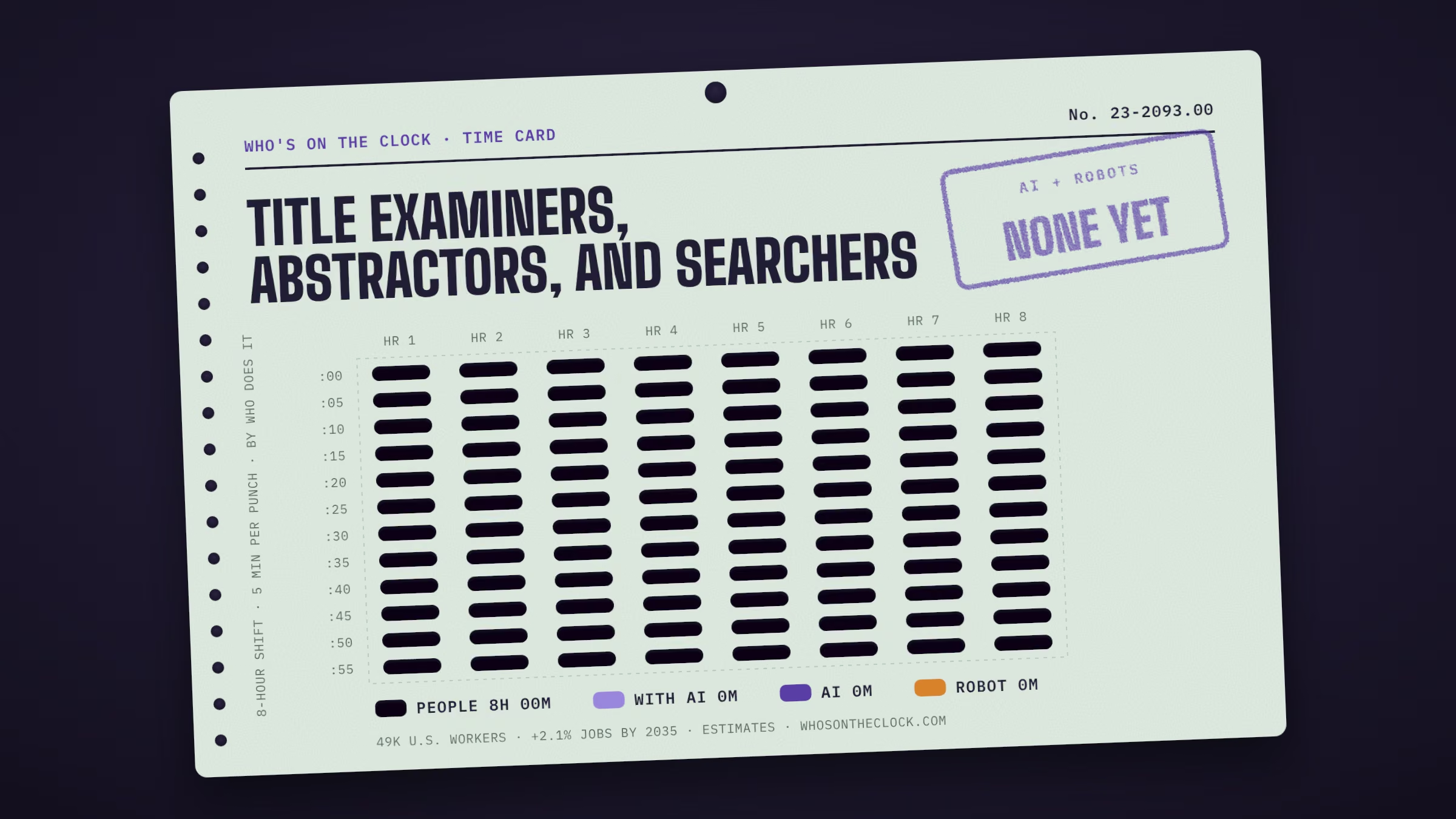
Most of the shift goes to “Examine documentation such as mortgages, liens, judgments, easements”, which remains people's work. So far the record shows no AI use or robot deployment for any of this job's tasks. That reflects today's evidence and could change. BLS expects about 2.1% more of these jobs by 2035.

Time card for title examiners, abstractors, and searchers showing a typical 8-hour shift: 8h done by people.
Each mark is 5 minutes of a typical shift for title examiners, abstractors, and searchers, colored by who does that task today. Estimates from O*NET tasks and Anthropic Economic Index data. How it's made

Home / Legal / Title Examiners, Abstractors, and Searchers

Search real estate records, examine titles, or summarize pertinent legal or insurance documents or details for a variety of purposes. May compile lists of mortgages, contracts, and other instruments pertaining to titles by searching public and private records for law firms, real estate agencies, or title insurance companies.

Time card

Untick tasks you don't do, or set your own times.
MineTask, by time spentHumanWith AIAIRobot
Examine documentation such as mortgages, liens, judgments, easements, plat books, maps, contracts, and agreements to verify factors such as properties' legal descriptions, ownership, or restrictions.1h 32m a shift · No AI or robot evidence found
Why this label?No AI use or robot deployment showed up for this task in our data. That isn't proof it's safe; it may just be rare in the data. How labels work
Confer with realtors, lending institution personnel, buyers, sellers, contractors, surveyors, and courthouse personnel to exchange title-related information or to resolve problems.49m a shift · No AI or robot evidence found
Why this label?No AI use or robot deployment showed up for this task in our data. That isn't proof it's safe; it may just be rare in the data. How labels work
Examine individual titles to determine if restrictions, such as delinquent taxes, will affect titles and limit property use.43m a shift · No AI or robot evidence found
Why this label?No AI use or robot deployment showed up for this task in our data. That isn't proof it's safe; it may just be rare in the data. How labels work
Prepare reports describing any title encumbrances encountered during searching activities and outlining actions needed to clear titles.37m a shift · No AI or robot evidence found
Why this label?No AI use or robot deployment showed up for this task in our data. That isn't proof it's safe; it may just be rare in the data. How labels work
Copy or summarize recorded documents, such as mortgages, trust deeds, and contracts, that affect property titles.37m a shift · No AI or robot evidence found
Why this label?No AI use or robot deployment showed up for this task in our data. That isn't proof it's safe; it may just be rare in the data. How labels work
Enter into record-keeping systems appropriate data needed to create new title records or to update existing ones.37m a shift · No AI or robot evidence found
Why this label?No AI use or robot deployment showed up for this task in our data. That isn't proof it's safe; it may just be rare in the data. How labels work
Prepare and issue title commitments and title insurance policies, based on information compiled from title searches.37m a shift · No AI or robot evidence found
Why this label?No AI use or robot deployment showed up for this task in our data. That isn't proof it's safe; it may just be rare in the data. How labels work
Verify accuracy and completeness of land-related documents accepted for registration, preparing rejection notices when documents are not acceptable.25m a shift · No AI or robot evidence found
Why this label?No AI use or robot deployment showed up for this task in our data. That isn't proof it's safe; it may just be rare in the data. How labels work
Prepare lists of all legal instruments applying to a specific piece of land and the buildings on it.25m a shift · No AI or robot evidence found
Why this label?No AI use or robot deployment showed up for this task in our data. That isn't proof it's safe; it may just be rare in the data. How labels work
Read search requests to ascertain types of title evidence required and to obtain descriptions of properties and names of involved parties.25m a shift · No AI or robot evidence found
Why this label?No AI use or robot deployment showed up for this task in our data. That isn't proof it's safe; it may just be rare in the data. How labels work
Obtain maps or drawings delineating properties from company title plants, county surveyors, or assessors' offices.18m a shift · No AI or robot evidence found
Why this label?No AI use or robot deployment showed up for this task in our data. That isn't proof it's safe; it may just be rare in the data. How labels work
Retrieve and examine real estate closing files for accuracy and to ensure that information included is recorded and executed according to regulations.18m a shift · No AI or robot evidence found
Why this label?No AI use or robot deployment showed up for this task in our data. That isn't proof it's safe; it may just be rare in the data. How labels work
Direct activities of workers who search records and examine titles, assigning, scheduling, and evaluating work, and providing technical guidance as necessary.12m a shift · No AI or robot evidence found
Why this label?No AI use or robot deployment showed up for this task in our data. That isn't proof it's safe; it may just be rare in the data. How labels work
Summarize pertinent legal or insurance details, or sections of statutes or case law from reference books for use in examinations or as proofs or ready reference.12m a shift · No AI or robot evidence found
Why this label?No AI use or robot deployment showed up for this task in our data. That isn't proof it's safe; it may just be rare in the data. How labels work
Determine whether land-related documents can be registered under the relevant legislation, such as the Land Titles Act.6m a shift · No AI or robot evidence found
Why this label?No AI use or robot deployment showed up for this task in our data. That isn't proof it's safe; it may just be rare in the data. How labels work
Assess fees related to registration of property-related documents.6m a shift · No AI or robot evidence found
Why this label?No AI use or robot deployment showed up for this task in our data. That isn't proof it's safe; it may just be rare in the data. How labels work

Clock history

  1. 0m touchedFirst published: O*NET 30.1, Anthropic Economic Index (2025 usage and September 2026 robot study), BLS May 2025

When new data changes this clock, the date, the new numbers and the reason are logged here. Company news alone never moves the clock.

On the floor

No company news tracked for this job yet. New stories are added as they happen.

Ask the clock

Will AI replace title examiners, abstractors, and searchers?

Not on current evidence. Less than 30 minutes of a typical shift goes to tasks that AI or robots are doing today. The other 8h (100%) stays with people. Separately, BLS expects about 2.1% more of these jobs by 2035 (all jobs: +3.5%).

What can AI already do for title examiners, abstractors, and searchers?

None of this job's tasks show regular AI use yet. That can mean the work is hands-on or in person, or simply that it rarely comes up in AI usage data.

What still needs a person?

8h of a typical shift, or 100%, goes to tasks with no AI or robot evidence yet. No AI usage or robot deployment has shown up for these so far. The biggest:

  • Examine documentation such as mortgages, liens, judgments, easements, plat books, maps, contracts, and agreements to verify factors such as properties' legal descriptions, ownership, or restrictions. (1h 32m a shift)
  • Confer with realtors, lending institution personnel, buyers, sellers, contractors, surveyors, and courthouse personnel to exchange title-related information or to resolve problems. (49m a shift)
  • Examine individual titles to determine if restrictions, such as delinquent taxes, will affect titles and limit property use. (43m a shift)
  • Prepare reports describing any title encumbrances encountered during searching activities and outlining actions needed to clear titles. (37m a shift)
  • Copy or summarize recorded documents, such as mortgages, trust deeds, and contracts, that affect property titles. (37m a shift)
Why is that work hard to automate?

Much of it comes down to where and how the work happens. In-person, hands-on and high-stakes work is where AI and robots have made the least headway so far. In the official O*NET survey of people in this job:

  • 85% talk face to face with others every day
  • 71% say dealing with the public is very or extremely important
  • 56% say a mistake would be very or extremely serious
Are employers still hiring title examiners, abstractors, and searchers?

On Indeed, job postings in the Legal sector are at 122% of their February 2020 level (all U.S. postings: 104%), up 1.2% from a year earlier, as of Oct 9, 2026. BLS separately expects about 5,300 openings a year in this job through 2035. Across all U.S. postings, 7.3% now mention AI skills. Sector postings cover more than this one job and move for many reasons besides AI.

How much do title examiners, abstractors, and searchers make?

The median pay is about $58,650 a year ($28.20 an hour), 15% above the median for all U.S. jobs ($50,980). Most people in this job earn between $38,170 and $90,830 a year; that range covers the middle 80%. Pay figures are from BLS, May 2025, and vary a lot by state and employer. Pick a state to compare:

Is this job growing or shrinking?

BLS projects growth of 2.1% from 2025 to 2035, compared with 3.5% growth for all jobs. That's about 61,000 jobs in 2035. It expects about 5,300 openings a year, mostly from people retiring or changing careers. These projections don't single out AI as a cause.

How many title examiners, abstractors, and searchers are there in the U.S.?

About 49,000 people in the U.S., roughly 0.03% of all workers (BLS, May 2025). That makes it the 393rd largest of the 796 jobs on this site. BLS expects about 61,000 in 2035.

What training do title examiners, abstractors, and searchers need?

The most common requirement is a high school diploma: about 60% of people in the job said so in the official O*NET survey. O*NET rates the job at level 2 of 5 for preparation, which usually means: high school diploma, some training. Requirements vary by state and employer, especially for licensed work.

What should I learn to stay ahead of AI?

These come from the job's official skill ratings and from the tasks that AI and robots touch least today. Building them keeps you strong in the parts of the work that still need a person:

  • Skills that matter more here than in most jobs: Reading Comprehension, Active Listening, Writing, Critical Thinking
  • Get strong at the parts of the job that stay with people (listed above), which take 8h of a typical shift
  • Tools employers list: Microsoft Outlook, Microsoft Office software, Microsoft Excel, Adobe Acrobat, Google Workspace software
What other jobs could title examiners, abstractors, and searchers move into?

These use similar skills. Matches come from 109 official ratings of skills, knowledge and work activities, and each needs the same or less preparation unless the official list relates the jobs directly:

  • Insurance Claims and Policy Processing Clerks (1h 20m touched, $49k median pay)
  • Paralegals and Legal Assistants (48m touched, $63k median pay)
  • Court, Municipal, and License Clerks (1h 28m touched, $49k median pay)
How solid are these numbers?

Each task carries its own evidence label. For this job: 16 with no AI or robot evidence found. The minutes per task are estimates, not measured hours, and "no evidence" doesn't prove a task is safe.

Tools in demand

  • Adobe Acrobat
  • Google Workspace software
  • Microsoft Access

Plus everyday office tools: Microsoft Outlook, Microsoft Office software, Microsoft Excel, Microsoft PowerPoint, Microsoft Windows.

Also called

Abstract Clerk, Abstract Searcher, Abstract Writer, Abstractor, Advisory Title Officer, Automotive Title Clerk, Closing Specialist, Commercial Title Examiner, DMV Title Clerk (Department of Motor Vehicles Title Clerk), Data Abstractor, Escrow Officer, Land Examiner, Land Title Examiner, Land and Estates Officer