Will AI replace tutors?

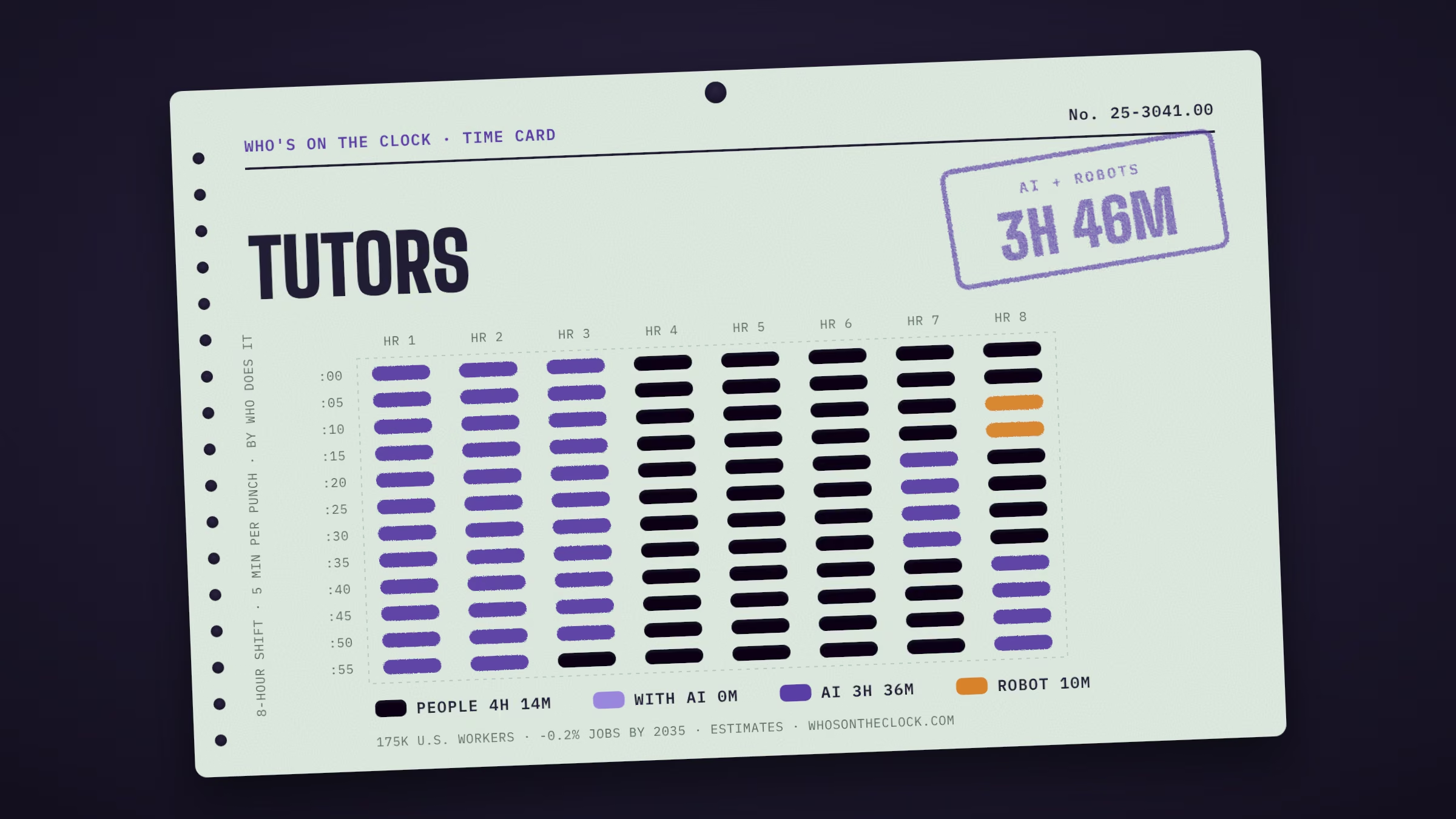
AI already handles some of this work on its own in real use, for tasks like “Provide private instruction to individual or small groups of students to improve academic performance”. That's 3h 36m of a typical shift; 4h 14m still has no AI or robot evidence. BLS expects about 0.2% fewer of these jobs by 2035.

Time card for tutors showing a typical 8-hour shift: 4h 14m done by people, 3h 36m by AI, 10m by robots.
Each mark is 5 minutes of a typical shift for tutors, colored by who does that task today. Estimates from O*NET tasks and Anthropic Economic Index data. How it's made

Home / Education / Tutors

Instruct individual students or small groups of students in academic subjects to support formal class instruction or to prepare students for standardized or admissions tests.

Time card

Untick tasks you don't do, or set your own times.
MineTask, by time spentHumanWith AIAIRobot
Provide private instruction to individual or small groups of students to improve academic performance, improve occupational skills, or prepare for academic or occupational tests.1h 44m a shift · Observed in AI useTypical AI request: about 4h 49m alone, 1h 8m with AI
Why this label?Marked AI because this task shows up regularly in real AI conversations (Anthropic Economic Index, 2025 usage), and in most of them AI does the task on its own rather than helping a person. Many workplaces may not use AI for it at all. How labels work
Review class material with students by discussing text, working solutions to problems, or reviewing worksheets or other assignments.1h 15m a shift · Observed in AI useTypical AI request: about 3h 6m alone, 38m with AI
Why this label?Marked AI because this task shows up regularly in real AI conversations (Anthropic Economic Index, 2025 usage), and in most of them AI does the task on its own rather than helping a person. Many workplaces may not use AI for it at all. How labels work
Prepare lesson plans or learning modules for tutoring sessions according to students' needs and goals.38m a shift · No AI or robot evidence found
Why this label?No AI use or robot deployment showed up for this task in our data. That isn't proof it's safe; it may just be rare in the data. How labels work
Provide feedback to students, using positive reinforcement techniques to encourage, motivate, or build confidence in students.28m a shift · No AI or robot evidence found
Why this label?No AI use or robot deployment showed up for this task in our data. That isn't proof it's safe; it may just be rare in the data. How labels work
Prepare and facilitate tutoring workshops, collaborative projects, or academic support sessions for small groups of students.28m a shift · No AI or robot evidence found
Why this label?No AI use or robot deployment showed up for this task in our data. That isn't proof it's safe; it may just be rare in the data. How labels work
Assess students' progress throughout tutoring sessions.19m a shift · No AI or robot evidence found
Why this label?No AI use or robot deployment showed up for this task in our data. That isn't proof it's safe; it may just be rare in the data. How labels work
Teach students study skills, note-taking skills, and test-taking strategies.19m a shift · No AI or robot evidence found
Why this label?No AI use or robot deployment showed up for this task in our data. That isn't proof it's safe; it may just be rare in the data. How labels work
Collaborate with students, parents, teachers, school administrators, or counselors to determine student needs, develop tutoring plans, or assess student progress.19m a shift · No AI or robot evidence found
Why this label?No AI use or robot deployment showed up for this task in our data. That isn't proof it's safe; it may just be rare in the data. How labels work
Monitor student performance or assist students in academic environments, such as classrooms, laboratories, or computing centers.19m a shift · No AI or robot evidence found
Why this label?No AI use or robot deployment showed up for this task in our data. That isn't proof it's safe; it may just be rare in the data. How labels work
Schedule tutoring appointments with students or their parents.19m a shift · No AI or robot evidence found
Why this label?No AI use or robot deployment showed up for this task in our data. That isn't proof it's safe; it may just be rare in the data. How labels work
Communicate students' progress to students, parents, or teachers in written progress reports, in person, by phone, or by email.19m a shift · No AI or robot evidence found
Why this label?No AI use or robot deployment showed up for this task in our data. That isn't proof it's safe; it may just be rare in the data. How labels work
Develop teaching or training materials, such as handouts, study materials, or quizzes.19m a shift · Observed in AI useTypical AI request: about 7h 59m alone, 28m with AI
Why this label?Marked AI because this task shows up regularly in real AI conversations (Anthropic Economic Index, 2025 usage), and in most of them AI does the task on its own rather than helping a person. Many workplaces may not use AI for it at all. How labels work
Travel to students' homes, libraries, or schools to conduct tutoring sessions.19m a shift · No AI or robot evidence found
Why this label?This is physical work, and no robot has been shown doing it yet. How labels work
Participate in training and development sessions to improve tutoring practices or learn new tutoring techniques.9m a shift · No AI or robot evidence found
Why this label?No AI use or robot deployment showed up for this task in our data. That isn't proof it's safe; it may just be rare in the data. How labels work
Organize tutoring environment to promote productivity and learning.9m a shift · Robots deployed · e.g. Avidbots Neo / Neo 2
Why this label?Marked Robot because Avidbots Neo / Neo 2 (in real use) has done this task in a real workplace. It shows a robot can do it somewhere, not that most tutors work alongside one. How labels work
Maintain records of students' assessment results, progress, feedback, or school performance, ensuring confidentiality of all records.9m a shift · No AI or robot evidence found
Why this label?No AI use or robot deployment showed up for this task in our data. That isn't proof it's safe; it may just be rare in the data. How labels work
Identify, develop, or implement intervention strategies, tutoring plans, or individualized education plans (IEPs) for students.9m a shift · No AI or robot evidence found
Why this label?No AI use or robot deployment showed up for this task in our data. That isn't proof it's safe; it may just be rare in the data. How labels work
Administer, proctor, or score academic or diagnostic assessments.9m a shift · Observed in AI useTypical AI request: about 3h 14m alone, 25m with AI
Why this label?Marked AI because this task shows up regularly in real AI conversations (Anthropic Economic Index, 2025 usage), and in most of them AI does the task on its own rather than helping a person. Many workplaces may not use AI for it at all. How labels work
Research or recommend textbooks, software, equipment, or other learning materials to complement tutoring.9m a shift · Observed in AI useTypical AI request: about 4h 20m alone, 43m with AI
Why this label?Marked AI because this task shows up regularly in real AI conversations (Anthropic Economic Index, 2025 usage), and in most of them AI does the task on its own rather than helping a person. Many workplaces may not use AI for it at all. How labels work

Clock history

  1. 3h 46m touchedFirst published: O*NET 30.1, Anthropic Economic Index (2025 usage and September 2026 robot study), BLS May 2025

When new data changes this clock, the date, the new numbers and the reason are logged here. Company news alone never moves the clock.

On the floor

  1. Rolling outChegg
    Chegg cuts 45% of staff, citing AI and lost Google traffic

    Chegg cut 388 roles, about 45% of its workforce. It cited the new realities of AI and reduced traffic from Google.

    Fortune

  2. New Hampshire offers Khanmigo AI tutor to schools statewide

    New Hampshire signed a $2.3 million contract to give educators and students in grades 5 to 12 free access to Khan Academy's Khanmigo AI tutor and teaching assistant. The contract runs through July 31, 2025.

    New Hampshire Department of Education

Ask the clock

Will AI replace tutors?

Some tasks are already being done by AI or machines; the rest still needs a person. About 3h 46m of a typical shift is made up of tasks that AI or robots have done on their own in real use somewhere. That doesn't mean those hours are automated in a typical workplace. The breakdown: 3h 36m that AI mostly does alone, 10m that robots have done in real workplaces. The other 4h 14m (53%) stays with people. Separately, BLS expects about 0.2% fewer of these jobs by 2035 (all jobs: +3.5%).

What can AI already do for tutors?

AI shows up regularly in 5 of 19 tasks, about 3h 36m of a typical shift. The biggest ones:

  • Provide private instruction to individual or small groups of students to improve academic performance, improve occupational skills, or prepare for academic or occupational tests. (1h 44m a shift, AI mostly does it alone)
  • Review class material with students by discussing text, working solutions to problems, or reviewing worksheets or other assignments. (1h 15m a shift, AI mostly does it alone)
  • Develop teaching or training materials, such as handouts, study materials, or quizzes. (19m a shift, AI mostly does it alone)
  • Administer, proctor, or score academic or diagnostic assessments. (9m a shift, AI mostly does it alone)
  • Research or recommend textbooks, software, equipment, or other learning materials to complement tutoring. (9m a shift, AI mostly does it alone)
Where do robots fit in?

For some tasks, yes. Robots have done 1 of this job's tasks in workplaces like this one, about 10m of a typical shift. For 1 physical task, no robot has shown it can do the work yet.

  • Organize tutoring environment to promote productivity and learning. (9m a shift; e.g. Avidbots Neo / Neo 2, in use)
What still needs a person?

4h 14m of a typical shift, or 53%, goes to tasks with no AI or robot evidence yet. No AI usage or robot deployment has shown up for these so far. The biggest:

  • Prepare lesson plans or learning modules for tutoring sessions according to students' needs and goals. (38m a shift)
  • Provide feedback to students, using positive reinforcement techniques to encourage, motivate, or build confidence in students. (28m a shift)
  • Prepare and facilitate tutoring workshops, collaborative projects, or academic support sessions for small groups of students. (28m a shift)
  • Assess students' progress throughout tutoring sessions. (19m a shift)
  • Teach students study skills, note-taking skills, and test-taking strategies. (19m a shift)
Why is that work hard to automate?

Much of it comes down to where and how the work happens. In-person, hands-on and high-stakes work is where AI and robots have made the least headway so far. In the official O*NET survey of people in this job:

  • 100% work at arm's length or closer to other people
  • 77% are in constant contact with other people
  • 71% say dealing with the public is very or extremely important
What are companies actually doing?

We track 2 sourced company moves that affect this job. Most recent:

  • Oct 28, 2025: Chegg cuts 45% of staff, citing AI and lost Google traffic (Rolling out)
  • Jun 12, 2024: New Hampshire offers Khanmigo AI tutor to schools statewide (Rolling out)
How much time does AI save on these tasks?

For the 5 tasks in this job where AI shows up and timing data exists, a typical request takes about 4h 20m for a person alone and about 38m with AI. These are Claude's own estimates from real conversations in April and May 2026 (Anthropic Economic Index). They describe single requests, not whole workdays, and time saved on a task doesn't mean jobs are cut. The biggest gaps:

  • Develop teaching or training materials, such as handouts, study materials, or quizzes (about 7h 59m alone, 28m with AI)
  • Provide private instruction to individual or small groups of students to improve academic performance, improve occupational skills, or prepare for academic or occupational tests (about 4h 49m alone, 1h 8m with AI)
  • Research or recommend textbooks, software, equipment, or other learning materials to complement tutoring (about 4h 20m alone, 43m with AI)
Are employers still hiring tutors?

On Indeed, job postings in the Education & Instruction sector are at 107% of their February 2020 level (all U.S. postings: 104%), down 9.5% from a year earlier, as of Oct 9, 2026. BLS separately expects about 34,000 openings a year in this job through 2035. Across all U.S. postings, 7.3% now mention AI skills. Sector postings cover more than this one job and move for many reasons besides AI.

How much do tutors make?

The median pay is about $43,350 a year ($20.84 an hour), 15% below the median for all U.S. jobs ($50,980). Most people in this job earn between $29,430 and $75,990 a year; that range covers the middle 80%. Pay figures are from BLS, May 2025, and vary a lot by state and employer. Pick a state to compare:

Is this job growing or shrinking?

BLS projects a decline of 0.2% from 2025 to 2035, compared with 3.5% growth for all jobs. That's about 208,000 jobs in 2035. Even so, it expects about 34,000 openings a year, mostly from people retiring or changing careers. These projections don't single out AI as a cause.

How many tutors are there in the U.S.?

About 175,000 people in the U.S., roughly 0.11% of all workers (BLS, May 2025). That makes it the 189th largest of the 796 jobs on this site. BLS expects about 208,000 in 2035.

What training do tutors need?

The most common requirement is a bachelor's degree: about 41% of people in the job said so in the official O*NET survey. O*NET rates the job at level 3 of 5 for preparation, which usually means: vocational school or associate's degree. Requirements vary by state and employer, especially for licensed work.

What should I learn to stay ahead of AI?

These come from the job's official skill ratings and from the tasks that AI and robots touch least today. Building them keeps you strong in the parts of the work that still need a person:

  • Skills that matter more here than in most jobs: Instructing, Learning Strategies, Social Perceptiveness, Reading Comprehension
  • Get strong at the parts of the job that stay with people (listed above), which take 4h 14m of a typical shift
  • Tools employers list: Facebook, Microsoft Excel, Microsoft Office software, Microsoft PowerPoint, Microsoft Word
  • Learn to use AI well on the tasks where it already shows up in this job (listed above)
What other jobs could tutors move into?

These use similar skills, with less of a typical shift touched by AI or robots. Matches come from 109 official ratings of skills, knowledge and work activities, and each needs the same or less preparation unless the official list relates the jobs directly:

  • Adult Basic Education, Adult Secondary Education, and English as a Second Language Instructors (1h 39m touched, $62k median pay)
  • Elementary School Teachers (1h 29m touched, $64k median pay)
  • Postsecondary Teaching Assistants (1h 2m touched, $43k median pay)
How solid are these numbers?

Each task carries its own evidence label. For this job: 5 observed in real AI use, 1 with robots in real deployments, 13 with no AI or robot evidence found. The minutes per task are estimates, not measured hours, and "no evidence" doesn't prove a task is safe.

Tools in demand

  • Facebook
  • Zoom

Plus everyday office tools: Microsoft Excel, Microsoft Office software, Microsoft PowerPoint, Microsoft Word.

Also called

ACT Instructor (American College Testing Instructor), ACT Tutor (American College Test Tutor), Academic Coach, Academic Guidance Specialist, Academic Mentor, Academic Teacher, Academic Tutor, Accounting Tutor, After School Tutor, Algebra Tutor, Biology Tutor, Calculus Tutor, Chemistry Tutor, Children's Tutor