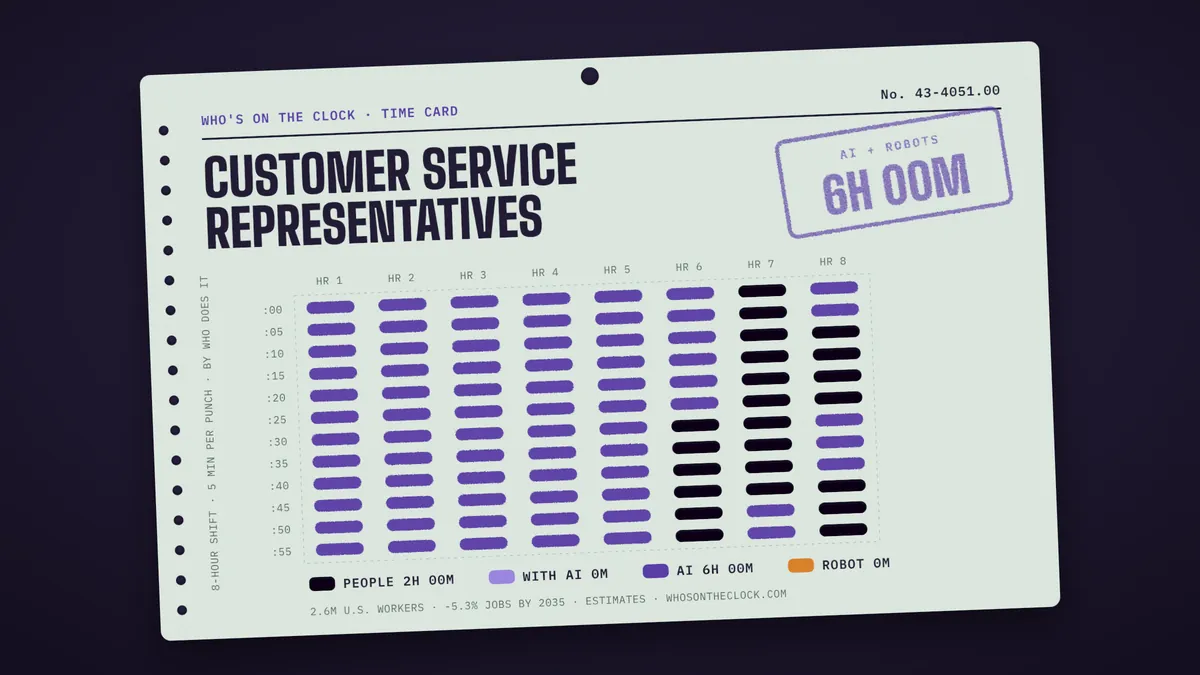
What does this mean for workers? Klarna's moves touch 3 jobs, which together employ about 2.8 million people in the U.S. Across them, AI and robots already touch between 2h 19m (graphic designers) and 6h (customer service representatives) of a typical 8-hour shift. A single company's move is an early signal for these jobs, and the time cards show how far the change has spread nationally.
Pulled back means the company ended, paused or reversed the change. Rolling out means it is in use and spreading to more locations or teams.
On the floor
- Klarna brings back human customer service agents
After cutting about 700 support roles and leaning on AI chat, Klarna began rehiring human agents for a hybrid model: AI for simple cases, people for the rest.
- Klarna uses AI image tools and cuts image production costs by $6 million
Klarna said Midjourney, DALL-E and Firefly cut its image development cycle from 6 weeks to 7 days and saved $6 million in image production costs. Spending on external translation and other agencies also fell.
Marketing Dive · Graphic Designers, Interpreters and Translators
Jobs affected
- Customer Service Representatives6h of 8h touched · 2.6 million workers · $45k · -5.3% by 2035Where AI or robots show up most: Confer with customers by telephone or in person to provide information about products or services, take or enter orders, cancel accounts, or obtain details of complaints (3h a shift, AI on its own)
- Graphic Designers2h 19m of 8h touched · 198,000 workers · $63k · -1.7% by 2035Where AI or robots show up most: Develop graphics and layouts for product illustrations, company logos, and Web sites (1h 3m a shift, AI on its own)
- Interpreters and Translators4h 47m of 8h touched · 52,000 workers · $60k · +2% by 2035Where AI or robots show up most: Translate messages simultaneously or consecutively into specified languages, orally or by using hand signs, maintaining message content, context, and style as much as possible (2h 23m a shift, AI on its own)