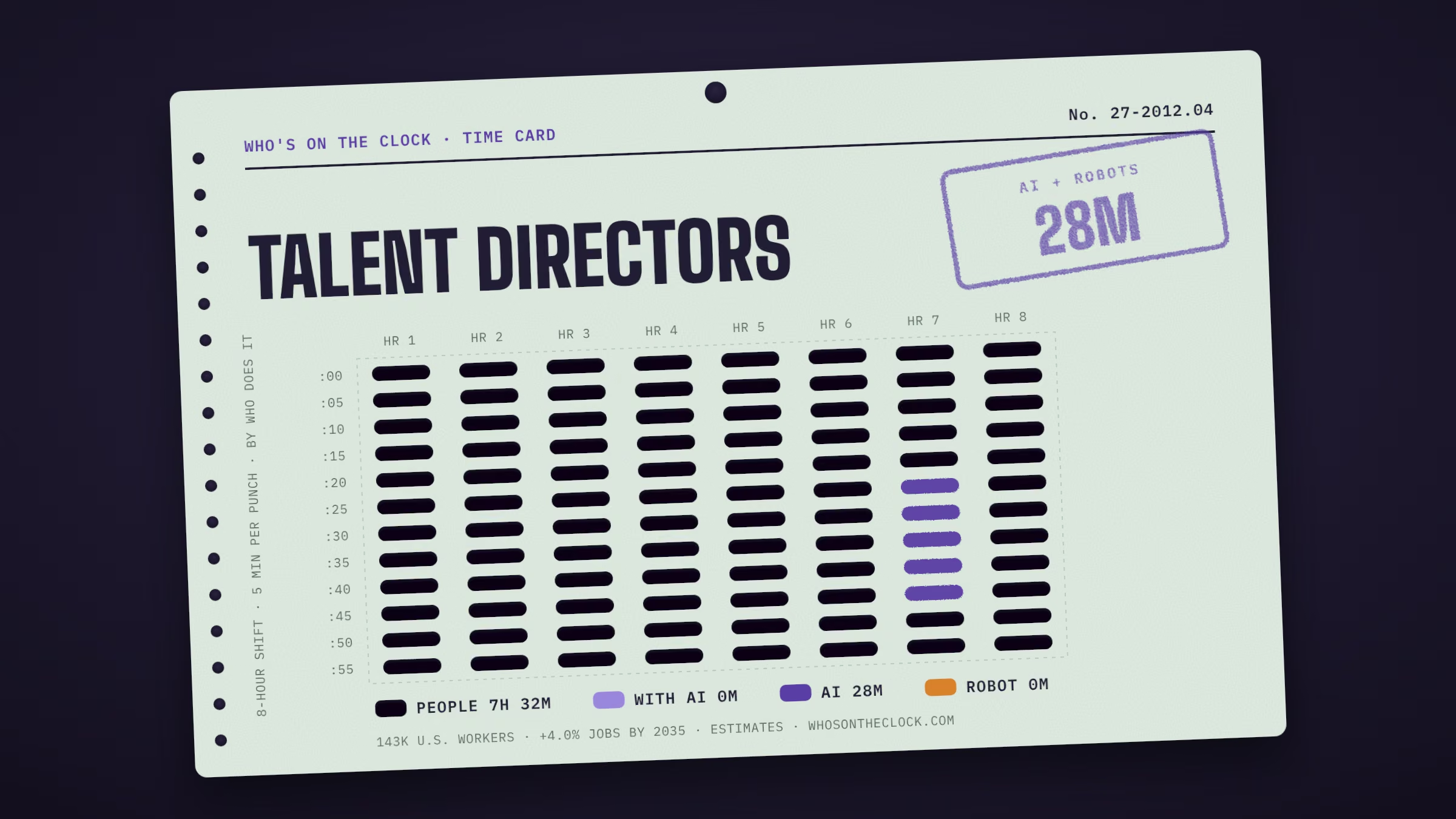
Not on current evidence. Less than 30 minutes of a typical shift goes to tasks that AI or robots are doing today. The other 7h 32m (94%) stays with people. Separately, BLS expects about 4% more of these jobs by 2035 (all jobs: +3.5%).
⤢ Full sizeEach mark is 5 minutes of a typical shift for talent directors, colored by who does that task today. Estimates from O*NET tasks and Anthropic Economic Index data. How it's made
Audition and interview performers to select most appropriate talent for parts in stage, television, radio, or motion picture productions.
Time card
Untick tasks you don't do, or set your own times.
Mine
Task, by time spent
Human
With AI
AI
Robot
Audition and interview performers to match their attributes to specific roles or to increase the pool of available acting talent.1h 23m a shift · No AI or robot evidence found
Review performer information, such as photos, resumes, voice tapes, videos, and union membership, to decide whom to audition for parts.1h 12m a shift · No AI or robot evidence found
Contact agents and actors to provide notification of audition and performance opportunities and to set up audition times.50m a shift · No AI or robot evidence found
Select performers for roles or submit lists of suitable performers to producers or directors for final selection.44m a shift · No AI or robot evidence found
Serve as liaisons between directors, actors, and agents.39m a shift · No AI or robot evidence found
Arrange for or design screen tests or auditions for prospective performers.33m a shift · No AI or robot evidence found
Prepare actors for auditions by providing scripts and information about roles and casting requirements.28m a shift · No AI or robot evidence found
Negotiate contract agreements with performers, with agents, or between performers and agents or production companies.28m a shift · No AI or robot evidence found
Read scripts and confer with producers to determine the types and numbers of performers required for a given production.28m a shift · Observed in AI use
Maintain talent files that include information such as performers' specialties, past performances, and availability.22m a shift · No AI or robot evidence found
Attend or view productions to maintain knowledge of available actors.17m a shift · No AI or robot evidence found
Hire and supervise workers who help locate people with specified attributes and talents.17m a shift · No AI or robot evidence found
Locate performers or extras for crowd and background scenes, and stand-ins or photo doubles for actors, by direct contact or through agents.11m a shift · No AI or robot evidence found
Direct shows, productions, and plays.6m a shift · No AI or robot evidence found
Teach acting classes.6m a shift · No AI or robot evidence found
On the floor
No company news tracked for this job yet. New stories are added as they happen.
Ask the clock
Will AI replace talent directors?
Not on current evidence. Less than 30 minutes of a typical shift goes to tasks that AI or robots are doing today. The other 7h 32m (94%) stays with people. Separately, BLS expects about 4% more of these jobs by 2035 (all jobs: +3.5%).
What can AI already do for talent directors?
AI shows up regularly in 1 of 15 tasks, about 28m of a typical shift. The biggest ones:
Read scripts and confer with producers to determine the types and numbers of performers required for a given production. (28m a shift, AI mostly does it alone)
What still needs a person?
7h 32m of a typical shift, or 94%, goes to tasks with no AI or robot evidence yet. No AI usage or robot deployment has shown up for these so far. The biggest:
Audition and interview performers to match their attributes to specific roles or to increase the pool of available acting talent. (1h 23m a shift)
Review performer information, such as photos, resumes, voice tapes, videos, and union membership, to decide whom to audition for parts. (1h 12m a shift)
Contact agents and actors to provide notification of audition and performance opportunities and to set up audition times. (50m a shift)
Select performers for roles or submit lists of suitable performers to producers or directors for final selection. (44m a shift)
Serve as liaisons between directors, actors, and agents. (39m a shift)
Why is that work hard to automate?
Much of it comes down to where and how the work happens. In-person, hands-on and high-stakes work is where AI and robots have made the least headway so far. In the official O*NET survey of people in this job:
81% are in constant contact with other people
71% talk face to face with others every day
65% say dealing with the public is very or extremely important
Are employers still hiring talent directors?
On Indeed, job postings in the Arts & Entertainment sector are at 87% of their February 2020 level (all U.S. postings: 104%), up 12.4% from a year earlier, as of Oct 9, 2026. BLS separately expects about 12,000 openings a year in this job through 2035. Across all U.S. postings, 7.3% now mention AI skills. Sector postings cover more than this one job and move for many reasons besides AI.
How much do talent directors make?
The median pay is about $90,360 a year ($43.44 an hour), 77% above the median for all U.S. jobs ($50,980). Most people in this job earn between $45,780 and $198,540 a year; that range covers the middle 80%. Pay figures are from BLS, May 2025, and vary a lot by state and employer. Pick a state to compare:
Is this job growing or shrinking?
BLS projects growth of 4% from 2025 to 2035, compared with 3.5% growth for all jobs. That's about 188,000 jobs in 2035. It expects about 12,000 openings a year, mostly from people retiring or changing careers. These projections don't single out AI as a cause.
How many talent directors are there in the U.S.?
About 143,000 people in the U.S., roughly 0.09% of all workers (BLS, May 2025). That makes it the 223rd largest of the 796 jobs on this site. BLS expects about 188,000 in 2035.
What training do talent directors need?
The most common requirement is a bachelor's degree: about 42% of people in the job said so in the official O*NET survey. O*NET rates the job at level 4 of 5 for preparation, which usually means: bachelor's degree. Requirements vary by state and employer, especially for licensed work.
What should I learn to stay ahead of AI?
These come from the job's official skill ratings and from the tasks that AI and robots touch least today. Building them keeps you strong in the parts of the work that still need a person:
Skills that matter more here than in most jobs: Negotiation, Social Perceptiveness, Judgment and Decision Making, Speaking
Get strong at the parts of the job that stay with people (listed above), which take 7h 32m of a typical shift
Tools employers list: Microsoft PowerPoint, Microsoft Office software, Microsoft Excel, Amazon Web Services AWS software, Linux
Learn to use AI well on the tasks where it already shows up in this job (listed above)
What other jobs could talent directors move into?
These use similar skills. Matches come from 109 official ratings of skills, knowledge and work activities, and each needs the same or less preparation unless the official list relates the jobs directly:
Agents and Business Managers of Artists, Performers, and Athletes (1h 53m touched, $83k median pay)
Music Directors and Composers (26m touched, $74k median pay)
Writers and Authors (2h 36m touched, $77k median pay)
Choreographers (25m touched, $55k median pay)
How solid are these numbers?
Each task carries its own evidence label. For this job: 1 observed in real AI use, 14 with no AI or robot evidence found. The minutes per task are estimates, not measured hours, and "no evidence" doesn't prove a task is safe.
Tools in demand
Microsoft PowerPoint
Microsoft Office software
Microsoft Excel
Amazon Web Services AWS software
Linux
Microsoft Windows
Microsoft Word
Oracle Java
Also called
Artist Manager, Artistic Director, Casting Agent, Casting Coordinator, Casting Director, Contestant Coordinator, Entertainment Agent, Extras Casting Director, Model Booker, Pageant Director, Repertoire Manager, Talent Agent, Talent Producer, Talent Scout