Will AI replace aircraft service attendants?

No AI use or robot deployment shows up yet for any of this job's tasks; the biggest part of the day, “Refuel aircraft using hoses connected to fuel trucks”, is still entirely people's work. That's today's evidence, not a guarantee. BLS expects about 5.6% more of these jobs by 2035.

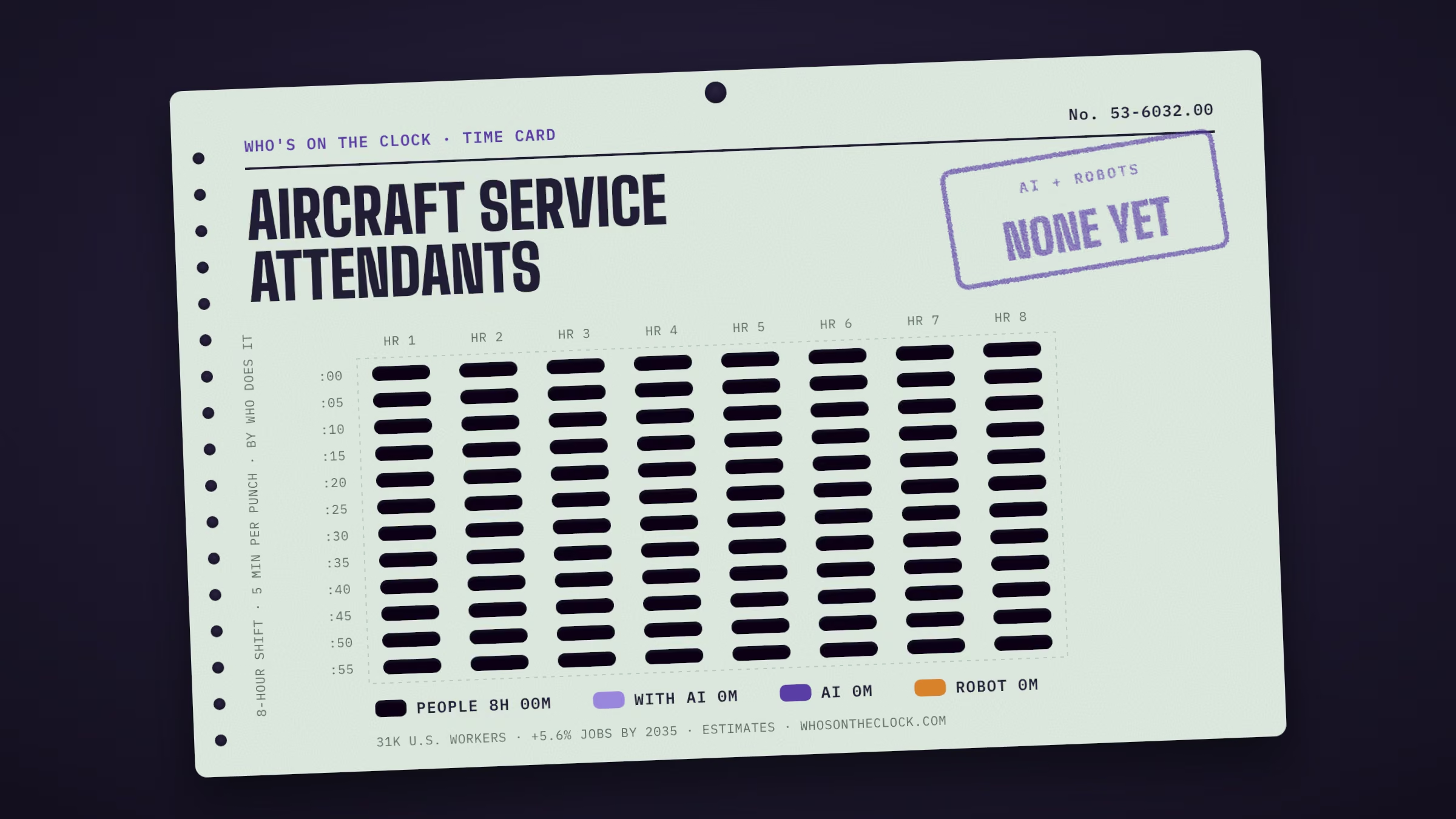
Time card for aircraft service attendants showing a typical 8-hour shift: 8h done by people.
Each mark is 5 minutes of a typical shift for aircraft service attendants, colored by who does that task today. Estimates from O*NET tasks and Anthropic Economic Index data. How it's made

Home / Transportation & warehouse / Aircraft Service Attendants

Service aircraft with fuel. May de-ice aircraft, refill water and cooling agents, empty sewage tanks, service air and oxygen systems, or clean and polish exterior.

Time card

Untick tasks you don't do, or set your own times.
MineTask, by time spentHumanWith AIAIRobot
Refuel aircraft using hoses connected to fuel trucks.3h 7m a shift · Robots only in factory cells
Why this label?Robots have done this only in factory setups built around the machine, so it stays Human for aircraft service attendants. How labels work
Clean aircraft interiors by picking up waste, wiping down windows, or vacuuming.37m a shift · Robots only in factory cells
Why this label?Robots have done this only in factory setups built around the machine, so it stays Human for aircraft service attendants. How labels work
Complete forms describing tasks completed.37m a shift · No AI or robot evidence found
Why this label?No AI use or robot deployment showed up for this task in our data. That isn't proof it's safe; it may just be rare in the data. How labels work
Empty aircraft lavatory systems or refill them with sanitizer fluid.25m a shift · Robots only in factory cells
Why this label?Robots have done this only in factory setups built around the machine, so it stays Human for aircraft service attendants. How labels work
Load baggage or cargo for crew or passengers.25m a shift · No AI or robot evidence found
Why this label?This is physical work, and no robot has been shown doing it yet. How labels work
Wash the aircraft exteriors using lifts, cranes, detergent, or other equipment.25m a shift · Robots only in factory cells
Why this label?Robots have done this only in factory setups built around the machine, so it stays Human for aircraft service attendants. How labels work
Apply de-icing fluid to aircraft from baskets lifted by truck-mounted cranes.19m a shift · Robots only in factory cells
Why this label?Robots have done this only in factory setups built around the machine, so it stays Human for aircraft service attendants. How labels work
Guide aircraft to designated areas using hand signals, batons, or other methods.19m a shift · No AI or robot evidence found
Why this label?No AI use or robot deployment showed up for this task in our data. That isn't proof it's safe; it may just be rare in the data. How labels work
Radio to flight dispatchers or other personnel to discuss incoming or outgoing aircraft.19m a shift · No AI or robot evidence found
Why this label?No AI use or robot deployment showed up for this task in our data. That isn't proof it's safe; it may just be rare in the data. How labels work
Refill aircraft potable water tanks.19m a shift · Robots only in factory cells
Why this label?Robots have done this only in factory setups built around the machine, so it stays Human for aircraft service attendants. How labels work
Tow aircraft to gates or hangars using tugs, tractors, or other vehicles.19m a shift · Robots only in factory cells
Why this label?Robots have done this only in factory setups built around the machine, so it stays Human for aircraft service attendants. How labels work
Inspect aircraft components to locate cracks, breaks, leaks, or other problems.12m a shift · Robots only in factory cells
Why this label?Robots have done this only in factory setups built around the machine, so it stays Human for aircraft service attendants. How labels work
Change aircraft oil, coolant, or other fluids.6m a shift · Robots only in factory cells
Why this label?Robots have done this only in factory setups built around the machine, so it stays Human for aircraft service attendants. How labels work
Climb ladders to reach aircraft surfaces to be cleaned.6m a shift · Robots only in factory cells
Why this label?Robots have done this only in factory setups built around the machine, so it stays Human for aircraft service attendants. How labels work
De-grease aircraft exteriors.6m a shift · Robots only in factory cells
Why this label?Robots have done this only in factory setups built around the machine, so it stays Human for aircraft service attendants. How labels work
Mix cleaning compounds or solutions.6m a shift · Robots only in factory cells
Why this label?Robots have done this only in factory setups built around the machine, so it stays Human for aircraft service attendants. How labels work
Polish aircraft exteriors.6m a shift · Robots only in factory cells
Why this label?Robots have done this only in factory setups built around the machine, so it stays Human for aircraft service attendants. How labels work
Remove exhaust stains from aircraft using cleaning fluids.6m a shift · Robots only in factory cells
Why this label?Robots have done this only in factory setups built around the machine, so it stays Human for aircraft service attendants. How labels work

Clock history

  1. 0m touchedFirst published: O*NET 30.1, Anthropic Economic Index (2025 usage and September 2026 robot study), BLS May 2025

When new data changes this clock, the date, the new numbers and the reason are logged here. Company news alone never moves the clock.

On the floor

No company news tracked for this job yet. New stories are added as they happen.

Ask the clock

Will AI replace aircraft service attendants?

Not on current evidence. Less than 30 minutes of a typical shift goes to tasks that AI or robots are doing today. The other 8h (100%) stays with people. Separately, BLS expects about 5.6% more of these jobs by 2035 (all jobs: +3.5%).

What can AI already do for aircraft service attendants?

None of this job's tasks show regular AI use yet. That can mean the work is hands-on or in person, or simply that it rarely comes up in AI usage data.

Where do robots fit in?

Not in workplaces like this one, based on a 2026 review of robot deployments. 14 more tasks have only been done in factory setups built around the machine, so they stay with people here. For 1 physical task, no robot has shown it can do the work yet.

What still needs a person?

8h of a typical shift, or 100%, goes to tasks with no AI or robot evidence yet. No AI usage or robot deployment has shown up for these so far. The biggest:

  • Refuel aircraft using hoses connected to fuel trucks. (3h 7m a shift)
  • Clean aircraft interiors by picking up waste, wiping down windows, or vacuuming. (37m a shift)
  • Complete forms describing tasks completed. (37m a shift)
  • Empty aircraft lavatory systems or refill them with sanitizer fluid. (25m a shift)
  • Load baggage or cargo for crew or passengers. (25m a shift)
How much do aircraft service attendants make?

The median pay is about $40,450 a year ($19.45 an hour), 21% below the median for all U.S. jobs ($50,980). Most people in this job earn between $33,830 and $57,610 a year; that range covers the middle 80%. Pay figures are from BLS, May 2025, and vary a lot by state and employer. Pick a state to compare:

Is this job growing or shrinking?

BLS projects growth of 5.6% from 2025 to 2035, compared with 3.5% growth for all jobs. That's about 33,000 jobs in 2035. It expects about 4,000 openings a year, mostly from people retiring or changing careers. These projections don't single out AI as a cause.

How many aircraft service attendants are there in the U.S.?

About 31,000 people in the U.S., roughly 0.02% of all workers (BLS, May 2025). That makes it the 472nd largest of the 796 jobs on this site. BLS expects about 33,000 in 2035.

What training do aircraft service attendants need?

O*NET rates the job at level 2 of 5 for preparation, which usually means: high school diploma, some training. Requirements vary by state and employer, especially for licensed work.

What should I learn to stay ahead of AI?

These come from the job's official skill ratings and from the tasks that AI and robots touch least today. Building them keeps you strong in the parts of the work that still need a person:

  • Get strong at the parts of the job that stay with people (listed above), which take 8h of a typical shift
  • Tools employers list: Microsoft Excel, Microsoft Office software, Microsoft Windows, Microsoft Word
What other jobs could aircraft service attendants move into?

These use similar skills. Matches come from 109 official ratings of skills, knowledge and work activities, and each needs the same or less preparation unless the official list relates the jobs directly:

  • Aircraft Mechanics and Service Technicians (0m touched, $80k median pay)
  • Avionics Technicians (0m touched, $82k median pay)
  • Aircraft Structure, Surfaces, Rigging, and Systems Assemblers (35m touched, $65k median pay)
  • Commercial Pilots (2h 14m touched, $123k median pay)
  • Cleaners of Vehicles and Equipment (1h 11m touched, $36k median pay)
How solid are these numbers?

Each task carries its own evidence label. For this job: 18 with no AI or robot evidence found. The minutes per task are estimates, not measured hours, and "no evidence" doesn't prove a task is safe.

Tools in demand

Mostly everyday office tools: Microsoft Excel, Microsoft Office software, Microsoft Windows, Microsoft Word. The job's skills matter more than any specific software.

Also called

Aircraft Cleaner, Aircraft Deicer, Aircraft Detailer, Aircraft Fueler, Aircraft Refueler, Aircraft Service Attendant, Aircraft Technical Cleaner, Airfield Maintenance Equipment Operator, Airline Refueler, Airplane Refueler, Exterior Aircraft Cleaner, Fuel Technician, Ground Operations Agent, Lavatory Technician