Will AI replace animal breeders?

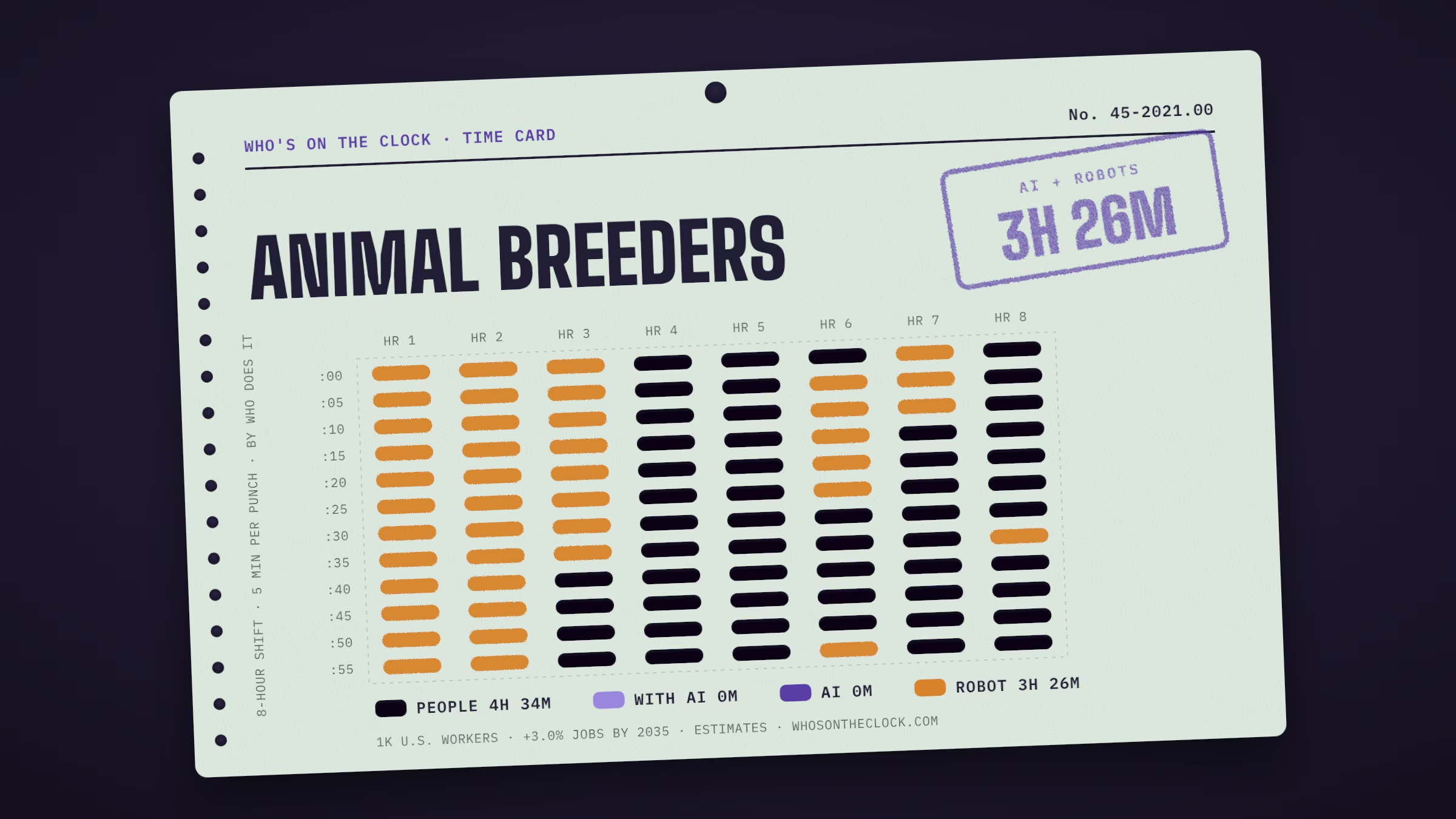
The biggest change here is physical: systems like Lely Vector automatic feeding system have done tasks such as “Feed and water animals, and clean and disinfect pens, cages, yards” in real workplaces, about 3h 26m of a typical shift. Most of the rest, 4h 34m, has no AI or robot evidence. BLS expects about 3% more of these jobs by 2035.

Time card for animal breeders showing a typical 8-hour shift: 4h 34m done by people, 3h 26m by robots.
Each mark is 5 minutes of a typical shift for animal breeders, colored by who does that task today. Estimates from O*NET tasks and Anthropic Economic Index data. How it's made

Home / Farming & fishing / Animal Breeders

Select and breed animals according to their genealogy, characteristics, and offspring. May require knowledge of artificial insemination techniques and equipment use. May involve keeping records on heats, birth intervals, or pedigree.

Time card

Untick tasks you don't do, or set your own times.
MineTask, by time spentHumanWith AIAIRobot
Feed and water animals, and clean and disinfect pens, cages, yards, and hutches.2h 40m a shift · Robots deployed · e.g. Lely Vector automatic feeding system
Why this label?Marked Robot because Lely Vector automatic feeding system (in real use) has done this task in a real workplace. It shows a robot can do it somewhere, not that most animal breeders work alongside one. How labels work
Observe animals in heat to detect approach of estrus and exercise animals to induce or hasten estrus, if necessary.34m a shift · No AI or robot evidence found
Why this label?This is physical work, and no robot has been shown doing it yet. How labels work
Examine animals to detect symptoms of illness or injury.34m a shift · No AI or robot evidence found
Why this label?This is physical work, and no robot has been shown doing it yet. How labels work
Treat minor injuries and ailments and contact veterinarians to obtain treatment for animals with serious illnesses or injuries.23m a shift · No AI or robot evidence found
Why this label?This is physical work, and no robot has been shown doing it yet. How labels work
Select animals to be bred, and semen specimens to be used, according to knowledge of animals, genealogies, traits, and desired offspring characteristics.23m a shift · No AI or robot evidence found
Why this label?No AI use or robot deployment showed up for this task in our data. That isn't proof it's safe; it may just be rare in the data. How labels work
Build hutches, pens, and fenced yards.23m a shift · No AI or robot evidence found
Why this label?This is physical work, and no robot has been shown doing it yet. How labels work
Record animal characteristics such as weights, growth patterns, and diets.23m a shift · Robots deployed · e.g. Lely Astronaut / T4C herd management
Why this label?Marked Robot because Lely Astronaut / T4C herd management (in real use) has done this task in a real workplace. It shows a robot can do it somewhere, not that most animal breeders work alongside one. How labels work
Arrange for sale of animals and eggs to hospitals, research centers, pet shops, and food processing plants.23m a shift · No AI or robot evidence found
Why this label?No AI use or robot deployment showed up for this task in our data. That isn't proof it's safe; it may just be rare in the data. How labels work
Purchase and stock supplies of feed and medicines.17m a shift · Robots deployed · e.g. Stretch
Why this label?Marked Robot because Stretch (in real use) has done this task in a real workplace. It shows a robot can do it somewhere, not that most animal breeders work alongside one. How labels work
Bathe and groom animals.17m a shift · No AI or robot evidence found
Why this label?This is physical work, and no robot has been shown doing it yet. How labels work
Exercise animals to keep them in healthy condition.17m a shift · Robots only in factory cells
Why this label?Robots have done this only in factory setups built around the machine, so it stays Human for animal breeders. How labels work
Inject prepared animal semen into female animals for breeding purposes, by inserting nozzle of syringe into vagina and depressing syringe plunger.17m a shift · No AI or robot evidence found
Why this label?This is physical work, and no robot has been shown doing it yet. How labels work
Place vaccines in drinking water, inject vaccines, or dust air with vaccine powder to protect animals from diseases.11m a shift · No AI or robot evidence found
Why this label?This is physical work, and no robot has been shown doing it yet. How labels work
Maintain logs of semen specimens used and animals bred.11m a shift · No AI or robot evidence found
Why this label?No AI use or robot deployment showed up for this task in our data. That isn't proof it's safe; it may just be rare in the data. How labels work
Exhibit animals at shows.11m a shift · No AI or robot evidence found
Why this label?This is physical work, and no robot has been shown doing it yet. How labels work
Brand, tattoo, or tag animals to allow animal identification.6m a shift · No AI or robot evidence found
Why this label?This is physical work, and no robot has been shown doing it yet. How labels work
Adjust controls to maintain specific building temperatures required for animals' health and safety.6m a shift · Robots deployed · e.g. CHORE-TRONICS 3 Controller
Why this label?Marked Robot because CHORE-TRONICS 3 Controller (in real use) has done this task in a real workplace. It shows a robot can do it somewhere, not that most animal breeders work alongside one. How labels work
Clip or shear hair on animals.6m a shift · No AI or robot evidence found
Why this label?This is physical work, and no robot has been shown doing it yet. How labels work
Package and label semen to be used for artificial insemination, recording information such as the date, source, quality, and concentration.6m a shift · Robots only in factory cells
Why this label?Robots have done this only in factory setups built around the machine, so it stays Human for animal breeders. How labels work
Measure specified amounts of semen into calibrated syringes, and insert syringes into inseminating guns.6m a shift · Robots only in factory cells
Why this label?Robots have done this only in factory setups built around the machine, so it stays Human for animal breeders. How labels work
Examine semen microscopically to assess and record density and motility of gametes, and dilute semen with prescribed diluents, according to formulas.6m a shift · Robots only in factory cells
Why this label?Robots have done this only in factory setups built around the machine, so it stays Human for animal breeders. How labels work

Clock history

  1. 3h 26m touchedFirst published: O*NET 30.1, Anthropic Economic Index (2025 usage and September 2026 robot study), BLS May 2025

When new data changes this clock, the date, the new numbers and the reason are logged here. Company news alone never moves the clock.

On the floor

No company news tracked for this job yet. New stories are added as they happen.

Ask the clock

Will AI replace animal breeders?

Some tasks are already being done by AI or machines; the rest still needs a person. About 3h 26m of a typical shift is made up of tasks that AI or robots have done on their own in real use somewhere. That doesn't mean those hours are automated in a typical workplace. The other 4h 34m (57%) stays with people. Separately, BLS expects about 3% more of these jobs by 2035 (all jobs: +3.5%).

What can AI already do for animal breeders?

None of this job's tasks show regular AI use yet. That can mean the work is hands-on or in person, or simply that it rarely comes up in AI usage data.

Where do robots fit in?

For some tasks, yes. Robots have done 4 of this job's tasks in workplaces like this one, about 3h 26m of a typical shift. 4 more tasks have only been done in factory setups built around the machine, so they stay with people here. For 10 physical tasks, no robot has shown it can do the work yet.

  • Feed and water animals, and clean and disinfect pens, cages, yards, and hutches. (2h 40m a shift; e.g. Lely Vector automatic feeding system, in use)
  • Record animal characteristics such as weights, growth patterns, and diets. (23m a shift; e.g. Lely Astronaut / T4C herd management, in use)
  • Purchase and stock supplies of feed and medicines. (17m a shift; e.g. Stretch, in use)
  • Adjust controls to maintain specific building temperatures required for animals' health and safety. (6m a shift; e.g. CHORE-TRONICS 3 Controller, in use)
What still needs a person?

4h 34m of a typical shift, or 57%, goes to tasks with no AI or robot evidence yet. No AI usage or robot deployment has shown up for these so far. The biggest:

  • Observe animals in heat to detect approach of estrus and exercise animals to induce or hasten estrus, if necessary. (34m a shift)
  • Examine animals to detect symptoms of illness or injury. (34m a shift)
  • Treat minor injuries and ailments and contact veterinarians to obtain treatment for animals with serious illnesses or injuries. (23m a shift)
  • Select animals to be bred, and semen specimens to be used, according to knowledge of animals, genealogies, traits, and desired offspring characteristics. (23m a shift)
  • Build hutches, pens, and fenced yards. (23m a shift)
Why is that work hard to automate?

Much of it comes down to where and how the work happens. In-person, hands-on and high-stakes work is where AI and robots have made the least headway so far. In the official O*NET survey of people in this job:

  • 70% work outdoors in all weather every day
  • 58% say a mistake would be very or extremely serious
  • 51% use their hands on tools, objects or controls more than half the time
How much do animal breeders make?

The median pay is about $51,130 a year ($24.58 an hour), about the same as the median for all U.S. jobs ($50,980). Most people in this job earn between $38,480 and $90,550 a year; that range covers the middle 80%. Pay figures are from BLS, May 2025, and vary a lot by state and employer. Pick a state to compare:

Is this job growing or shrinking?

BLS projects growth of 3% from 2025 to 2035, compared with 3.5% growth for all jobs. That's about 7,100 jobs in 2035. It expects about 1,000 openings a year, mostly from people retiring or changing careers. These projections don't single out AI as a cause.

How many animal breeders are there in the U.S.?

About 1,330 people in the U.S., roughly 0.00% of all workers (BLS, May 2025). That makes it the 784th largest of the 796 jobs on this site. BLS expects about 7,100 in 2035.

What training do animal breeders need?

The most common requirement is a high school diploma: about 86% of people in the job said so in the official O*NET survey. O*NET rates the job at level 2 of 5 for preparation, which usually means: high school diploma, some training. Requirements vary by state and employer, especially for licensed work.

What should I learn to stay ahead of AI?

These come from the job's official skill ratings and from the tasks that AI and robots touch least today. Building them keeps you strong in the parts of the work that still need a person:

  • Skills that matter more here than in most jobs: Science, Active Learning, Complex Problem Solving, Judgment and Decision Making
  • Get strong at the parts of the job that stay with people (listed above), which take 4h 34m of a typical shift
  • Tools employers list: Adobe Acrobat, Adobe Creative Cloud software, Adobe Illustrator, Adobe InDesign, Adobe Photoshop
What other jobs could animal breeders move into?

These use similar skills. Matches come from 109 official ratings of skills, knowledge and work activities, and each needs the same or less preparation unless the official list relates the jobs directly:

  • Farmworkers, Farm, Ranch, and Aquacultural Animals (4h 51m touched, $37k median pay)
  • Animal Caretakers (7m touched, $35k median pay)
  • Animal Trainers (0m touched, $40k median pay)
  • Veterinary Assistants and Laboratory Animal Caretakers (13m touched, $38k median pay)
  • Farmers, Ranchers, and Other Agricultural Managers (2h 27m touched, $90k median pay)
How solid are these numbers?

Each task carries its own evidence label. For this job: 4 with robots in real deployments, 17 with no AI or robot evidence found. The minutes per task are estimates, not measured hours, and "no evidence" doesn't prove a task is safe.

Tools in demand

  • Adobe Acrobat
  • Adobe Creative Cloud software
  • Adobe Illustrator
  • Adobe InDesign
  • Adobe Photoshop
  • Microsoft Access

Plus everyday office tools: Microsoft Excel, Microsoft Office software.

Also called

Animal Breeder, Animal Husbandman, Animal Husbandry Technician, Animal Technician, Artificial Insemination Technician (AI Technician), Artificial Inseminator, Aviculturist, Bee Breeder, Breeder, Canary Breeder, Cat Breeder, Chicken Fancier, Dairy Husbandman, Dairy Husbandry Worker