Will AI replace cashiers?

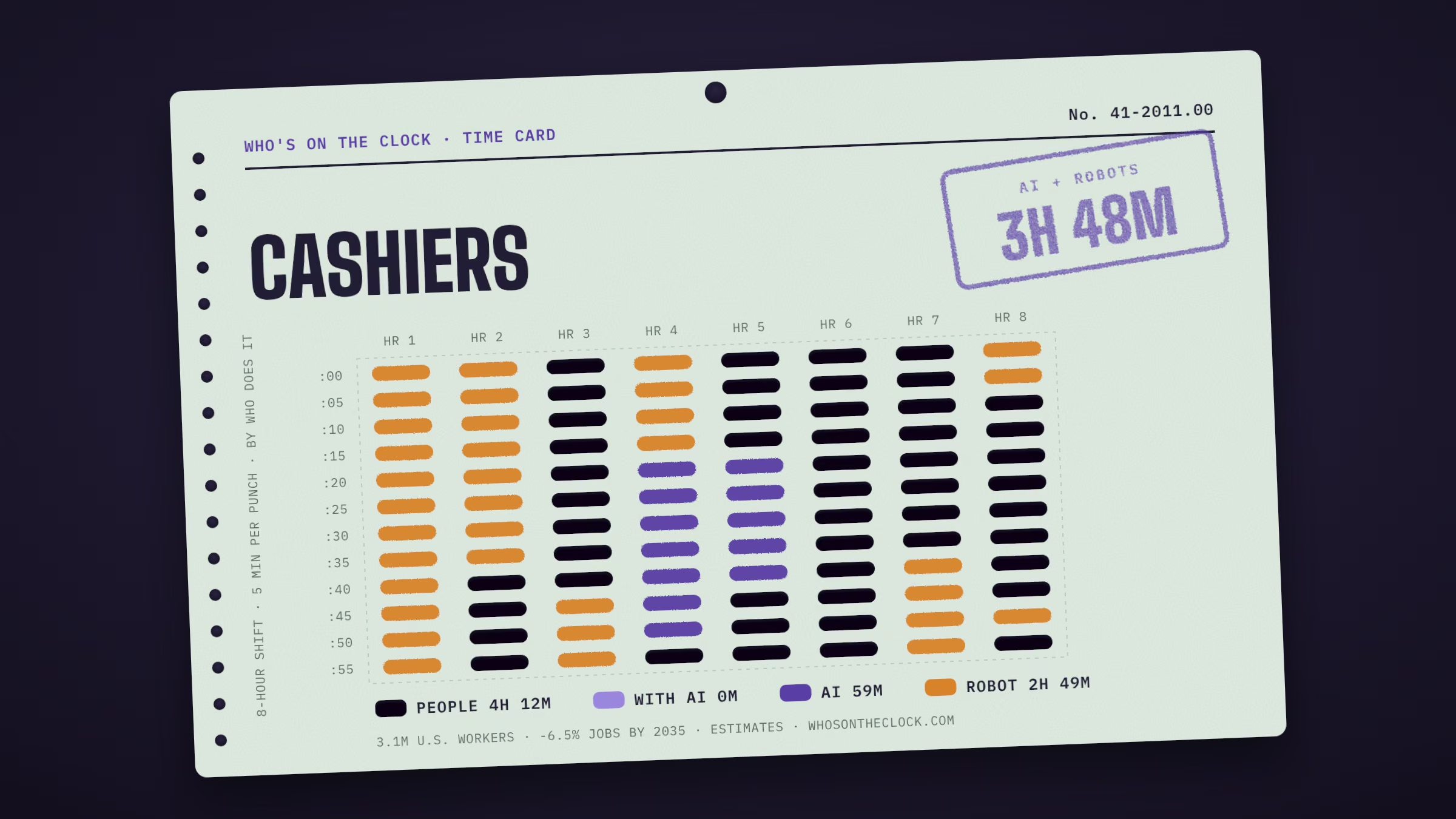
The biggest change here is physical: systems like self-checkout terminals have done tasks such as “Receive payment by cash, check, credit cards, vouchers” in real workplaces, about 2h 48m of a typical shift. Most of the rest, 4h 13m, has no AI or robot evidence. BLS expects about 6.5% fewer of these jobs by 2035.

Time card for cashiers showing a typical 8-hour shift: 4h 13m done by people, 59m by AI, 2h 48m by robots.
Each mark is 5 minutes of a typical shift for cashiers, colored by who does that task today. Estimates from O*NET tasks and Anthropic Economic Index data. How it's made

Home / Sales & retail / Cashiers

Receive and disburse money in establishments other than financial institutions. May use electronic scanners, cash registers, or related equipment. May process credit or debit card transactions and validate checks.

Time card

Untick tasks you don't do, or set your own times.
MineTask, by time spentHumanWith AIAIRobot
Receive payment by cash, check, credit cards, vouchers, or automatic debits.1h 41m a shift · Robots deployed · e.g. Self-checkout terminals (installed base, US grocery)
Why this label?Marked Robot because Self-checkout terminals (installed base, US grocery) (in real use) has done this task in a real workplace. It shows a robot can do it somewhere, not that most cashiers work alongside one. How labels work
Establish or identify prices of goods, services, or admission, and tabulate bills, using calculators, cash registers, or optical price scanners.1h 7m a shift · Robots only in factory cells
Why this label?Robots have done this only in factory setups built around the machine, so it stays Human for cashiers. How labels work
Issue receipts, refunds, credits, or change due to customers.34m a shift · Robots deployed · e.g. NCR self-checkout at Royal Farms stores
Why this label?Marked Robot because NCR self-checkout at Royal Farms stores (in real use) has done this task in a real workplace. It shows a robot can do it somewhere, not that most cashiers work alongside one. How labels work
Assist customers by providing information and resolving their complaints.34m a shift · Observed in AI useTypical AI request: about 38m alone, 14m with AI
Why this label?Marked AI because this task shows up regularly in real AI conversations (Anthropic Economic Index, 2025 usage), and in most of them AI does the task on its own rather than helping a person. Many workplaces may not use AI for it at all. How labels work
Greet customers entering establishments.25m a shift · No AI or robot evidence found
Why this label?No AI use or robot deployment showed up for this task in our data. That isn't proof it's safe; it may just be rare in the data. How labels work
Answer customers' questions, and provide information on procedures or policies.25m a shift · Observed in AI useTypical AI request: about 1h 19m alone, 17m with AI
Why this label?Marked AI because this task shows up regularly in real AI conversations (Anthropic Economic Index, 2025 usage), and in most of them AI does the task on its own rather than helping a person. Many workplaces may not use AI for it at all. How labels work
Help customers find the location of products.17m a shift · No AI or robot evidence found
Why this label?No AI use or robot deployment showed up for this task in our data. That isn't proof it's safe; it may just be rare in the data. How labels work
Maintain clean and orderly checkout areas, and complete other general cleaning duties, such as mopping floors and emptying trash cans.17m a shift · No AI or robot evidence found
Why this label?This is physical work, and no robot has been shown doing it yet. How labels work
Assist with duties in other areas of the store, such as monitoring fitting rooms or bagging and carrying out customers' items.17m a shift · Robots only in factory cells
Why this label?Robots have done this only in factory setups built around the machine, so it stays Human for cashiers. How labels work
Stock shelves, sort and reshelve returned items, and mark prices on items and shelves.17m a shift · Robots only in factory cells
Why this label?Robots have done this only in factory setups built around the machine, so it stays Human for cashiers. How labels work
Bag, box, wrap, or gift-wrap merchandise, and prepare packages for shipment.17m a shift · Robots only in factory cells
Why this label?Robots have done this only in factory setups built around the machine, so it stays Human for cashiers. How labels work
Monitor checkout stations to ensure they have adequate cash available and are staffed appropriately.8m a shift · Robots only in factory cells
Why this label?Robots have done this only in factory setups built around the machine, so it stays Human for cashiers. How labels work
Answer incoming phone calls.8m a shift · No AI or robot evidence found
Why this label?No AI use or robot deployment showed up for this task in our data. That isn't proof it's safe; it may just be rare in the data. How labels work
Request information or assistance, using paging systems.8m a shift · No AI or robot evidence found
Why this label?No AI use or robot deployment showed up for this task in our data. That isn't proof it's safe; it may just be rare in the data. How labels work
Process merchandise returns and exchanges.8m a shift · No AI or robot evidence found
Why this label?This is physical work, and no robot has been shown doing it yet. How labels work
Calculate total payments received during a time period, and reconcile this with total sales.8m a shift · Robots deployed · e.g. Glory CI-100X at Waitrose
Why this label?Marked Robot because Glory CI-100X at Waitrose (in real use) has done this task in a real workplace. It shows a robot can do it somewhere, not that most cashiers work alongside one. How labels work
Count money in cash drawers at the beginning of shifts to ensure that amounts are correct and that there is adequate change.8m a shift · Robots deployed · e.g. Glory CASHINFINITY CI-100X back-office cash recycler
Why this label?Marked Robot because Glory CASHINFINITY CI-100X back-office cash recycler (in real use) has done this task in a real workplace. It shows a robot can do it somewhere, not that most cashiers work alongside one. How labels work
Issue trading stamps, and redeem food stamps and coupons.8m a shift · Robots deployed · e.g. Weis Markets supermarket self-checkout terminals (coupon-acceptor slot)
Why this label?Marked Robot because Weis Markets supermarket self-checkout terminals (coupon-acceptor slot) (in real use) has done this task in a real workplace. It shows a robot can do it somewhere, not that most cashiers work alongside one. How labels work
Compute and record totals of transactions.8m a shift · No AI or robot evidence found
Why this label?No AI use or robot deployment showed up for this task in our data. That isn't proof it's safe; it may just be rare in the data. How labels work
Weigh items sold by weight to determine prices.8m a shift · Robots only in factory cells
Why this label?Robots have done this only in factory setups built around the machine, so it stays Human for cashiers. How labels work
Sort, count, and wrap currency and coins.8m a shift · Robots only in factory cells
Why this label?Robots have done this only in factory setups built around the machine, so it stays Human for cashiers. How labels work
Supervise others and provide on-the-job training.8m a shift · No AI or robot evidence found
Why this label?No AI use or robot deployment showed up for this task in our data. That isn't proof it's safe; it may just be rare in the data. How labels work
Sell tickets and other items to customers.8m a shift · Robots deployed · e.g. OMNY vending machines (MTA/Cubic)
Why this label?Marked Robot because OMNY vending machines (MTA/Cubic) (in real use) has done this task in a real workplace. It shows a robot can do it somewhere, not that most cashiers work alongside one. How labels work
Offer customers carry-out service at the completion of transactions.8m a shift · No AI or robot evidence found
Why this label?No AI use or robot deployment showed up for this task in our data. That isn't proof it's safe; it may just be rare in the data. How labels work
Post charges against guests' or patients' accounts.time not estimated · No AI or robot evidence found
Why this label?No AI use or robot deployment showed up for this task in our data. That isn't proof it's safe; it may just be rare in the data. How labels work
Keep periodic balance sheets of amounts and numbers of transactions.time not estimated · Robots deployed · e.g. CashGuard (StrongPoint) closed cash management at checkouts
Why this label?Marked Robot because CashGuard (StrongPoint) closed cash management at checkouts (in real use) has done this task in a real workplace. It shows a robot can do it somewhere, not that most cashiers work alongside one. How labels work
Compile and maintain non-monetary reports and records.time not estimated · No AI or robot evidence found
Why this label?No AI use or robot deployment showed up for this task in our data. That isn't proof it's safe; it may just be rare in the data. How labels work
Cash checks for customers.time not estimated · Robots deployed · e.g. SAM check-cashing kiosk (SAMCO Financial Services / SAM Machine Corp)
Why this label?Marked Robot because SAM check-cashing kiosk (SAMCO Financial Services / SAM Machine Corp) (in real use) has done this task in a real workplace. It shows a robot can do it somewhere, not that most cashiers work alongside one. How labels work

Clock history

  1. 3h 47m touchedFirst published: O*NET 30.1, Anthropic Economic Index (2025 usage and September 2026 robot study), BLS May 2025

When new data changes this clock, the date, the new numbers and the reason are logged here. Company news alone never moves the clock.

On the floor

  1. AnnouncedSquare
    Square launches a restaurant kiosk that takes orders by voice

    Square's new kiosk lets guests order by talking or tapping, with AI that answers menu questions, handles substitutions and suggests add-ons. It costs $1,999 plus $99 a month per device.

    Fast Casual

  2. Pulled backRetail industry
    Only 36% of retailers plan to invest in self-checkout

    In a survey of 340 retail operators, only 36% said they plan to invest in self-checkout, down seven percentage points from last year. Walmart, Costco and Kroger have increased staff involvement in self-checkout lanes.

    TechSpot

  3. Rolling outSenseTime
    SenseTime opens robot run stores in Shanghai and plans 100 by end of 2026

    SenseTime subsidiary SenseTime Shanhui has opened several SenseMartGo robot stores in Shanghai, where robots take orders, pick items and handle inventory. It plans 100 outlets by the end of 2026.

    Gasgoo

  4. Pulled backWalmart
    Walmart swaps self-checkout for staffed registers at a Philadelphia store

    Walmart removed self-checkout lanes at its South Philadelphia store in March and replaced them with staffed registers. A spokesperson said it is the only Philadelphia store to fully roll back self-checkout.

    Complex

  5. Rolling outWendy's
    Wendy's FreshAI drive-thru ordering live at 160+ restaurants

    Wendy's FreshAI drive-thru ordering system is live at over 160 restaurants across the U.S. The company plans digital menu boards and AI drive-thru ordering at over 500 restaurants by the end of the year.

    Restaurant Dive via Yahoo Finance

  6. Pulled backDollar General
    Dollar General removes self-checkout from about 12,000 stores

    Dollar General has eliminated self-checkout at about 12,000 locations, most of its stores. Five Below is removing self-checkout in some highest-risk locations and replacing it with employees.

    NBC News

Ask the clock

Will AI replace cashiers?

Some tasks are already being done by AI or machines; the rest still needs a person. About 3h 47m of a typical shift is made up of tasks that AI or robots have done on their own in real use somewhere. That doesn't mean those hours are automated in a typical workplace. The breakdown: 59m that AI mostly does alone, 2h 48m that robots have done in real workplaces. The other 4h 13m (53%) stays with people. Separately, BLS expects about 6.5% fewer of these jobs by 2035 (all jobs: +3.5%).

What can AI already do for cashiers?

AI shows up regularly in 2 of 28 tasks, about 59m of a typical shift. The biggest ones:

  • Assist customers by providing information and resolving their complaints. (34m a shift, AI mostly does it alone)
  • Answer customers' questions, and provide information on procedures or policies. (25m a shift, AI mostly does it alone)
Where do robots fit in?

For some tasks, yes. Robots have done 6 of this job's tasks in workplaces like this one, about 2h 48m of a typical shift. 7 more tasks have only been done in factory setups built around the machine, so they stay with people here. For 2 physical tasks, no robot has shown it can do the work yet.

  • Receive payment by cash, check, credit cards, vouchers, or automatic debits. (1h 41m a shift; e.g. Self-checkout terminals (installed base, US grocery), in use)
  • Issue receipts, refunds, credits, or change due to customers. (34m a shift; e.g. NCR self-checkout at Royal Farms stores, in use)
  • Calculate total payments received during a time period, and reconcile this with total sales. (8m a shift; e.g. Glory CI-100X at Waitrose, in use)
  • Count money in cash drawers at the beginning of shifts to ensure that amounts are correct and that there is adequate change. (8m a shift; e.g. Glory CASHINFINITY CI-100X back-office cash recycler, in use)
What still needs a person?

4h 13m of a typical shift, or 53%, goes to tasks with no AI or robot evidence yet. No AI usage or robot deployment has shown up for these so far. The biggest:

  • Establish or identify prices of goods, services, or admission, and tabulate bills, using calculators, cash registers, or optical price scanners. (1h 7m a shift)
  • Greet customers entering establishments. (25m a shift)
  • Help customers find the location of products. (17m a shift)
  • Maintain clean and orderly checkout areas, and complete other general cleaning duties, such as mopping floors and emptying trash cans. (17m a shift)
  • Assist with duties in other areas of the store, such as monitoring fitting rooms or bagging and carrying out customers' items. (17m a shift)
Why is that work hard to automate?

Much of it comes down to where and how the work happens. In-person, hands-on and high-stakes work is where AI and robots have made the least headway so far. In the official O*NET survey of people in this job:

  • 96% are in constant contact with other people
  • 79% talk face to face with others every day
  • 69% spend more than half the day on their feet
What are companies actually doing?

We track 6 sourced company moves that affect this job, including at least one pullback. Most recent:

  • Oct 14, 2026: Square launches a restaurant kiosk that takes orders by voice (Announced)
  • Oct 6, 2026: Only 36% of retailers plan to invest in self-checkout (Pulled back)
  • May 12, 2026: SenseTime opens robot run stores in Shanghai and plans 100 by end of 2026 (Rolling out)
How much time does AI save on these tasks?

For the 2 tasks in this job where AI shows up and timing data exists, a typical request takes about 59m for a person alone and about 16m with AI. These are Claude's own estimates from real conversations in April and May 2026 (Anthropic Economic Index). They describe single requests, not whole workdays, and time saved on a task doesn't mean jobs are cut. The biggest gaps:

  • Answer customers' questions, and provide information on procedures or policies (about 1h 19m alone, 17m with AI)
  • Assist customers by providing information and resolving their complaints (about 38m alone, 14m with AI)
Are employers still hiring cashiers?

On Indeed, job postings in the Retail sector are at 90% of their February 2020 level (all U.S. postings: 104%), up 4.2% from a year earlier, as of Oct 9, 2026. BLS separately expects about 521,000 openings a year in this job through 2035. Across all U.S. postings, 7.3% now mention AI skills. Sector postings cover more than this one job and move for many reasons besides AI.

How much do cashiers make?

The median pay is about $32,880 a year ($15.81 an hour), 36% below the median for all U.S. jobs ($50,980). Most people in this job earn between $24,530 and $40,410 a year; that range covers the middle 80%. Pay figures are from BLS, May 2025, and vary a lot by state and employer. Pick a state to compare:

Is this job growing or shrinking?

BLS projects a decline of 6.5% from 2025 to 2035, compared with 3.5% growth for all jobs. That's about 2.9 million jobs in 2035. Even so, it expects about 521,000 openings a year, mostly from people retiring or changing careers. These projections don't single out AI as a cause.

How many cashiers are there in the U.S.?

About 3.1 million people in the U.S., roughly 2.0% of all workers (BLS, May 2025). That makes it the 7th largest of the 796 jobs on this site. BLS expects about 2.9 million in 2035.

What training do cashiers need?

The most common requirement is a high school diploma: about 44% of people in the job said so in the official O*NET survey. O*NET rates the job at level 2 of 5 for preparation, which usually means: high school diploma, some training. Requirements vary by state and employer, especially for licensed work.

What should I learn to stay ahead of AI?

These come from the job's official skill ratings and from the tasks that AI and robots touch least today. Building them keeps you strong in the parts of the work that still need a person:

  • Skills that matter more here than in most jobs: Service Orientation, Social Perceptiveness, Speaking, Active Listening
  • Get strong at the parts of the job that stay with people (listed above), which take 4h 13m of a typical shift
  • Tools employers list: Apple Safari, Microsoft Edge, Microsoft Excel, Microsoft Office software, Microsoft Windows
  • Learn to use AI well on the tasks where it already shows up in this job (listed above)
What other jobs could cashiers move into?

These use similar skills, with less of a typical shift touched by AI or robots. Matches come from 109 official ratings of skills, knowledge and work activities, and each needs the same or less preparation unless the official list relates the jobs directly:

  • Gambling Dealers (1h 31m touched, $34k median pay)
  • Locker Room, Coatroom, and Dressing Room Attendants (1h 46m touched, $36k median pay)
  • Ushers, Lobby Attendants, and Ticket Takers (2h 17m touched, $33k median pay)
  • Postal Service Mail Carriers (1h 22m touched, $61k median pay)
  • Fast Food and Counter Workers (58m touched, $31k median pay)
How solid are these numbers?

Each task carries its own evidence label. For this job: 2 observed in real AI use, 8 with robots in real deployments, 18 with no AI or robot evidence found. The minutes per task are estimates, not measured hours, and "no evidence" doesn't prove a task is safe.

Tools in demand

Mostly everyday office tools: Apple Safari, Microsoft Edge, Microsoft Excel, Microsoft Office software, Microsoft Windows, Mozilla Firefox. The job's skills matter more than any specific software.

Also called

Auction Clerk, Bottle Booth Attendant, Box Office Attendant, Bridge Toll Collector, Cage Cashier, Cash Checker, Cash Office Worker, Cash Person, Cash Register Operator (Cash Register Op), Cashier, Cashier Associate, Cashier Host, Cashier Hostess, Cashier Team Member