Will AI replace fast food and counter workers?

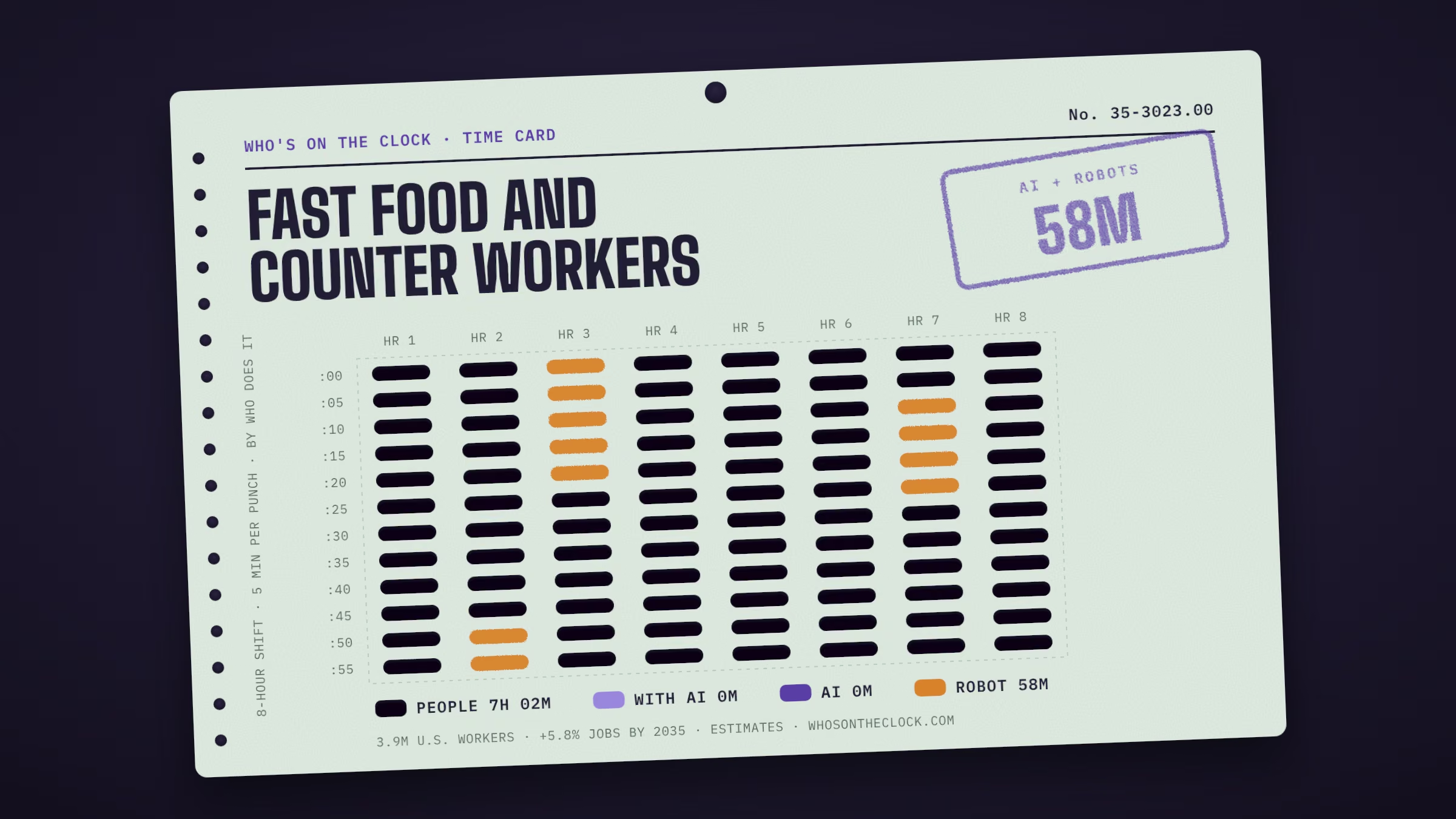
The biggest change here is physical: systems like McDonald's cash-accepting self-order kiosks have done tasks such as “Accept payment from customers, and make change as necessary” in real workplaces, about 58m of a typical shift. Most of the rest, 7h 2m, has no AI or robot evidence. BLS expects about 5.8% more of these jobs by 2035.

Time card for fast food and counter workers showing a typical 8-hour shift: 7h 2m done by people, 58m by robots.
Each mark is 5 minutes of a typical shift for fast food and counter workers, colored by who does that task today. Estimates from O*NET tasks and Anthropic Economic Index data. How it's made

Home / Food service / Fast Food and Counter Workers

Perform duties such as taking orders and serving food and beverages. Serve customers at counter or from a steam table. May take payment. May prepare food and beverages.

Time card

Untick tasks you don't do, or set your own times.
MineTask, by time spentHumanWith AIAIRobot
Prepare daily food items, and cook simple foods and beverages, such as sandwiches, salads, soups, pizza, or coffee, using proper safety precautions and sanitary measures.1h 7m a shift · Robots only in factory cells
Why this label?Robots have done this only in factory setups built around the machine, so it stays Human for fast food and counter workers. How labels work
Request and record customer orders, and compute bills, using cash registers, multi-counting machines, or pencil and paper.48m a shift · No AI or robot evidence found
Why this label?No AI use or robot deployment showed up for this task in our data. That isn't proof it's safe; it may just be rare in the data. How labels work
Accept payment from customers, and make change as necessary.38m a shift · Robots deployed · e.g. McDonald's cash-accepting self-order kiosks
Why this label?Marked Robot because McDonald's cash-accepting self-order kiosks (in real use) has done this task in a real workplace. It shows a robot can do it somewhere, not that most fast food and counter workers work alongside one. How labels work
Communicate with customers regarding orders, comments, and complaints.29m a shift · No AI or robot evidence found
Why this label?No AI use or robot deployment showed up for this task in our data. That isn't proof it's safe; it may just be rare in the data. How labels work
Serve food, beverages, or desserts to customers in such settings as take-out counters of restaurants or lunchrooms, business or industrial establishments, hotel rooms, and cars.29m a shift · Robots only in factory cells
Why this label?Robots have done this only in factory setups built around the machine, so it stays Human for fast food and counter workers. How labels work
Perform cleaning duties, such as sweeping, mopping, and washing dishes, to keep equipment and facilities sanitary.29m a shift · Robots only in factory cells
Why this label?Robots have done this only in factory setups built around the machine, so it stays Human for fast food and counter workers. How labels work
Serve customers in eating places that specialize in fast service and inexpensive carry-out food.19m a shift · Robots only in factory cells
Why this label?Robots have done this only in factory setups built around the machine, so it stays Human for fast food and counter workers. How labels work
Monitor and order supplies or food items, and restock as necessary to maintain inventory.19m a shift · Robots only in factory cells
Why this label?Robots have done this only in factory setups built around the machine, so it stays Human for fast food and counter workers. How labels work
Brew coffee and tea, and fill containers with requested beverages.19m a shift · Robots only in factory cells
Why this label?Robots have done this only in factory setups built around the machine, so it stays Human for fast food and counter workers. How labels work
Clean and organize eating, service, and kitchen areas.19m a shift · Robots only in factory cells
Why this label?Robots have done this only in factory setups built around the machine, so it stays Human for fast food and counter workers. How labels work
Wrap menu items such as sandwiches, hot entrees, and desserts for serving or for takeout.19m a shift · Robots only in factory cells
Why this label?Robots have done this only in factory setups built around the machine, so it stays Human for fast food and counter workers. How labels work
Scrub and polish counters, steam tables, and other equipment, and clean glasses, dishes, and fountain equipment.19m a shift · Robots only in factory cells
Why this label?Robots have done this only in factory setups built around the machine, so it stays Human for fast food and counter workers. How labels work
Select food items from serving or storage areas and place them in dishes, on serving trays, or in take-out bags.19m a shift · Robots only in factory cells
Why this label?Robots have done this only in factory setups built around the machine, so it stays Human for fast food and counter workers. How labels work
Balance receipts and payments in cash registers.10m a shift · Robots deployed · e.g. Glory CASHINFINITY CI-10X at Swiss Tasty
Why this label?Marked Robot because Glory CASHINFINITY CI-10X at Swiss Tasty (in real use) has done this task in a real workplace. It shows a robot can do it somewhere, not that most fast food and counter workers work alongside one. How labels work
Prepare and serve cold drinks, frozen milk drinks, or desserts, using drink-dispensing, milkshake, or frozen-custard machines.10m a shift · Robots deployed · e.g. ADAM (Richtech Robotics)
Why this label?Marked Robot because ADAM (Richtech Robotics) (in real use) has done this task in a real workplace. It shows a robot can do it somewhere, not that most fast food and counter workers work alongside one. How labels work
Set up dining areas for meals, and clear them following meals.10m a shift · Robots only in factory cells
Why this label?Robots have done this only in factory setups built around the machine, so it stays Human for fast food and counter workers. How labels work
Collect and return dirty dishes to the kitchen for washing.10m a shift · Robots only in factory cells
Why this label?Robots have done this only in factory setups built around the machine, so it stays Human for fast food and counter workers. How labels work
Deliver orders to kitchens, and pick up and serve food when it is ready.10m a shift · Robots only in factory cells
Why this label?Robots have done this only in factory setups built around the machine, so it stays Human for fast food and counter workers. How labels work
Perform personnel activities, such as supervising and training employees.10m a shift · No AI or robot evidence found
Why this label?No AI use or robot deployment showed up for this task in our data. That isn't proof it's safe; it may just be rare in the data. How labels work
Add relishes and garnishes to food orders, according to instructions.10m a shift · Robots only in factory cells
Why this label?Robots have done this only in factory setups built around the machine, so it stays Human for fast food and counter workers. How labels work
Notify kitchen personnel of shortages or special orders.10m a shift · No AI or robot evidence found
Why this label?No AI use or robot deployment showed up for this task in our data. That isn't proof it's safe; it may just be rare in the data. How labels work
Take customers' orders and write ordered items on tickets, giving ticket stubs to customers when needed to identify filled orders.10m a shift · No AI or robot evidence found
Why this label?No AI use or robot deployment showed up for this task in our data. That isn't proof it's safe; it may just be rare in the data. How labels work
Replenish foods at serving stations.10m a shift · Robots only in factory cells
Why this label?Robots have done this only in factory setups built around the machine, so it stays Human for fast food and counter workers. How labels work
Wash dishes, glassware, and silverware after meals.10m a shift · Robots only in factory cells
Why this label?Robots have done this only in factory setups built around the machine, so it stays Human for fast food and counter workers. How labels work
Distribute food to servers.time not estimated · Robots only in factory cells
Why this label?Robots have done this only in factory setups built around the machine, so it stays Human for fast food and counter workers. How labels work
Plan, prepare, and deliver meals to individuals with special dietary needs.time not estimated · Robots only in factory cells
Why this label?Robots have done this only in factory setups built around the machine, so it stays Human for fast food and counter workers. How labels work
Arrange tables and decorations according to instructions.time not estimated · Robots only in factory cells
Why this label?Robots have done this only in factory setups built around the machine, so it stays Human for fast food and counter workers. How labels work

Clock history

  1. 58m touchedFirst published: O*NET 30.1, Anthropic Economic Index (2025 usage and September 2026 robot study), BLS May 2025

When new data changes this clock, the date, the new numbers and the reason are logged here. Company news alone never moves the clock.

On the floor

  1. AnnouncedSquare
    Square launches a restaurant kiosk that takes orders by voice

    Square's new kiosk lets guests order by talking or tapping, with AI that answers menu questions, handles substitutions and suggests add-ons. It costs $1,999 plus $99 a month per device.

    Fast Casual

  2. Rolling outTaco Bell
    Taco Bell voice AI now takes orders at 890+ drive-thrus

    Voice AI runs in more than 890 U.S. Taco Bell restaurants across 38 states, with more coming under a new deal. Taco Bell says it eases team members' workloads.

    Foodservice Equipment Reports

  3. PilotMcDonald's
    AI drive-thru ordering tested at five Chicago-area McDonald's

    The test covers five restaurants. McDonald's says it has not confirmed plans for a wider rollout.

    FOX 9

  4. PilotMcDonald's
    McDonald's pilots ArchIQ, an AI system built with Google

    Announced as part of its "McDonald's Next" strategy, ArchIQ includes a voice drive-thru assistant and is meant to streamline kitchen work. McDonald's has not said which restaurants take part.

    Washington Times

  5. Pulled backTaco Bell
    Taco Bell rethinks drive-thru voice AI after order problems

    After order errors and customers trying to trick the system, Taco Bell said it may limit voice AI at busy drive-thrus, where staff may handle orders better, and will coach staff on when to use or monitor it.

    The Independent

  6. Rolling outWendy's
    Wendy's FreshAI drive-thru ordering live at 160+ restaurants

    Wendy's FreshAI drive-thru ordering system is live at over 160 restaurants across the U.S. The company plans digital menu boards and AI drive-thru ordering at over 500 restaurants by the end of the year.

    Restaurant Dive via Yahoo Finance

  7. PilotChipotle
    Chipotle tests avocado robot and automated makeline in two restaurants

    Chipotle is testing Autocado, which cuts, cores and peels avocados, in one Huntington Beach, California store. An Augmented Makeline built with Hyphen that assembles bowls and salads is in one Corona del Mar restaurant.

    Chain Store Age

  8. Pulled backMcDonald's
    McDonald's ends its first AI drive-thru test

    McDonald's removed AI ordering from its drive-thrus in 2024 after frequent order errors.

    Mashed

Ask the clock

Will AI replace fast food and counter workers?

Unlikely, though parts of the work are changing. About 58m of an 8-hour shift goes to tasks touched by robots. The other 7h 2m (88%) stays with people. Separately, BLS expects about 5.8% more of these jobs by 2035 (all jobs: +3.5%).

What can AI already do for fast food and counter workers?

None of this job's tasks show regular AI use yet. That can mean the work is hands-on or in person, or simply that it rarely comes up in AI usage data.

Where do robots fit in?

For some tasks, yes. Robots have done 3 of this job's tasks in workplaces like this one, about 58m of a typical shift. 19 more tasks have only been done in factory setups built around the machine, so they stay with people here.

  • Accept payment from customers, and make change as necessary. (38m a shift; e.g. McDonald's cash-accepting self-order kiosks, in use)
  • Balance receipts and payments in cash registers. (10m a shift; e.g. Glory CASHINFINITY CI-10X at Swiss Tasty, in use)
  • Prepare and serve cold drinks, frozen milk drinks, or desserts, using drink-dispensing, milkshake, or frozen-custard machines. (10m a shift; e.g. ADAM (Richtech Robotics), in use)
What still needs a person?

7h 2m of a typical shift, or 88%, goes to tasks with no AI or robot evidence yet. No AI usage or robot deployment has shown up for these so far. The biggest:

  • Prepare daily food items, and cook simple foods and beverages, such as sandwiches, salads, soups, pizza, or coffee, using proper safety precautions and sanitary measures. (1h 7m a shift)
  • Request and record customer orders, and compute bills, using cash registers, multi-counting machines, or pencil and paper. (48m a shift)
  • Communicate with customers regarding orders, comments, and complaints. (29m a shift)
  • Serve food, beverages, or desserts to customers in such settings as take-out counters of restaurants or lunchrooms, business or industrial establishments, hotel rooms, and cars. (29m a shift)
  • Perform cleaning duties, such as sweeping, mopping, and washing dishes, to keep equipment and facilities sanitary. (29m a shift)
Why is that work hard to automate?

Much of it comes down to where and how the work happens. In-person, hands-on and high-stakes work is where AI and robots have made the least headway so far. In the official O*NET survey of people in this job:

  • 94% work at arm's length or closer to other people
  • 86% say dealing with the public is very or extremely important
  • 86% spend more than half the day on their feet
What are companies actually doing?

We track 8 sourced company moves that affect this job, including at least one pullback. Most recent:

  • Oct 14, 2026: Square launches a restaurant kiosk that takes orders by voice (Announced)
  • Jul 7, 2026: Taco Bell voice AI now takes orders at 890+ drive-thrus (Rolling out)
  • Jun 8, 2026: AI drive-thru ordering tested at five Chicago-area McDonald's (Pilot)
Are employers still hiring fast food and counter workers?

On Indeed, job postings in the Food Preparation & Service sector are at 96% of their February 2020 level (all U.S. postings: 104%), down 3.1% from a year earlier, as of Oct 9, 2026. BLS separately expects about 827,000 openings a year in this job through 2035. Across all U.S. postings, 7.3% now mention AI skills. Sector postings cover more than this one job and move for many reasons besides AI.

How much do fast food and counter workers make?

The median pay is about $31,200 a year ($15.00 an hour), 39% below the median for all U.S. jobs ($50,980). Most people in this job earn between $22,840 and $42,650 a year; that range covers the middle 80%. Pay figures are from BLS, May 2025, and vary a lot by state and employer. Pick a state to compare:

Is this job growing or shrinking?

BLS projects growth of 5.8% from 2025 to 2035, compared with 3.5% growth for all jobs. That's about 4.1 million jobs in 2035. It expects about 827,000 openings a year, mostly from people retiring or changing careers. These projections don't single out AI as a cause.

How many fast food and counter workers are there in the U.S.?

About 3.9 million people in the U.S., roughly 2.5% of all workers (BLS, May 2025). That makes it the 4th largest of the 796 jobs on this site. BLS expects about 4.1 million in 2035.

What training do fast food and counter workers need?

The most common requirement is less than a high school diploma: about 56% of people in the job said so in the official O*NET survey. O*NET rates the job at level 1 of 5 for preparation, which usually means: little or no preparation. Requirements vary by state and employer, especially for licensed work.

What should I learn to stay ahead of AI?

These come from the job's official skill ratings and from the tasks that AI and robots touch least today. Building them keeps you strong in the parts of the work that still need a person:

  • Skills that matter more here than in most jobs: Service Orientation, Coordination, Social Perceptiveness, Active Listening
  • Get strong at the parts of the job that stay with people (listed above), which take 7h 2m of a typical shift
  • Tools employers list: Facebook, Microsoft Excel, Microsoft Office software, Microsoft Windows
What new tasks are fast food and counter workers taking on?

Yes. Occupational experts recently added these to the official task list, a sign of how the work itself is shifting. New tasks aren't rated for AI or robots yet:

  • Check and monitor food temperatures while cooking.
What other jobs could fast food and counter workers move into?

These use similar skills, with less of a typical shift touched by AI or robots. Matches come from 109 official ratings of skills, knowledge and work activities, and each needs the same or less preparation unless the official list relates the jobs directly:

  • Restaurant Cooks (7m touched, $37k median pay)
  • Waiters and Waitresses (17m touched, $35k median pay)
How solid are these numbers?

Each task carries its own evidence label. For this job: 3 with robots in real deployments, 24 with no AI or robot evidence found. The minutes per task are estimates, not measured hours, and "no evidence" doesn't prove a task is safe.

Tools in demand

  • Facebook

Plus everyday office tools: Microsoft Excel, Microsoft Office software, Microsoft Windows.

Also called

Back of House Team Member (BOH Team Member), Bakery Associate, Barista, Bistro Team Member, Cafe Server, Cafe Worker, Cafeteria Food Server, Cafeteria Lunchroom Counter Attendant, Cafeteria Server, Cafeteria Worker, Candy Attendant, Candy Bar Attendant, Candy Counter Clerk, Canteen Operator