Will AI replace computer user support specialists?

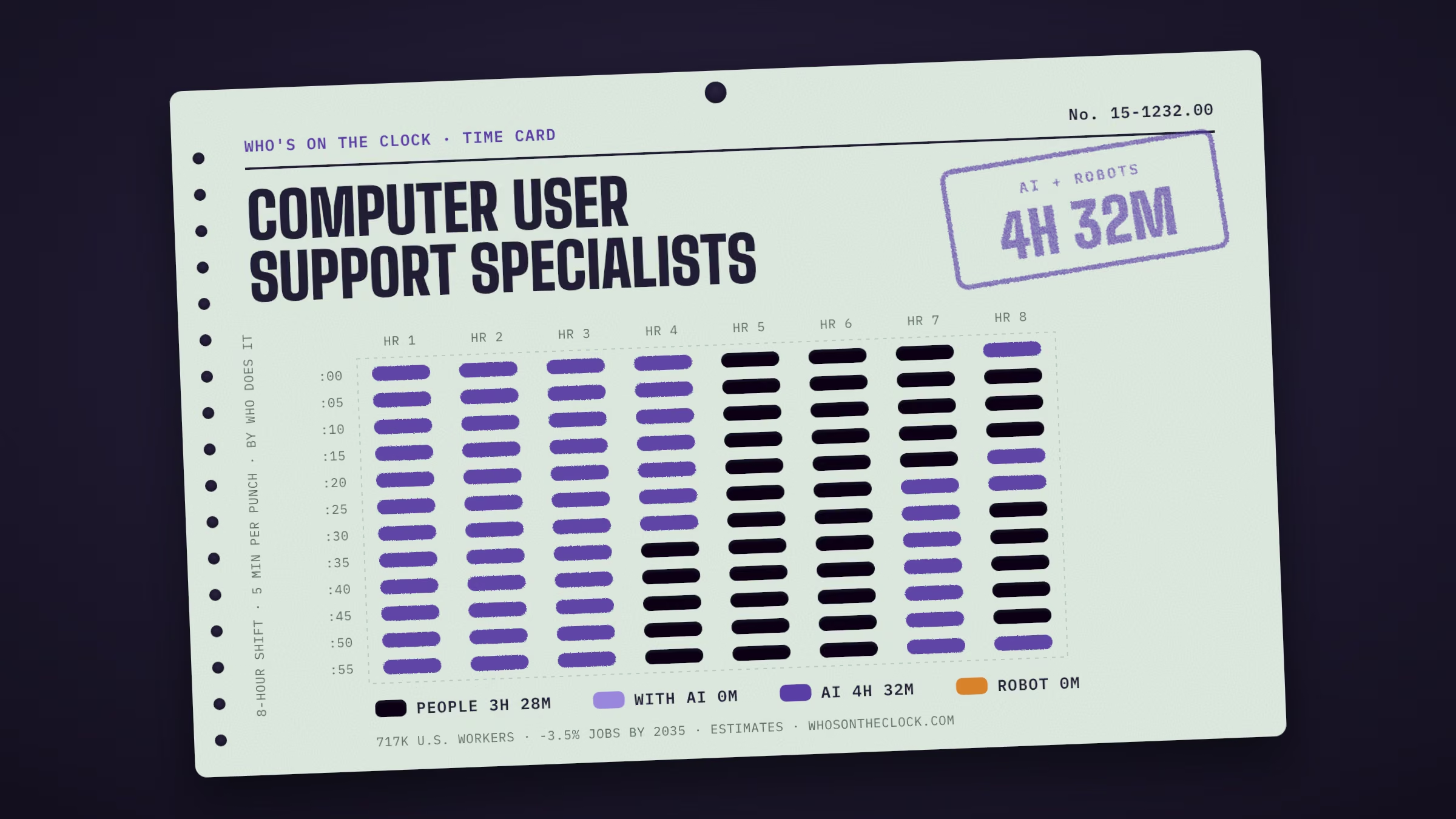
AI already handles some of this work on its own in real use, for tasks like “Answer user inquiries regarding computer software or hardware operation to resolve problems”. That's 4h 32m of a typical shift; 3h 28m still has no AI or robot evidence. BLS expects about 3.5% fewer of these jobs by 2035.

Time card for computer user support specialists showing a typical 8-hour shift: 3h 28m done by people, 4h 32m by AI.
Each mark is 5 minutes of a typical shift for computer user support specialists, colored by who does that task today. Estimates from O*NET tasks and Anthropic Economic Index data. How it's made

Home / Computers & math / Computer User Support Specialists

Provide technical assistance to computer users. Answer questions or resolve computer problems for clients in person, via telephone, or electronically. May provide assistance concerning the use of computer hardware and software, including printing, installation, word processing, electronic mail, and operating systems.

Time card

Untick tasks you don't do, or set your own times.
MineTask, by time spentHumanWith AIAIRobot
Answer user inquiries regarding computer software or hardware operation to resolve problems.2h a shift · Observed in AI useTypical AI request: about 1h 18m alone, 32m with AI
Why this label?Marked AI because this task shows up regularly in real AI conversations (Anthropic Economic Index, 2025 usage), and in most of them AI does the task on its own rather than helping a person. Many workplaces may not use AI for it at all. How labels work
Read technical manuals, confer with users, or conduct computer diagnostics to investigate and resolve problems or to provide technical assistance and support.1h 35m a shift · Observed in AI useTypical AI request: about 2h 18m alone, 31m with AI
Why this label?Marked AI because this task shows up regularly in real AI conversations (Anthropic Economic Index, 2025 usage), and in most of them AI does the task on its own rather than helping a person. Many workplaces may not use AI for it at all. How labels work
Set up equipment for employee use, performing or ensuring proper installation of cables, operating systems, or appropriate software.44m a shift · Robots only in factory cells
Why this label?Robots have done this only in factory setups built around the machine, so it stays Human for computer user support specialists. How labels work
Install and perform minor repairs to hardware, software, or peripheral equipment, following design or installation specifications.38m a shift · Robots only in factory cells
Why this label?Robots have done this only in factory setups built around the machine, so it stays Human for computer user support specialists. How labels work
Maintain records of daily data communication transactions, problems and remedial actions taken, or installation activities.38m a shift · No AI or robot evidence found
Why this label?No AI use or robot deployment showed up for this task in our data. That isn't proof it's safe; it may just be rare in the data. How labels work
Oversee the daily performance of computer systems.25m a shift · No AI or robot evidence found
Why this label?No AI use or robot deployment showed up for this task in our data. That isn't proof it's safe; it may just be rare in the data. How labels work
Confer with staff, users, and management to establish requirements for new systems or modifications.19m a shift · No AI or robot evidence found
Why this label?No AI use or robot deployment showed up for this task in our data. That isn't proof it's safe; it may just be rare in the data. How labels work
Enter commands and observe system functioning to verify correct operations and detect errors.19m a shift · Observed in AI useTypical AI request: about 4h 33m alone, 26m with AI
Why this label?Marked AI because this task shows up regularly in real AI conversations (Anthropic Economic Index, 2025 usage), and in most of them AI does the task on its own rather than helping a person. Many workplaces may not use AI for it at all. How labels work
Develop training materials and procedures, or train users in the proper use of hardware or software.19m a shift · Observed in AI use
Why this label?Marked AI because this task shows up regularly in real AI conversations (Anthropic Economic Index, 2025 usage), and in most of them AI does the task on its own rather than helping a person. Many workplaces may not use AI for it at all. How labels work
Refer major hardware or software problems or defective products to vendors or technicians for service.13m a shift · No AI or robot evidence found
Why this label?No AI use or robot deployment showed up for this task in our data. That isn't proof it's safe; it may just be rare in the data. How labels work
Prepare evaluations of software or hardware, and recommend improvements or upgrades.13m a shift · Observed in AI useTypical AI request: about 5h alone, 37m with AI
Why this label?Marked AI because this task shows up regularly in real AI conversations (Anthropic Economic Index, 2025 usage), and in most of them AI does the task on its own rather than helping a person. Many workplaces may not use AI for it at all. How labels work
Read trade magazines and technical manuals, or attend conferences and seminars to maintain knowledge of hardware and software.13m a shift · No AI or robot evidence found
Why this label?No AI use or robot deployment showed up for this task in our data. That isn't proof it's safe; it may just be rare in the data. How labels work
Inspect equipment and read order sheets to prepare for delivery to users.6m a shift · Robots only in factory cells
Why this label?Robots have done this only in factory setups built around the machine, so it stays Human for computer user support specialists. How labels work
Conduct office automation feasibility studies, including workflow analysis, space design, or cost comparison analysis.6m a shift · No AI or robot evidence found
Why this label?No AI use or robot deployment showed up for this task in our data. That isn't proof it's safe; it may just be rare in the data. How labels work
Hire, supervise, and direct workers engaged in special project work, problem-solving, monitoring, and installation of data communication equipment and software.6m a shift · No AI or robot evidence found
Why this label?No AI use or robot deployment showed up for this task in our data. That isn't proof it's safe; it may just be rare in the data. How labels work
Modify and customize commercial programs for internal needs.6m a shift · Observed in AI useTypical AI request: about 4h 11m alone, 30m with AI
Why this label?Marked AI because this task shows up regularly in real AI conversations (Anthropic Economic Index, 2025 usage), and in most of them AI does the task on its own rather than helping a person. Many workplaces may not use AI for it at all. How labels work

Clock history

  1. 4h 32m touchedFirst published: O*NET 30.1, Anthropic Economic Index (2025 usage and September 2026 robot study), BLS May 2025

When new data changes this clock, the date, the new numbers and the reason are logged here. Company news alone never moves the clock.

On the floor

  1. Rolling outPalo Alto Networks
    Palo Alto Networks cuts IT support staff nearly in half with AI

    Palo Alto Networks reduced its IT support staff by nearly 50%, with an expected reduction of 80%. Gartner projected that by 2027 AI will provide more IT technical support than humans, at least in written form.

    CNBC via NBC New York

Ask the clock

Will AI replace computer user support specialists?

Some tasks are already being done by AI or machines; the rest still needs a person. About 4h 32m of a typical shift is made up of tasks that AI or robots have done on their own in real use somewhere. That doesn't mean those hours are automated in a typical workplace. The other 3h 28m (43%) stays with people. Separately, BLS expects about 3.5% fewer of these jobs by 2035 (all jobs: +3.5%).

What can AI already do for computer user support specialists?

AI shows up regularly in 6 of 16 tasks, about 4h 32m of a typical shift. The biggest ones:

  • Answer user inquiries regarding computer software or hardware operation to resolve problems. (2h a shift, AI mostly does it alone)
  • Read technical manuals, confer with users, or conduct computer diagnostics to investigate and resolve problems or to provide technical assistance and support. (1h 35m a shift, AI mostly does it alone)
  • Enter commands and observe system functioning to verify correct operations and detect errors. (19m a shift, AI mostly does it alone)
  • Develop training materials and procedures, or train users in the proper use of hardware or software. (19m a shift, AI mostly does it alone)
  • Prepare evaluations of software or hardware, and recommend improvements or upgrades. (13m a shift, AI mostly does it alone)
Where do robots fit in?

Not in workplaces like this one, based on a 2026 review of robot deployments. 3 more tasks have only been done in factory setups built around the machine, so they stay with people here.

What still needs a person?

3h 28m of a typical shift, or 43%, goes to tasks with no AI or robot evidence yet. No AI usage or robot deployment has shown up for these so far. The biggest:

  • Set up equipment for employee use, performing or ensuring proper installation of cables, operating systems, or appropriate software. (44m a shift)
  • Install and perform minor repairs to hardware, software, or peripheral equipment, following design or installation specifications. (38m a shift)
  • Maintain records of daily data communication transactions, problems and remedial actions taken, or installation activities. (38m a shift)
  • Oversee the daily performance of computer systems. (25m a shift)
  • Confer with staff, users, and management to establish requirements for new systems or modifications. (19m a shift)
Why is that work hard to automate?

Much of it comes down to where and how the work happens. In-person, hands-on and high-stakes work is where AI and robots have made the least headway so far. In the official O*NET survey of people in this job:

  • 88% talk face to face with others every day
What are companies actually doing?

We track 1 sourced company move that affects this job. Most recent:

  • Dec 1, 2024: Palo Alto Networks cuts IT support staff nearly in half with AI (Rolling out)
How much time does AI save on these tasks?

For the 5 tasks in this job where AI shows up and timing data exists, a typical request takes about 4h 11m for a person alone and about 31m with AI. These are Claude's own estimates from real conversations in April and May 2026 (Anthropic Economic Index). They describe single requests, not whole workdays, and time saved on a task doesn't mean jobs are cut. The biggest gaps:

  • Prepare evaluations of software or hardware, and recommend improvements or upgrades (about 5h alone, 37m with AI)
  • Enter commands and observe system functioning to verify correct operations and detect errors (about 4h 33m alone, 26m with AI)
  • Modify and customize commercial programs for internal needs (about 4h 11m alone, 30m with AI)
Are employers still hiring computer user support specialists?

On Indeed, job postings in the IT Infrastructure, Operations & Support sector are at 70% of their February 2020 level (all U.S. postings: 104%), up 7.5% from a year earlier, as of Oct 9, 2026. BLS separately expects about 40,000 openings a year in this job through 2035. Across all U.S. postings, 7.3% now mention AI skills. Sector postings cover more than this one job and move for many reasons besides AI.

How much do computer user support specialists make?

The median pay is about $61,860 a year ($29.74 an hour), 21% above the median for all U.S. jobs ($50,980). Most people in this job earn between $40,980 and $100,540 a year; that range covers the middle 80%. Pay figures are from BLS, May 2025, and vary a lot by state and employer. Pick a state to compare:

Is this job growing or shrinking?

BLS projects a decline of 3.5% from 2025 to 2035, compared with 3.5% growth for all jobs. That's about 724,000 jobs in 2035. Even so, it expects about 40,000 openings a year, mostly from people retiring or changing careers. These projections don't single out AI as a cause.

How many computer user support specialists are there in the U.S.?

About 717,000 people in the U.S., roughly 0.46% of all workers (BLS, May 2025). That makes it the 55th largest of the 796 jobs on this site. BLS expects about 724,000 in 2035.

What training do computer user support specialists need?

The most common requirement is a bachelor's degree: about 47% of people in the job said so in the official O*NET survey. O*NET rates the job at level 3 of 5 for preparation, which usually means: vocational school or associate's degree. Requirements vary by state and employer, especially for licensed work.

What should I learn to stay ahead of AI?

These come from the job's official skill ratings and from the tasks that AI and robots touch least today. Building them keeps you strong in the parts of the work that still need a person:

  • Skills that matter more here than in most jobs: Troubleshooting, Speaking, Reading Comprehension, Active Listening
  • Get strong at the parts of the job that stay with people (listed above), which take 3h 28m of a typical shift
  • Tools employers list: Structured query language SQL, ServiceNow, Microsoft Windows, Microsoft Outlook, Microsoft Office software
  • Learn to use AI well on the tasks where it already shows up in this job (listed above)
What other jobs could computer user support specialists move into?

These use similar skills, with less of a typical shift touched by AI or robots. Matches come from 109 official ratings of skills, knowledge and work activities, and each needs the same or less preparation unless the official list relates the jobs directly:

  • Computer Network Support Specialists (2h 40m touched, $76k median pay)
  • Computer Systems Engineers/Architects (3h 7m touched, $117k median pay)
  • Network and Computer Systems Administrators (2h 56m touched, $99k median pay)
  • Computer Systems Analysts (3h 6m touched, $106k median pay)
  • Database Administrators (3h 35m touched, $105k median pay)
How solid are these numbers?

Each task carries its own evidence label. For this job: 6 observed in real AI use, 10 with no AI or robot evidence found. The minutes per task are estimates, not measured hours, and "no evidence" doesn't prove a task is safe.

Tools in demand

  • Structured query language SQL
  • ServiceNow
  • Microsoft Azure software
  • Microsoft Active Directory

Plus everyday office tools: Microsoft Windows, Microsoft Outlook, Microsoft Office software, Microsoft Excel.

Also called

Application Customer Service Representative (Application CSR), Application Support Engineer, Applications Analyst, Automatic Data Processing Customer Liaison (ADP Customer Liaison), Call Center Support Representative (Call Center Support Rep), Cloud Operations Specialist, Computer Customer Support Specialist, Computer Hardware Technician (Computer Hardware Tech), Computer Help Desk Representative (Computer Help Desk Rep), Computer Help Desk Specialist, Computer Lab Assistant (Computer Laboratory Assistant), Computer Operations Technician (Computer Operations Tech), Computer Operator, Computer Specialist