Will AI replace database administrators?

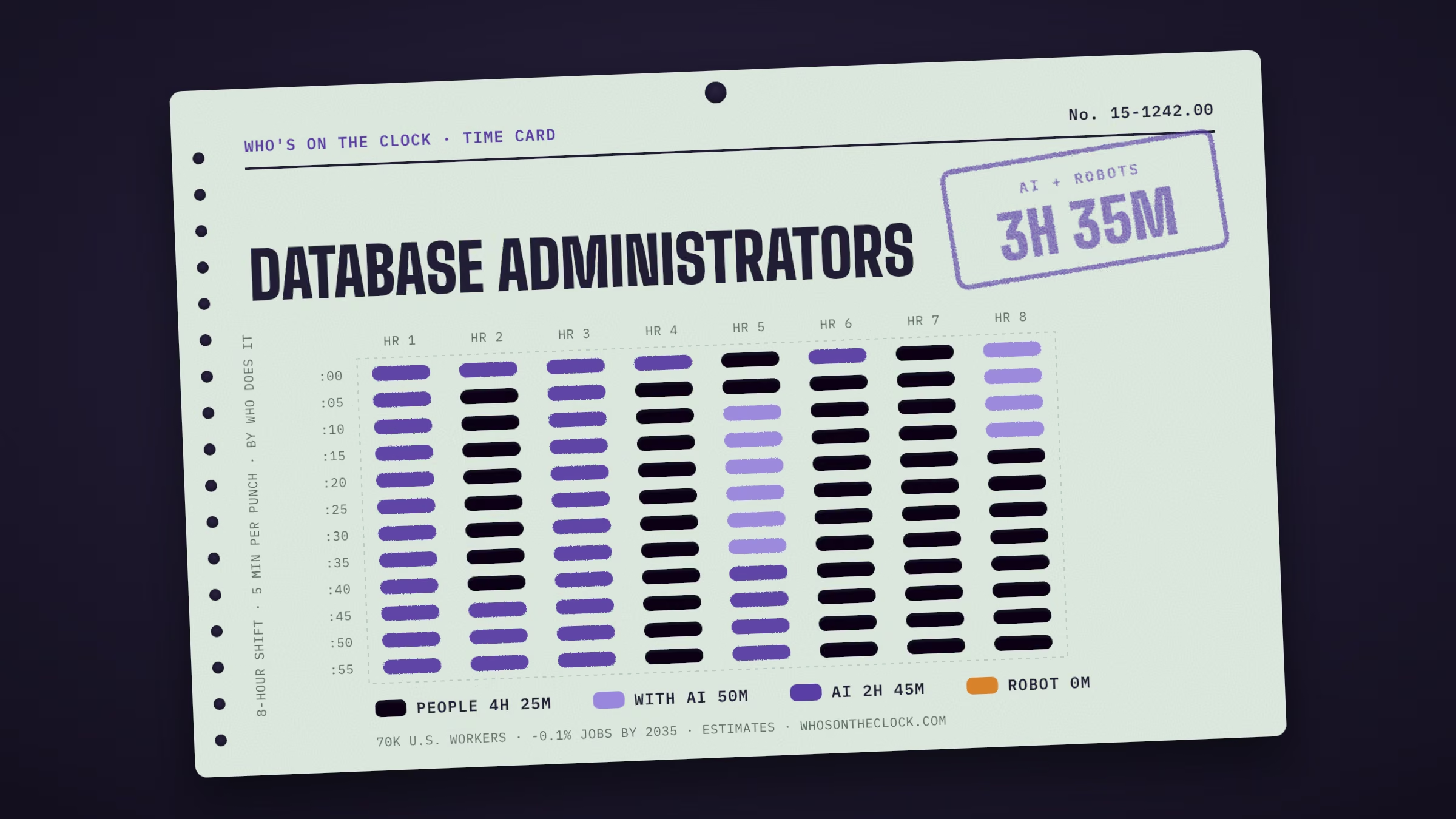
Parts of the job are being automated. About 2h 44m of an 8-hour shift goes to tasks that AI or robots already do largely on their own. The rest still needs a person. The breakdown: 50m done by people with AI help, 2h 44m that AI mostly does alone. The other 4h 25m (55%) stays with people. Separately, BLS expects about 0.1% fewer of these jobs by 2035 (all jobs: +3.5%).

Time card for database administrators showing a typical 8-hour shift: 4h 25m done by people, 50m done by people with AI, 2h 44m by AI.
Each mark is 5 minutes of a typical shift for database administrators, colored by who does that task today. Estimates from O*NET tasks and Anthropic Economic Index data. How it's made

Home / Computers & math / Database Administrators

Administer, test, and implement computer databases, applying knowledge of database management systems. Coordinate changes to computer databases. Identify, investigate, and resolve database performance issues, database capacity, and database scalability. May plan, coordinate, and implement security measures to safeguard computer databases.

Time card

Untick tasks you don't do, or set your own times.
MineTask, by time spentHumanWith AIAIRobot
Modify existing databases and database management systems or direct programmers and analysts to make changes.1h 3m a shift · Observed in AI useTypical AI request: about 4h 44m alone, 37m with AI
Plan, coordinate, and implement security measures to safeguard information in computer files against accidental or unauthorized damage, modification or disclosure.38m a shift · No AI or robot evidence found
Plan and install upgrades of database management system software to enhance database performance.38m a shift · Observed in AI use
Test programs or databases, correct errors, and make necessary modifications.38m a shift · Observed in AI use
Select and enter codes to monitor database performance and to create production databases.38m a shift · No AI or robot evidence found
Test changes to database applications or systems.32m a shift · No AI or robot evidence found
Provide technical support to junior staff or clients.32m a shift · Observed in AI useTypical AI request: about 3h 34m alone, 1h 22m with AI
Specify users and user access levels for each segment of database.25m a shift · Observed in AI use
Approve, schedule, plan, and supervise the installation and testing of new products and improvements to computer systems, such as the installation of new databases.25m a shift · No AI or robot evidence found
Write and code logical and physical database descriptions and specify identifiers of database to management system, or direct others in coding descriptions.25m a shift · No AI or robot evidence found
Develop data models describing data elements and how they are used, following procedures and using pen, template, or computer software.25m a shift · No AI or robot evidence found
Train users and answer questions.19m a shift · No AI or robot evidence found
Develop standards and guidelines for the use and acquisition of software and to protect vulnerable information.19m a shift · No AI or robot evidence found
Identify, evaluate and recommend hardware or software technologies to achieve desired database performance.19m a shift · Observed in AI useTypical AI request: about 1h 55m alone, 17m with AI
Review procedures in database management system manuals to make changes to database.19m a shift · No AI or robot evidence found
Identify and evaluate industry trends in database systems to serve as a source of information and advice for upper management.13m a shift · No AI or robot evidence found
Review workflow charts developed by programmer analyst to understand tasks computer will perform, such as updating records.6m a shift · No AI or robot evidence found
Revise company definition of data as defined in data dictionary.6m a shift · No AI or robot evidence found

On the floor

No company news tracked for this job yet. New stories are added as they happen.

Ask the clock

Will AI replace database administrators?

Parts of the job are being automated. About 2h 44m of an 8-hour shift goes to tasks that AI or robots already do largely on their own. The rest still needs a person. The breakdown: 50m done by people with AI help, 2h 44m that AI mostly does alone. The other 4h 25m (55%) stays with people. Separately, BLS expects about 0.1% fewer of these jobs by 2035 (all jobs: +3.5%).

What parts of the job can AI already do?

AI shows up regularly in 6 of 18 tasks, about 3h 35m of a typical shift. The biggest ones:

  • Modify existing databases and database management systems or direct programmers and analysts to make changes. (1h 3m a shift, AI mostly does it alone)
  • Plan and install upgrades of database management system software to enhance database performance. (38m a shift, AI mostly does it alone)
  • Test programs or databases, correct errors, and make necessary modifications. (38m a shift, AI mostly does it alone)
  • Specify users and user access levels for each segment of database. (25m a shift, AI mostly does it alone)
  • Provide technical support to junior staff or clients. (32m a shift, people use AI to help)
What parts of the job are still done by people?

4h 25m of a typical shift, or 55%, goes to tasks with no AI or robot evidence yet. No AI usage or robot deployment has shown up for these so far. The biggest:

  • Plan, coordinate, and implement security measures to safeguard information in computer files against accidental or unauthorized damage, modification or disclosure. (38m a shift)
  • Select and enter codes to monitor database performance and to create production databases. (38m a shift)
  • Test changes to database applications or systems. (32m a shift)
  • Approve, schedule, plan, and supervise the installation and testing of new products and improvements to computer systems, such as the installation of new databases. (25m a shift)
  • Write and code logical and physical database descriptions and specify identifiers of database to management system, or direct others in coding descriptions. (25m a shift)
How much time does AI save on this job's tasks?

For the 3 tasks in this job where AI shows up and timing data exists, a typical request takes about 3h 34m for a person alone and about 37m with AI. These are Claude's own estimates from real conversations in April and May 2026 (Anthropic Economic Index). They describe single requests, not whole workdays, and time saved on a task doesn't mean jobs are cut. The biggest gaps:

  • Modify existing databases and database management systems or direct programmers and analysts to make changes (about 4h 44m alone, 37m with AI)
  • Provide technical support to junior staff or clients (about 3h 34m alone, 1h 22m with AI)
  • Identify, evaluate and recommend hardware or software technologies to achieve desired database performance (about 1h 55m alone, 17m with AI)
Are employers still hiring for this job?

On Indeed, job postings in the IT Systems & Solutions sector are at 77% of their February 2020 level (all U.S. postings: 104%), up 10.8% from a year earlier, as of Oct 9, 2026. BLS separately expects about 3,300 openings a year in this job through 2035. Across all U.S. postings, 7.3% now mention AI skills. Sector postings cover more than this one job and move for many reasons besides AI.

How much do database administrators make?

The median pay is about $104,620 a year ($50.30 an hour), 105% above the median for all U.S. jobs ($50,980). Most people in this job earn between $60,230 and $163,320 a year; that range covers the middle 80%. Pay figures are from BLS, May 2025, and vary a lot by state and employer. Pick a state to compare:

Is this job growing or shrinking?

BLS projects a decline of 0.1% from 2025 to 2035, compared with 3.5% growth for all jobs. That's about 75,000 jobs in 2035. Even so, it expects about 3,300 openings a year, mostly from people retiring or changing careers. These projections don't single out AI as a cause.

How many people do this job?

About 70,000 people in the U.S., roughly 0.05% of all workers (BLS, May 2025). That makes it the 327th largest of the 796 jobs on this site. BLS expects about 75,000 in 2035.

What do you need to become one?

The most common requirement is a bachelor's degree: about 89% of people in the job said so in the official O*NET survey. O*NET rates the job at level 4 of 5 for preparation, which usually means: bachelor's degree. Requirements vary by state and employer, especially for licensed work.

What should I learn to stay ahead?

These come from the job's official skill ratings and from the tasks that AI and robots touch least today. Building them keeps you strong in the parts of the work that still need a person:

  • Skills that matter more here than in most jobs: Programming, Operations Analysis, Complex Problem Solving, Judgment and Decision Making
  • Get strong at the parts of the job that stay with people (listed above), which take 4h 25m of a typical shift
  • Tools employers list: UNIX, Tableau, Structured query language SQL, Snowflake, Scala
  • Learn to use AI well on the tasks where it already shows up in this job (listed above)
What similar jobs could I move into?

These use similar skills. Matches come from 109 official ratings of skills, knowledge and work activities, and each needs the same or less preparation unless the official list relates the jobs directly:

  • Software Developers (3h 20m touched, $136k median pay)
  • Information Security Analysts (4h 17m touched, $129k median pay)
  • Web Developers (4h 59m touched, $93k median pay)
  • Computer Programmers (5h 48m touched, $100k median pay)
  • Data Warehousing Specialists (6h 24m touched, $140k median pay)
How solid are these numbers?

Each task carries its own evidence label. For this job: 6 observed in real AI use, 12 with no AI or robot evidence found. The minutes per task are estimates, not measured hours, and "no evidence" doesn't prove a task is safe.

Tools in demand

  • UNIX
  • Tableau
  • Structured query language SQL
  • Snowflake
  • Scala
  • Salesforce software
  • Python
  • PostgreSQL

Also called

Administrator (Admin), Automatic Data Processing Planner (ADP Planner), Cyber Database Administrator (Cyber DBA), Data Administrator (Data Admin), Data Management Associate, Data Management IT Specialist (Data Management Information Technology Specialist), Data Miner, Data Recovery Planner, Data Security Administrator, Data Storage Specialist, Database Administration Associate, Database Administration Manager, Database Administrator (DBA), Database Analyst