Will AI replace civil engineers?

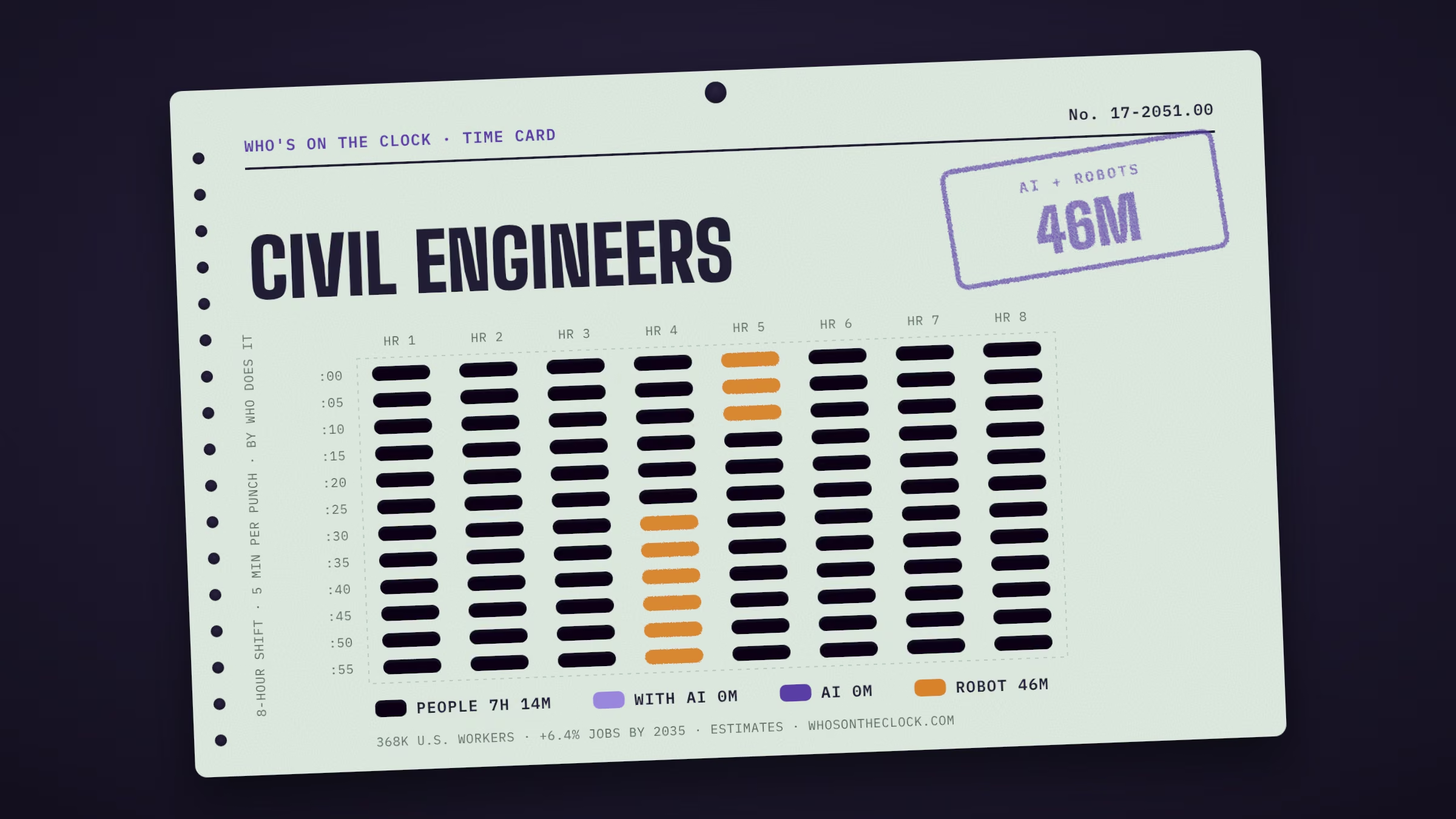
Unlikely, though parts of the work are changing. About 46m of an 8-hour shift goes to tasks touched by robots. The other 7h 14m (90%) stays with people. Separately, BLS expects about 6.4% more of these jobs by 2035 (all jobs: +3.5%).

Time card for civil engineers showing a typical 8-hour shift: 7h 14m done by people, 46m by robots.
Each mark is 5 minutes of a typical shift for civil engineers, colored by who does that task today. Estimates from O*NET tasks and Anthropic Economic Index data. How it's made

Home / Engineering & architecture / Civil Engineers

Perform engineering duties in planning, designing, and overseeing construction and maintenance of building structures and facilities, such as roads, railroads, airports, bridges, harbors, channels, dams, irrigation projects, pipelines, power plants, and water and sewage systems.

Time card

Untick tasks you don't do, or set your own times.
MineTask, by time spentHumanWith AIAIRobot
Plan and design transportation or hydraulic systems or structures, using computer-assisted design or drawing tools.1h 4m a shift · No AI or robot evidence found
Compute load and grade requirements, water flow rates, or material stress factors to determine design specifications.52m a shift · No AI or robot evidence found
Direct engineering activities, ensuring compliance with environmental, safety, or other governmental regulations.46m a shift · No AI or robot evidence found
Manage and direct the construction, operations, or maintenance activities at project site.46m a shift · No AI or robot evidence found
Inspect project sites to monitor progress and ensure conformance to design specifications and safety or sanitation standards.46m a shift · Robots deployed · e.g. DroneDeploy Robotics ground robots (Boston Dynamics Spot / Unitree Go2-W) with Progress AI and Safety AI
Provide technical advice to industrial or managerial personnel regarding design, construction, program modifications, or structural repairs.40m a shift · No AI or robot evidence found
Analyze survey reports, maps, drawings, blueprints, aerial photography, or other topographical or geologic data.40m a shift · No AI or robot evidence found
Prepare or present public reports on topics such as bid proposals, deeds, environmental impact statements, or property and right-of-way descriptions.35m a shift · No AI or robot evidence found
Estimate quantities and cost of materials, equipment, or labor to determine project feasibility.29m a shift · No AI or robot evidence found
Direct or participate in surveying to lay out installations or establish reference points, grades, or elevations to guide construction.17m a shift · No AI or robot evidence found
Conduct studies of traffic patterns or environmental conditions to identify engineering problems and assess potential project impact.17m a shift · No AI or robot evidence found
Design energy-efficient or environmentally sound civil structures.12m a shift · No AI or robot evidence found
Test soils or materials to determine the adequacy and strength of foundations, concrete, asphalt, or steel.12m a shift · No AI or robot evidence found
Identify environmental risks and develop risk management strategies for civil engineering projects.12m a shift · No AI or robot evidence found
Develop or implement engineering solutions to clean up industrial accidents or other contaminated sites.6m a shift · No AI or robot evidence found
Design or engineer systems to efficiently dispose of chemical, biological, or other toxic wastes.6m a shift · No AI or robot evidence found

On the floor

  1. TxDOT AI plan proposes automated bridge inspections and road design

    TxDOT's 2025 to 2027 AI Strategic Plan draws on 230 potential use cases, including AI bridge inspections and generated initial road designs. AI cut some engineering invoice entry from seven days to 30 minutes.

    ASCE Civil Engineering Source

Ask the clock

Will AI replace civil engineers?

Unlikely, though parts of the work are changing. About 46m of an 8-hour shift goes to tasks touched by robots. The other 7h 14m (90%) stays with people. Separately, BLS expects about 6.4% more of these jobs by 2035 (all jobs: +3.5%).

What can AI already do for civil engineers?

None of this job's tasks show regular AI use yet. That can mean the work is hands-on or in person, or simply that it rarely comes up in AI usage data.

Where do robots fit in?

For some tasks, yes. Robots have done 1 of this job's tasks in workplaces like this one, about 46m of a typical shift.

  • Inspect project sites to monitor progress and ensure conformance to design specifications and safety or sanitation standards. (46m a shift; e.g. DroneDeploy Robotics ground robots (Boston Dynamics Spot / Unitree Go2-W) with Progress AI and Safety AI, in use)
What still needs a person?

7h 14m of a typical shift, or 90%, goes to tasks with no AI or robot evidence yet. No AI usage or robot deployment has shown up for these so far. The biggest:

  • Plan and design transportation or hydraulic systems or structures, using computer-assisted design or drawing tools. (1h 4m a shift)
  • Compute load and grade requirements, water flow rates, or material stress factors to determine design specifications. (52m a shift)
  • Direct engineering activities, ensuring compliance with environmental, safety, or other governmental regulations. (46m a shift)
  • Manage and direct the construction, operations, or maintenance activities at project site. (46m a shift)
  • Provide technical advice to industrial or managerial personnel regarding design, construction, program modifications, or structural repairs. (40m a shift)
Why is that work hard to automate?

Much of it comes down to where and how the work happens. In-person, hands-on and high-stakes work is where AI and robots have made the least headway so far. In the official O*NET survey of people in this job:

  • 76% talk face to face with others every day
  • 62% say dealing with the public is very or extremely important
  • 62% say a mistake would be very or extremely serious
What are companies actually doing?

We track 1 sourced company move that affects this job. Most recent:

  • Sep 18, 2025: TxDOT AI plan proposes automated bridge inspections and road design (Plan)
Are employers still hiring civil engineers?

On Indeed, job postings in the Civil Engineering sector are at 163% of their February 2020 level (all U.S. postings: 104%), up 6.3% from a year earlier, as of Oct 9, 2026. BLS separately expects about 23,000 openings a year in this job through 2035. Across all U.S. postings, 7.3% now mention AI skills. Sector postings cover more than this one job and move for many reasons besides AI.

How much do civil engineers make?

The median pay is about $100,840 a year ($48.48 an hour), 98% above the median for all U.S. jobs ($50,980). Most people in this job earn between $68,240 and $163,220 a year; that range covers the middle 80%. Pay figures are from BLS, May 2025, and vary a lot by state and employer. Pick a state to compare:

Is this job growing or shrinking?

BLS projects growth of 6.4% from 2025 to 2035, compared with 3.5% growth for all jobs. That's about 405,000 jobs in 2035. It expects about 23,000 openings a year, mostly from people retiring or changing careers. These projections don't single out AI as a cause.

How many civil engineers are there in the U.S.?

About 368,000 people in the U.S., roughly 0.24% of all workers (BLS, May 2025). That makes it the 113th largest of the 796 jobs on this site. BLS expects about 405,000 in 2035.

What training do civil engineers need?

The most common requirement is a bachelor's degree: about 86% of people in the job said so in the official O*NET survey. O*NET rates the job at level 4 of 5 for preparation, which usually means: bachelor's degree. Requirements vary by state and employer, especially for licensed work.

What should I learn to stay ahead of AI?

These come from the job's official skill ratings and from the tasks that AI and robots touch least today. Building them keeps you strong in the parts of the work that still need a person:

  • Skills that matter more here than in most jobs: Operations Analysis, Mathematics, Science, Time Management
  • Get strong at the parts of the job that stay with people (listed above), which take 7h 14m of a typical shift
  • Tools employers list: Microsoft PowerPoint, Microsoft Outlook, Microsoft Office software, Microsoft Excel, Bentley MicroStation
What new tasks are civil engineers taking on?

Yes. Occupational experts recently added these to the official task list, a sign of how the work itself is shifting. New tasks aren't rated for AI or robots yet:

  • Use drone technology for site surveying, inspection, and monitoring of infrastructure projects.
What other jobs could civil engineers move into?

These use similar skills, with less of a typical shift touched by AI or robots. Matches come from 109 official ratings of skills, knowledge and work activities, and each needs the same or less preparation unless the official list relates the jobs directly:

  • Transportation Engineers (7m touched, $101k median pay)
  • Water/Wastewater Engineers (0m touched, $101k median pay)
  • Fire-Prevention and Protection Engineers (0m touched, $115k median pay)
  • Wind Energy Engineers (0m touched, $123k median pay)
  • Landscape Architects (0m touched, $80k median pay)
How solid are these numbers?

Each task carries its own evidence label. For this job: 1 with robots in real deployments, 15 with no AI or robot evidence found. The minutes per task are estimates, not measured hours, and "no evidence" doesn't prove a task is safe.

Tools in demand

  • Microsoft PowerPoint
  • Microsoft Outlook
  • Microsoft Office software
  • Microsoft Excel
  • Bentley MicroStation
  • Autodesk Revit
  • Autodesk AutoCAD Civil 3D
  • Autodesk AutoCAD

Also called

Airport Engineer, Architectural Engineer, Asphalt Engineer, Base Engineer, Bridge Design Engineer, Bridge Engineer, Building Construction Engineer, Building Engineer, Cadastral Engineer, Cartographic Engineer, City Engineer, Civil Engineer, Civil Engineering Intern, Civil Project Engineer