Will AI replace floral designers?

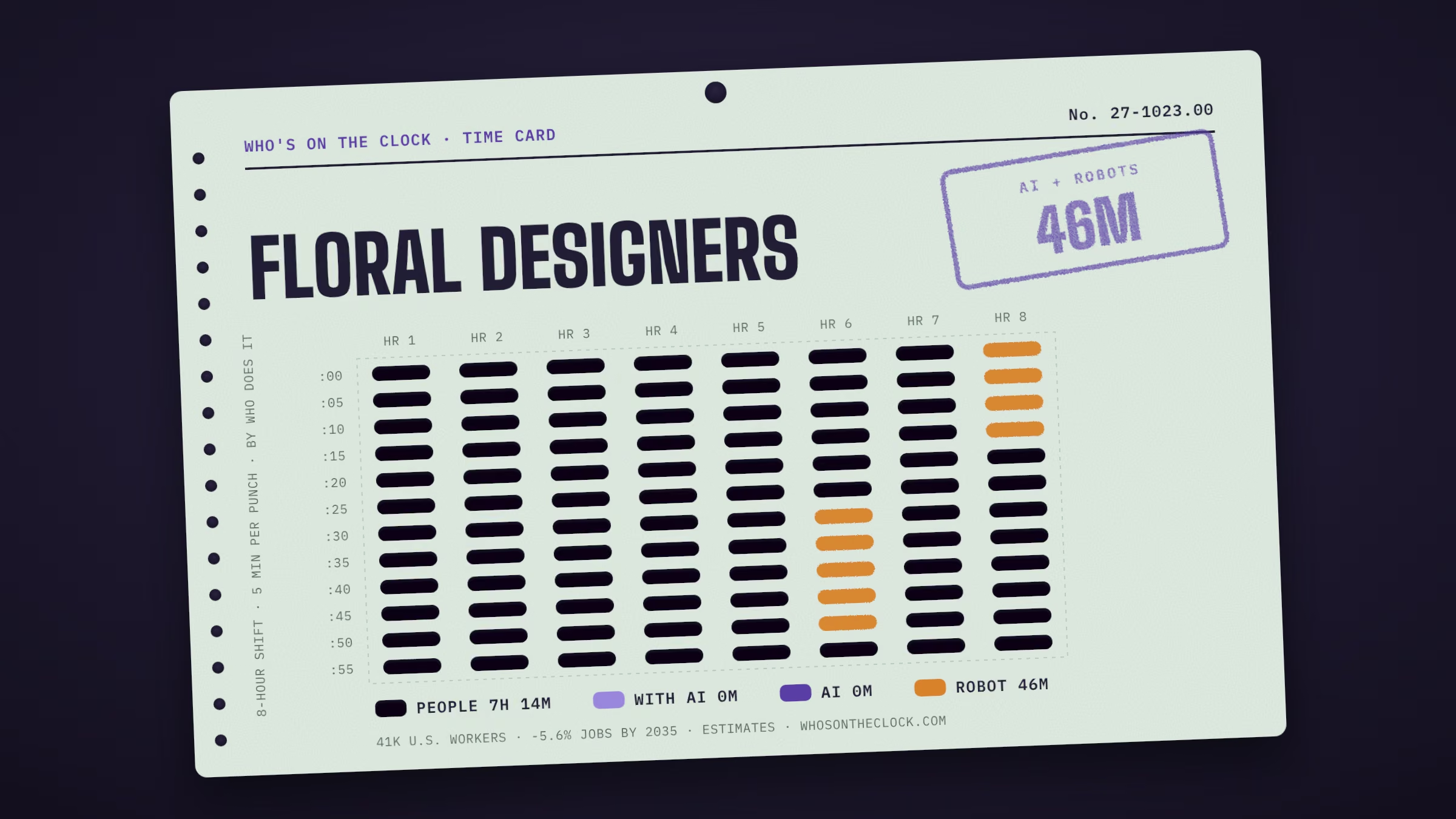
The biggest change here is physical: systems like starship delivery robot have done tasks such as “Deliver arrangements to customers” in real workplaces, about 46m of a typical shift. Most of the rest, 7h 14m, has no AI or robot evidence. BLS expects about 5.6% fewer of these jobs by 2035.

Time card for floral designers showing a typical 8-hour shift: 7h 14m done by people, 46m by robots.
Each mark is 5 minutes of a typical shift for floral designers, colored by who does that task today. Estimates from O*NET tasks and Anthropic Economic Index data. How it's made

Home / Arts, media & sports / Floral Designers

Design, cut, and arrange live, dried, or artificial flowers and foliage.

Time card

Untick tasks you don't do, or set your own times.
MineTask, by time spentHumanWith AIAIRobot
Trim material and arrange bouquets, wreaths, terrariums, and other items, using trimmers, shapers, wire, pins, floral tape, foam, and other materials.2h 10m a shift · No AI or robot evidence found
Why this label?This is physical work, and no robot has been shown doing it yet. How labels work
Confer with clients regarding price and type of arrangement desired and the date, time, and place of delivery.52m a shift · No AI or robot evidence found
Why this label?No AI use or robot deployment showed up for this task in our data. That isn't proof it's safe; it may just be rare in the data. How labels work
Perform office and retail service duties, such as keeping financial records, serving customers, answering telephones, selling giftware items, and receiving payment.45m a shift · No AI or robot evidence found
Why this label?No AI use or robot deployment showed up for this task in our data. That isn't proof it's safe; it may just be rare in the data. How labels work
Select flora and foliage for arrangements, working with numerous combinations to synthesize and develop new creations.39m a shift · No AI or robot evidence found
Why this label?This is physical work, and no robot has been shown doing it yet. How labels work
Plan arrangement according to client's requirements, using knowledge of design and properties of materials, or select appropriate standard design pattern.32m a shift · No AI or robot evidence found
Why this label?No AI use or robot deployment showed up for this task in our data. That isn't proof it's safe; it may just be rare in the data. How labels work
Water plants, and cut, condition, and clean flowers and foliage for storage.32m a shift · Robots only in factory cells
Why this label?Robots have done this only in factory setups built around the machine, so it stays Human for floral designers. How labels work
Deliver arrangements to customers, or oversee employees responsible for deliveries.26m a shift · Robots deployed · e.g. Starship delivery robot
Why this label?Marked Robot because Starship delivery robot (in real use) has done this task in a real workplace. It shows a robot can do it somewhere, not that most floral designers work alongside one. How labels work
Wrap and price completed arrangements.26m a shift · Robots only in factory cells
Why this label?Robots have done this only in factory setups built around the machine, so it stays Human for floral designers. How labels work
Order and purchase flowers and supplies from wholesalers and growers.19m a shift · No AI or robot evidence found
Why this label?No AI use or robot deployment showed up for this task in our data. That isn't proof it's safe; it may just be rare in the data. How labels work
Unpack stock as it comes into the shop.19m a shift · Robots only in factory cells
Why this label?Robots have done this only in factory setups built around the machine, so it stays Human for floral designers. How labels work
Perform general cleaning duties in the store to ensure the shop is clean and tidy.19m a shift · Robots deployed · e.g. Pudu CC1 / CC1 Pro
Why this label?Marked Robot because Pudu CC1 / CC1 Pro (in real use) has done this task in a real workplace. It shows a robot can do it somewhere, not that most floral designers work alongside one. How labels work
Create and change in-store and window displays, designs, and looks to enhance a shop's image.13m a shift · No AI or robot evidence found
Why this label?This is physical work, and no robot has been shown doing it yet. How labels work
Decorate, or supervise the decoration of, buildings, halls, churches, or other facilities for parties, weddings and other occasions.13m a shift · No AI or robot evidence found
Why this label?This is physical work, and no robot has been shown doing it yet. How labels work
Inform customers about the care, maintenance, and handling of various flowers and foliage, indoor plants, and other items.6m a shift · No AI or robot evidence found
Why this label?No AI use or robot deployment showed up for this task in our data. That isn't proof it's safe; it may just be rare in the data. How labels work
Conduct classes or demonstrations, or train other workers.6m a shift · No AI or robot evidence found
Why this label?This is physical work, and no robot has been shown doing it yet. How labels work

Clock history

  1. 46m touchedFirst published: O*NET 30.1, Anthropic Economic Index (2025 usage and September 2026 robot study), BLS May 2025

When new data changes this clock, the date, the new numbers and the reason are logged here. Company news alone never moves the clock.

On the floor

No company news tracked for this job yet. New stories are added as they happen.

Ask the clock

Will AI replace floral designers?

Unlikely, though parts of the work are changing. About 46m of an 8-hour shift goes to tasks touched by robots. The other 7h 14m (90%) stays with people. Separately, BLS expects about 5.6% fewer of these jobs by 2035 (all jobs: +3.5%).

What can AI already do for floral designers?

None of this job's tasks show regular AI use yet. That can mean the work is hands-on or in person, or simply that it rarely comes up in AI usage data.

Where do robots fit in?

For some tasks, yes. Robots have done 2 of this job's tasks in workplaces like this one, about 46m of a typical shift. 3 more tasks have only been done in factory setups built around the machine, so they stay with people here. For 5 physical tasks, no robot has shown it can do the work yet.

  • Deliver arrangements to customers, or oversee employees responsible for deliveries. (26m a shift; e.g. Starship delivery robot, in use)
  • Perform general cleaning duties in the store to ensure the shop is clean and tidy. (19m a shift; e.g. Pudu CC1 / CC1 Pro, in use)
What still needs a person?

7h 14m of a typical shift, or 90%, goes to tasks with no AI or robot evidence yet. No AI usage or robot deployment has shown up for these so far. The biggest:

  • Trim material and arrange bouquets, wreaths, terrariums, and other items, using trimmers, shapers, wire, pins, floral tape, foam, and other materials. (2h 10m a shift)
  • Confer with clients regarding price and type of arrangement desired and the date, time, and place of delivery. (52m a shift)
  • Perform office and retail service duties, such as keeping financial records, serving customers, answering telephones, selling giftware items, and receiving payment. (45m a shift)
  • Select flora and foliage for arrangements, working with numerous combinations to synthesize and develop new creations. (39m a shift)
  • Plan arrangement according to client's requirements, using knowledge of design and properties of materials, or select appropriate standard design pattern. (32m a shift)
Why is that work hard to automate?

Much of it comes down to where and how the work happens. In-person, hands-on and high-stakes work is where AI and robots have made the least headway so far. In the official O*NET survey of people in this job:

  • 97% use their hands on tools, objects or controls more than half the time
  • 94% say dealing with the public is very or extremely important
  • 92% work at arm's length or closer to other people
Are employers still hiring floral designers?

On Indeed, job postings in the Arts & Entertainment sector are at 87% of their February 2020 level (all U.S. postings: 104%), up 12.4% from a year earlier, as of Oct 9, 2026. BLS separately expects about 5,200 openings a year in this job through 2035. Across all U.S. postings, 7.3% now mention AI skills. Sector postings cover more than this one job and move for many reasons besides AI.

How much do floral designers make?

The median pay is about $37,360 a year ($17.96 an hour), 27% below the median for all U.S. jobs ($50,980). Most people in this job earn between $28,600 and $51,000 a year; that range covers the middle 80%. Pay figures are from BLS, May 2025, and vary a lot by state and employer. Pick a state to compare:

Is this job growing or shrinking?

BLS projects a decline of 5.6% from 2025 to 2035, compared with 3.5% growth for all jobs. That's about 43,000 jobs in 2035. Even so, it expects about 5,200 openings a year, mostly from people retiring or changing careers. These projections don't single out AI as a cause.

How many floral designers are there in the U.S.?

About 41,000 people in the U.S., roughly 0.03% of all workers (BLS, May 2025). That makes it the 420th largest of the 796 jobs on this site. BLS expects about 43,000 in 2035.

What training do floral designers need?

The most common requirement is a high school diploma: about 76% of people in the job said so in the official O*NET survey. O*NET rates the job at level 2 of 5 for preparation, which usually means: high school diploma, some training. Requirements vary by state and employer, especially for licensed work.

What should I learn to stay ahead of AI?

These come from the job's official skill ratings and from the tasks that AI and robots touch least today. Building them keeps you strong in the parts of the work that still need a person:

  • Skills that matter more here than in most jobs: Operations Analysis, Active Listening, Service Orientation, Speaking
  • Get strong at the parts of the job that stay with people (listed above), which take 7h 14m of a typical shift
  • Tools employers list: Facebook, Microsoft Excel, Microsoft Office software, Microsoft Outlook, Microsoft PowerPoint
What other jobs could floral designers move into?

These use similar skills. Matches come from 109 official ratings of skills, knowledge and work activities, and each needs the same or less preparation unless the official list relates the jobs directly:

  • Craft Artists (26m touched, $46k median pay)
  • Tailors, Dressmakers, and Custom Sewers (21m touched, $42k median pay)
  • Retail Salespersons (4h 39m touched, $35k median pay)
How solid are these numbers?

Each task carries its own evidence label. For this job: 2 with robots in real deployments, 13 with no AI or robot evidence found. The minutes per task are estimates, not measured hours, and "no evidence" doesn't prove a task is safe.

Tools in demand

  • Facebook

Plus everyday office tools: Microsoft Excel, Microsoft Office software, Microsoft Outlook, Microsoft PowerPoint, Microsoft Word.

Also called

Artificial Foliage Arranger, Corsage Maker, Design Maker, Designer, Floral Arranger, Floral Artist, Floral Assistant, Floral Clerk, Floral Decorator, Floral Department Specialist, Floral Designer, Floral Designer Salesperson, Floral Specialist, Florist