Will AI replace tailors, dressmakers, and custom sewers?

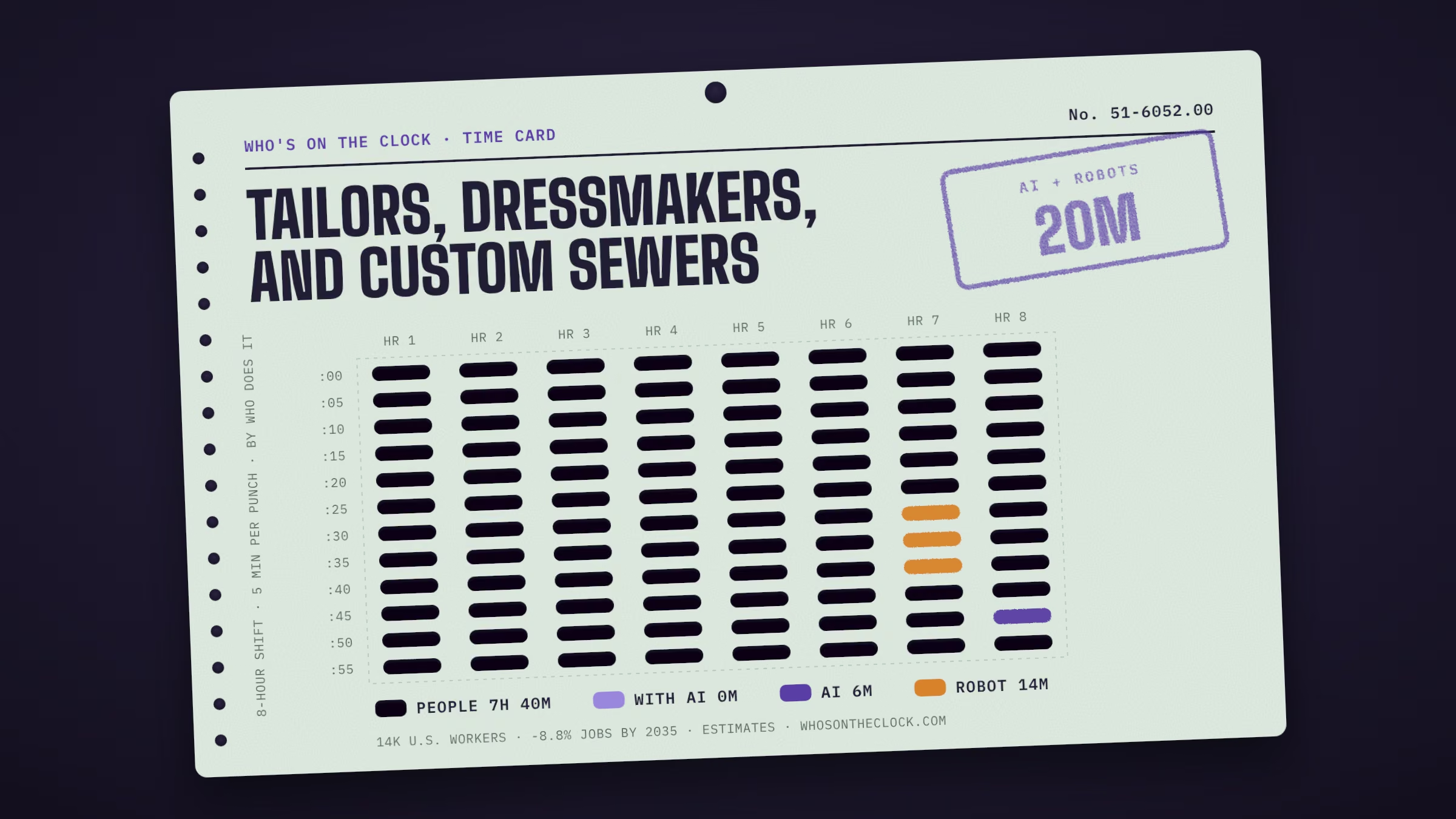
The biggest change here is physical: systems like VITUS Smart XXL 3D body scanner have done tasks such as “Measure customers, using tape measures, and record measurements” in real workplaces, about 14m of a typical shift. Most of the rest, 7h 39m, has no AI or robot evidence. BLS expects about 8.8% fewer of these jobs by 2035.

Time card for tailors, dressmakers, and custom sewers showing a typical 8-hour shift: 7h 39m done by people, 7m by AI, 14m by robots.
Each mark is 5 minutes of a typical shift for tailors, dressmakers, and custom sewers, colored by who does that task today. Estimates from O*NET tasks and Anthropic Economic Index data. How it's made

Home / Production & factory / Tailors, Dressmakers, and Custom Sewers

Design, make, alter, repair, or fit garments.

Time card

Untick tasks you don't do, or set your own times.
MineTask, by time spentHumanWith AIAIRobot
Sew garments, using needles and thread or sewing machines.1h 21m a shift · No AI or robot evidence found
Why this label?This is physical work, and no robot has been shown doing it yet. How labels work
Take up or let down hems to shorten or lengthen garment parts, such as sleeves.47m a shift · No AI or robot evidence found
Why this label?This is physical work, and no robot has been shown doing it yet. How labels work
Repair or replace defective garment parts, such as pockets, zippers, snaps, buttons, and linings.41m a shift · No AI or robot evidence found
Why this label?This is physical work, and no robot has been shown doing it yet. How labels work
Measure parts, such as sleeves or pant legs, and mark or pin-fold alteration lines.34m a shift · No AI or robot evidence found
Why this label?This is physical work, and no robot has been shown doing it yet. How labels work
Let out or take in seams in suits and other garments to improve fit.34m a shift · No AI or robot evidence found
Why this label?This is physical work, and no robot has been shown doing it yet. How labels work
Remove stitches from garments to be altered, using rippers or razor blades.27m a shift · No AI or robot evidence found
Why this label?This is physical work, and no robot has been shown doing it yet. How labels work
Fit and study garments on customers to determine required alterations.27m a shift · No AI or robot evidence found
Why this label?This is physical work, and no robot has been shown doing it yet. How labels work
Assemble garment parts and join parts with basting stitches, using needles and thread or sewing machines.27m a shift · No AI or robot evidence found
Why this label?This is physical work, and no robot has been shown doing it yet. How labels work
Press garments, using hand irons or pressing machines.27m a shift · Robots only in factory cells
Why this label?Robots have done this only in factory setups built around the machine, so it stays Human for tailors, dressmakers, and custom sewers. How labels work
Fit, alter, repair, and make made-to-measure clothing, according to customers' and clothing manufacturers' specifications and fit, and applying principles of garment design, construction, and styling.20m a shift · No AI or robot evidence found
Why this label?This is physical work, and no robot has been shown doing it yet. How labels work
Confer with customers to determine types of material and garment styles desired.20m a shift · No AI or robot evidence found
Why this label?No AI use or robot deployment showed up for this task in our data. That isn't proof it's safe; it may just be rare in the data. How labels work
Measure customers, using tape measures, and record measurements.14m a shift · Robots deployed · e.g. VITUS Smart XXL 3D body scanner (Human Solutions of North America)
Why this label?Marked Robot because VITUS Smart XXL 3D body scanner (Human Solutions of North America) (in real use) has done this task in a real workplace. It shows a robot can do it somewhere, not that most tailors, dressmakers, and custom sewers work alongside one. How labels work
Trim excess material, using scissors.14m a shift · Robots only in factory cells
Why this label?Robots have done this only in factory setups built around the machine, so it stays Human for tailors, dressmakers, and custom sewers. How labels work
Make garment style changes, such as tapering pant legs, narrowing lapels, and adding or removing padding.14m a shift · No AI or robot evidence found
Why this label?This is physical work, and no robot has been shown doing it yet. How labels work
Position patterns of garment parts on fabric, and cut fabric along outlines, using scissors.14m a shift · Robots only in factory cells
Why this label?Robots have done this only in factory setups built around the machine, so it stays Human for tailors, dressmakers, and custom sewers. How labels work
Maintain garment drape and proportions as alterations are performed.7m a shift · No AI or robot evidence found
Why this label?This is physical work, and no robot has been shown doing it yet. How labels work
Estimate how much a garment will cost to make, based on factors such as time and material requirements.7m a shift · No AI or robot evidence found
Why this label?No AI use or robot deployment showed up for this task in our data. That isn't proof it's safe; it may just be rare in the data. How labels work
Record required alterations and instructions on tags, and attach them to garments.7m a shift · Robots only in factory cells
Why this label?Robots have done this only in factory setups built around the machine, so it stays Human for tailors, dressmakers, and custom sewers. How labels work
Examine tags on garments to determine alterations that are needed.7m a shift · Robots only in factory cells
Why this label?Robots have done this only in factory setups built around the machine, so it stays Human for tailors, dressmakers, and custom sewers. How labels work
Develop, copy, or adapt designs for garments, and design patterns to fit measurements, applying knowledge of garment design, construction, styling, and fabric.7m a shift · Observed in AI use
Why this label?Marked AI because this task shows up regularly in real AI conversations (Anthropic Economic Index, 2025 usage), and in most of them AI does the task on its own rather than helping a person. Many workplaces may not use AI for it at all. How labels work
Sew buttonholes and attach buttons to finish garments.7m a shift · Robots only in factory cells
Why this label?Robots have done this only in factory setups built around the machine, so it stays Human for tailors, dressmakers, and custom sewers. How labels work
Put in padding and shaping materials.time not estimated · No AI or robot evidence found
Why this label?This is physical work, and no robot has been shown doing it yet. How labels work

Clock history

  1. 21m touchedFirst published: O*NET 30.1, Anthropic Economic Index (2025 usage and September 2026 robot study), BLS May 2025

When new data changes this clock, the date, the new numbers and the reason are logged here. Company news alone never moves the clock.

On the floor

No company news tracked for this job yet. New stories are added as they happen.

Ask the clock

Will AI replace tailors, dressmakers, and custom sewers?

Not on current evidence. Less than 30 minutes of a typical shift goes to tasks that AI or robots are doing today. The breakdown: 7m that AI mostly does alone, 14m that robots have done in real workplaces. The other 7h 39m (96%) stays with people. Separately, BLS expects about 8.8% fewer of these jobs by 2035 (all jobs: +3.5%).

What can AI already do for tailors, dressmakers, and custom sewers?

AI shows up regularly in 1 of 22 tasks, about 7m of a typical shift. The biggest ones:

  • Develop, copy, or adapt designs for garments, and design patterns to fit measurements, applying knowledge of garment design, construction, styling, and fabric. (7m a shift, AI mostly does it alone)
Where do robots fit in?

For some tasks, yes. Robots have done 1 of this job's tasks in workplaces like this one, about 14m of a typical shift. 6 more tasks have only been done in factory setups built around the machine, so they stay with people here. For 12 physical tasks, no robot has shown it can do the work yet.

  • Measure customers, using tape measures, and record measurements. (14m a shift; e.g. VITUS Smart XXL 3D body scanner (Human Solutions of North America), in use)
What still needs a person?

7h 39m of a typical shift, or 96%, goes to tasks with no AI or robot evidence yet. No AI usage or robot deployment has shown up for these so far. The biggest:

  • Sew garments, using needles and thread or sewing machines. (1h 21m a shift)
  • Take up or let down hems to shorten or lengthen garment parts, such as sleeves. (47m a shift)
  • Repair or replace defective garment parts, such as pockets, zippers, snaps, buttons, and linings. (41m a shift)
  • Measure parts, such as sleeves or pant legs, and mark or pin-fold alteration lines. (34m a shift)
  • Let out or take in seams in suits and other garments to improve fit. (34m a shift)
Why is that work hard to automate?

Much of it comes down to where and how the work happens. In-person, hands-on and high-stakes work is where AI and robots have made the least headway so far. In the official O*NET survey of people in this job:

  • 95% use their hands on tools, objects or controls more than half the time
  • 76% say dealing with the public is very or extremely important
  • 62% work at arm's length or closer to other people
Are employers still hiring tailors, dressmakers, and custom sewers?

On Indeed, job postings in the Production & Manufacturing sector are at 124% of their February 2020 level (all U.S. postings: 104%), up 12.6% from a year earlier, as of Oct 9, 2026. BLS separately expects about 3,700 openings a year in this job through 2035. Across all U.S. postings, 7.3% now mention AI skills. Sector postings cover more than this one job and move for many reasons besides AI.

How much do tailors, dressmakers, and custom sewers make?

The median pay is about $41,640 a year ($20.02 an hour), 18% below the median for all U.S. jobs ($50,980). Most people in this job earn between $29,920 and $63,670 a year; that range covers the middle 80%. Pay figures are from BLS, May 2025, and vary a lot by state and employer. Pick a state to compare:

Is this job growing or shrinking?

BLS projects a decline of 8.8% from 2025 to 2035, compared with 3.5% growth for all jobs. That's about 30,000 jobs in 2035. Even so, it expects about 3,700 openings a year, mostly from people retiring or changing careers. These projections don't single out AI as a cause.

How many tailors, dressmakers, and custom sewers are there in the U.S.?

About 14,000 people in the U.S., roughly 0.01% of all workers (BLS, May 2025). That makes it the 609th largest of the 796 jobs on this site. BLS expects about 30,000 in 2035.

What training do tailors, dressmakers, and custom sewers need?

The most common requirement is a high school diploma: about 58% of people in the job said so in the official O*NET survey. O*NET rates the job at level 2 of 5 for preparation, which usually means: high school diploma, some training. Requirements vary by state and employer, especially for licensed work.

What should I learn to stay ahead of AI?

These come from the job's official skill ratings and from the tasks that AI and robots touch least today. Building them keeps you strong in the parts of the work that still need a person:

  • Skills that matter more here than in most jobs: Time Management, Speaking, Critical Thinking, Active Listening
  • Get strong at the parts of the job that stay with people (listed above), which take 7h 39m of a typical shift
  • Tools employers list: Google Docs, Microsoft Excel, Microsoft Office software, Microsoft Word
  • Learn to use AI well on the tasks where it already shows up in this job (listed above)
What other jobs could tailors, dressmakers, and custom sewers move into?

These use similar skills. Matches come from 109 official ratings of skills, knowledge and work activities, and each needs the same or less preparation unless the official list relates the jobs directly:

  • Hand Sewers (0m touched, $36k median pay)
  • Pressers, Textile, Garment, and Related Materials (40m touched, $35k median pay)
  • Welders, Cutters, Solderers, and Brazers (29m touched, $54k median pay)
  • Sewing Machine Operators (19m touched, $37k median pay)
  • Ophthalmic Laboratory Technicians (40m touched, $39k median pay)
How solid are these numbers?

Each task carries its own evidence label. For this job: 1 observed in real AI use, 1 with robots in real deployments, 20 with no AI or robot evidence found. The minutes per task are estimates, not measured hours, and "no evidence" doesn't prove a task is safe.

Tools in demand

  • Google Docs

Plus everyday office tools: Microsoft Excel, Microsoft Office software, Microsoft Word.

Also called

Alteration Tailor, Alterations Associate, Alterations Expert, Alterations Sewer, Alterations Specialist, Alterations Tailor, Alterations and Tailor Shop Fitter, Alterations and Tailor Shop Sewer, Appliquer, Bridal Designer, Bridal Gown Fitter, Cloth Cutter, Clothing Busheler, Clothing Cutter