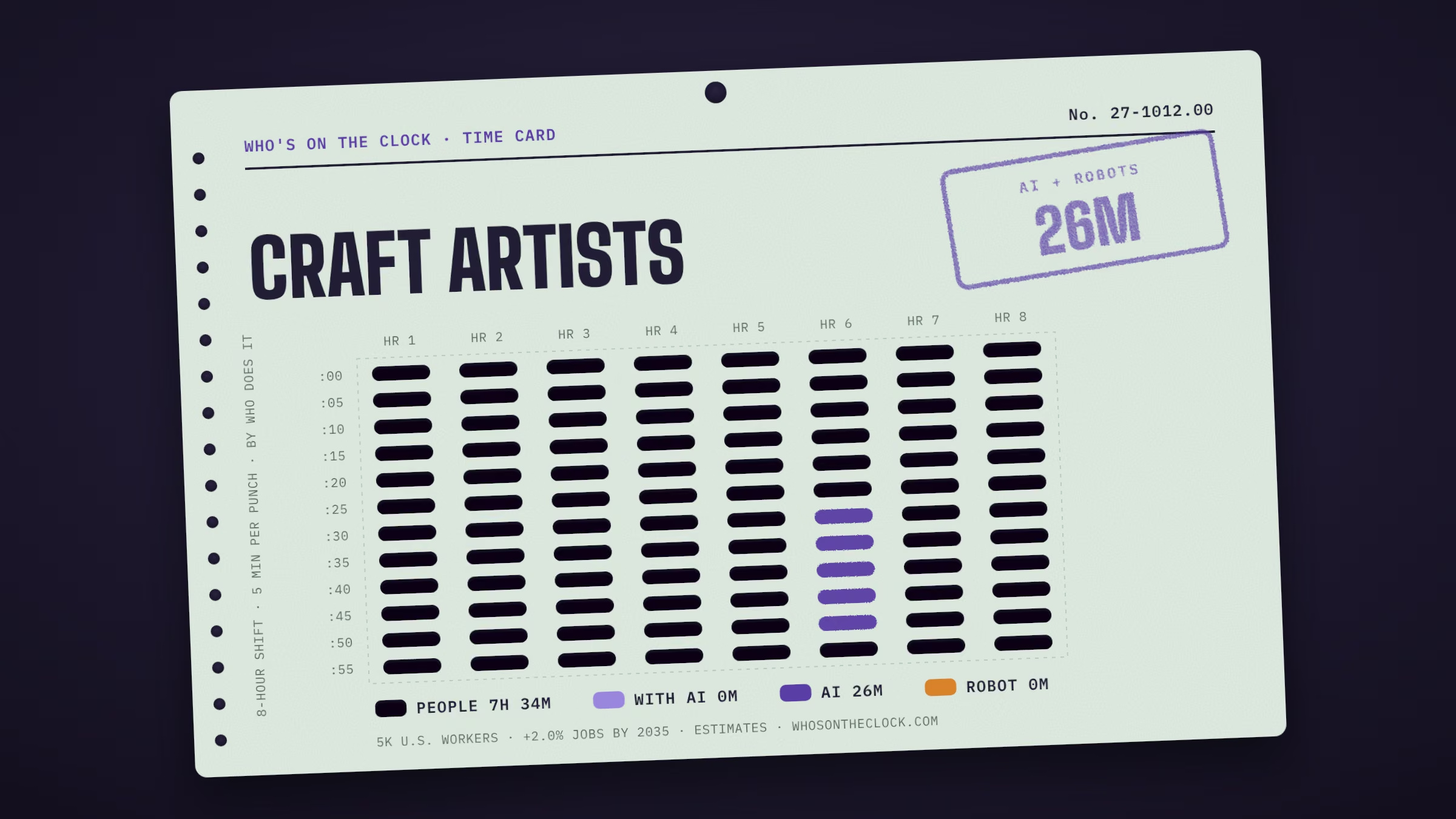
Not on current evidence. Less than 30 minutes of a typical shift goes to tasks that AI or robots are doing today. The other 7h 34m (95%) stays with people. Separately, BLS expects about 2% more of these jobs by 2035 (all jobs: +3.5%).
⤢ Full sizeEach mark is 5 minutes of a typical shift for craft artists, colored by who does that task today. Estimates from O*NET tasks and Anthropic Economic Index data. How it's made
Create or reproduce handmade objects for sale and exhibition using a variety of techniques, such as welding, weaving, pottery, and needlecraft.
Time card
Untick tasks you don't do, or set your own times.
Mine
Task, by time spent
Human
With AI
AI
Robot
Create functional or decorative objects by hand, using a variety of methods and materials.2h 8m a shift · Robots only in factory cells
Cut, shape, fit, join, mold, or otherwise process materials, using hand tools, power tools, or machinery.1h 30m a shift · Robots only in factory cells
Apply finishes to objects being crafted.38m a shift · Robots only in factory cells
Plan and attend craft shows to market products.38m a shift · No AI or robot evidence found
Advertise products and work, using media such as internet advertising and brochures.32m a shift · No AI or robot evidence found
Develop concepts or creative ideas for craft objects.26m a shift · Observed in AI useTypical AI request: about 4h 38m alone, 1h with AI
Confer with customers to assess customer needs or obtain feedback.26m a shift · No AI or robot evidence found
Select materials for use based on strength, color, texture, balance, weight, size, malleability and other characteristics.19m a shift · Robots only in factory cells
Develop product packaging, display, and pricing strategies.19m a shift · No AI or robot evidence found
Sketch or draw objects to be crafted.13m a shift · No AI or robot evidence found
Fabricate patterns or templates to guide craft production.13m a shift · Robots only in factory cells
Create prototypes or models of objects to be crafted.13m a shift · Robots only in factory cells
Research craft trends, venues, and customer buying patterns to inspire designs and marketing strategies.13m a shift · No AI or robot evidence found
Set specifications for materials, dimensions, and finishes.6m a shift · No AI or robot evidence found
Develop designs using specialized computer software.6m a shift · No AI or robot evidence found
Pack products for shipping.time not estimated · No AI or robot evidence found
On the floor
No company news tracked for this job yet. New stories are added as they happen.
Ask the clock
Will AI replace craft artists?
Not on current evidence. Less than 30 minutes of a typical shift goes to tasks that AI or robots are doing today. The other 7h 34m (95%) stays with people. Separately, BLS expects about 2% more of these jobs by 2035 (all jobs: +3.5%).
What can AI already do for craft artists?
AI shows up regularly in 1 of 16 tasks, about 26m of a typical shift. The biggest ones:
Develop concepts or creative ideas for craft objects. (26m a shift, AI mostly does it alone)
Where do robots fit in?
Not in workplaces like this one, based on a 2026 review of robot deployments. 6 more tasks have only been done in factory setups built around the machine, so they stay with people here. For 1 physical task, no robot has shown it can do the work yet.
What still needs a person?
7h 34m of a typical shift, or 95%, goes to tasks with no AI or robot evidence yet. No AI usage or robot deployment has shown up for these so far. The biggest:
Create functional or decorative objects by hand, using a variety of methods and materials. (2h 8m a shift)
Cut, shape, fit, join, mold, or otherwise process materials, using hand tools, power tools, or machinery. (1h 30m a shift)
Apply finishes to objects being crafted. (38m a shift)
Plan and attend craft shows to market products. (38m a shift)
Advertise products and work, using media such as internet advertising and brochures. (32m a shift)
Why is that work hard to automate?
Much of it comes down to where and how the work happens. In-person, hands-on and high-stakes work is where AI and robots have made the least headway so far. In the official O*NET survey of people in this job:
91% use their hands on tools, objects or controls more than half the time
55% say dealing with the public is very or extremely important
How much time does AI save on these tasks?
For the 1 task in this job where AI shows up and timing data exists, a typical request takes about 4h 38m for a person alone and about 1h with AI. These are Claude's own estimates from real conversations in April and May 2026 (Anthropic Economic Index). They describe single requests, not whole workdays, and time saved on a task doesn't mean jobs are cut. The biggest gaps:
Develop concepts or creative ideas for craft objects (about 4h 38m alone, 1h with AI)
Are employers still hiring craft artists?
On Indeed, job postings in the Arts & Entertainment sector are at 87% of their February 2020 level (all U.S. postings: 104%), up 12.4% from a year earlier, as of Oct 9, 2026. BLS separately expects about 1,000 openings a year in this job through 2035. Across all U.S. postings, 7.3% now mention AI skills. Sector postings cover more than this one job and move for many reasons besides AI.
How much do craft artists make?
The median pay is about $46,080 a year ($22.15 an hour), 10% below the median for all U.S. jobs ($50,980). Most people in this job earn between $25,960 and $71,990 a year; that range covers the middle 80%. Pay figures are from BLS, May 2025, and vary a lot by state and employer. Pick a state to compare:
Is this job growing or shrinking?
BLS projects growth of 2% from 2025 to 2035, compared with 3.5% growth for all jobs. That's about 12,000 jobs in 2035. It expects about 1,000 openings a year, mostly from people retiring or changing careers. These projections don't single out AI as a cause.
How many craft artists are there in the U.S.?
About 4,580 people in the U.S., roughly 0.00% of all workers (BLS, May 2025). That makes it the 733rd largest of the 796 jobs on this site. BLS expects about 12,000 in 2035.
What training do craft artists need?
The most common requirement is a high school diploma: about 26% of people in the job said so in the official O*NET survey. O*NET rates the job at level 3 of 5 for preparation, which usually means: vocational school or associate's degree. Requirements vary by state and employer, especially for licensed work.
What should I learn to stay ahead of AI?
These come from the job's official skill ratings and from the tasks that AI and robots touch least today. Building them keeps you strong in the parts of the work that still need a person:
Skills that matter more here than in most jobs: Monitoring, Critical Thinking, Reading Comprehension, Speaking
Get strong at the parts of the job that stay with people (listed above), which take 7h 34m of a typical shift
Tools employers list: Facebook
Learn to use AI well on the tasks where it already shows up in this job (listed above)
What other jobs could craft artists move into?
These use similar skills. Matches come from 109 official ratings of skills, knowledge and work activities, and each needs the same or less preparation unless the official list relates the jobs directly:
Fine Artists, Including Painters, Sculptors, and Illustrators (3h 57m touched, $55k median pay)
Jewelers and Precious Stone and Metal Workers (0m touched, $53k median pay)
Floral Designers (46m touched, $37k median pay)
Etchers and Engravers (14m touched, $43k median pay)
How solid are these numbers?
Each task carries its own evidence label. For this job: 1 observed in real AI use, 15 with no AI or robot evidence found. The minutes per task are estimates, not measured hours, and "no evidence" doesn't prove a task is safe.