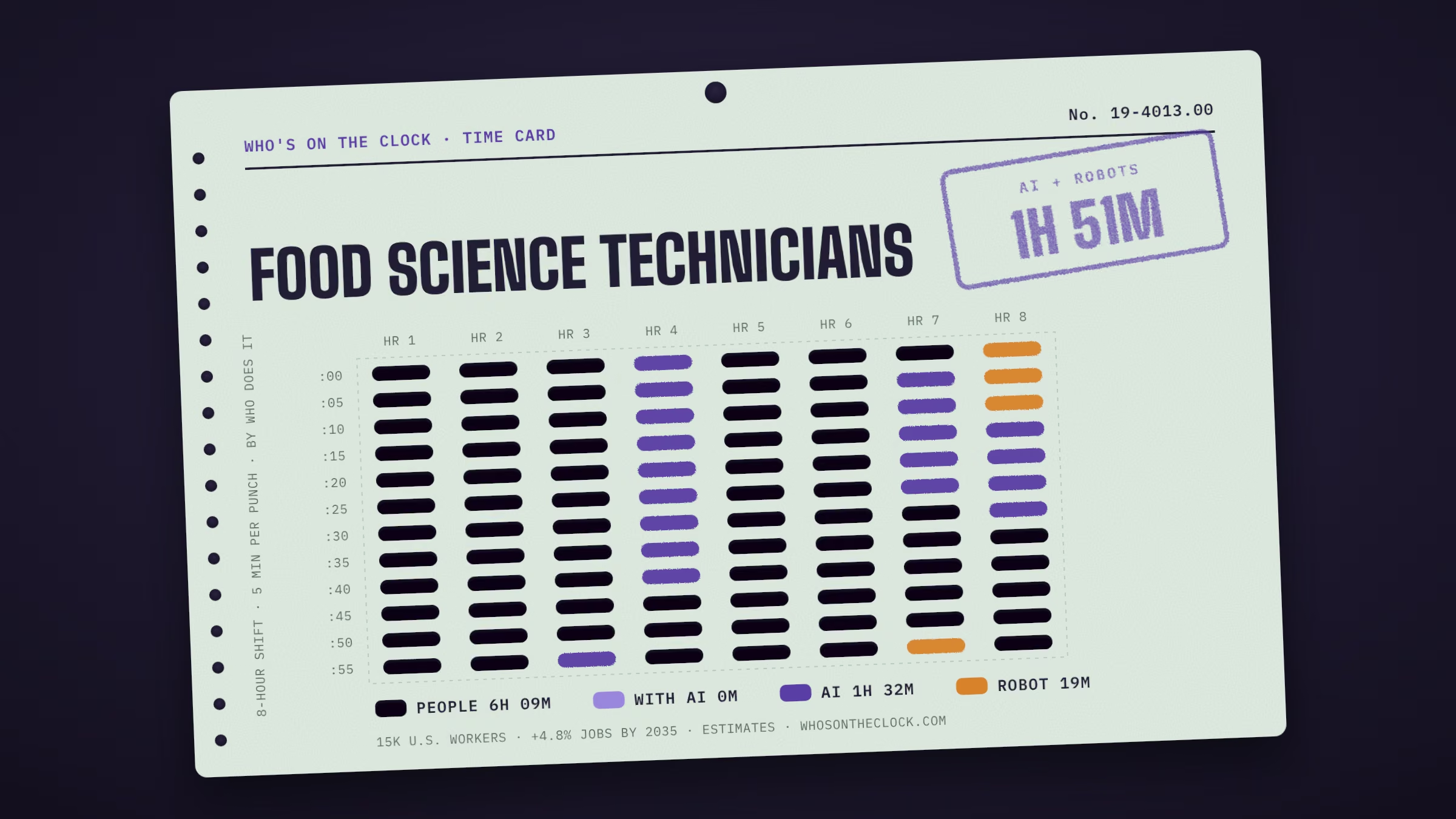
Work with food scientists or technologists to perform standardized qualitative and quantitative tests to determine physical or chemical properties of food or beverage products. Includes technicians who assist in research and development of production technology, quality control, packaging, processing, and use of foods.
Time card
Untick tasks you don't do, or set your own times.
| Mine | Task, by time spent | Human | With AI | AI | Robot |
|---|---|---|---|---|---|
Conduct standardized tests on food, beverages, additives, or preservatives to ensure compliance with standards and regulations regarding factors such as color, texture, or nutrients.2h 3m a shift · Robots only in factory cellsWhy this label?Robots have done this only in factory setups built around the machine, so it stays Human for food science technicians. How labels work | |||||
Record or compile test results or prepare graphs, charts, or reports.49m a shift · No AI or robot evidence foundWhy this label?No AI use or robot deployment showed up for this task in our data. That isn't proof it's safe; it may just be rare in the data. How labels work | |||||
Provide assistance to food scientists or technologists in research and development, production technology, or quality control.49m a shift · Observed in AI useWhy this label?Marked AI because this task shows up regularly in real AI conversations (Anthropic Economic Index, 2025 usage), and in most of them AI does the task on its own rather than helping a person. Many workplaces may not use AI for it at all. How labels work | |||||
Analyze test results to classify products or compare results with standard tables.37m a shift · No AI or robot evidence foundWhy this label?No AI use or robot deployment showed up for this task in our data. That isn't proof it's safe; it may just be rare in the data. How labels work | |||||
Perform regular maintenance of laboratory equipment by inspecting, calibrating, cleaning, or sterilizing.31m a shift · Robots only in factory cellsWhy this label?Robots have done this only in factory setups built around the machine, so it stays Human for food science technicians. How labels work | |||||
Taste or smell foods or beverages to ensure that flavors meet specifications or to select samples with specific characteristics.25m a shift · Robots only in factory cellsWhy this label?Robots have done this only in factory setups built around the machine, so it stays Human for food science technicians. How labels work | |||||
Maintain records of testing results or other documents as required by state or other governing agencies.25m a shift · No AI or robot evidence foundWhy this label?No AI use or robot deployment showed up for this task in our data. That isn't proof it's safe; it may just be rare in the data. How labels work | |||||
Monitor and control temperature of products.25m a shift · Robots only in factory cellsWhy this label?Robots have done this only in factory setups built around the machine, so it stays Human for food science technicians. How labels work | |||||
Compute moisture or salt content, percentages of ingredients, formulas, or other product factors, using mathematical and chemical procedures.25m a shift · Observed in AI useTypical AI request: about 2h 50m alone, 28m with AIWhy this label?Marked AI because this task shows up regularly in real AI conversations (Anthropic Economic Index, 2025 usage), and in most of them AI does the task on its own rather than helping a person. Many workplaces may not use AI for it at all. How labels work | |||||
Mix, blend, or cultivate ingredients to make reagents or to manufacture food or beverage products.25m a shift · Robots only in factory cellsWhy this label?Robots have done this only in factory setups built around the machine, so it stays Human for food science technicians. How labels work | |||||
Measure, test, or weigh bottles, cans, or other containers to ensure that hardness, strength, or dimensions meet specifications.18m a shift · Robots deployed · e.g. CMC-KUHNKE AUTO-XTSWhy this label?Marked Robot because CMC-KUHNKE AUTO-XTS (in real use) has done this task in a real workplace. It shows a robot can do it somewhere, not that most food science technicians work alongside one. How labels work | |||||
Examine chemical or biological samples to identify cell structures or to locate bacteria or extraneous material, using a microscope.18m a shift · Observed in AI useWhy this label?Marked AI because this task shows up regularly in real AI conversations (Anthropic Economic Index, 2025 usage), and in most of them AI does the task on its own rather than helping a person. Many workplaces may not use AI for it at all. How labels work | |||||
Order supplies needed to maintain inventories in laboratories or in storage facilities of food or beverage processing plants.12m a shift · No AI or robot evidence foundWhy this label?No AI use or robot deployment showed up for this task in our data. That isn't proof it's safe; it may just be rare in the data. How labels work | |||||
Train newly hired laboratory personnel.6m a shift · No AI or robot evidence foundWhy this label?No AI use or robot deployment showed up for this task in our data. That isn't proof it's safe; it may just be rare in the data. How labels work | |||||
Supervise other food science technicians.6m a shift · No AI or robot evidence foundWhy this label?No AI use or robot deployment showed up for this task in our data. That isn't proof it's safe; it may just be rare in the data. How labels work | |||||
Prepare or incubate slides with cell cultures.6m a shift · Robots only in factory cellsWhy this label?Robots have done this only in factory setups built around the machine, so it stays Human for food science technicians. How labels work |