Will AI replace agricultural technicians?

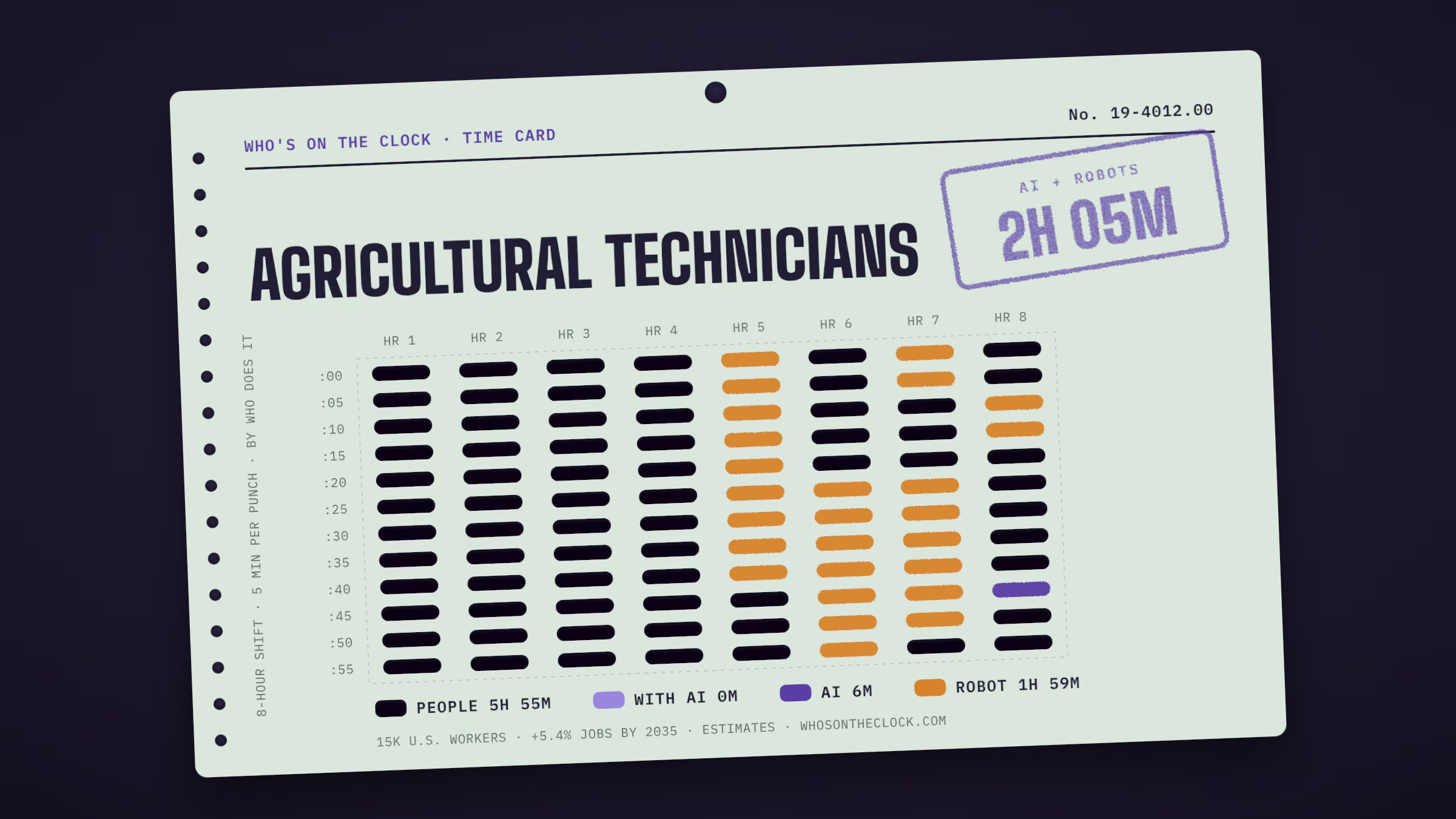
Some tasks are already handled by AI or machines; the rest still needs a person. About 2h 5m of an 8-hour shift goes to tasks that AI or robots largely take over. The breakdown: 6m that AI mostly does alone, 1h 59m that robots have done in real workplaces. The other 5h 55m (74%) stays with people. Separately, BLS expects about 5.4% more of these jobs by 2035 (all jobs: +3.5%).

Time card for agricultural technicians showing a typical 8-hour shift: 5h 55m done by people, 6m by AI, 1h 59m by robots.
Each mark is 5 minutes of a typical shift for agricultural technicians, colored by who does that task today. Estimates from O*NET tasks and Anthropic Economic Index data. How it's made

Home / Science / Agricultural Technicians

Work with agricultural scientists in plant, fiber, and animal research, or assist with animal breeding and nutrition. Set up or maintain laboratory equipment and collect samples from crops or animals. Prepare specimens or record data to assist scientists in biology or related life science experiments. Conduct tests and experiments to improve yield and quality of crops or to increase the resistance of plants and animals to disease or insects.

Time card

Untick tasks you don't do, or set your own times.
MineTask, by time spentHumanWith AIAIRobot
Record data pertaining to experimentation, research, or animal care.50m a shift · No AI or robot evidence found
Perform crop production duties, such as tilling, hoeing, pruning, weeding, or harvesting crops.37m a shift · Robots only in factory cells
Collect animal or crop samples.37m a shift · Robots only in factory cells
Maintain or repair agricultural facilities, equipment, or tools to ensure operational readiness, safety, and cleanliness.31m a shift · No AI or robot evidence found
Prepare laboratory samples for analysis, following proper protocols to ensure that they will be stored, prepared, and disposed of efficiently and effectively.31m a shift · Robots only in factory cells
Prepare data summaries, reports, or analyses that include results, charts, or graphs to document research findings and results.31m a shift · No AI or robot evidence found
Perform laboratory or field testing, using spectrometers, nitrogen determination apparatus, air samplers, centrifuges, or potential hydrogen (pH) meters to perform tests.31m a shift · Robots only in factory cells
Operate farm machinery, including tractors, plows, mowers, combines, balers, sprayers, earthmoving equipment, or trucks.25m a shift · Robots deployed · e.g. SwarmBot
Examine animals or crop specimens to determine the presence of diseases or other problems.19m a shift · Robots deployed · e.g. Solix robot (Solinftec)
Set up laboratory or field equipment as required for site testing.19m a shift · No AI or robot evidence found
Supervise or train agricultural technicians or farm laborers.19m a shift · No AI or robot evidence found
Prepare land for cultivated crops, orchards, or vineyards by plowing, discing, leveling, or contouring.12m a shift · Robots deployed · e.g. John Deere autonomous tillage (Autonomy Precision Upgrade, Operations Center Mobile)
Conduct studies of nitrogen or alternative fertilizer application methods, quantities, or timing to ensure satisfaction of crop needs and minimization of leaching, runoff, or denitrification.12m a shift · Robots deployed · e.g. Rogo SmartCore autonomous soil sampler
Measure or weigh ingredients used in laboratory testing.12m a shift · Robots deployed · e.g. Rothamsted plant material dispenser and liquid handling system
Perform tests on seeds to evaluate seed viability.12m a shift · Robots only in factory cells
Supervise pest or weed control operations, including locating and identifying pests or weeds, selecting chemicals and application methods, or scheduling application.12m a shift · Robots deployed · e.g. Solix Ag Robotics platform
Conduct insect or plant disease surveys.12m a shift · Robots deployed · e.g. PATS-C / PATS-X
Perform general nursery duties, such as propagating standard varieties of plant materials, collecting and germinating seeds, maintaining cuttings of plants, or controlling environmental conditions.12m a shift · Robots only in factory cells
Record environmental data from field samples of soil, air, water, or pests to monitor the effectiveness of integrated pest management (IPM) practices.12m a shift · Robots deployed · e.g. Solix (Solinftec)
Transplant trees, vegetables, or horticultural plants.12m a shift · Robots only in factory cells
Devise cultural methods or environmental controls for plants for which guidelines are sketchy or nonexistent.6m a shift · No AI or robot evidence found
Determine the germination rates of seeds planted in specified areas.6m a shift · Robots only in factory cells
Prepare culture media, following standard procedures.6m a shift · Robots only in factory cells
Respond to general inquiries or requests from the public.6m a shift · Observed in AI use
Prepare or present agricultural demonstrations.6m a shift · No AI or robot evidence found
Assess comparative soil erosion from various planting or tillage systems, such as conservation tillage with mulch or ridge till systems, no-till systems, or conventional tillage systems with or without moldboard plows.6m a shift · Robots only in factory cells

On the floor

No company news tracked for this job yet. New stories are added as they happen.

Ask the clock

Will AI replace agricultural technicians?

Some tasks are already handled by AI or machines; the rest still needs a person. About 2h 5m of an 8-hour shift goes to tasks that AI or robots largely take over. The breakdown: 6m that AI mostly does alone, 1h 59m that robots have done in real workplaces. The other 5h 55m (74%) stays with people. Separately, BLS expects about 5.4% more of these jobs by 2035 (all jobs: +3.5%).

What can AI already do for agricultural technicians?

AI shows up regularly in 1 of 26 tasks, about 6m of a typical shift. The biggest ones:

  • Respond to general inquiries or requests from the public. (6m a shift, AI mostly does it alone)
Where do robots fit in?

For some tasks, yes. Robots have done 8 of this job's tasks in workplaces like this one, about 1h 59m of a typical shift. 10 more tasks have only been done in factory setups built around the machine, so they stay with people here. For 3 physical tasks, no robot has shown it can do the work yet.

  • Operate farm machinery, including tractors, plows, mowers, combines, balers, sprayers, earthmoving equipment, or trucks. (25m a shift; e.g. SwarmBot, in use)
  • Examine animals or crop specimens to determine the presence of diseases or other problems. (19m a shift; e.g. Solix robot (Solinftec), in use)
  • Prepare land for cultivated crops, orchards, or vineyards by plowing, discing, leveling, or contouring. (12m a shift; e.g. John Deere autonomous tillage (Autonomy Precision Upgrade, Operations Center Mobile), in use)
  • Conduct studies of nitrogen or alternative fertilizer application methods, quantities, or timing to ensure satisfaction of crop needs and minimization of leaching, runoff, or denitrification. (12m a shift; e.g. Rogo SmartCore autonomous soil sampler, in use)
What still needs a person?

5h 55m of a typical shift, or 74%, goes to tasks with no AI or robot evidence yet. No AI usage or robot deployment has shown up for these so far. The biggest:

  • Record data pertaining to experimentation, research, or animal care. (50m a shift)
  • Perform crop production duties, such as tilling, hoeing, pruning, weeding, or harvesting crops. (37m a shift)
  • Collect animal or crop samples. (37m a shift)
  • Maintain or repair agricultural facilities, equipment, or tools to ensure operational readiness, safety, and cleanliness. (31m a shift)
  • Prepare laboratory samples for analysis, following proper protocols to ensure that they will be stored, prepared, and disposed of efficiently and effectively. (31m a shift)
Why is that work hard to automate?

Much of it comes down to where and how the work happens. In-person, hands-on and high-stakes work is where AI and robots have made the least headway so far. In the official O*NET survey of people in this job:

  • 94% use their hands on tools, objects or controls more than half the time
  • 76% talk face to face with others every day
  • 57% work in very hot or cold conditions at least weekly
Are employers still hiring agricultural technicians?

On Indeed, job postings in the Scientific Research & Development sector are at 84% of their February 2020 level (all U.S. postings: 104%), up 19.9% from a year earlier, as of Oct 9, 2026. BLS separately expects about 2,800 openings a year in this job through 2035. Across all U.S. postings, 7.3% now mention AI skills. Sector postings cover more than this one job and move for many reasons besides AI.

How much do agricultural technicians make?

The median pay is about $49,630 a year ($23.86 an hour), 3% below the median for all U.S. jobs ($50,980). Most people in this job earn between $35,980 and $76,480 a year; that range covers the middle 80%. Pay figures are from BLS, May 2025, and vary a lot by state and employer. Pick a state to compare:

Is this job growing or shrinking?

BLS projects growth of 5.4% from 2025 to 2035, compared with 3.5% growth for all jobs. That's about 21,000 jobs in 2035. It expects about 2,800 openings a year, mostly from people retiring or changing careers. These projections don't single out AI as a cause.

How many agricultural technicians are there in the U.S.?

About 15,000 people in the U.S., roughly 0.01% of all workers (BLS, May 2025). That makes it the 591st largest of the 796 jobs on this site. BLS expects about 21,000 in 2035.

What training do agricultural technicians need?

The most common requirement is a high school diploma: about 41% of people in the job said so in the official O*NET survey. O*NET rates the job at level 3 of 5 for preparation, which usually means: vocational school or associate's degree. Requirements vary by state and employer, especially for licensed work.

What should I learn to stay ahead of AI?

These come from the job's official skill ratings and from the tasks that AI and robots touch least today. Building them keeps you strong in the parts of the work that still need a person:

  • Skills that matter more here than in most jobs: Operations Monitoring, Instructing, Active Learning, Writing
  • Get strong at the parts of the job that stay with people (listed above), which take 5h 55m of a typical shift
  • Tools employers list: Microsoft Office software, Microsoft Excel, Microsoft Access, Microsoft Outlook, Microsoft PowerPoint
  • Learn to use AI well on the tasks where it already shows up in this job (listed above)
What other jobs could agricultural technicians move into?

These use similar skills. Matches come from 109 official ratings of skills, knowledge and work activities, and each needs the same or less preparation unless the official list relates the jobs directly:

  • Agricultural Engineers (55m touched, $99k median pay)
  • Biological Technicians (2h 46m touched, $58k median pay)
  • Farmers, Ranchers, and Other Agricultural Managers (2h 27m touched, $90k median pay)
  • Precision Agriculture Technicians (56m touched, $50k median pay)
  • Food Science Technicians (1h 51m touched, $52k median pay)
How solid are these numbers?

Each task carries its own evidence label. For this job: 1 observed in real AI use, 8 with robots in real deployments, 17 with no AI or robot evidence found. The minutes per task are estimates, not measured hours, and "no evidence" doesn't prove a task is safe.

Tools in demand

  • Microsoft Office software
  • Microsoft Excel
  • Microsoft Access
  • Microsoft Outlook
  • Microsoft PowerPoint
  • Microsoft Word
  • SAP software

Also called

Acidity Tester, Agricultural Assistant, Agricultural Equipment Technician, Agricultural Research Technician (Agricultural Research Tech), Agricultural Research Technologist, Agricultural Service Technician, Agricultural Specialist, Agricultural Technician (Agricultural Tech), Agriculture Assistant, Agriculture Field Technician (Agriculture Field Tech), Agriculture Research Lab Assistant (Agriculture Research Laboratory Assistant), Agriculture Technician (Agriculture Tech), Agronomy Research Technician (Agronomy Research Tech), Agronomy Technician (Agronomy Tech)