Will AI replace forest and conservation technicians?

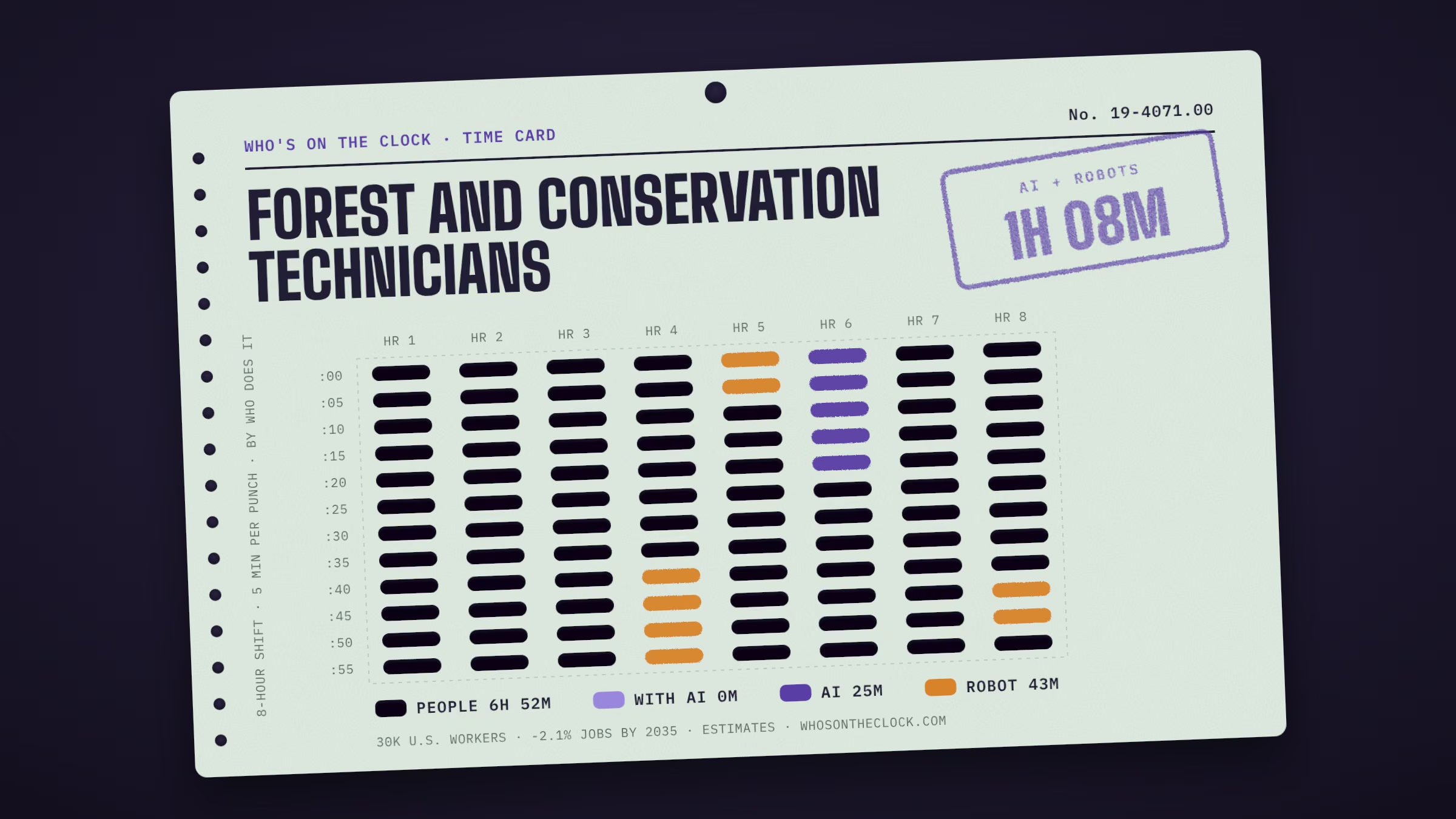
Not replace, but it is changing the job. About 1h 8m of an 8-hour shift goes to tasks touched by robots. The breakdown: 25m that AI mostly does alone, 43m that robots have done in real workplaces. The other 6h 52m (86%) stays with people. Separately, BLS expects about 2.1% fewer of these jobs by 2035 (all jobs: +3.5%).

Time card for forest and conservation technicians showing a typical 8-hour shift: 6h 52m done by people, 25m by AI, 43m by robots.
Each mark is 5 minutes of a typical shift for forest and conservation technicians, colored by who does that task today. Estimates from O*NET tasks and Anthropic Economic Index data. How it's made

Home / Science / Forest and Conservation Technicians

Provide technical assistance regarding the conservation of soil, water, forests, or related natural resources. May compile data pertaining to size, content, condition, and other characteristics of forest tracts under the direction of foresters, or train and lead forest workers in forest propagation and fire prevention and suppression. May assist conservation scientists in managing, improving, and protecting rangelands and wildlife habitats.

Time card

Untick tasks you don't do, or set your own times.
MineTask, by time spentHumanWith AIAIRobot
Manage forest protection activities, including fire control, fire crew training, and coordination of fire detection and public education programs.43m a shift · No AI or robot evidence found
Thin and space trees and control weeds and undergrowth, using manual tools and chemicals, or supervise workers performing these tasks.37m a shift · No AI or robot evidence found
Train and lead forest and conservation workers in seasonal activities, such as planting tree seedlings, putting out forest fires, and maintaining recreational facilities.37m a shift · No AI or robot evidence found
Map forest tract data using digital mapping systems.37m a shift · No AI or robot evidence found
Perform reforestation or forest renewal, including nursery and silviculture operations, site preparation, seeding and tree planting programs, cone collection, and tree improvement.37m a shift · Robots only in factory cells
Survey, measure, and map access roads and forest areas such as burns, cut-over areas, experimental plots, and timber sales sections.37m a shift · No AI or robot evidence found
Patrol park or forest areas to protect resources and prevent damage.31m a shift · Robots deployed · e.g. Knightscope K5 Autonomous Security Robot
Provide information about, and enforce, regulations, such as those concerning environmental protection, resource utilization, fire safety, and accident prevention.25m a shift · No AI or robot evidence found
Select and mark trees for thinning or logging, drawing detailed plans that include access roads.25m a shift · No AI or robot evidence found
Develop and maintain computer databases.25m a shift · Observed in AI use
Provide forestry education and general information, advice, and recommendations to woodlot owners, community organizations, and the general public.25m a shift · No AI or robot evidence found
Monitor activities of logging companies and contractors.18m a shift · No AI or robot evidence found
Supervise forest nursery operations, timber harvesting, land use activities such as livestock grazing, and disease or insect control programs.18m a shift · No AI or robot evidence found
Inspect trees and collect samples of plants, seeds, foliage, bark, and roots to locate insect and disease damage.18m a shift · No AI or robot evidence found
Plan and supervise construction of access routes and forest roads.12m a shift · No AI or robot evidence found
Measure distances, clean sightlines, and record data to help survey crews.12m a shift · No AI or robot evidence found
Issue fire permits, timber permits, and other forest use licenses.12m a shift · No AI or robot evidence found
Provide technical support to forestry research programs in areas such as tree improvement, seed orchard operations, insect and disease surveys, or experimental forestry and forest engineering research.12m a shift · No AI or robot evidence found
Conduct laboratory or field experiments with plants, animals, insects, diseases, and soils.12m a shift · Robots deployed · e.g. TerraSentia (EarthSense, Inc.)
Keep records of the amount and condition of logs taken to mills.6m a shift · No AI or robot evidence found

On the floor

No company news tracked for this job yet. New stories are added as they happen.

Ask the clock

Will AI replace forest and conservation technicians?

Not replace, but it is changing the job. About 1h 8m of an 8-hour shift goes to tasks touched by robots. The breakdown: 25m that AI mostly does alone, 43m that robots have done in real workplaces. The other 6h 52m (86%) stays with people. Separately, BLS expects about 2.1% fewer of these jobs by 2035 (all jobs: +3.5%).

What parts of the job can AI already do?

AI shows up regularly in 1 of 20 tasks, about 25m of a typical shift. The biggest ones:

  • Develop and maintain computer databases. (25m a shift, AI mostly does it alone)
Can a robot do this job?

For some tasks, yes. Robots have done 2 of this job's tasks in workplaces like this one, about 43m of a typical shift. 1 more task has only been done in factory setups built around the machine, so it stays with people here. For 9 physical tasks, no robot has shown it can do the work yet.

  • Patrol park or forest areas to protect resources and prevent damage. (31m a shift; e.g. Knightscope K5 Autonomous Security Robot, in use)
  • Conduct laboratory or field experiments with plants, animals, insects, diseases, and soils. (12m a shift; e.g. TerraSentia (EarthSense, Inc.), in use)
What parts of the job are still done by people?

6h 52m of a typical shift, or 86%, goes to tasks with no AI or robot evidence yet. No AI usage or robot deployment has shown up for these so far. The biggest:

  • Manage forest protection activities, including fire control, fire crew training, and coordination of fire detection and public education programs. (43m a shift)
  • Thin and space trees and control weeds and undergrowth, using manual tools and chemicals, or supervise workers performing these tasks. (37m a shift)
  • Train and lead forest and conservation workers in seasonal activities, such as planting tree seedlings, putting out forest fires, and maintaining recreational facilities. (37m a shift)
  • Map forest tract data using digital mapping systems. (37m a shift)
  • Perform reforestation or forest renewal, including nursery and silviculture operations, site preparation, seeding and tree planting programs, cone collection, and tree improvement. (37m a shift)
Why does a person still do this work?

Part of the answer is the setting, not just the tasks. Work that is in person, hands on or high stakes is where AI and robots have made the least headway so far. In the official O*NET survey of people in this job:

  • 98% talk face to face with others every day
  • 73% carry high or very high responsibility for other workers' safety
  • 69% say dealing with the public is very or extremely important
Are employers still hiring for this job?

On Indeed, job postings in the Scientific Research & Development sector are at 84% of their February 2020 level (all U.S. postings: 104%), up 19.9% from a year earlier, as of Oct 9, 2026. BLS separately expects about 3,800 openings a year in this job through 2035. Across all U.S. postings, 7.3% now mention AI skills. Sector postings cover more than this one job and move for many reasons besides AI.

How much do forest and conservation technicians make?

The median pay is about $54,560 a year ($26.23 an hour), 7% above the median for all U.S. jobs ($50,980). Most people in this job earn between $40,330 and $83,630 a year; that range covers the middle 80%. Pay figures are from BLS, May 2025, and vary a lot by state and employer. Pick a state to compare:

Is this job growing or shrinking?

BLS projects a decline of 2.1% from 2025 to 2035, compared with 3.5% growth for all jobs. That's about 32,000 jobs in 2035. Even so, it expects about 3,800 openings a year, mostly from people retiring or changing careers. These projections don't single out AI as a cause.

How many people do this job?

About 30,000 people in the U.S., roughly 0.02% of all workers (BLS, May 2025). That makes it the 479th largest of the 796 jobs on this site. BLS expects about 32,000 in 2035.

What do you need to become one?

The most common requirement is a high school diploma: about 35% of people in the job said so in the official O*NET survey. O*NET rates the job at level 3 of 5 for preparation, which usually means: vocational school or associate's degree. Requirements vary by state and employer, especially for licensed work.

What should I learn to stay ahead?

These come from the job's official skill ratings and from the tasks that AI and robots touch least today. Building them keeps you strong in the parts of the work that still need a person:

  • Skills that matter more here than in most jobs: Systems Analysis, Critical Thinking, Instructing, Time Management
  • Get strong at the parts of the job that stay with people (listed above), which take 6h 52m of a typical shift
  • Tools employers list: Microsoft Office software, ESRI ArcGIS software, Facebook, Microsoft Access, Microsoft Active Server Pages ASP
  • Learn to use AI well on the tasks where it already shows up in this job (listed above)
Are there new tasks in this job?

Yes. Occupational experts recently added these to the official task list, a sign of how the work itself is shifting. New tasks aren't rated for AI or robots yet:

  • Develop contracts related to operations.
  • Monitor environmental conditions such as temperature or humidity.
  • Operate and manage drone technology for aerial surveys and mapping, wildlife monitoring, and forest health assessments.
  • Write reports on forestry or conservation activities.
What similar jobs could I move into?

These use similar skills, with less of a typical shift touched by AI or robots. Matches come from 109 official ratings of skills, knowledge and work activities, and each needs the same or less preparation unless the official list relates the jobs directly:

  • Range Managers (19m touched, $73k median pay)
  • Conservation Scientists (18m touched, $73k median pay)
How solid are these numbers?

Each task carries its own evidence label. For this job: 1 observed in real AI use, 2 with robots in real deployments, 17 with no AI or robot evidence found. The minutes per task are estimates, not measured hours, and "no evidence" doesn't prove a task is safe.

Tools in demand

  • Microsoft Office software
  • ESRI ArcGIS software
  • Facebook
  • Microsoft Access
  • Microsoft Active Server Pages ASP
  • Microsoft Excel
  • Microsoft Outlook
  • Microsoft PowerPoint

Also called

Biological Science Aide, Conservation Agent, Conservation Officer, Conservation Technician, Field Technician (Field Tech), Forest Technician, Forester Aide, Forestry Aid Technician, Forestry Aide, Forestry Aide Technician, Forestry Technician (Forestry Tech), Grazing Aide, Grazing Examiner, Natural Resources Technician