Will AI replace general and operations managers?

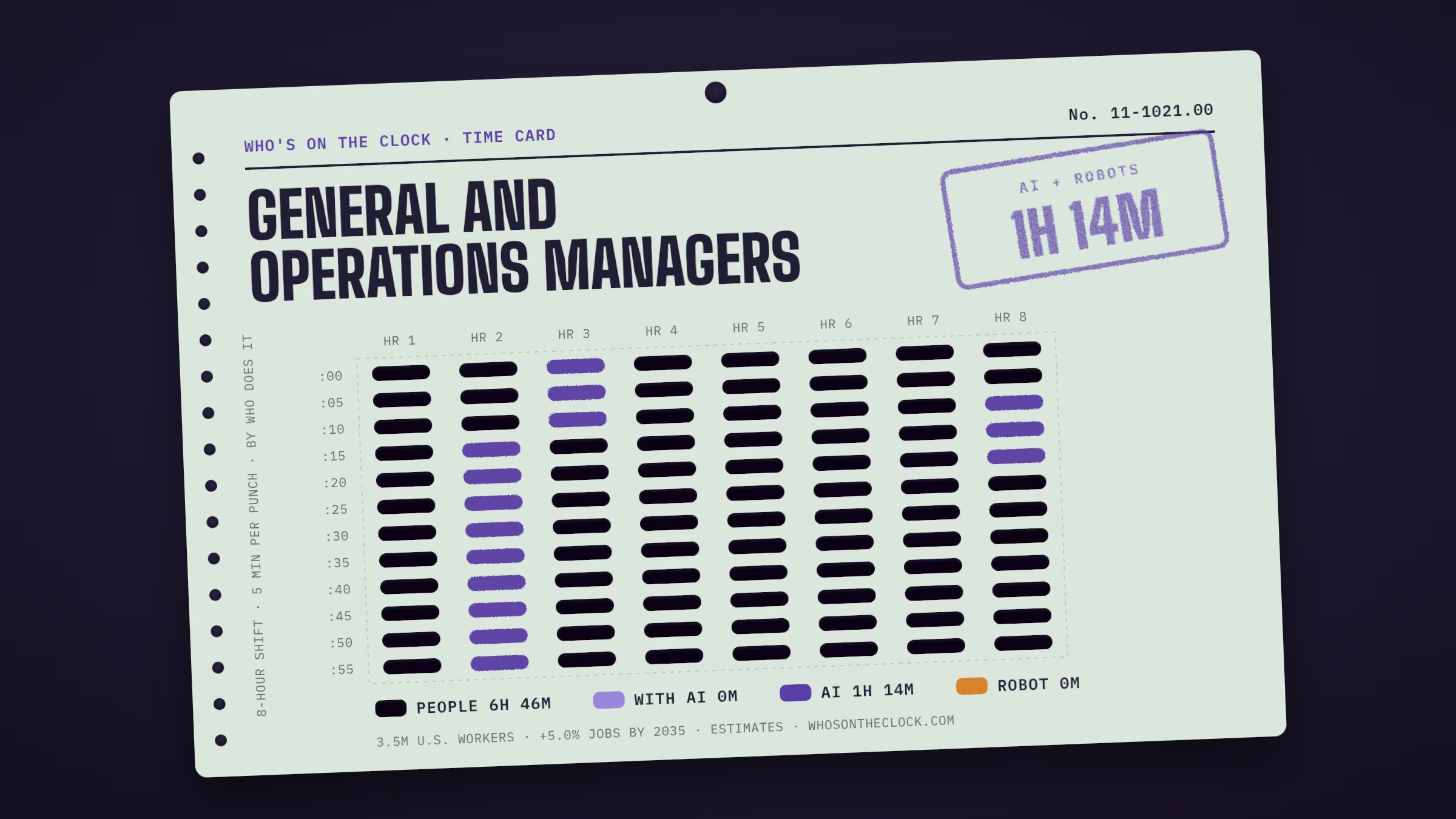
AI already handles some of this work on its own in real use, for tasks like “Review financial statements, sales or activity reports”. That's 1h 14m of a typical shift; 6h 46m still has no AI or robot evidence. BLS expects about 5% more of these jobs by 2035.

Time card for general and operations managers showing a typical 8-hour shift: 6h 46m done by people, 1h 14m by AI.
Each mark is 5 minutes of a typical shift for general and operations managers, colored by who does that task today. Estimates from O*NET tasks and Anthropic Economic Index data. How it's made

Home / Management / General and Operations Managers

Plan, direct, or coordinate the operations of public or private sector organizations, overseeing multiple departments or locations. Duties and responsibilities include formulating policies, managing daily operations, and planning the use of materials and human resources, but are too diverse and general in nature to be classified in any one functional area of management or administration, such as personnel, purchasing, or administrative services. Usually manage through subordinate supervisors. Excludes First-Line Supervisors.

Time card

Untick tasks you don't do, or set your own times.
MineTask, by time spentHumanWith AIAIRobot
Direct and coordinate activities of businesses or departments concerned with the production, pricing, sales, or distribution of products.1h 14m a shift · No AI or robot evidence found
Why this label?No AI use or robot deployment showed up for this task in our data. That isn't proof it's safe; it may just be rare in the data. How labels work
Review financial statements, sales or activity reports, or other performance data to measure productivity or goal achievement or to identify areas needing cost reduction or program improvement.58m a shift · Observed in AI useTypical AI request: about 6h 59m alone, 58m with AI
Why this label?Marked AI because this task shows up regularly in real AI conversations (Anthropic Economic Index, 2025 usage), and in most of them AI does the task on its own rather than helping a person. Many workplaces may not use AI for it at all. How labels work
Direct administrative activities directly related to making products or providing services.58m a shift · No AI or robot evidence found
Why this label?No AI use or robot deployment showed up for this task in our data. That isn't proof it's safe; it may just be rare in the data. How labels work
Perform personnel functions, such as selection, training, or evaluation.47m a shift · No AI or robot evidence found
Why this label?No AI use or robot deployment showed up for this task in our data. That isn't proof it's safe; it may just be rare in the data. How labels work
Direct or coordinate financial or budget activities to fund operations, maximize investments, or increase efficiency.42m a shift · No AI or robot evidence found
Why this label?No AI use or robot deployment showed up for this task in our data. That isn't proof it's safe; it may just be rare in the data. How labels work
Establish or implement departmental policies, goals, objectives, or procedures in conjunction with board members, organization officials, or staff members.37m a shift · No AI or robot evidence found
Why this label?No AI use or robot deployment showed up for this task in our data. That isn't proof it's safe; it may just be rare in the data. How labels work
Prepare staff work schedules and assign specific duties.32m a shift · No AI or robot evidence found
Why this label?No AI use or robot deployment showed up for this task in our data. That isn't proof it's safe; it may just be rare in the data. How labels work
Plan or direct activities, such as sales promotions, that require coordination with other department managers.26m a shift · No AI or robot evidence found
Why this label?No AI use or robot deployment showed up for this task in our data. That isn't proof it's safe; it may just be rare in the data. How labels work
Monitor suppliers to ensure that they efficiently and effectively provide needed goods or services within budgetary limits.21m a shift · No AI or robot evidence found
Why this label?No AI use or robot deployment showed up for this task in our data. That isn't proof it's safe; it may just be rare in the data. How labels work
Manage the movement of goods into and out of production facilities to ensure efficiency, effectiveness, or sustainability of operations.16m a shift · No AI or robot evidence found
Why this label?No AI use or robot deployment showed up for this task in our data. That isn't proof it's safe; it may just be rare in the data. How labels work
Perform sales floor work, such as greeting or assisting customers, stocking shelves, or taking inventory.16m a shift · Robots only in factory cells
Why this label?Robots have done this only in factory setups built around the machine, so it stays Human for general and operations managers. How labels work
Develop or implement product-marketing strategies, including advertising campaigns or sales promotions.16m a shift · Observed in AI useTypical AI request: about 10h 50m alone, 1h 7m with AI
Why this label?Marked AI because this task shows up regularly in real AI conversations (Anthropic Economic Index, 2025 usage), and in most of them AI does the task on its own rather than helping a person. Many workplaces may not use AI for it at all. How labels work
Set prices or credit terms for goods or services, based on forecasts of customer demand.11m a shift · No AI or robot evidence found
Why this label?No AI use or robot deployment showed up for this task in our data. That isn't proof it's safe; it may just be rare in the data. How labels work
Direct non-merchandising departments of businesses, such as advertising or purchasing.11m a shift · No AI or robot evidence found
Why this label?No AI use or robot deployment showed up for this task in our data. That isn't proof it's safe; it may just be rare in the data. How labels work
Implement or oversee environmental management or sustainability programs addressing issues such as recycling, conservation, or waste management.5m a shift · No AI or robot evidence found
Why this label?No AI use or robot deployment showed up for this task in our data. That isn't proof it's safe; it may just be rare in the data. How labels work
Plan store layouts or design displays.5m a shift · No AI or robot evidence found
Why this label?No AI use or robot deployment showed up for this task in our data. That isn't proof it's safe; it may just be rare in the data. How labels work
Recommend locations for new facilities, or oversee the remodeling or renovating of current facilities.5m a shift · No AI or robot evidence found
Why this label?No AI use or robot deployment showed up for this task in our data. That isn't proof it's safe; it may just be rare in the data. How labels work

Clock history

  1. 1h 14m touchedFirst published: O*NET 30.1, Anthropic Economic Index (2025 usage and September 2026 robot study), BLS May 2025

When new data changes this clock, the date, the new numbers and the reason are logged here. Company news alone never moves the clock.

On the floor

  1. Rolling outAmazon
    Amazon cuts about 14,000 corporate jobs to reduce layers

    Amazon said it would cut about 14,000 corporate jobs to reduce layers and bureaucracy, and the cuts could eventually exceed 30,000. HR chief Beth Galetti called AI the most transformative technology since the Internet.

    TechRepublic

  2. Rolling outMicrosoft
    Microsoft cuts more than 6,000 jobs, aiming for fewer managers

    Microsoft cut 3% of its workforce, more than 6,000 jobs, with a focus on reducing management layers. Microsoft has not said whether the cuts are tied to AI efficiencies.

    TechRepublic

  3. ForecastGartner
    Gartner predicts 1 in 5 firms will use AI to cut middle management

    Gartner predicted that through 2026, 1 in 5 organizations will flatten their structure through AI, eliminating more than half of current middle management positions.

    CIO Dive

Ask the clock

Will AI replace general and operations managers?

Unlikely, though parts of the work are changing. About 1h 14m of an 8-hour shift goes to tasks touched by AI working on its own. The other 6h 46m (85%) stays with people. Separately, BLS expects about 5% more of these jobs by 2035 (all jobs: +3.5%).

What can AI already do for general and operations managers?

AI shows up regularly in 2 of 17 tasks, about 1h 14m of a typical shift. The biggest ones:

  • Review financial statements, sales or activity reports, or other performance data to measure productivity or goal achievement or to identify areas needing cost reduction or program improvement. (58m a shift, AI mostly does it alone)
  • Develop or implement product-marketing strategies, including advertising campaigns or sales promotions. (16m a shift, AI mostly does it alone)
Where do robots fit in?

Not in workplaces like this one, based on a 2026 review of robot deployments. 1 more task has only been done in factory setups built around the machine, so it stays with people here.

What still needs a person?

6h 46m of a typical shift, or 85%, goes to tasks with no AI or robot evidence yet. No AI usage or robot deployment has shown up for these so far. The biggest:

  • Direct and coordinate activities of businesses or departments concerned with the production, pricing, sales, or distribution of products. (1h 14m a shift)
  • Direct administrative activities directly related to making products or providing services. (58m a shift)
  • Perform personnel functions, such as selection, training, or evaluation. (47m a shift)
  • Direct or coordinate financial or budget activities to fund operations, maximize investments, or increase efficiency. (42m a shift)
  • Establish or implement departmental policies, goals, objectives, or procedures in conjunction with board members, organization officials, or staff members. (37m a shift)
Why is that work hard to automate?

Much of it comes down to where and how the work happens. In-person, hands-on and high-stakes work is where AI and robots have made the least headway so far. In the official O*NET survey of people in this job:

  • 97% carry high or very high responsibility for other workers' safety
  • 90% say dealing with the public is very or extremely important
  • 86% talk face to face with others every day
What are companies actually doing?

We track 3 sourced company moves that affect this job. Most recent:

  • Oct 28, 2025: Amazon cuts about 14,000 corporate jobs to reduce layers (Rolling out)
  • May 15, 2025: Microsoft cuts more than 6,000 jobs, aiming for fewer managers (Rolling out)
  • Oct 22, 2024: Gartner predicts 1 in 5 firms will use AI to cut middle management (Forecast)
How much time does AI save on these tasks?

For the 2 tasks in this job where AI shows up and timing data exists, a typical request takes about 8h 54m for a person alone and about 1h 3m with AI. These are Claude's own estimates from real conversations in April and May 2026 (Anthropic Economic Index). They describe single requests, not whole workdays, and time saved on a task doesn't mean jobs are cut. The biggest gaps:

  • Develop or implement product-marketing strategies, including advertising campaigns or sales promotions (about 10h 50m alone, 1h 7m with AI)
  • Review financial statements, sales or activity reports, or other performance data to measure productivity or goal achievement or to identify areas needing cost reduction or program improvement (about 6h 59m alone, 58m with AI)
Are employers still hiring general and operations managers?

On Indeed, job postings in the Management sector are at 104% of their February 2020 level (all U.S. postings: 104%), up 8.3% from a year earlier, as of Oct 9, 2026. BLS separately expects about 285,000 openings a year in this job through 2035. Across all U.S. postings, 7.3% now mention AI skills. Sector postings cover more than this one job and move for many reasons besides AI.

How much do general and operations managers make?

The median pay is about $105,770 a year ($50.85 an hour), 107% above the median for all U.S. jobs ($50,980). Most people in this job earn between $50,090 and $253,390 or more a year; that range covers the middle 80%. Pay figures are from BLS, May 2025, and vary a lot by state and employer. Pick a state to compare:

Is this job growing or shrinking?

BLS projects growth of 5% from 2025 to 2035, compared with 3.5% growth for all jobs. That's about 3.8 million jobs in 2035. It expects about 285,000 openings a year, mostly from people retiring or changing careers. These projections don't single out AI as a cause.

How many general and operations managers are there in the U.S.?

About 3.5 million people in the U.S., roughly 2.3% of all workers (BLS, May 2025). That makes it the 5th largest of the 796 jobs on this site. BLS expects about 3.8 million in 2035.

What training do general and operations managers need?

The most common requirement is a high school diploma: about 29% of people in the job said so in the official O*NET survey. O*NET rates the job at level 4 of 5 for preparation, which usually means: bachelor's degree. Requirements vary by state and employer, especially for licensed work.

What should I learn to stay ahead of AI?

These come from the job's official skill ratings and from the tasks that AI and robots touch least today. Building them keeps you strong in the parts of the work that still need a person:

  • Skills that matter more here than in most jobs: Management of Material Resources, Management of Financial Resources, Management of Personnel Resources, Coordination
  • Get strong at the parts of the job that stay with people (listed above), which take 6h 46m of a typical shift
  • Tools employers list: Microsoft PowerPoint, Microsoft Office software, Microsoft Excel, Adobe Acrobat, Adobe Creative Cloud software
  • Learn to use AI well on the tasks where it already shows up in this job (listed above)
What other jobs could general and operations managers move into?

These use similar skills, with less of a typical shift touched by AI or robots. Matches come from 109 official ratings of skills, knowledge and work activities, and each needs the same or less preparation unless the official list relates the jobs directly:

  • Chief Executives (40m touched, $214k median pay)
  • Medical and Health Services Managers (31m touched, $124k median pay)
  • Sales Managers (26m touched, $148k median pay)
  • Supply Chain Managers (0m touched, $107k median pay)
  • Administrative Services Managers (0m touched, $114k median pay)
How solid are these numbers?

Each task carries its own evidence label. For this job: 2 observed in real AI use, 15 with no AI or robot evidence found. The minutes per task are estimates, not measured hours, and "no evidence" doesn't prove a task is safe.

Tools in demand

  • Adobe Acrobat
  • Adobe Creative Cloud software
  • Adobe Photoshop
  • Amazon Web Services AWS software
  • Apache Hadoop

Plus everyday office tools: Microsoft PowerPoint, Microsoft Office software, Microsoft Excel.

Also called

Area Manager, Boards and Commissions Director, Business Coordinator, Business Manager, Center Manager, Chief Administrative Officer (CAO), Corporate Manager, Department Manager, Department Store General Manager (Dept Store GM), Department Store Manager (Dept Store Manager), District Commercial Superintendent, District Manager, District Plant Superintendent, District Traffic Chief