Will AI replace human resources assistants?

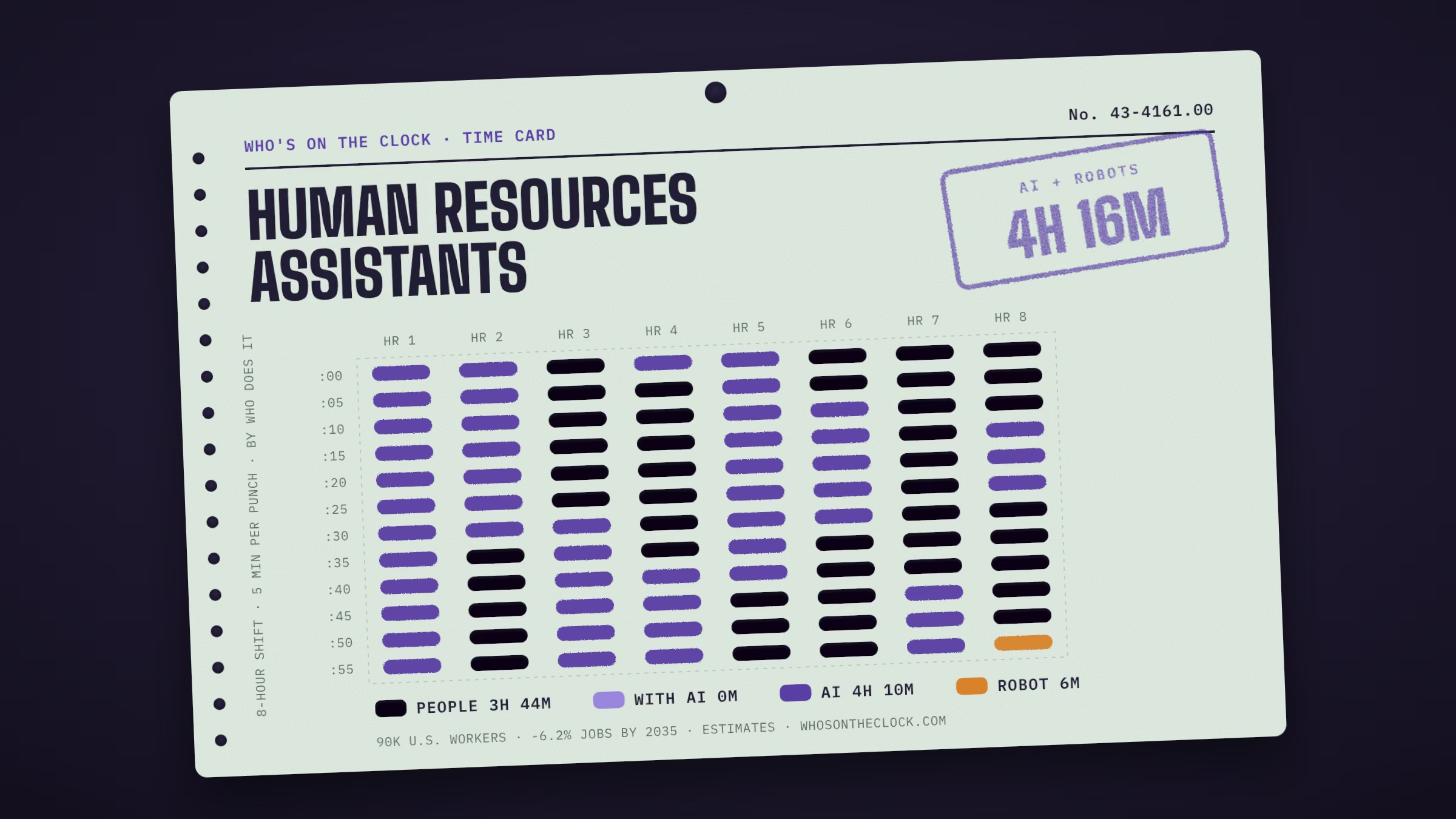
AI already handles some of this work on its own in real use, for tasks like “Process, verify, and maintain personnel related documentation”. That's 4h 10m of a typical shift; 3h 44m still has no AI or robot evidence. BLS expects about 6.2% fewer of these jobs by 2035.

Time card for human resources assistants showing a typical 8-hour shift: 3h 44m done by people, 4h 10m by AI, 6m by robots.
Each mark is 5 minutes of a typical shift for human resources assistants, colored by who does that task today. Estimates from O*NET tasks and Anthropic Economic Index data. How it's made

Home / Office & admin / Human Resources Assistants

Compile and keep personnel records. Record data for each employee, such as address, weekly earnings, absences, amount of sales or production, supervisory reports, and date of and reason for termination. May prepare reports for employment records, file employment records, or search employee files and furnish information to authorized persons.

Time card

Untick tasks you don't do, or set your own times.
MineTask, by time spentHumanWith AIAIRobot
Process, verify, and maintain personnel related documentation, including staffing, recruitment, training, grievances, performance evaluations, classifications, and employee leaves of absence.1h 34m a shift · Observed in AI use
Why this label?Marked AI because this task shows up regularly in real AI conversations (Anthropic Economic Index, 2025 usage), and in most of them AI does the task on its own rather than helping a person. Many workplaces may not use AI for it at all. How labels work
Record data for each employee, including such information as addresses, weekly earnings, absences, amount of sales or production, supervisory reports on performance, and dates of and reasons for terminations.56m a shift · No AI or robot evidence found
Why this label?No AI use or robot deployment showed up for this task in our data. That isn't proof it's safe; it may just be rare in the data. How labels work
Explain company personnel policies, benefits, and procedures to employees or job applicants.37m a shift · Observed in AI useTypical AI request: about 1h 34m alone, 29m with AI
Why this label?Marked AI because this task shows up regularly in real AI conversations (Anthropic Economic Index, 2025 usage), and in most of them AI does the task on its own rather than helping a person. Many workplaces may not use AI for it at all. How labels work
Provide assistance in administering employee benefit programs and worker's compensation plans.37m a shift · No AI or robot evidence found
Why this label?No AI use or robot deployment showed up for this task in our data. That isn't proof it's safe; it may just be rare in the data. How labels work
Answer questions regarding examinations, eligibility, salaries, benefits, and other pertinent information.37m a shift · Observed in AI useTypical AI request: about 1h 28m alone, 20m with AI
Why this label?Marked AI because this task shows up regularly in real AI conversations (Anthropic Economic Index, 2025 usage), and in most of them AI does the task on its own rather than helping a person. Many workplaces may not use AI for it at all. How labels work
Compile and prepare reports and documents pertaining to personnel activities.31m a shift · Observed in AI useTypical AI request: about 4h 35m alone, 22m with AI
Why this label?Marked AI because this task shows up regularly in real AI conversations (Anthropic Economic Index, 2025 usage), and in most of them AI does the task on its own rather than helping a person. Many workplaces may not use AI for it at all. How labels work
Examine employee files to answer inquiries and provide information for personnel actions.25m a shift · No AI or robot evidence found
Why this label?No AI use or robot deployment showed up for this task in our data. That isn't proof it's safe; it may just be rare in the data. How labels work
Process and review employment applications to evaluate qualifications or eligibility of applicants.25m a shift · Observed in AI use
Why this label?Marked AI because this task shows up regularly in real AI conversations (Anthropic Economic Index, 2025 usage), and in most of them AI does the task on its own rather than helping a person. Many workplaces may not use AI for it at all. How labels work
Prepare and set up for new employee orientations.19m a shift · Robots only in factory cells
Why this label?Robots have done this only in factory setups built around the machine, so it stays Human for human resources assistants. How labels work
Gather personnel records from other departments or employees.19m a shift · No AI or robot evidence found
Why this label?No AI use or robot deployment showed up for this task in our data. That isn't proof it's safe; it may just be rare in the data. How labels work
Search employee files to obtain information for authorized persons and organizations, such as credit bureaus and finance companies.12m a shift · No AI or robot evidence found
Why this label?No AI use or robot deployment showed up for this task in our data. That isn't proof it's safe; it may just be rare in the data. How labels work
Interview job applicants to obtain and verify information used to screen and evaluate them.12m a shift · No AI or robot evidence found
Why this label?No AI use or robot deployment showed up for this task in our data. That isn't proof it's safe; it may just be rare in the data. How labels work
Inform job applicants of their acceptance or rejection of employment.12m a shift · Observed in AI use
Why this label?Marked AI because this task shows up regularly in real AI conversations (Anthropic Economic Index, 2025 usage), and in most of them AI does the task on its own rather than helping a person. Many workplaces may not use AI for it at all. How labels work
Select applicants meeting specified job requirements and refer them to hiring personnel.12m a shift · No AI or robot evidence found
Why this label?No AI use or robot deployment showed up for this task in our data. That isn't proof it's safe; it may just be rare in the data. How labels work
Arrange for advertising or posting of job vacancies and notify eligible workers of position availability.12m a shift · Observed in AI use
Why this label?Marked AI because this task shows up regularly in real AI conversations (Anthropic Economic Index, 2025 usage), and in most of them AI does the task on its own rather than helping a person. Many workplaces may not use AI for it at all. How labels work
Request information from law enforcement officials, previous employers, and other references to determine applicants' employment acceptability.12m a shift · No AI or robot evidence found
Why this label?No AI use or robot deployment showed up for this task in our data. That isn't proof it's safe; it may just be rare in the data. How labels work
Arrange for in-house and external training activities.12m a shift · No AI or robot evidence found
Why this label?No AI use or robot deployment showed up for this task in our data. That isn't proof it's safe; it may just be rare in the data. How labels work
Administer and score applicant and employee aptitude, personality, and interest assessment instruments.6m a shift · No AI or robot evidence found
Why this label?No AI use or robot deployment showed up for this task in our data. That isn't proof it's safe; it may just be rare in the data. How labels work
Prepare badges, passes, and identification cards, and perform other security-related duties.6m a shift · Robots deployed · e.g. Unicard Systems self-service card issuance kiosk
Why this label?Marked Robot because Unicard Systems self-service card issuance kiosk (in real use) has done this task in a real workplace. It shows a robot can do it somewhere, not that most human resources assistants work alongside one. How labels work

Clock history

  1. 4h 16m touchedFirst published: O*NET 30.1, Anthropic Economic Index (2025 usage and September 2026 robot study), BLS May 2025

When new data changes this clock, the date, the new numbers and the reason are logged here. Company news alone never moves the clock.

On the floor

  1. Rolling outIBM
    IBM replaces about 200 HR positions with AI agents

    IBM replaced about 200 HR positions with AI-driven agents. CEO Arvind Krishna said IBM's total employment has gone up.

    Computing

Ask the clock

Will AI replace human resources assistants?

Some tasks are already being done by AI or machines; the rest still needs a person. About 4h 16m of a typical shift is made up of tasks that AI or robots have done on their own in real use somewhere. That doesn't mean those hours are automated in a typical workplace. The breakdown: 4h 10m that AI mostly does alone, 6m that robots have done in real workplaces. The other 3h 44m (47%) stays with people. Separately, BLS expects about 6.2% fewer of these jobs by 2035 (all jobs: +3.5%).

What can AI already do for human resources assistants?

AI shows up regularly in 7 of 19 tasks, about 4h 10m of a typical shift. The biggest ones:

  • Process, verify, and maintain personnel related documentation, including staffing, recruitment, training, grievances, performance evaluations, classifications, and employee leaves of absence. (1h 34m a shift, AI mostly does it alone)
  • Explain company personnel policies, benefits, and procedures to employees or job applicants. (37m a shift, AI mostly does it alone)
  • Answer questions regarding examinations, eligibility, salaries, benefits, and other pertinent information. (37m a shift, AI mostly does it alone)
  • Compile and prepare reports and documents pertaining to personnel activities. (31m a shift, AI mostly does it alone)
  • Process and review employment applications to evaluate qualifications or eligibility of applicants. (25m a shift, AI mostly does it alone)
Where do robots fit in?

For some tasks, yes. Robots have done 1 of this job's tasks in workplaces like this one, about 6m of a typical shift. 1 more task has only been done in factory setups built around the machine, so it stays with people here.

  • Prepare badges, passes, and identification cards, and perform other security-related duties. (6m a shift; e.g. Unicard Systems self-service card issuance kiosk, in use)
What still needs a person?

3h 44m of a typical shift, or 47%, goes to tasks with no AI or robot evidence yet. No AI usage or robot deployment has shown up for these so far. The biggest:

  • Record data for each employee, including such information as addresses, weekly earnings, absences, amount of sales or production, supervisory reports on performance, and dates of and reasons for terminations. (56m a shift)
  • Provide assistance in administering employee benefit programs and worker's compensation plans. (37m a shift)
  • Examine employee files to answer inquiries and provide information for personnel actions. (25m a shift)
  • Prepare and set up for new employee orientations. (19m a shift)
  • Gather personnel records from other departments or employees. (19m a shift)
Why is that work hard to automate?

Much of it comes down to where and how the work happens. In-person, hands-on and high-stakes work is where AI and robots have made the least headway so far. In the official O*NET survey of people in this job:

  • 91% are in constant contact with other people
  • 71% say dealing with the public is very or extremely important
  • 68% handle conflict at least once a week
What are companies actually doing?

We track 1 sourced company move that affects this job. Most recent:

  • Jun 2, 2025: IBM replaces about 200 HR positions with AI agents (Rolling out)
How much time does AI save on these tasks?

For the 3 tasks in this job where AI shows up and timing data exists, a typical request takes about 1h 34m for a person alone and about 22m with AI. These are Claude's own estimates from real conversations in April and May 2026 (Anthropic Economic Index). They describe single requests, not whole workdays, and time saved on a task doesn't mean jobs are cut. The biggest gaps:

  • Compile and prepare reports and documents pertaining to personnel activities (about 4h 35m alone, 22m with AI)
  • Answer questions regarding examinations, eligibility, salaries, benefits, and other pertinent information (about 1h 28m alone, 20m with AI)
  • Explain company personnel policies, benefits, and procedures to employees or job applicants (about 1h 34m alone, 29m with AI)
Are employers still hiring human resources assistants?

On Indeed, job postings in the Customer Service sector are at 87% of their February 2020 level (all U.S. postings: 104%), down 1.5% from a year earlier, as of Oct 9, 2026. BLS separately expects about 7,900 openings a year in this job through 2035. Across all U.S. postings, 7.3% now mention AI skills. Sector postings cover more than this one job and move for many reasons besides AI.

How much do human resources assistants make?

The median pay is about $50,610 a year ($24.33 an hour), 1% below the median for all U.S. jobs ($50,980). Most people in this job earn between $37,340 and $68,280 a year; that range covers the middle 80%. Pay figures are from BLS, May 2025, and vary a lot by state and employer. Pick a state to compare:

Is this job growing or shrinking?

BLS projects a decline of 6.2% from 2025 to 2035, compared with 3.5% growth for all jobs. That's about 91,000 jobs in 2035. Even so, it expects about 7,900 openings a year, mostly from people retiring or changing careers. These projections don't single out AI as a cause.

How many human resources assistants are there in the U.S.?

About 90,000 people in the U.S., roughly 0.06% of all workers (BLS, May 2025). That makes it the 291st largest of the 796 jobs on this site. BLS expects about 91,000 in 2035.

What training do human resources assistants need?

The most common requirement is a bachelor's degree: about 34% of people in the job said so in the official O*NET survey. O*NET rates the job at level 3 of 5 for preparation, which usually means: vocational school or associate's degree. Requirements vary by state and employer, especially for licensed work.

What should I learn to stay ahead of AI?

These come from the job's official skill ratings and from the tasks that AI and robots touch least today. Building them keeps you strong in the parts of the work that still need a person:

  • Skills that matter more here than in most jobs: Reading Comprehension, Active Listening, Writing, Social Perceptiveness
  • Get strong at the parts of the job that stay with people (listed above), which take 3h 44m of a typical shift
  • Tools employers list: Microsoft Word, Microsoft PowerPoint, Microsoft Outlook, Microsoft Office software, Microsoft Excel
  • Learn to use AI well on the tasks where it already shows up in this job (listed above)
What other jobs could human resources assistants move into?

These use similar skills, with less of a typical shift touched by AI or robots. Matches come from 109 official ratings of skills, knowledge and work activities, and each needs the same or less preparation unless the official list relates the jobs directly:

  • Human Resources Specialists (3h 26m touched, $76k median pay)
  • Executive Secretaries and Executive Administrative Assistants (2h 17m touched, $77k median pay)
  • Government Programs Eligibility Interviewers (32m touched, $54k median pay)
  • Payroll and Timekeeping Clerks (37m touched, $58k median pay)
  • Compensation, Benefits, and Job Analysis Specialists (31m touched, $78k median pay)
How solid are these numbers?

Each task carries its own evidence label. For this job: 7 observed in real AI use, 1 with robots in real deployments, 11 with no AI or robot evidence found. The minutes per task are estimates, not measured hours, and "no evidence" doesn't prove a task is safe.

Tools in demand

  • Google Docs
  • Microsoft Access
  • Microsoft SharePoint

Plus everyday office tools: Microsoft Word, Microsoft PowerPoint, Microsoft Outlook, Microsoft Office software, Microsoft Excel.

Also called

Assignment Clerk, Benefits Clerk, Benefits Coordinator, Benefits Technician, Civil Service Clerk, Civil Service Worker, Contract Clerk, Employment Assistant, Employment Clerk, Enrollment Specialist, Human Resources Administrative Assistant (HR Administrative Assistant), Human Resources Assistant (HR Assistant), Human Resources Associate (HR Associate), Human Resources Clerk (HR Clerk)