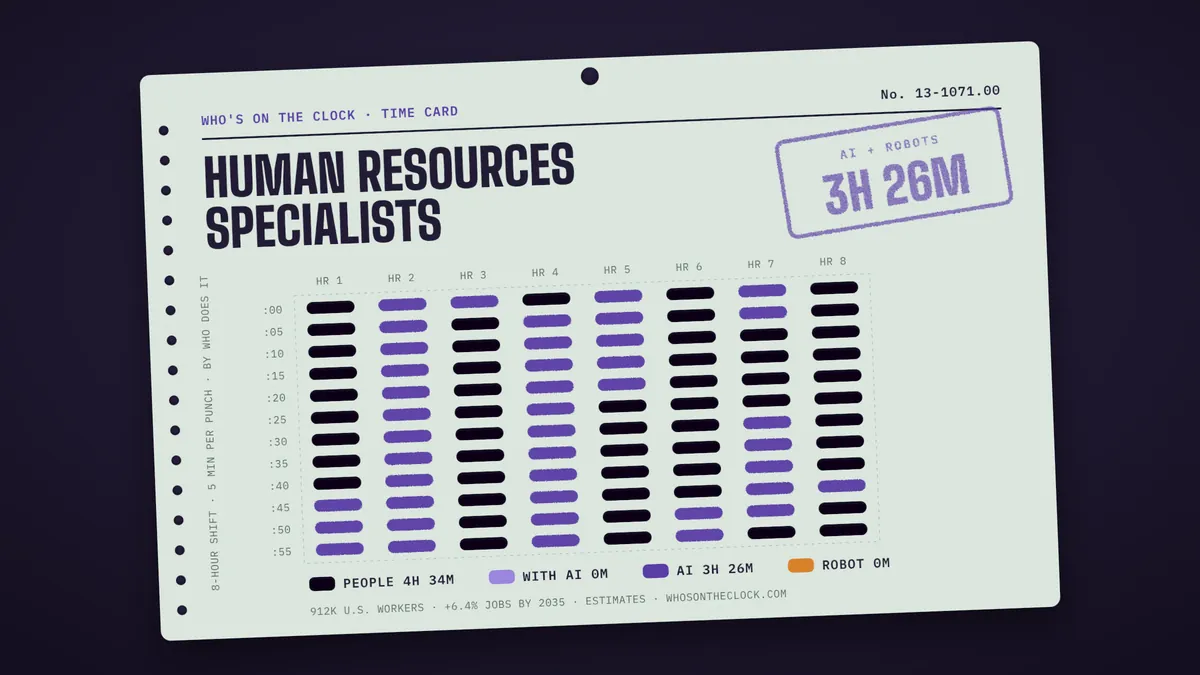
What does this mean for workers? IBM's moves touch 3 jobs, which together employ about 2.7 million people in the U.S. Across them, AI and robots already touch between 3h 20m (software developers) and 4h 16m (human resources assistants) of a typical 8-hour shift. A single company's move is an early signal for these jobs, and the time cards show how far the change has spread nationally.
A plan is a stated intention with a timeline, not yet in use. Rolling out means it is in use and spreading to more locations or teams.
On the floor
- IBM says it is tripling entry-level hiring and rewriting junior roles for AI
IBM's chief HR officer Nickle LaMoreaux said the company is tripling entry-level hiring, including software developers. IBM says junior developers will spend less time on routine coding and HR staff will step in when chatbots need help.
- IBM replaces about 200 HR positions with AI agents
IBM replaced about 200 HR positions with AI-driven agents. CEO Arvind Krishna said IBM's total employment has gone up.
Computing · Human Resources Specialists, Human Resources Assistants
Jobs affected
- Human Resources Specialists3h 26m of 8h touched · 912,000 workers · $76k · +6.4% by 2035Where AI or robots show up most: Interview job applicants to obtain information on work history, training, education, or job skills (43m a shift, AI on its own)
- Software Developers3h 20m of 8h touched · 1.7 million workers · $136k · +10.2% by 2035Where AI or robots show up most: Modify existing software to correct errors, adapt it to new hardware, or upgrade interfaces and improve performance (1h 26m a shift, people with AI)
- Human Resources Assistants4h 16m of 8h touched · 90,000 workers · $51k · -6.2% by 2035Where AI or robots show up most: Process, verify, and maintain personnel related documentation, including staffing, recruitment, training, grievances, performance evaluations, classifications, and employee leaves of absence (1h 34m a shift, AI on its own)