Will AI replace payroll and timekeeping clerks?

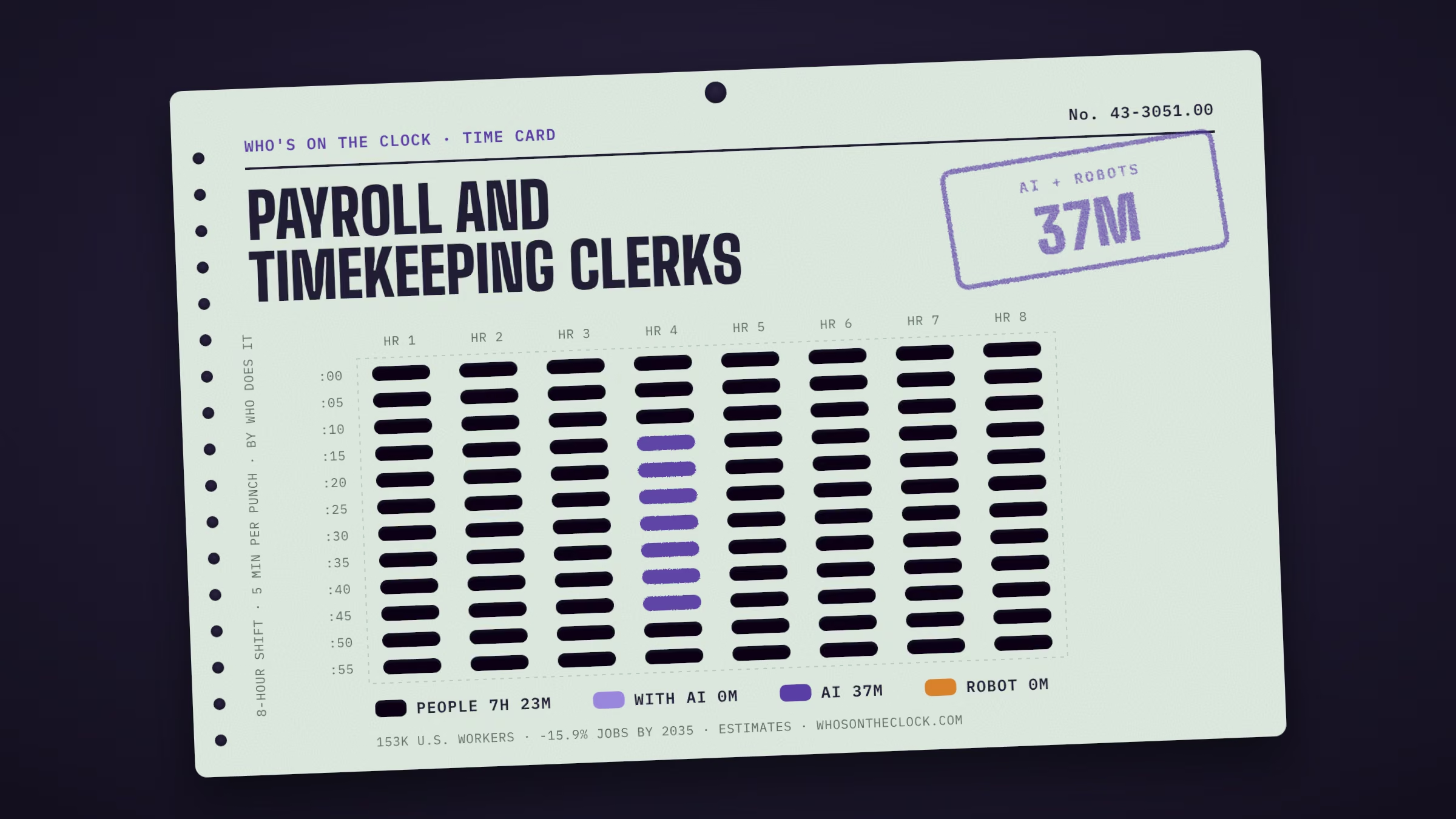
AI already handles some of this work on its own in real use, for tasks like “Provide information to employees and managers on payroll matters”. That's 37m of a typical shift; 7h 23m still has no AI or robot evidence. BLS expects about 15.9% fewer of these jobs by 2035.

Time card for payroll and timekeeping clerks showing a typical 8-hour shift: 7h 23m done by people, 37m by AI.
Each mark is 5 minutes of a typical shift for payroll and timekeeping clerks, colored by who does that task today. Estimates from O*NET tasks and Anthropic Economic Index data. How it's made

Home / Office & admin / Payroll and Timekeeping Clerks

Compile and record employee time and payroll data. May compute employees' time worked, production, and commission. May compute and post wages and deductions, or prepare paychecks.

Time card

Untick tasks you don't do, or set your own times.
MineTask, by time spentHumanWith AIAIRobot
Verify attendance, hours worked, and pay adjustments, and post information onto designated records.56m a shift · No AI or robot evidence found
Why this label?No AI use or robot deployment showed up for this task in our data. That isn't proof it's safe; it may just be rare in the data. How labels work
Compute wages and deductions, and enter data into computers.50m a shift · No AI or robot evidence found
Why this label?No AI use or robot deployment showed up for this task in our data. That isn't proof it's safe; it may just be rare in the data. How labels work
Process and issue employee paychecks and statements of earnings and deductions.44m a shift · No AI or robot evidence found
Why this label?No AI use or robot deployment showed up for this task in our data. That isn't proof it's safe; it may just be rare in the data. How labels work
Review time sheets, work charts, wage computation, and other information to detect and reconcile payroll discrepancies.44m a shift · No AI or robot evidence found
Why this label?No AI use or robot deployment showed up for this task in our data. That isn't proof it's safe; it may just be rare in the data. How labels work
Provide information to employees and managers on payroll matters, tax issues, benefit plans, and collective agreement provisions.37m a shift · Observed in AI use
Why this label?Marked AI because this task shows up regularly in real AI conversations (Anthropic Economic Index, 2025 usage), and in most of them AI does the task on its own rather than helping a person. Many workplaces may not use AI for it at all. How labels work
Prepare and balance period-end reports, and reconcile issued payrolls to bank statements.31m a shift · No AI or robot evidence found
Why this label?No AI use or robot deployment showed up for this task in our data. That isn't proof it's safe; it may just be rare in the data. How labels work
Compile employee time, production, and payroll data from time sheets and other records.31m a shift · No AI or robot evidence found
Why this label?No AI use or robot deployment showed up for this task in our data. That isn't proof it's safe; it may just be rare in the data. How labels work
Process paperwork for new employees and enter employee information into the payroll system.25m a shift · No AI or robot evidence found
Why this label?No AI use or robot deployment showed up for this task in our data. That isn't proof it's safe; it may just be rare in the data. How labels work
Record employee information, such as exemptions, transfers, and resignations, to maintain and update payroll records.25m a shift · No AI or robot evidence found
Why this label?No AI use or robot deployment showed up for this task in our data. That isn't proof it's safe; it may just be rare in the data. How labels work
Keep track of leave time, such as vacation, personal, and sick leave, for employees.25m a shift · No AI or robot evidence found
Why this label?No AI use or robot deployment showed up for this task in our data. That isn't proof it's safe; it may just be rare in the data. How labels work
Issue and record adjustments to pay related to previous errors or retroactive increases.19m a shift · No AI or robot evidence found
Why this label?No AI use or robot deployment showed up for this task in our data. That isn't proof it's safe; it may just be rare in the data. How labels work
Prepare and file payroll tax returns.19m a shift · No AI or robot evidence found
Why this label?No AI use or robot deployment showed up for this task in our data. That isn't proof it's safe; it may just be rare in the data. How labels work
Keep informed about changes in tax and deduction laws that apply to the payroll process.12m a shift · No AI or robot evidence found
Why this label?No AI use or robot deployment showed up for this task in our data. That isn't proof it's safe; it may just be rare in the data. How labels work
Compile statistical reports, statements, and summaries related to pay and benefits accounts, and submit them to appropriate departments.12m a shift · No AI or robot evidence found
Why this label?No AI use or robot deployment showed up for this task in our data. That isn't proof it's safe; it may just be rare in the data. How labels work
Balance cash and payroll accounts.12m a shift · No AI or robot evidence found
Why this label?No AI use or robot deployment showed up for this task in our data. That isn't proof it's safe; it may just be rare in the data. How labels work
Complete, verify, and process forms and documentation for administration of benefits, such as pension plans, and unemployment and medical insurance.12m a shift · No AI or robot evidence found
Why this label?No AI use or robot deployment showed up for this task in our data. That isn't proof it's safe; it may just be rare in the data. How labels work
Distribute and collect timecards each pay period.6m a shift · Robots only in factory cells
Why this label?Robots have done this only in factory setups built around the machine, so it stays Human for payroll and timekeeping clerks. How labels work
Complete time sheets showing employees' arrival and departure times.6m a shift · No AI or robot evidence found
Why this label?No AI use or robot deployment showed up for this task in our data. That isn't proof it's safe; it may just be rare in the data. How labels work
Conduct verifications of employment.6m a shift · No AI or robot evidence found
Why this label?No AI use or robot deployment showed up for this task in our data. That isn't proof it's safe; it may just be rare in the data. How labels work
Train employees on organizations' timekeeping systems.6m a shift · No AI or robot evidence found
Why this label?No AI use or robot deployment showed up for this task in our data. That isn't proof it's safe; it may just be rare in the data. How labels work
Coordinate special programs, such as United Way campaigns, that involve payroll deductions.time not estimated · No AI or robot evidence found
Why this label?No AI use or robot deployment showed up for this task in our data. That isn't proof it's safe; it may just be rare in the data. How labels work

Clock history

  1. 37m touchedFirst published: O*NET 30.1, Anthropic Economic Index (2025 usage and September 2026 robot study), BLS May 2025

When new data changes this clock, the date, the new numbers and the reason are logged here. Company news alone never moves the clock.

On the floor

  1. AnnouncedWorkday
    Workday gives its Payroll Agent autopilot checks before each run

    Workday said its Payroll Agent will check payroll data and flag problems before a payroll run, with early adopter availability planned for early 2027. Its Talent Acquisition Agent, which can coordinate interview scheduling, is available now to early adopters.

    Workday

Ask the clock

Will AI replace payroll and timekeeping clerks?

Unlikely, though parts of the work are changing. About 37m of an 8-hour shift goes to tasks touched by AI working on its own. The other 7h 23m (92%) stays with people. Separately, BLS expects about 15.9% fewer of these jobs by 2035 (all jobs: +3.5%).

What can AI already do for payroll and timekeeping clerks?

AI shows up regularly in 1 of 21 tasks, about 37m of a typical shift. The biggest ones:

  • Provide information to employees and managers on payroll matters, tax issues, benefit plans, and collective agreement provisions. (37m a shift, AI mostly does it alone)
Where do robots fit in?

Not in workplaces like this one, based on a 2026 review of robot deployments. 1 more task has only been done in factory setups built around the machine, so it stays with people here.

What still needs a person?

7h 23m of a typical shift, or 92%, goes to tasks with no AI or robot evidence yet. No AI usage or robot deployment has shown up for these so far. The biggest:

  • Verify attendance, hours worked, and pay adjustments, and post information onto designated records. (56m a shift)
  • Compute wages and deductions, and enter data into computers. (50m a shift)
  • Process and issue employee paychecks and statements of earnings and deductions. (44m a shift)
  • Review time sheets, work charts, wage computation, and other information to detect and reconcile payroll discrepancies. (44m a shift)
  • Prepare and balance period-end reports, and reconcile issued payrolls to bank statements. (31m a shift)
Why is that work hard to automate?

Much of it comes down to where and how the work happens. In-person, hands-on and high-stakes work is where AI and robots have made the least headway so far. In the official O*NET survey of people in this job:

  • 83% talk face to face with others every day
What are companies actually doing?

We track 1 sourced company move that affects this job. Most recent:

  • Oct 13, 2026: Workday gives its Payroll Agent autopilot checks before each run (Announced)
Are employers still hiring payroll and timekeeping clerks?

On Indeed, job postings in the Accounting sector are at 105% of their February 2020 level (all U.S. postings: 104%), down 5.9% from a year earlier, as of Oct 9, 2026. BLS separately expects about 11,000 openings a year in this job through 2035. Across all U.S. postings, 7.3% now mention AI skills. Sector postings cover more than this one job and move for many reasons besides AI.

How much do payroll and timekeeping clerks make?

The median pay is about $58,260 a year ($28.01 an hour), 14% above the median for all U.S. jobs ($50,980). Most people in this job earn between $39,500 and $81,350 a year; that range covers the middle 80%. Pay figures are from BLS, May 2025, and vary a lot by state and employer. Pick a state to compare:

Is this job growing or shrinking?

BLS projects a decline of 15.9% from 2025 to 2035, compared with 3.5% growth for all jobs. That's about 134,000 jobs in 2035. Even so, it expects about 11,000 openings a year, mostly from people retiring or changing careers. These projections don't single out AI as a cause.

How many payroll and timekeeping clerks are there in the U.S.?

About 153,000 people in the U.S., roughly 0.10% of all workers (BLS, May 2025). That makes it the 212th largest of the 796 jobs on this site. BLS expects about 134,000 in 2035.

What training do payroll and timekeeping clerks need?

The most common requirement is a bachelor's degree: about 32% of people in the job said so in the official O*NET survey. O*NET rates the job at level 3 of 5 for preparation, which usually means: vocational school or associate's degree. Requirements vary by state and employer, especially for licensed work.

What should I learn to stay ahead of AI?

These come from the job's official skill ratings and from the tasks that AI and robots touch least today. Building them keeps you strong in the parts of the work that still need a person:

  • Skills that matter more here than in most jobs: Mathematics, Reading Comprehension, Active Listening, Service Orientation
  • Get strong at the parts of the job that stay with people (listed above), which take 7h 23m of a typical shift
  • Tools employers list: Workday software, Microsoft Word, Microsoft Outlook, Microsoft Office software, Microsoft Excel
  • Learn to use AI well on the tasks where it already shows up in this job (listed above)
What other jobs could payroll and timekeeping clerks move into?

These use similar skills. Matches come from 109 official ratings of skills, knowledge and work activities, and each needs the same or less preparation unless the official list relates the jobs directly:

  • Billing and Posting Clerks (4h 19m touched, $49k median pay)
  • Correspondence Clerks (3h 57m touched, $47k median pay)
  • Bookkeeping, Accounting, and Auditing Clerks (1h 58m touched, $51k median pay)
  • General Office Clerks (4h 30m touched, $45k median pay)
  • Court, Municipal, and License Clerks (1h 28m touched, $49k median pay)
How solid are these numbers?

Each task carries its own evidence label. For this job: 1 observed in real AI use, 20 with no AI or robot evidence found. The minutes per task are estimates, not measured hours, and "no evidence" doesn't prove a task is safe.

Tools in demand

  • Workday software
  • Kronos Workforce Timekeeper
  • Intuit QuickBooks
  • Microsoft Access

Plus everyday office tools: Microsoft Word, Microsoft Outlook, Microsoft Office software, Microsoft Excel.

Also called

Accounting Assistant, Attendance Clerk, Bonus Clerk, Checkman, Commissions Clerk, Finance Specialist, Flight Crew Scheduler, Flight Crew Time Clerk, Human Resources Administrative Assistant (HR Administrative Assistant), Payroll Administrator (Payroll Admin), Payroll Analyst, Payroll Assistant, Payroll Associate, Payroll Bookkeeper