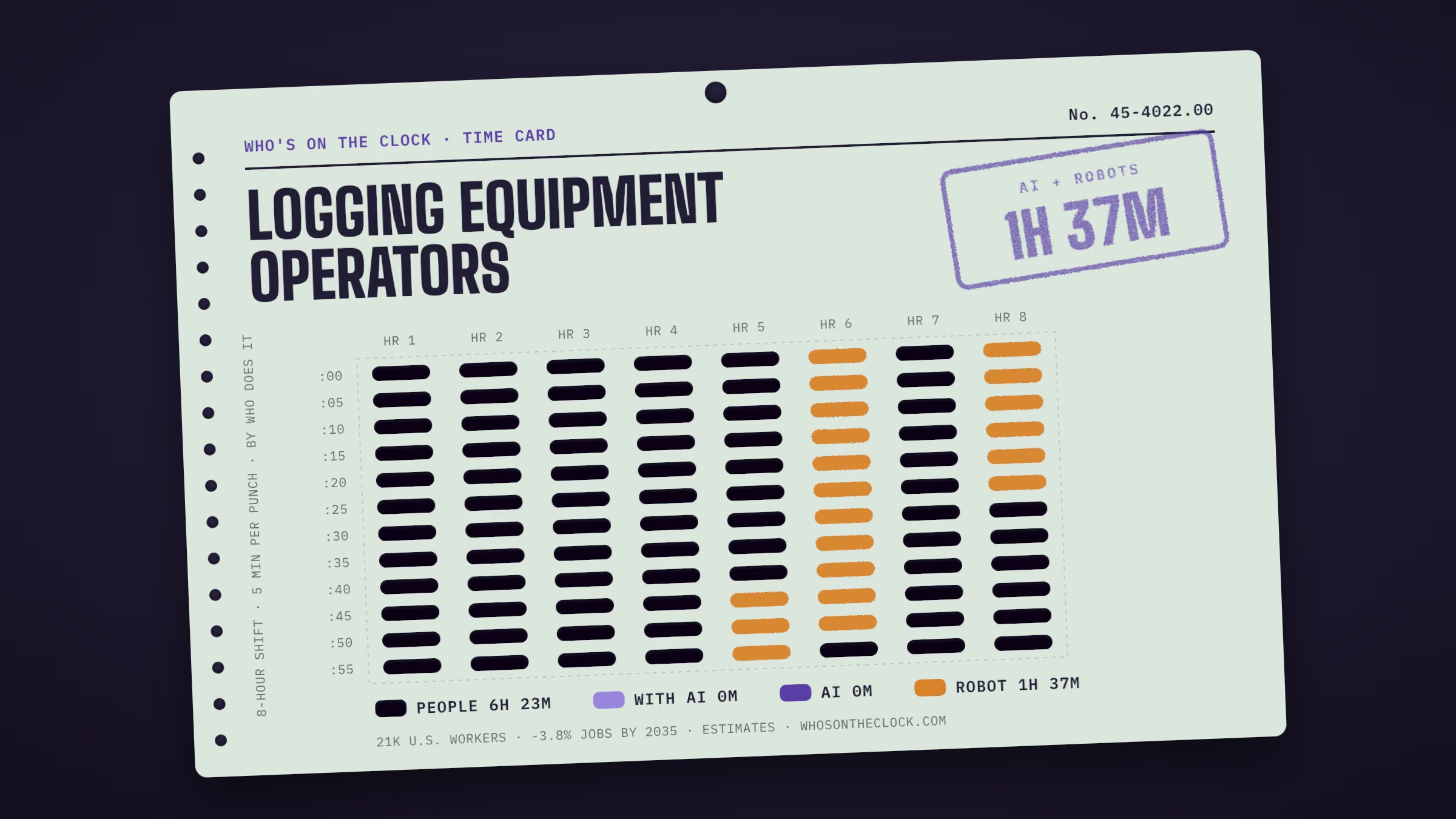
Unlikely, though parts of the work are changing. About 1h 37m of an 8-hour shift goes to tasks touched by robots. The other 6h 23m (80%) stays with people. Separately, BLS expects about 3.8% fewer of these jobs by 2035 (all jobs: +3.5%).
⤢ Full sizeEach mark is 5 minutes of a typical shift for logging equipment operators, colored by who does that task today. Estimates from O*NET tasks and Anthropic Economic Index data. How it's made
Drive logging tractor or wheeled vehicle equipped with one or more accessories, such as bulldozer blade, frontal shear, grapple, logging arch, cable winches, hoisting rack, or crane boom, to fell tree; to skid, load, unload, or stack logs; or to pull stumps or clear brush. Includes operating stand-alone logging machines, such as log chippers.
Time card
Untick tasks you don't do, or set your own times.
Mine
Task, by time spent
Human
With AI
AI
Robot
Drive straight or articulated tractors equipped with accessories such as bulldozer blades, grapples, logging arches, cable winches, and crane booms to skid, load, unload, or stack logs, pull stumps, or clear brush.1h 43m a shift · Robots only in factory cells
Drive crawler or wheeled tractors to drag or transport logs from felling sites to log landing areas for processing and loading.1h 43m a shift · Robots only in factory cells
Drive and maneuver tractors and tree harvesters to shear the tops off of trees, cut and limb the trees, and cut the logs into desired lengths.1h 20m a shift · Robots only in factory cells
Inspect equipment for safety prior to use, and perform necessary basic maintenance tasks.1h 3m a shift · No AI or robot evidence found
Drive tractors for building or repairing logging and skid roads.29m a shift · Robots deployed · e.g. A4CSEL (Kajima)
Grade logs according to characteristics such as knot size and straightness, and according to established industry or company standards.17m a shift · Robots only in factory cells
Fill out required job or shift report forms.11m a shift · No AI or robot evidence found
Calculate total board feet, cordage, or other wood measurement units, using conversion tables.6m a shift · No AI or robot evidence found
On the floor
No company news tracked for this job yet. New stories are added as they happen.
Ask the clock
Will AI replace logging equipment operators?
Unlikely, though parts of the work are changing. About 1h 37m of an 8-hour shift goes to tasks touched by robots. The other 6h 23m (80%) stays with people. Separately, BLS expects about 3.8% fewer of these jobs by 2035 (all jobs: +3.5%).
What can AI already do for logging equipment operators?
None of this job's tasks show regular AI use yet. That can mean the work is hands-on or in person, or simply that it rarely comes up in AI usage data.
Where do robots fit in?
For some tasks, yes. Robots have done 2 of this job's tasks in workplaces like this one, about 1h 37m of a typical shift. 4 more tasks have only been done in factory setups built around the machine, so they stay with people here. For 1 physical task, no robot has shown it can do the work yet.
Control hydraulic tractors equipped with tree clamps and booms to lift, swing, and bunch sheared trees. (1h 9m a shift; e.g. ANDRITZ autonomous logyard cranes (2 x 25 t, 540 m runway) at Metsä Fibre Kemi, in use)
Drive tractors for building or repairing logging and skid roads. (29m a shift; e.g. A4CSEL (Kajima), in use)
What still needs a person?
6h 23m of a typical shift, or 80%, goes to tasks with no AI or robot evidence yet. No AI usage or robot deployment has shown up for these so far. The biggest:
Drive straight or articulated tractors equipped with accessories such as bulldozer blades, grapples, logging arches, cable winches, and crane booms to skid, load, unload, or stack logs, pull stumps, or clear brush. (1h 43m a shift)
Drive crawler or wheeled tractors to drag or transport logs from felling sites to log landing areas for processing and loading. (1h 43m a shift)
Drive and maneuver tractors and tree harvesters to shear the tops off of trees, cut and limb the trees, and cut the logs into desired lengths. (1h 20m a shift)
Inspect equipment for safety prior to use, and perform necessary basic maintenance tasks. (1h 3m a shift)
Grade logs according to characteristics such as knot size and straightness, and according to established industry or company standards. (17m a shift)
Why is that work hard to automate?
Much of it comes down to where and how the work happens. In-person, hands-on and high-stakes work is where AI and robots have made the least headway so far. In the official O*NET survey of people in this job:
99% use their hands on tools, objects or controls more than half the time
83% carry high or very high responsibility for other workers' safety
68% say a mistake would be very or extremely serious
How much do logging equipment operators make?
The median pay is about $49,740 a year ($23.91 an hour), 2% below the median for all U.S. jobs ($50,980). Most people in this job earn between $35,170 and $74,300 a year; that range covers the middle 80%. Pay figures are from BLS, May 2025, and vary a lot by state and employer. Pick a state to compare:
Is this job growing or shrinking?
BLS projects a decline of 3.8% from 2025 to 2035, compared with 3.5% growth for all jobs. That's about 28,000 jobs in 2035. Even so, it expects about 3,700 openings a year, mostly from people retiring or changing careers. These projections don't single out AI as a cause.
How many logging equipment operators are there in the U.S.?
About 21,000 people in the U.S., roughly 0.01% of all workers (BLS, May 2025). That makes it the 541st largest of the 796 jobs on this site. BLS expects about 28,000 in 2035.
What training do logging equipment operators need?
The most common requirement is less than a high school diploma: about 55% of people in the job said so in the official O*NET survey. O*NET rates the job at level 1 of 5 for preparation, which usually means: little or no preparation. Requirements vary by state and employer, especially for licensed work.
What should I learn to stay ahead of AI?
These come from the job's official skill ratings and from the tasks that AI and robots touch least today. Building them keeps you strong in the parts of the work that still need a person:
Skills that matter more here than in most jobs: Operation and Control, Equipment Maintenance, Operations Monitoring, Troubleshooting
Get strong at the parts of the job that stay with people (listed above), which take 6h 23m of a typical shift
Tools employers list: Microsoft Excel, Microsoft Office software, Microsoft Outlook, Microsoft Word, SAP software
What new tasks are logging equipment operators taking on?
Yes. Occupational experts recently added these to the official task list, a sign of how the work itself is shifting. New tasks aren't rated for AI or robots yet:
Operate remote-controlled logging machines and drones for dangerous or hard-to-reach tasks.
What other jobs could logging equipment operators move into?
These use similar skills. Matches come from 109 official ratings of skills, knowledge and work activities, and each needs the same or less preparation unless the official list relates the jobs directly:
Excavating and Loading Machine and Dragline Operators, Surface Mining (5h 38m touched, $57k median pay)
Continuous Mining Machine Operators (1h 44m touched, $62k median pay)
Operating Engineers and Other Construction Equipment Operators (5h 28m touched, $60k median pay)
Industrial Truck and Tractor Operators (7h 41m touched, $46k median pay)
How solid are these numbers?
Each task carries its own evidence label. For this job: 2 with robots in real deployments, 7 with no AI or robot evidence found. The minutes per task are estimates, not measured hours, and "no evidence" doesn't prove a task is safe.