Home / Skills / Operations Monitoring
O*NET defines operations monitoring as: Watching gauges, dials, or other indicators to make sure a machine is working properly.
122 jobs on this site rate it as important or very important. In those jobs, AI and robots touch an average of 1h 55m of an 8-hour shift, 22m more than the 1h 33m average across all jobs.
Good pay, least AI time
Jobs that lean on operations monitoring, pay at least the $59,570 median for this group, and have the least AI or robot time.
- Nuclear Engineers no AI or robot evidence · $133,970
- Elevator and Escalator Installers and Repairers no AI or robot evidence · $109,910
- Aerospace Engineering and Operations Technologists and Technicians no AI or robot evidence · $82,890
- Avionics Technicians no AI or robot evidence · $82,280
- Aircraft Mechanics and Service Technicians no AI or robot evidence · $79,870
- Electrical and Electronics Repairers, Commercial and Industrial Equipment no AI or robot evidence · $74,090
- Electro-Mechanical and Mechatronics Technologists and Technicians no AI or robot evidence · $73,900
- Robotics Technicians no AI or robot evidence · $73,900
- Pile Driver Operators no AI or robot evidence · $73,300
- Millwrights no AI or robot evidence · $65,700
How much AI touches these jobs
Of the 122 jobs, 23 have no AI or robot evidence, 26 have under an hour, 41 have 1 to 3 hours and 32 have 3 hours or more.
Skills that usually come with it
Jobs that rely on operations monitoring most often also rely on operation and control (55%), critical thinking (43%), monitoring (32%), active listening (22%), troubleshooting (22%).
Jobs that rely on it most
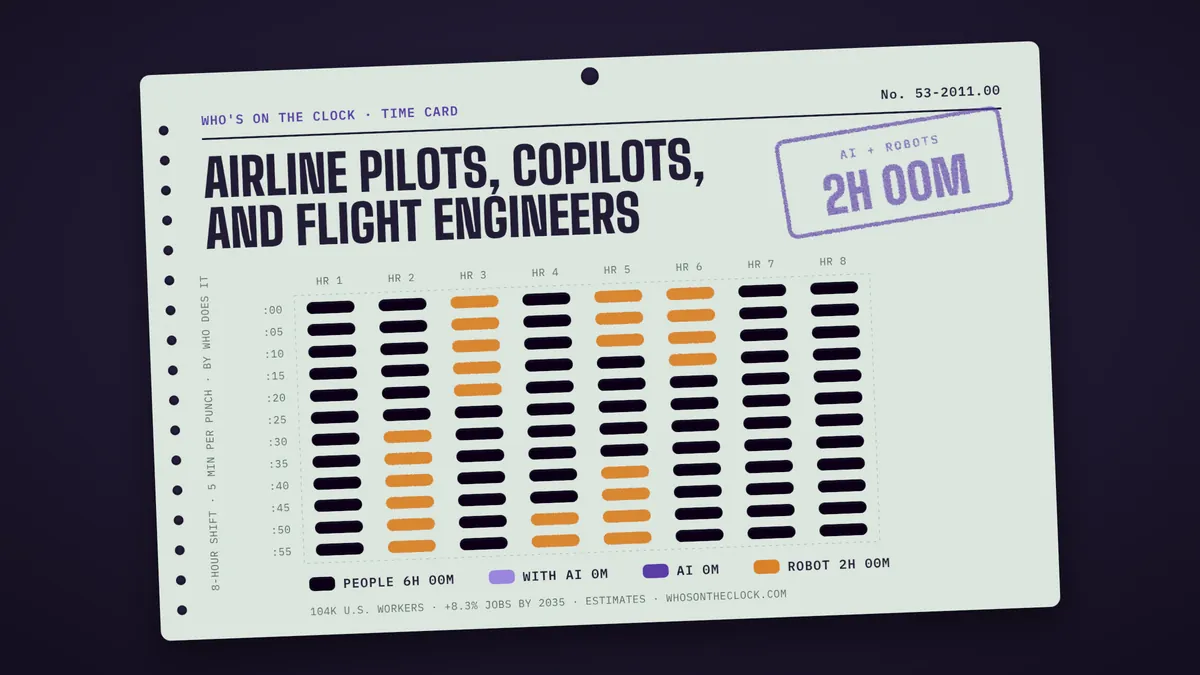
- Airline Pilots, Copilots, and Flight Engineers 2h touched · $232,140
- Commercial Pilots 2h 14m touched · $123,220
- Aircraft Mechanics and Service Technicians no AI or robot evidence · $79,870
- Computer Numerically Controlled Tool Operators 1h 22m touched · $50,690
- Gas Plant Operators 5h 4m touched · $87,820
- Chemical Plant and System Operators 1h 1m touched · $78,120
- Industrial Machinery Mechanics 6m touched · $64,520
- Multiple Machine Tool Setters, Operators, and Tenders, Metal and Plastic 1h 10m touched · $47,180
- Grinding, Lapping, Polishing, and Buffing Machine Tool Setters, Operators, and Tenders, Metal and Plastic no AI or robot evidence · $46,550
- Service Unit Operators, Oil and Gas 2h 52m touched · $58,160
- Locomotive Engineers 3h 20m touched · $81,410
- Petroleum Pump System Operators, Refinery Operators, and Gaugers 3h 6m touched · $96,710
- Power Plant Operators 3h 26m touched · $102,040
- Biomass Plant Technicians 4h 58m touched · $102,040
- Stationary Engineers and Boiler Operators 4h 12m touched · $78,620
- Rolling Machine Setters, Operators, and Tenders, Metal and Plastic 1h 4m touched · $50,140
- Conveyor Operators and Tenders 4h 27m touched · $42,420
- Earth Drillers 3h 38m touched · $60,190
- Wellhead Pumpers 2h 47m touched · $69,960
- Electro-Mechanical and Mechatronics Technologists and Technicians no AI or robot evidence · $73,900
- Extruding and Forming Machine Setters, Operators, and Tenders, Synthetic and Glass Fibers 2h 36m touched · $46,350
- Derrick Operators, Oil and Gas 4h 28m touched · $58,620
- Boilermakers 29m touched · $76,410
- Wind Turbine Service Technicians 12m touched · $64,120
- Nuclear Power Reactor Operators 19m touched · $122,890
And 97 more. Use the finder to filter by pay, school and state.
Importance ratings come from O*NET 30.1, on a 1 to 5 scale; this page counts a job when the rating is 3.5 or higher. Time touched comes from each job's time card (how we keep time). See every skill or search by task.