Will AI replace millwrights?

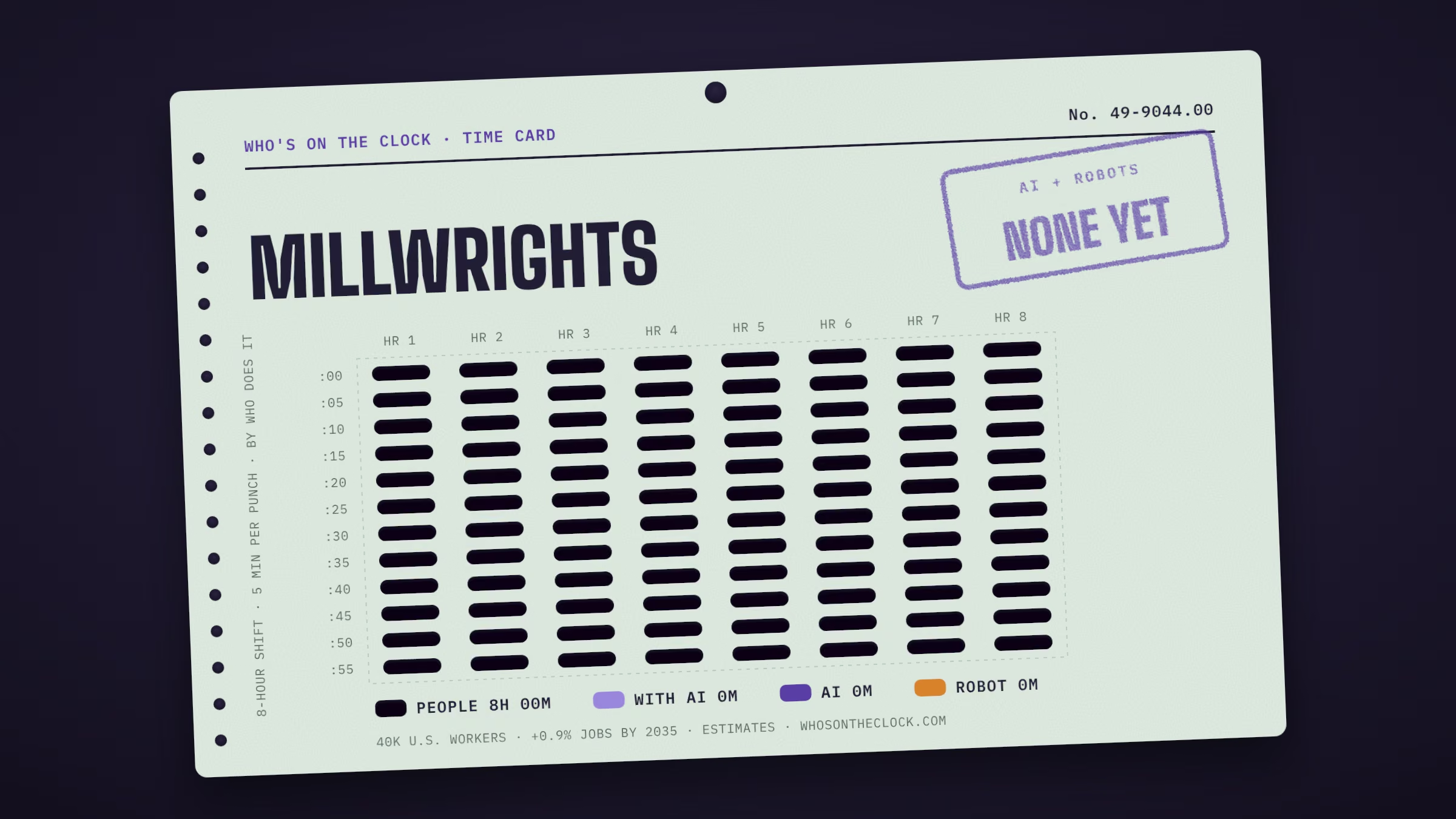
“Replace defective parts of machine” is the largest task here, and like every other task on this time card it is still done by people. We found no AI use or robot deployment for any of them. That reflects today's evidence and could change. BLS expects about 0.9% more of these jobs by 2035.

Time card for millwrights showing a typical 8-hour shift: 8h done by people.
Each mark is 5 minutes of a typical shift for millwrights, colored by who does that task today. Estimates from O*NET tasks and Anthropic Economic Index data. How it's made

Home / Repair & maintenance / Millwrights

Install, dismantle, or move machinery and heavy equipment according to layout plans, blueprints, or other drawings.

Time card

Untick tasks you don't do, or set your own times.
MineTask, by time spentHumanWith AIAIRobot
Replace defective parts of machine, or adjust clearances and alignment of moving parts.51m a shift · No AI or robot evidence found
Why this label?This is physical work, and no robot has been shown doing it yet. How labels work
Align machines or equipment, using hoists, jacks, hand tools, squares, rules, micrometers, lasers, or plumb bobs.45m a shift · Robots only in factory cells
Why this label?Robots have done this only in factory setups built around the machine, so it stays Human for millwrights. How labels work
Assemble and install equipment, using hand tools and power tools.45m a shift · Robots only in factory cells
Why this label?Robots have done this only in factory setups built around the machine, so it stays Human for millwrights. How labels work
Conduct preventative maintenance and repair, and lubricate machines and equipment.40m a shift · No AI or robot evidence found
Why this label?This is physical work, and no robot has been shown doing it yet. How labels work
Dismantle machines, using hammers, wrenches, crowbars, and other hand tools.34m a shift · No AI or robot evidence found
Why this label?This is physical work, and no robot has been shown doing it yet. How labels work
Assemble machines, and bolt, weld, rivet, or otherwise fasten them to foundation or other structures, using hand tools and power tools.28m a shift · Robots only in factory cells
Why this label?Robots have done this only in factory setups built around the machine, so it stays Human for millwrights. How labels work
Move machinery and equipment, using hoists, dollies, rollers, and trucks.28m a shift · Robots only in factory cells
Why this label?Robots have done this only in factory setups built around the machine, so it stays Human for millwrights. How labels work
Weld, repair, and fabricate equipment or machinery.28m a shift · Robots only in factory cells
Why this label?Robots have done this only in factory setups built around the machine, so it stays Human for millwrights. How labels work
Troubleshoot equipment, electrical components, hydraulics, or other mechanical systems.28m a shift · Robots only in factory cells
Why this label?Robots have done this only in factory setups built around the machine, so it stays Human for millwrights. How labels work
Insert shims, adjust tension on nuts and bolts, or position parts, using hand tools and measuring instruments, to set specified clearances between moving and stationary parts.23m a shift · Robots only in factory cells
Why this label?Robots have done this only in factory setups built around the machine, so it stays Human for millwrights. How labels work
Level bedplate and establish centerline, using straightedge, levels, and transit.17m a shift · No AI or robot evidence found
Why this label?This is physical work, and no robot has been shown doing it yet. How labels work
Bolt parts, such as side and deck plates, jaw plates, and journals, to basic assembly unit.17m a shift · Robots only in factory cells
Why this label?Robots have done this only in factory setups built around the machine, so it stays Human for millwrights. How labels work
Attach moving parts and subassemblies to basic assembly unit, using hand tools and power tools.17m a shift · Robots only in factory cells
Why this label?Robots have done this only in factory setups built around the machine, so it stays Human for millwrights. How labels work
Signal crane operator to lower basic assembly units to bedplate, and align unit to centerline.11m a shift · Robots only in factory cells
Why this label?Robots have done this only in factory setups built around the machine, so it stays Human for millwrights. How labels work
Lay out mounting holes, using measuring instruments, and drill holes with power drill.11m a shift · Robots only in factory cells
Why this label?Robots have done this only in factory setups built around the machine, so it stays Human for millwrights. How labels work
Connect power unit to machines or steam piping to equipment, and test unit to evaluate its mechanical operation.11m a shift · Robots only in factory cells
Why this label?Robots have done this only in factory setups built around the machine, so it stays Human for millwrights. How labels work
Fabricate and dismantle parts, equipment, and machines, using a cutting torch or other cutting equipment.11m a shift · No AI or robot evidence found
Why this label?This is physical work, and no robot has been shown doing it yet. How labels work
Shrink-fit bushings, sleeves, rings, liners, gears, and wheels to specified items, using portable gas heating equipment.6m a shift · Robots only in factory cells
Why this label?Robots have done this only in factory setups built around the machine, so it stays Human for millwrights. How labels work
Dismantle machinery and equipment for shipment to installation site, performing installation and maintenance work as part of team.6m a shift · No AI or robot evidence found
Why this label?This is physical work, and no robot has been shown doing it yet. How labels work
Position steel beams to support bedplates of machines and equipment, using blueprints and schematic drawings to determine work procedures.6m a shift · Robots only in factory cells
Why this label?Robots have done this only in factory setups built around the machine, so it stays Human for millwrights. How labels work
Construct foundation for machines, using hand tools and building materials such as wood, cement, and steel.6m a shift · Robots only in factory cells
Why this label?Robots have done this only in factory setups built around the machine, so it stays Human for millwrights. How labels work
Operate engine lathe to grind, file, and turn machine parts to dimensional specifications.6m a shift · Robots only in factory cells
Why this label?Robots have done this only in factory setups built around the machine, so it stays Human for millwrights. How labels work
Install robot and modify its program, using teach pendant.6m a shift · No AI or robot evidence found
Why this label?This is physical work, and no robot has been shown doing it yet. How labels work

Clock history

  1. 0m touchedFirst published: O*NET 30.1, Anthropic Economic Index (2025 usage and September 2026 robot study), BLS May 2025

When new data changes this clock, the date, the new numbers and the reason are logged here. Company news alone never moves the clock.

On the floor

No company news tracked for this job yet. New stories are added as they happen.

Ask the clock

Will AI replace millwrights?

Not on current evidence. Less than 30 minutes of a typical shift goes to tasks that AI or robots are doing today. The other 8h (100%) stays with people. Separately, BLS expects about 0.9% more of these jobs by 2035 (all jobs: +3.5%).

What can AI already do for millwrights?

None of this job's tasks show regular AI use yet. That can mean the work is hands-on or in person, or simply that it rarely comes up in AI usage data.

Where do robots fit in?

Not in workplaces like this one, based on a 2026 review of robot deployments. 16 more tasks have only been done in factory setups built around the machine, so they stay with people here. For 7 physical tasks, no robot has shown it can do the work yet.

What still needs a person?

8h of a typical shift, or 100%, goes to tasks with no AI or robot evidence yet. No AI usage or robot deployment has shown up for these so far. The biggest:

  • Replace defective parts of machine, or adjust clearances and alignment of moving parts. (51m a shift)
  • Align machines or equipment, using hoists, jacks, hand tools, squares, rules, micrometers, lasers, or plumb bobs. (45m a shift)
  • Assemble and install equipment, using hand tools and power tools. (45m a shift)
  • Conduct preventative maintenance and repair, and lubricate machines and equipment. (40m a shift)
  • Dismantle machines, using hammers, wrenches, crowbars, and other hand tools. (34m a shift)
Why is that work hard to automate?

Much of it comes down to where and how the work happens. In-person, hands-on and high-stakes work is where AI and robots have made the least headway so far. In the official O*NET survey of people in this job:

  • 95% carry high or very high responsibility for other workers' safety
  • 91% work at arm's length or closer to other people
  • 91% spend more than half the day on their feet
Are employers still hiring millwrights?

On Indeed, job postings in the Installation & Maintenance sector are at 118% of their February 2020 level (all U.S. postings: 104%), up 4.1% from a year earlier, as of Oct 9, 2026. BLS separately expects about 3,200 openings a year in this job through 2035. Across all U.S. postings, 7.3% now mention AI skills. Sector postings cover more than this one job and move for many reasons besides AI.

How much do millwrights make?

The median pay is about $65,700 a year ($31.59 an hour), 29% above the median for all U.S. jobs ($50,980). Most people in this job earn between $46,290 and $93,600 a year; that range covers the middle 80%. Pay figures are from BLS, May 2025, and vary a lot by state and employer. Pick a state to compare:

Is this job growing or shrinking?

BLS projects growth of 0.9% from 2025 to 2035, compared with 3.5% growth for all jobs. That's about 41,000 jobs in 2035. It expects about 3,200 openings a year, mostly from people retiring or changing careers. These projections don't single out AI as a cause.

How many millwrights are there in the U.S.?

About 40,000 people in the U.S., roughly 0.03% of all workers (BLS, May 2025). That makes it the 421st largest of the 796 jobs on this site. BLS expects about 41,000 in 2035.

What training do millwrights need?

The most common requirement is a high school diploma: about 45% of people in the job said so in the official O*NET survey. O*NET rates the job at level 2 of 5 for preparation, which usually means: high school diploma, some training. Requirements vary by state and employer, especially for licensed work.

What should I learn to stay ahead of AI?

These come from the job's official skill ratings and from the tasks that AI and robots touch least today. Building them keeps you strong in the parts of the work that still need a person:

  • Skills that matter more here than in most jobs: Installation, Equipment Maintenance, Repairing, Troubleshooting
  • Get strong at the parts of the job that stay with people (listed above), which take 8h of a typical shift
  • Tools employers list: Autodesk AutoCAD, Dassault Systemes SolidWorks, Microsoft Excel, Microsoft Office software, Microsoft Outlook
What new tasks are millwrights taking on?

Yes. Occupational experts recently added these to the official task list, a sign of how the work itself is shifting. New tasks aren't rated for AI or robots yet:

  • Inventory and store parts, tools, and equipment.
What other jobs could millwrights move into?

These use similar skills. Matches come from 109 official ratings of skills, knowledge and work activities, and each needs the same or less preparation unless the official list relates the jobs directly:

  • Geothermal Technicians (51m touched, $49k median pay)
  • Manufactured Building and Mobile Home Installers (0m touched, $46k median pay)
  • Maintenance and Repair Workers, General (11m touched, $50k median pay)
  • Aircraft Structure, Surfaces, Rigging, and Systems Assemblers (35m touched, $65k median pay)
How solid are these numbers?

Each task carries its own evidence label. For this job: 23 with no AI or robot evidence found. The minutes per task are estimates, not measured hours, and "no evidence" doesn't prove a task is safe.

Tools in demand

  • Autodesk AutoCAD
  • Dassault Systemes SolidWorks
  • SAP software

Plus everyday office tools: Microsoft Excel, Microsoft Office software, Microsoft Outlook, Microsoft Word.

Also called

Automated Equipment Engineer, Automated Equipment Engineering Technician (Automated Equipment Engineering Tech), Automated Equipment Technician (Automated Equipment Tech), Automobile Equipment Engineer Technician (Auto Equipment Engineer Tech), Automobile Equipment Technician Engineer (Auto Equipment Tech Engineer), Construction Millwright, Gear Repairer, Industrial Machine Assembler, Industrial Millwright, Installation Service Representative (Installation Service Rep), Journeyman Millwright, Machine Erector, Machine Installer, Machine Mover