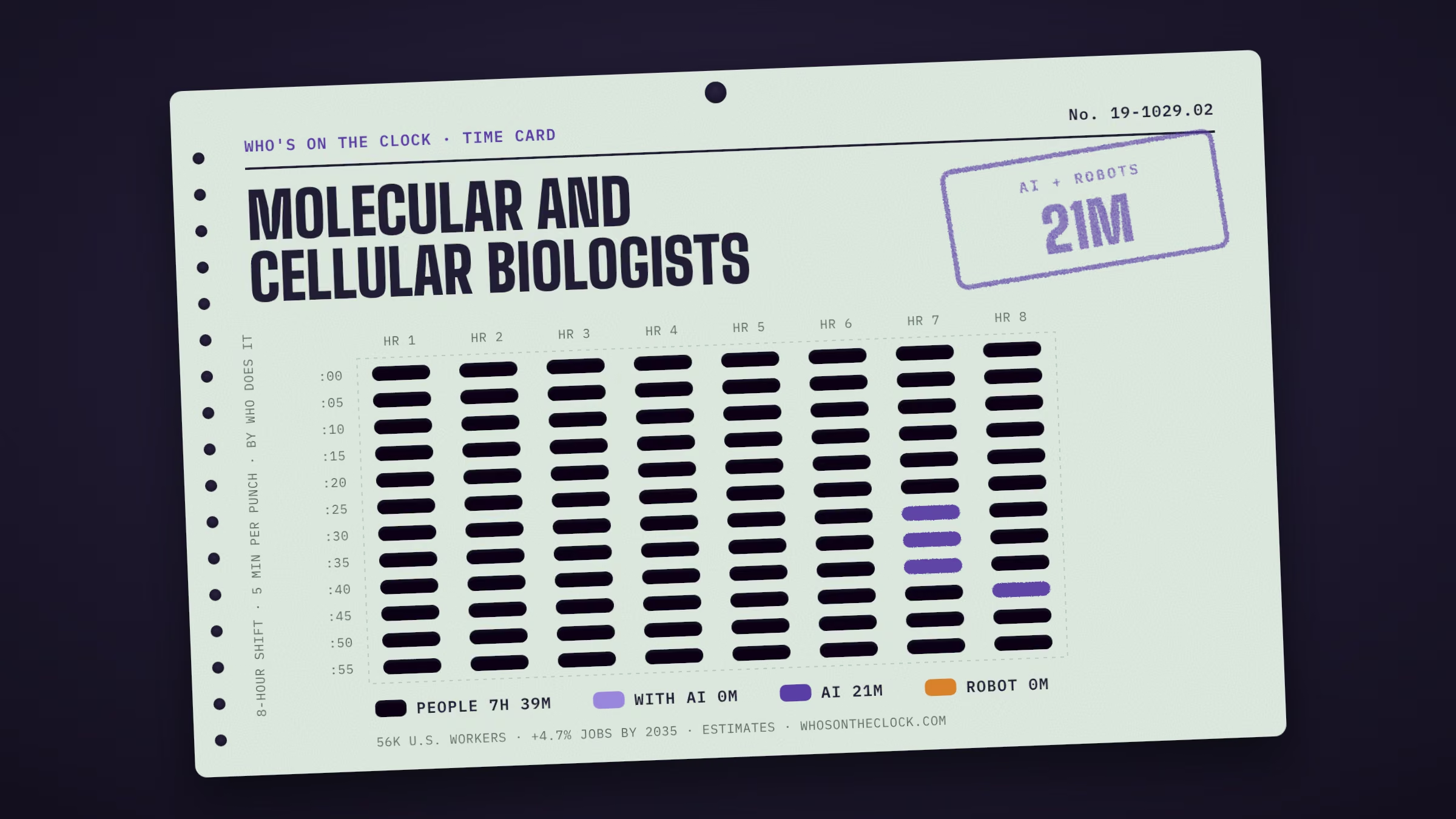
Research and study cellular molecules and organelles to understand cell function and organization.
Time card
Untick tasks you don't do, or set your own times.
| Mine | Task, by time spent | Human | With AI | AI | Robot |
|---|---|---|---|---|---|
Perform laboratory procedures following protocols including deoxyribonucleic acid (DNA) sequencing, cloning and extraction, ribonucleic acid (RNA) purification, or gel electrophoresis.1h 8m a shift · Robots only in factory cellsWhy this label?Robots have done this only in factory setups built around the machine, so it stays Human for molecular and cellular biologists. How labels work | |||||
Design molecular or cellular laboratory experiments, oversee their execution, and interpret results.47m a shift · No AI or robot evidence foundWhy this label?No AI use or robot deployment showed up for this task in our data. That isn't proof it's safe; it may just be rare in the data. How labels work | |||||
Conduct research on cell organization and function, including mechanisms of gene expression, cellular bioinformatics, cell signaling, or cell differentiation.47m a shift · Robots only in factory cellsWhy this label?Robots have done this only in factory setups built around the machine, so it stays Human for molecular and cellular biologists. How labels work | |||||
Prepare or review reports, manuscripts, or meeting presentations.42m a shift · No AI or robot evidence foundWhy this label?No AI use or robot deployment showed up for this task in our data. That isn't proof it's safe; it may just be rare in the data. How labels work | |||||
Compile and analyze molecular or cellular experimental data and adjust experimental designs as necessary.42m a shift · No AI or robot evidence foundWhy this label?No AI use or robot deployment showed up for this task in our data. That isn't proof it's safe; it may just be rare in the data. How labels work | |||||
Maintain accurate laboratory records and data.31m a shift · No AI or robot evidence foundWhy this label?No AI use or robot deployment showed up for this task in our data. That isn't proof it's safe; it may just be rare in the data. How labels work | |||||
Write grant applications to obtain funding.26m a shift · No AI or robot evidence foundWhy this label?No AI use or robot deployment showed up for this task in our data. That isn't proof it's safe; it may just be rare in the data. How labels work | |||||
Instruct undergraduate and graduate students within the areas of cellular or molecular biology.21m a shift · No AI or robot evidence foundWhy this label?No AI use or robot deployment showed up for this task in our data. That isn't proof it's safe; it may just be rare in the data. How labels work | |||||
Direct, coordinate, organize, or prioritize biological laboratory activities.21m a shift · No AI or robot evidence foundWhy this label?No AI use or robot deployment showed up for this task in our data. That isn't proof it's safe; it may just be rare in the data. How labels work | |||||
Supervise technical personnel and postdoctoral research fellows.21m a shift · No AI or robot evidence foundWhy this label?No AI use or robot deployment showed up for this task in our data. That isn't proof it's safe; it may just be rare in the data. How labels work | |||||
Monitor or operate specialized equipment, such as gas chromatographs and high pressure liquid chromatographs, electrophoresis units, thermocyclers, fluorescence activated cell sorters, and phosphorimagers.21m a shift · Robots only in factory cellsWhy this label?Robots have done this only in factory setups built around the machine, so it stays Human for molecular and cellular biologists. How labels work | |||||
Conduct applied research aimed at improvements in areas such as disease testing, crop quality, pharmaceuticals, and the harnessing of microbes to recycle waste.16m a shift · Observed in AI useWhy this label?Marked AI because this task shows up regularly in real AI conversations (Anthropic Economic Index, 2025 usage), and in most of them AI does the task on its own rather than helping a person. Many workplaces may not use AI for it at all. How labels work | |||||
Develop assays that monitor cell characteristics.16m a shift · Robots only in factory cellsWhy this label?Robots have done this only in factory setups built around the machine, so it stays Human for molecular and cellular biologists. How labels work | |||||
Evaluate new technologies to enhance or complement current research.10m a shift · No AI or robot evidence foundWhy this label?No AI use or robot deployment showed up for this task in our data. That isn't proof it's safe; it may just be rare in the data. How labels work | |||||
Provide scientific direction for project teams regarding the evaluation or handling of devices, drugs, or cells for in vitro and in vivo disease models.10m a shift · No AI or robot evidence foundWhy this label?No AI use or robot deployment showed up for this task in our data. That isn't proof it's safe; it may just be rare in the data. How labels work | |||||
Coordinate molecular or cellular research activities with scientists specializing in other fields.10m a shift · No AI or robot evidence foundWhy this label?No AI use or robot deployment showed up for this task in our data. That isn't proof it's safe; it may just be rare in the data. How labels work | |||||
Develop guidelines for procedures such as the management of viruses.5m a shift · No AI or robot evidence foundWhy this label?No AI use or robot deployment showed up for this task in our data. That isn't proof it's safe; it may just be rare in the data. How labels work | |||||
Verify all financial, physical, and human resources assigned to research or development projects are used as planned.5m a shift · No AI or robot evidence foundWhy this label?No AI use or robot deployment showed up for this task in our data. That isn't proof it's safe; it may just be rare in the data. How labels work | |||||
Evaluate new supplies and equipment to ensure operability in specific laboratory settings.5m a shift · Robots only in factory cellsWhy this label?Robots have done this only in factory setups built around the machine, so it stays Human for molecular and cellular biologists. How labels work | |||||
Participate in all levels of bioproduct development, including proposing new products, performing market analyses, designing and performing experiments, and collaborating with operations and quality control teams during product launches.5m a shift · Observed in AI useWhy this label?Marked AI because this task shows up regularly in real AI conversations (Anthropic Economic Index, 2025 usage), and in most of them AI does the task on its own rather than helping a person. Many workplaces may not use AI for it at all. How labels work | |||||
Confer with vendors to evaluate new equipment or reagents or to discuss the customization of product lines to meet user requirements.5m a shift · No AI or robot evidence foundWhy this label?No AI use or robot deployment showed up for this task in our data. That isn't proof it's safe; it may just be rare in the data. How labels work | |||||
Design databases, such as mutagenesis libraries.5m a shift · No AI or robot evidence foundWhy this label?No AI use or robot deployment showed up for this task in our data. That isn't proof it's safe; it may just be rare in the data. How labels work |