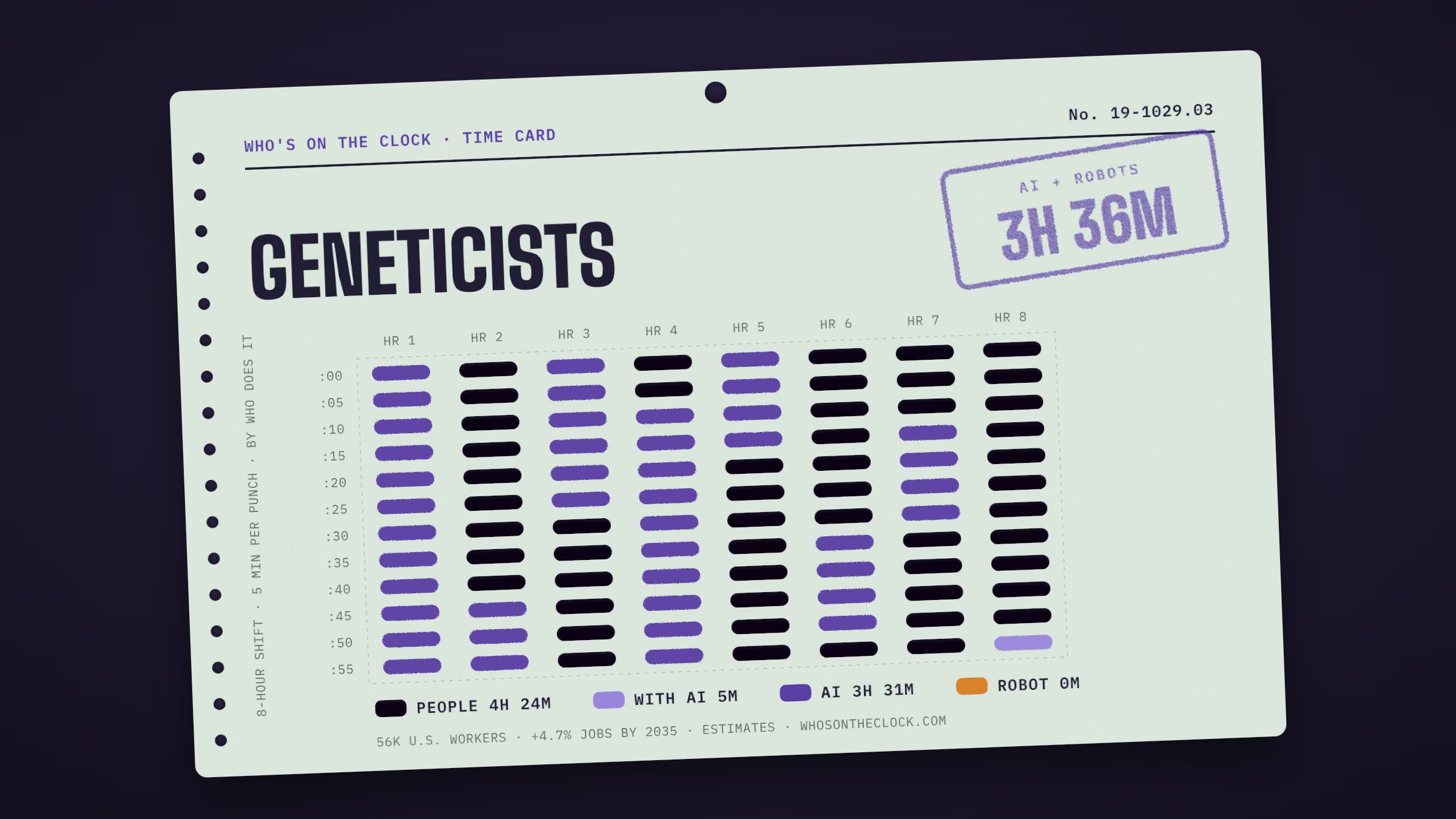
Research and study the inheritance of traits at the molecular, organism or population level. May evaluate or treat patients with genetic disorders.
Time card
Untick tasks you don't do, or set your own times.
| Mine | Task, by time spent | Human | With AI | AI | Robot |
|---|---|---|---|---|---|
Plan or conduct basic genomic and biological research related to areas such as regulation of gene expression, protein interactions, metabolic networks, and nucleic acid or protein complexes.58m a shift · Observed in AI useWhy this label?Marked AI because this task shows up regularly in real AI conversations (Anthropic Economic Index, 2025 usage), and in most of them AI does the task on its own rather than helping a person. Many workplaces may not use AI for it at all. How labels work | |||||
Supervise or direct the work of other geneticists, biologists, technicians, or biometricians working on genetics research projects.42m a shift · No AI or robot evidence foundWhy this label?No AI use or robot deployment showed up for this task in our data. That isn't proof it's safe; it may just be rare in the data. How labels work | |||||
Prepare results of experimental findings for presentation at professional conferences or in scientific journals.42m a shift · Observed in AI useTypical AI request: about 12h 43m alone, 1h 3m with AIWhy this label?Marked AI because this task shows up regularly in real AI conversations (Anthropic Economic Index, 2025 usage), and in most of them AI does the task on its own rather than helping a person. Many workplaces may not use AI for it at all. How labels work | |||||
Write grants and papers or attend fundraising events to seek research funds.37m a shift · No AI or robot evidence foundWhy this label?No AI use or robot deployment showed up for this task in our data. That isn't proof it's safe; it may just be rare in the data. How labels work | |||||
Evaluate genetic data by performing appropriate mathematical or statistical calculations and analyses.37m a shift · Observed in AI useWhy this label?Marked AI because this task shows up regularly in real AI conversations (Anthropic Economic Index, 2025 usage), and in most of them AI does the task on its own rather than helping a person. Many workplaces may not use AI for it at all. How labels work | |||||
Review, approve, or interpret genetic laboratory results.32m a shift · Observed in AI useWhy this label?Marked AI because this task shows up regularly in real AI conversations (Anthropic Economic Index, 2025 usage), and in most of them AI does the task on its own rather than helping a person. Many workplaces may not use AI for it at all. How labels work | |||||
Extract deoxyribonucleic acid (DNA) or perform diagnostic tests involving processes such as gel electrophoresis, Southern blot analysis, and polymerase chain reaction analysis.32m a shift · Robots only in factory cellsWhy this label?Robots have done this only in factory setups built around the machine, so it stays Human for geneticists. How labels work | |||||
Collaborate with biologists and other professionals to conduct appropriate genetic and biochemical analyses.26m a shift · No AI or robot evidence foundWhy this label?No AI use or robot deployment showed up for this task in our data. That isn't proof it's safe; it may just be rare in the data. How labels work | |||||
Maintain laboratory notebooks that record research methods, procedures, and results.21m a shift · No AI or robot evidence foundWhy this label?No AI use or robot deployment showed up for this task in our data. That isn't proof it's safe; it may just be rare in the data. How labels work | |||||
Search scientific literature to select and modify methods and procedures most appropriate for genetic research goals.21m a shift · Observed in AI useWhy this label?Marked AI because this task shows up regularly in real AI conversations (Anthropic Economic Index, 2025 usage), and in most of them AI does the task on its own rather than helping a person. Many workplaces may not use AI for it at all. How labels work | |||||
Attend clinical and research conferences and read scientific literature to keep abreast of technological advances and current genetic research findings.21m a shift · No AI or robot evidence foundWhy this label?No AI use or robot deployment showed up for this task in our data. That isn't proof it's safe; it may just be rare in the data. How labels work | |||||
Analyze determinants responsible for specific inherited traits, and devise methods for altering traits or producing new traits.21m a shift · Observed in AI useWhy this label?Marked AI because this task shows up regularly in real AI conversations (Anthropic Economic Index, 2025 usage), and in most of them AI does the task on its own rather than helping a person. Many workplaces may not use AI for it at all. How labels work | |||||
Instruct medical students, graduate students, or others in methods or procedures for diagnosis and management of genetic disorders.21m a shift · No AI or robot evidence foundWhy this label?No AI use or robot deployment showed up for this task in our data. That isn't proof it's safe; it may just be rare in the data. How labels work | |||||
Create or use statistical models for the analysis of genetic data.16m a shift · No AI or robot evidence foundWhy this label?No AI use or robot deployment showed up for this task in our data. That isn't proof it's safe; it may just be rare in the data. How labels work | |||||
Develop protocols to improve existing genetic techniques or to incorporate new diagnostic procedures.11m a shift · No AI or robot evidence foundWhy this label?This is physical work, and no robot has been shown doing it yet. How labels work | |||||
Evaluate, diagnose, or treat genetic diseases.11m a shift · No AI or robot evidence foundWhy this label?No AI use or robot deployment showed up for this task in our data. That isn't proof it's safe; it may just be rare in the data. How labels work | |||||
Maintain laboratory safety programs and train personnel in laboratory safety techniques.5m a shift · No AI or robot evidence foundWhy this label?No AI use or robot deployment showed up for this task in our data. That isn't proof it's safe; it may just be rare in the data. How labels work | |||||
Verify that cytogenetic, molecular genetic, and related equipment and instrumentation is maintained in working condition to ensure accuracy and quality of experimental results.5m a shift · No AI or robot evidence foundWhy this label?No AI use or robot deployment showed up for this task in our data. That isn't proof it's safe; it may just be rare in the data. How labels work | |||||
Confer with information technology specialists to develop computer applications for genetic data analysis.5m a shift · No AI or robot evidence foundWhy this label?No AI use or robot deployment showed up for this task in our data. That isn't proof it's safe; it may just be rare in the data. How labels work | |||||
Design sampling plans or coordinate the field collection of samples such as tissue specimens.5m a shift · No AI or robot evidence foundWhy this label?No AI use or robot deployment showed up for this task in our data. That isn't proof it's safe; it may just be rare in the data. How labels work | |||||
Conduct family medical studies to evaluate the genetic basis for traits or diseases.5m a shift · No AI or robot evidence foundWhy this label?No AI use or robot deployment showed up for this task in our data. That isn't proof it's safe; it may just be rare in the data. How labels work | |||||
Design and maintain genetics computer databases.5m a shift · Observed in AI useWhy this label?Marked With AI because people regularly use AI to help with this task in real conversations (Anthropic Economic Index, 2025 usage), but AI doesn't usually finish it alone. How labels work | |||||
Participate in the development of endangered species breeding programs or species survival plans.time not estimated · No AI or robot evidence foundWhy this label?No AI use or robot deployment showed up for this task in our data. That isn't proof it's safe; it may just be rare in the data. How labels work | |||||
Plan curatorial programs for species collections that include acquisition, distribution, maintenance, or regeneration.time not estimated · No AI or robot evidence foundWhy this label?No AI use or robot deployment showed up for this task in our data. That isn't proof it's safe; it may just be rare in the data. How labels work |