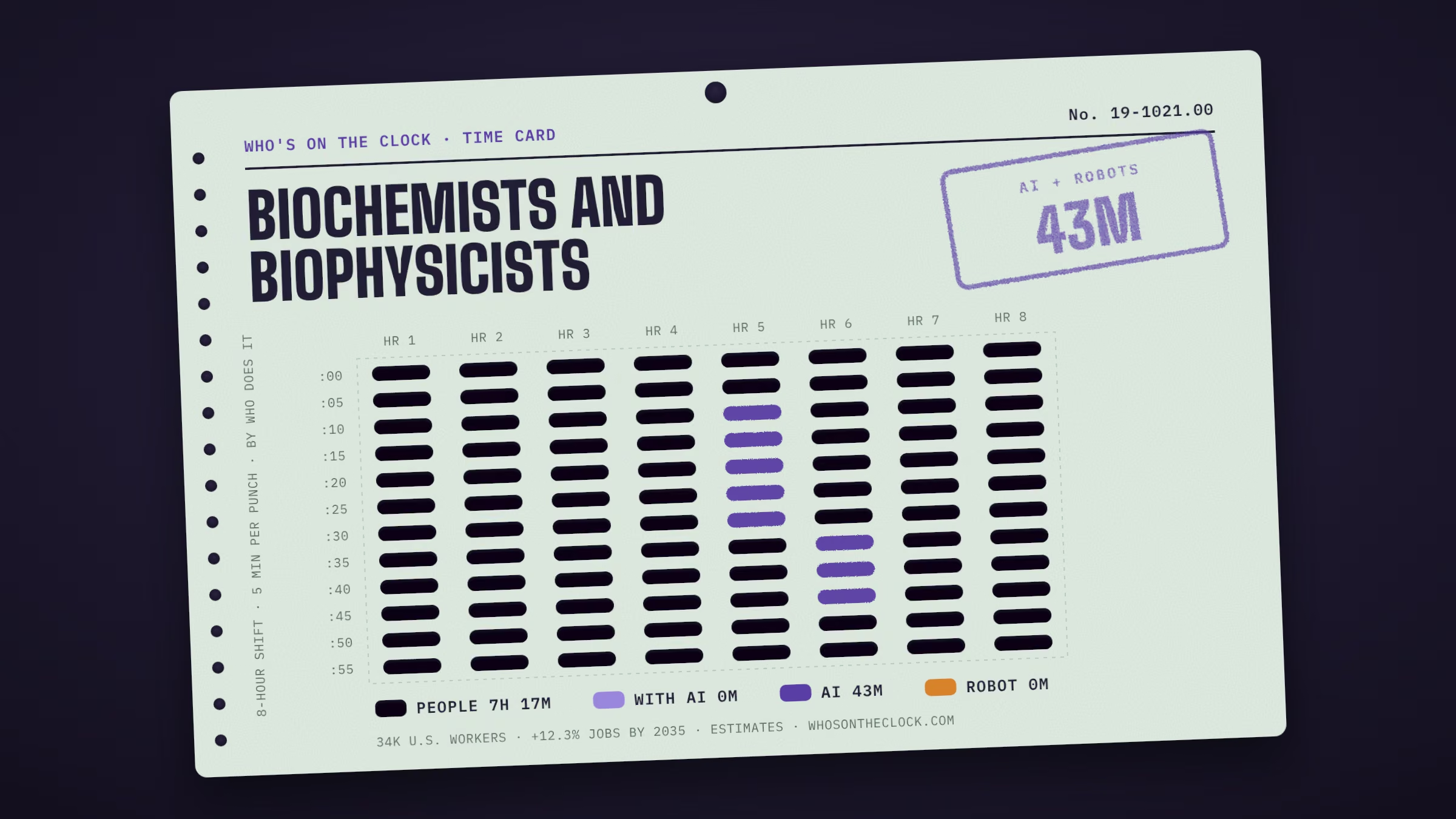
Study the chemical composition or physical principles of living cells and organisms, their electrical and mechanical energy, and related phenomena. May conduct research to further understanding of the complex chemical combinations and reactions involved in metabolism, reproduction, growth, and heredity. May determine the effects of foods, drugs, serums, hormones, and other substances on tissues and vital processes of living organisms.
Time card
Untick tasks you don't do, or set your own times.
| Mine | Task, by time spent | Human | With AI | AI | Robot |
|---|---|---|---|---|---|
Design or perform experiments with equipment, such as lasers, accelerators, or mass spectrometers.59m a shift · Robots only in factory cellsWhy this label?Robots have done this only in factory setups built around the machine, so it stays Human for biochemists and biophysicists. How labels work | |||||
Share research findings by writing scientific articles or by making presentations at scientific conferences.48m a shift · No AI or robot evidence foundWhy this label?No AI use or robot deployment showed up for this task in our data. That isn't proof it's safe; it may just be rare in the data. How labels work | |||||
Teach or advise undergraduate or graduate students or supervise their research.37m a shift · No AI or robot evidence foundWhy this label?No AI use or robot deployment showed up for this task in our data. That isn't proof it's safe; it may just be rare in the data. How labels work | |||||
Manage laboratory teams or monitor the quality of a team's work.32m a shift · No AI or robot evidence foundWhy this label?No AI use or robot deployment showed up for this task in our data. That isn't proof it's safe; it may just be rare in the data. How labels work | |||||
Write grant proposals to obtain funding for research.32m a shift · No AI or robot evidence foundWhy this label?No AI use or robot deployment showed up for this task in our data. That isn't proof it's safe; it may just be rare in the data. How labels work | |||||
Develop new methods to study the mechanisms of biological processes.27m a shift · No AI or robot evidence foundWhy this label?This is physical work, and no robot has been shown doing it yet. How labels work | |||||
Prepare reports or recommendations, based upon research outcomes.27m a shift · Observed in AI useTypical AI request: about 17h 52m alone, 47m with AIWhy this label?Marked AI because this task shows up regularly in real AI conversations (Anthropic Economic Index, 2025 usage), and in most of them AI does the task on its own rather than helping a person. Many workplaces may not use AI for it at all. How labels work | |||||
Study the chemistry of living processes, such as cell development, breathing and digestion, or living energy changes, such as growth, aging, or death.27m a shift · Robots only in factory cellsWhy this label?Robots have done this only in factory setups built around the machine, so it stays Human for biochemists and biophysicists. How labels work | |||||
Research the chemical effects of substances, such as drugs, serums, hormones, or food, on tissues or vital processes.21m a shift · Robots only in factory cellsWhy this label?Robots have done this only in factory setups built around the machine, so it stays Human for biochemists and biophysicists. How labels work | |||||
Study physical principles of living cells or organisms and their electrical or mechanical energy, applying methods and knowledge of mathematics, physics, chemistry, or biology.16m a shift · Robots only in factory cellsWhy this label?Robots have done this only in factory setups built around the machine, so it stays Human for biochemists and biophysicists. How labels work | |||||
Study the mutations in organisms that lead to cancer or other diseases.16m a shift · Observed in AI useWhy this label?Marked AI because this task shows up regularly in real AI conversations (Anthropic Economic Index, 2025 usage), and in most of them AI does the task on its own rather than helping a person. Many workplaces may not use AI for it at all. How labels work | |||||
Develop or execute tests to detect diseases, genetic disorders, or other abnormalities.16m a shift · Robots only in factory cellsWhy this label?Robots have done this only in factory setups built around the machine, so it stays Human for biochemists and biophysicists. How labels work | |||||
Develop or test new drugs or medications intended for commercial distribution.16m a shift · Robots only in factory cellsWhy this label?Robots have done this only in factory setups built around the machine, so it stays Human for biochemists and biophysicists. How labels work | |||||
Isolate, analyze, or synthesize vitamins, hormones, allergens, minerals, or enzymes and determine their effects on body functions.16m a shift · Robots only in factory cellsWhy this label?Robots have done this only in factory setups built around the machine, so it stays Human for biochemists and biophysicists. How labels work | |||||
Investigate the nature, composition, or expression of genes or research how genetic engineering can impact these processes.16m a shift · Robots only in factory cellsWhy this label?Robots have done this only in factory setups built around the machine, so it stays Human for biochemists and biophysicists. How labels work | |||||
Determine the three-dimensional structure of biological macromolecules.11m a shift · Robots only in factory cellsWhy this label?Robots have done this only in factory setups built around the machine, so it stays Human for biochemists and biophysicists. How labels work | |||||
Study spatial configurations of submicroscopic molecules, such as proteins, using x-rays or electron microscopes.11m a shift · Robots only in factory cellsWhy this label?Robots have done this only in factory setups built around the machine, so it stays Human for biochemists and biophysicists. How labels work | |||||
Examine the molecular or chemical aspects of immune system functioning.11m a shift · Robots only in factory cellsWhy this label?Robots have done this only in factory setups built around the machine, so it stays Human for biochemists and biophysicists. How labels work | |||||
Develop methods to process, store, or use foods, drugs, or chemical compounds.11m a shift · Robots only in factory cellsWhy this label?Robots have done this only in factory setups built around the machine, so it stays Human for biochemists and biophysicists. How labels work | |||||
Produce pharmaceutically or industrially useful proteins, using recombinant DNA technology.11m a shift · Robots only in factory cellsWhy this label?Robots have done this only in factory setups built around the machine, so it stays Human for biochemists and biophysicists. How labels work | |||||
Design or build laboratory equipment needed for special research projects.5m a shift · No AI or robot evidence foundWhy this label?This is physical work, and no robot has been shown doing it yet. How labels work | |||||
Research transformations of substances in cells, using atomic isotopes.5m a shift · Robots only in factory cellsWhy this label?Robots have done this only in factory setups built around the machine, so it stays Human for biochemists and biophysicists. How labels work | |||||
Research how characteristics of plants or animals are carried through successive generations.5m a shift · Robots only in factory cellsWhy this label?Robots have done this only in factory setups built around the machine, so it stays Human for biochemists and biophysicists. How labels work | |||||
Prepare pharmaceutical compounds for commercial distribution.5m a shift · Robots only in factory cellsWhy this label?Robots have done this only in factory setups built around the machine, so it stays Human for biochemists and biophysicists. How labels work |