Will AI replace production, planning, and expediting clerks?

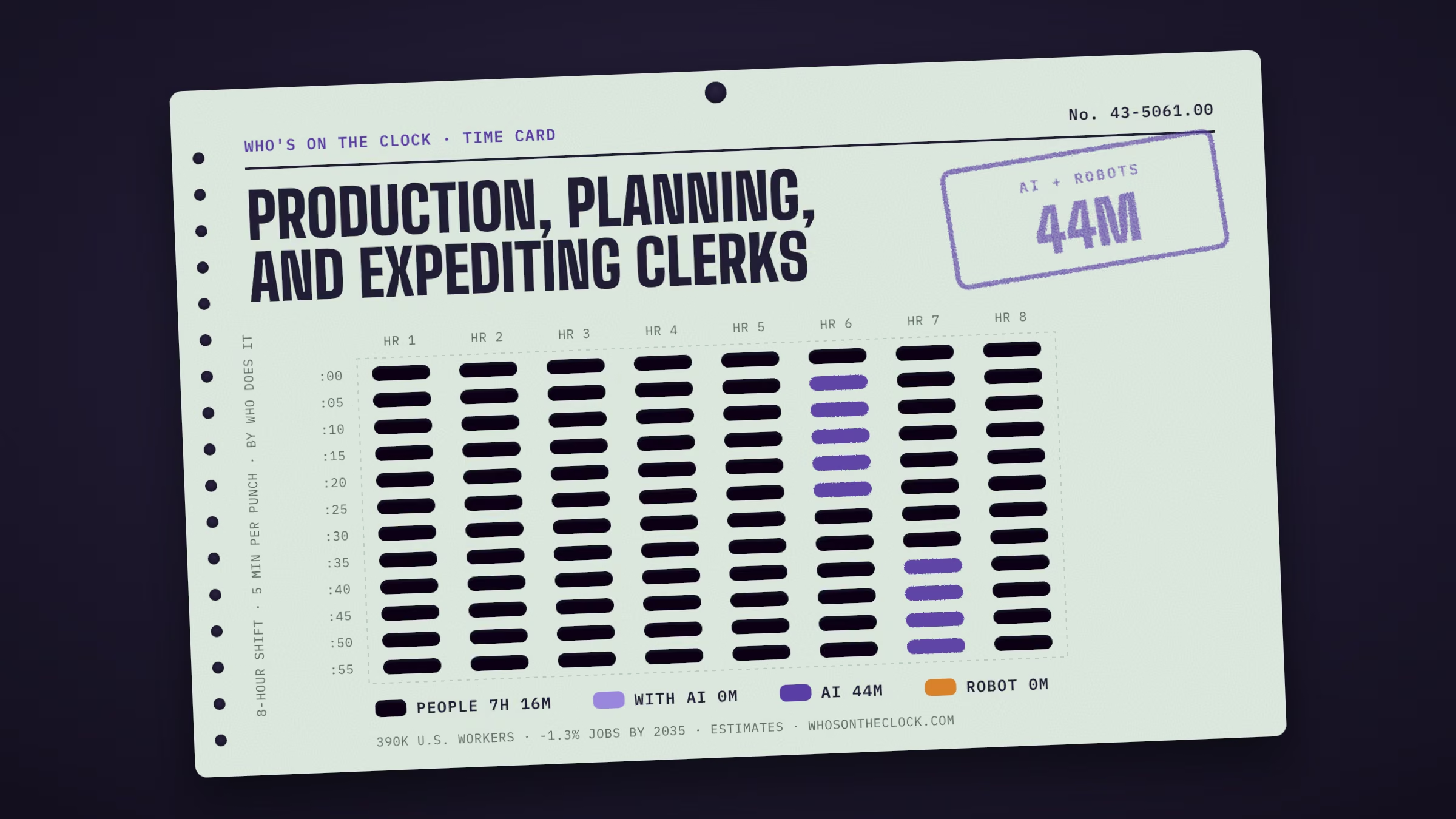
AI already handles some of this work on its own in real use, for tasks like “Examine documents, materials”. That's 44m of a typical shift; 7h 16m still has no AI or robot evidence. BLS expects about 1.3% fewer of these jobs by 2035.

Time card for production, planning, and expediting clerks showing a typical 8-hour shift: 7h 16m done by people, 44m by AI.
Each mark is 5 minutes of a typical shift for production, planning, and expediting clerks, colored by who does that task today. Estimates from O*NET tasks and Anthropic Economic Index data. How it's made

Home / Office & admin / Production, Planning, and Expediting Clerks

Coordinate and expedite the flow of work and materials within or between departments of an establishment according to production schedule. Duties include reviewing and distributing production, work, and shipment schedules; conferring with department supervisors to determine progress of work and completion dates; and compiling reports on progress of work, inventory levels, costs, and production problems.

Time card

Untick tasks you don't do, or set your own times.
MineTask, by time spentHumanWith AIAIRobot
Revise production schedules when required due to design changes, labor or material shortages, backlogs, or other interruptions, collaborating with management, marketing, sales, production, or engineering.50m a shift · No AI or robot evidence found
Why this label?No AI use or robot deployment showed up for this task in our data. That isn't proof it's safe; it may just be rare in the data. How labels work
Confer with establishment personnel, vendors, or customers to coordinate production or shipping activities and to resolve complaints or eliminate delays.50m a shift · No AI or robot evidence found
Why this label?No AI use or robot deployment showed up for this task in our data. That isn't proof it's safe; it may just be rare in the data. How labels work
Review documents, such as production schedules, work orders, or staffing tables, to determine personnel or materials requirements or material priorities.44m a shift · No AI or robot evidence found
Why this label?No AI use or robot deployment showed up for this task in our data. That isn't proof it's safe; it may just be rare in the data. How labels work
Arrange for delivery, assembly, or distribution of supplies or parts to expedite flow of materials and meet production schedules.37m a shift · No AI or robot evidence found
Why this label?No AI use or robot deployment showed up for this task in our data. That isn't proof it's safe; it may just be rare in the data. How labels work
Confer with department supervisors or other personnel to assess progress and discuss needed changes.37m a shift · No AI or robot evidence found
Why this label?No AI use or robot deployment showed up for this task in our data. That isn't proof it's safe; it may just be rare in the data. How labels work
Compile information, such as production rates and progress, materials inventories, materials used, or customer information, so that status reports can be completed.37m a shift · No AI or robot evidence found
Why this label?No AI use or robot deployment showed up for this task in our data. That isn't proof it's safe; it may just be rare in the data. How labels work
Requisition and maintain inventories of materials or supplies necessary to meet production demands.31m a shift · No AI or robot evidence found
Why this label?No AI use or robot deployment showed up for this task in our data. That isn't proof it's safe; it may just be rare in the data. How labels work
Plan production commitments or timetables for business units, specific programs, or jobs, using sales forecasts.25m a shift · No AI or robot evidence found
Why this label?No AI use or robot deployment showed up for this task in our data. That isn't proof it's safe; it may just be rare in the data. How labels work
Examine documents, materials, or products and monitor work processes to assess completeness, accuracy, and conformance to standards and specifications.25m a shift · Observed in AI useTypical AI request: about 4h 29m alone, 28m with AI
Why this label?Marked AI because this task shows up regularly in real AI conversations (Anthropic Economic Index, 2025 usage), and in most of them AI does the task on its own rather than helping a person. Many workplaces may not use AI for it at all. How labels work
Compile and prepare documentation related to production sequences, transportation, personnel schedules, or purchase, maintenance, or repair orders.25m a shift · No AI or robot evidence found
Why this label?No AI use or robot deployment showed up for this task in our data. That isn't proof it's safe; it may just be rare in the data. How labels work
Record production data, including volume produced, consumption of raw materials, or quality control measures.25m a shift · No AI or robot evidence found
Why this label?No AI use or robot deployment showed up for this task in our data. That isn't proof it's safe; it may just be rare in the data. How labels work
Distribute production schedules or work orders to departments.19m a shift · No AI or robot evidence found
Why this label?No AI use or robot deployment showed up for this task in our data. That isn't proof it's safe; it may just be rare in the data. How labels work
Calculate figures, such as required amounts of labor or materials, manufacturing costs, or wages, using pricing schedules, adding machines, calculators, or computers.19m a shift · Observed in AI useTypical AI request: about 3h 2m alone, 31m with AI
Why this label?Marked AI because this task shows up regularly in real AI conversations (Anthropic Economic Index, 2025 usage), and in most of them AI does the task on its own rather than helping a person. Many workplaces may not use AI for it at all. How labels work
Contact suppliers to verify shipment details.19m a shift · No AI or robot evidence found
Why this label?No AI use or robot deployment showed up for this task in our data. That isn't proof it's safe; it may just be rare in the data. How labels work
Maintain files, such as maintenance records, bills of lading, or cost reports.19m a shift · No AI or robot evidence found
Why this label?No AI use or robot deployment showed up for this task in our data. That isn't proof it's safe; it may just be rare in the data. How labels work
Provide documentation and information to account for delays, difficulties, or changes to cost estimates.12m a shift · No AI or robot evidence found
Why this label?No AI use or robot deployment showed up for this task in our data. That isn't proof it's safe; it may just be rare in the data. How labels work
Establish and prepare product construction directions and locations and information on required tools, materials, equipment, numbers of workers needed, and cost projections.6m a shift · No AI or robot evidence found
Why this label?No AI use or robot deployment showed up for this task in our data. That isn't proof it's safe; it may just be rare in the data. How labels work

Clock history

  1. 44m touchedFirst published: O*NET 30.1, Anthropic Economic Index (2025 usage and September 2026 robot study), BLS May 2025

When new data changes this clock, the date, the new numbers and the reason are logged here. Company news alone never moves the clock.

On the floor

  1. AnnouncedPlataine
    Plataine shows AI agents that reschedule composites production

    Plataine demonstrated AI agents, including an AI Production Scheduler that reschedules work when priorities or machine availability change. When authorized, the agents can execute approved decisions within set limits.

    CompositesWorld

Ask the clock

Will AI replace production, planning, and expediting clerks?

Unlikely, though parts of the work are changing. About 44m of an 8-hour shift goes to tasks touched by AI working on its own. The other 7h 16m (91%) stays with people. Separately, BLS expects about 1.3% fewer of these jobs by 2035 (all jobs: +3.5%).

What can AI already do for production, planning, and expediting clerks?

AI shows up regularly in 2 of 17 tasks, about 44m of a typical shift. The biggest ones:

  • Examine documents, materials, or products and monitor work processes to assess completeness, accuracy, and conformance to standards and specifications. (25m a shift, AI mostly does it alone)
  • Calculate figures, such as required amounts of labor or materials, manufacturing costs, or wages, using pricing schedules, adding machines, calculators, or computers. (19m a shift, AI mostly does it alone)
What still needs a person?

7h 16m of a typical shift, or 91%, goes to tasks with no AI or robot evidence yet. No AI usage or robot deployment has shown up for these so far. The biggest:

  • Revise production schedules when required due to design changes, labor or material shortages, backlogs, or other interruptions, collaborating with management, marketing, sales, production, or engineering. (50m a shift)
  • Confer with establishment personnel, vendors, or customers to coordinate production or shipping activities and to resolve complaints or eliminate delays. (50m a shift)
  • Review documents, such as production schedules, work orders, or staffing tables, to determine personnel or materials requirements or material priorities. (44m a shift)
  • Arrange for delivery, assembly, or distribution of supplies or parts to expedite flow of materials and meet production schedules. (37m a shift)
  • Confer with department supervisors or other personnel to assess progress and discuss needed changes. (37m a shift)
Why is that work hard to automate?

Much of it comes down to where and how the work happens. In-person, hands-on and high-stakes work is where AI and robots have made the least headway so far. In the official O*NET survey of people in this job:

  • 92% talk face to face with others every day
  • 65% are in constant contact with other people
  • 54% say dealing with the public is very or extremely important
What are companies actually doing?

We track 1 sourced company move that affects this job. Most recent:

  • Jul 23, 2026: Plataine shows AI agents that reschedule composites production (Announced)
How much time does AI save on these tasks?

For the 2 tasks in this job where AI shows up and timing data exists, a typical request takes about 3h 46m for a person alone and about 30m with AI. These are Claude's own estimates from real conversations in April and May 2026 (Anthropic Economic Index). They describe single requests, not whole workdays, and time saved on a task doesn't mean jobs are cut. The biggest gaps:

  • Examine documents, materials, or products and monitor work processes to assess completeness, accuracy, and conformance to standards and specifications (about 4h 29m alone, 28m with AI)
  • Calculate figures, such as required amounts of labor or materials, manufacturing costs, or wages, using pricing schedules, adding machines, calculators, or computers (about 3h 2m alone, 31m with AI)
Are employers still hiring production, planning, and expediting clerks?

On Indeed, job postings in the Logistic Support sector are at 119% of their February 2020 level (all U.S. postings: 104%), up 5.1% from a year earlier, as of Oct 9, 2026. BLS separately expects about 33,000 openings a year in this job through 2035. Across all U.S. postings, 7.3% now mention AI skills. Sector postings cover more than this one job and move for many reasons besides AI.

How much do production, planning, and expediting clerks make?

The median pay is about $59,650 a year ($28.68 an hour), 17% above the median for all U.S. jobs ($50,980). Most people in this job earn between $40,080 and $86,000 a year; that range covers the middle 80%. Pay figures are from BLS, May 2025, and vary a lot by state and employer. Pick a state to compare:

Is this job growing or shrinking?

BLS projects a decline of 1.3% from 2025 to 2035, compared with 3.5% growth for all jobs. That's about 387,000 jobs in 2035. Even so, it expects about 33,000 openings a year, mostly from people retiring or changing careers. These projections don't single out AI as a cause.

How many production, planning, and expediting clerks are there in the U.S.?

About 390,000 people in the U.S., roughly 0.25% of all workers (BLS, May 2025). That makes it the 107th largest of the 796 jobs on this site. BLS expects about 387,000 in 2035.

What training do production, planning, and expediting clerks need?

The most common requirement is a high school diploma: about 37% of people in the job said so in the official O*NET survey. O*NET rates the job at level 2 of 5 for preparation, which usually means: high school diploma, some training. Requirements vary by state and employer, especially for licensed work.

What should I learn to stay ahead of AI?

These come from the job's official skill ratings and from the tasks that AI and robots touch least today. Building them keeps you strong in the parts of the work that still need a person:

  • Skills that matter more here than in most jobs: Time Management, Reading Comprehension, Speaking, Writing
  • Get strong at the parts of the job that stay with people (listed above), which take 7h 16m of a typical shift
  • Tools employers list: Microsoft Word, Microsoft PowerPoint, Microsoft Outlook, Microsoft Office software, Microsoft Excel
  • Learn to use AI well on the tasks where it already shows up in this job (listed above)
What other jobs could production, planning, and expediting clerks move into?

These use similar skills. Matches come from 109 official ratings of skills, knowledge and work activities, and each needs the same or less preparation unless the official list relates the jobs directly:

  • Project Management Specialists (1h 20m touched, $102k median pay)
  • Shipping, Receiving, and Inventory Clerks (50m touched, $45k median pay)
  • First-Line Supervisors of Helpers, Laborers, and Material Movers, Hand (2h 12m touched, $63k median pay)
  • First-Line Supervisors of Production and Operating Workers (11m touched, $74k median pay)
  • Weighers, Measurers, Checkers, and Samplers, Recordkeeping (1h 36m touched, $46k median pay)
How solid are these numbers?

Each task carries its own evidence label. For this job: 2 observed in real AI use, 15 with no AI or robot evidence found. The minutes per task are estimates, not measured hours, and "no evidence" doesn't prove a task is safe.

Tools in demand

  • Adobe Acrobat
  • Adobe Illustrator
  • Adobe InDesign

Plus everyday office tools: Microsoft Word, Microsoft PowerPoint, Microsoft Outlook, Microsoft Office software, Microsoft Excel.

Also called

Advertising Dispatch Clerk, Aircraft Log Clerk, Alterations Workroom Clerk, Assignment Agent, Assignment Clerk, Automated Logistical Specialist, Back Shoe Worker, Batch Records Clerk, Beef Tagger, Billet Recorder, Box Estimator, Clerical Production Worker, Computer Processing Scheduler, Computerized Mill Recorder