Will AI replace first-line supervisors of helpers, laborers, and material movers, hand?

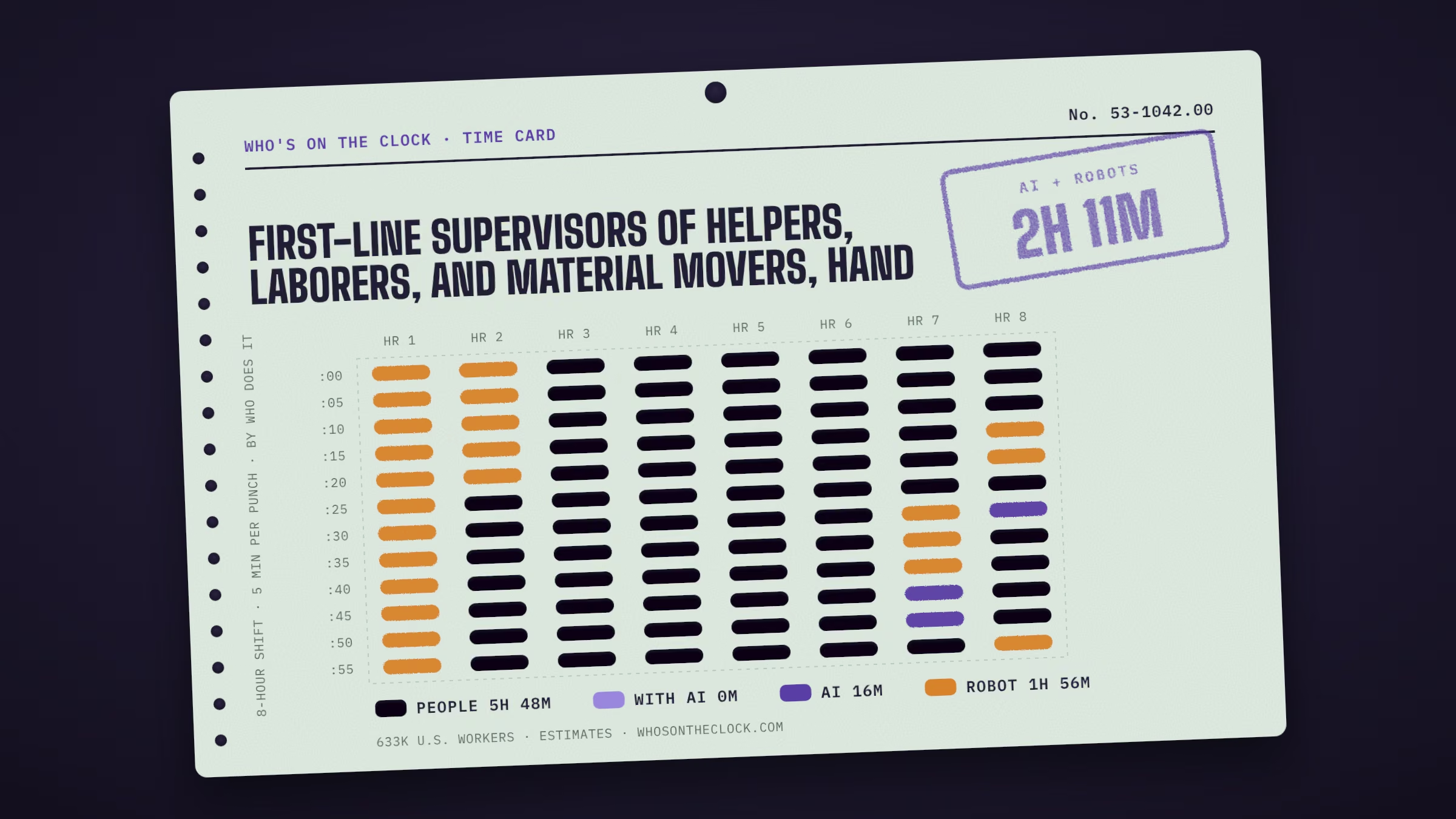
Some tasks are already handled by AI or machines; the rest still needs a person. About 2h 11m of an 8-hour shift goes to tasks that AI or robots largely take over. The breakdown: 16m that AI mostly does alone, 1h 56m that robots have done in real workplaces. The other 5h 48m (73%) stays with people.

Time card for first-line supervisors of helpers, laborers, and material movers, hand showing a typical 8-hour shift: 5h 48m done by people, 16m by AI, 1h 56m by robots.
Each mark is 5 minutes of a typical shift for first-line supervisors of helpers, laborers, and material movers, hand, colored by who does that task today. Estimates from O*NET tasks and Anthropic Economic Index data. How it's made

Home / Transportation & warehouse / First-Line Supervisors of Helpers, Laborers, and Material Movers, Hand

Directly supervise and coordinate the activities of helpers, laborers, or material movers, hand.

Time card

Untick tasks you don't do, or set your own times.
MineTask, by time spentHumanWith AIAIRobot
Perform the same work duties as those supervised, or perform more difficult or skilled tasks or assist in their performance.1h 24m a shift · Robots deployed · e.g. Stretch
Review work throughout the work process and at completion to ensure that it has been performed properly.53m a shift · No AI or robot evidence found
Collaborate with workers and managers to solve work-related problems.37m a shift · No AI or robot evidence found
Maintain a safe working environment by monitoring safety procedures and equipment.32m a shift · No AI or robot evidence found
Prepare and maintain work records and reports of information such as employee time and wages, daily receipts, or inspection results.32m a shift · No AI or robot evidence found
Transmit and explain work orders to laborers.32m a shift · No AI or robot evidence found
Plan work schedules and assign duties to maintain adequate staff for effective performance of activities and response to fluctuating workloads.32m a shift · No AI or robot evidence found
Inform designated employees or departments of items loaded or problems encountered.21m a shift · No AI or robot evidence found
Inspect equipment for wear and for conformance to specifications.16m a shift · Robots only in factory cells
Estimate material, time, and staffing requirements for a given project, based on work orders, job specifications, and experience.16m a shift · No AI or robot evidence found
Assess training needs of staff and arrange for or provide appropriate instruction.16m a shift · No AI or robot evidence found
Conduct staff meetings to relay general information or to address specific topics, such as safety.16m a shift · No AI or robot evidence found
Check specifications of materials loaded or unloaded against information contained in work orders.16m a shift · Robots deployed · e.g. Verity inventory drones
Participate in the hiring process by reviewing credentials, conducting interviews, or making hiring decisions or recommendations.11m a shift · Observed in AI useTypical AI request: about 4h 32m alone, 38m with AI
Counsel employees in work-related activities, personal growth, or career development.11m a shift · No AI or robot evidence found
Resolve personnel problems, complaints, or formal grievances when possible, or refer them to higher-level supervisors for resolution.11m a shift · No AI or robot evidence found
Inventory supplies and requisition or purchase additional items, as necessary.11m a shift · Robots deployed · e.g. Verity inventory drones at UPS Velocity facility
Recommend or initiate personnel actions, such as promotions, transfers, or disciplinary measures.5m a shift · No AI or robot evidence found
Evaluate employee performance and prepare performance appraisals.5m a shift · Observed in AI useTypical AI request: about 4h 38m alone, 33m with AI
Examine freight to determine loading sequences.5m a shift · No AI or robot evidence found
Schedule times of shipment and modes of transportation for materials.5m a shift · No AI or robot evidence found
Quote prices to customers.5m a shift · No AI or robot evidence found
Provide assistance in balancing books, tracking, monitoring, or projecting a unit's budget needs, and in developing unit policies and procedures.5m a shift · No AI or robot evidence found
Inspect job sites to determine the extent of maintenance or repairs needed.5m a shift · Robots deployed · e.g. Spot with Orbit (Boston Dynamics)

On the floor

No company news tracked for this job yet. New stories are added as they happen.

Ask the clock

Will AI replace first-line supervisors of helpers, laborers, and material movers, hand?

Some tasks are already handled by AI or machines; the rest still needs a person. About 2h 11m of an 8-hour shift goes to tasks that AI or robots largely take over. The breakdown: 16m that AI mostly does alone, 1h 56m that robots have done in real workplaces. The other 5h 48m (73%) stays with people.

What can AI already do for first-line supervisors of helpers, laborers, and material movers, hand?

AI shows up regularly in 2 of 24 tasks, about 16m of a typical shift. The biggest ones:

  • Participate in the hiring process by reviewing credentials, conducting interviews, or making hiring decisions or recommendations. (11m a shift, AI mostly does it alone)
  • Evaluate employee performance and prepare performance appraisals. (5m a shift, AI mostly does it alone)
Where do robots fit in?

For some tasks, yes. Robots have done 4 of this job's tasks in workplaces like this one, about 1h 56m of a typical shift. 1 more task has only been done in factory setups built around the machine, so it stays with people here. For 2 physical tasks, no robot has shown it can do the work yet.

  • Perform the same work duties as those supervised, or perform more difficult or skilled tasks or assist in their performance. (1h 24m a shift; e.g. Stretch, in use)
  • Check specifications of materials loaded or unloaded against information contained in work orders. (16m a shift; e.g. Verity inventory drones, in use)
  • Inventory supplies and requisition or purchase additional items, as necessary. (11m a shift; e.g. Verity inventory drones at UPS Velocity facility, in use)
  • Inspect job sites to determine the extent of maintenance or repairs needed. (5m a shift; e.g. Spot with Orbit (Boston Dynamics), in use)
What still needs a person?

5h 48m of a typical shift, or 73%, goes to tasks with no AI or robot evidence yet. No AI usage or robot deployment has shown up for these so far. The biggest:

  • Review work throughout the work process and at completion to ensure that it has been performed properly. (53m a shift)
  • Collaborate with workers and managers to solve work-related problems. (37m a shift)
  • Maintain a safe working environment by monitoring safety procedures and equipment. (32m a shift)
  • Prepare and maintain work records and reports of information such as employee time and wages, daily receipts, or inspection results. (32m a shift)
  • Transmit and explain work orders to laborers. (32m a shift)
Why is that work hard to automate?

Much of it comes down to where and how the work happens. In-person, hands-on and high-stakes work is where AI and robots have made the least headway so far. In the official O*NET survey of people in this job:

  • 98% talk face to face with others every day
  • 94% are in constant contact with other people
  • 63% say dealing with the public is very or extremely important
How much time does AI save on these tasks?

For the 2 tasks in this job where AI shows up and timing data exists, a typical request takes about 4h 35m for a person alone and about 36m with AI. These are Claude's own estimates from real conversations in April and May 2026 (Anthropic Economic Index). They describe single requests, not whole workdays, and time saved on a task doesn't mean jobs are cut. The biggest gaps:

  • Evaluate employee performance and prepare performance appraisals (about 4h 38m alone, 33m with AI)
  • Participate in the hiring process by reviewing credentials, conducting interviews, or making hiring decisions or recommendations (about 4h 32m alone, 38m with AI)
Are employers still hiring first-line supervisors of helpers, laborers, and material movers, hand?

On Indeed, job postings in the Logistic Support sector are at 119% of their February 2020 level (all U.S. postings: 104%), up 5.1% from a year earlier, as of Oct 9, 2026. Across all U.S. postings, 7.3% now mention AI skills. Sector postings cover more than this one job and move for many reasons besides AI.

How much do first-line supervisors of helpers, laborers, and material movers, hand make?

The median pay is about $62,840 a year ($30.21 an hour), 23% above the median for all U.S. jobs ($50,980). Most people in this job earn between $43,350 and $96,100 a year; that range covers the middle 80%. Pay figures are from BLS, May 2025, and vary a lot by state and employer.

How many first-line supervisors of helpers, laborers, and material movers, hand are there in the U.S.?

About 633,000 people in the U.S., roughly 0.41% of all workers (BLS, May 2025). That makes it the 64th largest of the 796 jobs on this site.

What training do first-line supervisors of helpers, laborers, and material movers, hand need?

The most common requirement is a high school diploma: about 35% of people in the job said so in the official O*NET survey. O*NET rates the job at level 2 of 5 for preparation, which usually means: high school diploma, some training. Requirements vary by state and employer, especially for licensed work.

What should I learn to stay ahead of AI?

These come from the job's official skill ratings and from the tasks that AI and robots touch least today. Building them keeps you strong in the parts of the work that still need a person:

  • Skills that matter more here than in most jobs: Management of Personnel Resources, Coordination, Time Management, Negotiation
  • Get strong at the parts of the job that stay with people (listed above), which take 5h 48m of a typical shift
  • Tools employers list: SAP software, Microsoft Word, Microsoft PowerPoint, Microsoft Outlook, Microsoft Office software
  • Learn to use AI well on the tasks where it already shows up in this job (listed above)
What other jobs could first-line supervisors of helpers, laborers, and material movers, hand move into?

These use similar skills, with less of a typical shift touched by AI or robots. Matches come from 109 official ratings of skills, knowledge and work activities, and each needs the same or less preparation unless the official list relates the jobs directly:

  • First-Line Supervisors of Production and Operating Workers (11m touched, $74k median pay)
  • First-Line Supervisors of Mechanics, Installers, and Repairers (1h 23m touched, $80k median pay)
  • First-Line Supervisors of Material-Moving Machine and Vehicle Operators (48m touched, $63k median pay)
How solid are these numbers?

Each task carries its own evidence label. For this job: 2 observed in real AI use, 4 with robots in real deployments, 18 with no AI or robot evidence found. The minutes per task are estimates, not measured hours, and "no evidence" doesn't prove a task is safe.

Tools in demand

  • SAP software
  • Microsoft Word
  • Microsoft PowerPoint
  • Microsoft Outlook
  • Microsoft Office software
  • Microsoft Excel
  • Microsoft Access
  • Oracle Database

Also called

Agency Operator, Aircraft Cleaning Supervisor, Boat and Plant Utility Supervisor, Building Materials Supervisor, Car Cleaning Supervisor, Car Wash Supervisor, Carpenter Labor Supervisor, Chute Boss, Circus Supervisor, Circus Train Supervisor, Cleaning Supervisor, Dock Boss, Field Pipe Lines Supervisor, Floor Supervisor