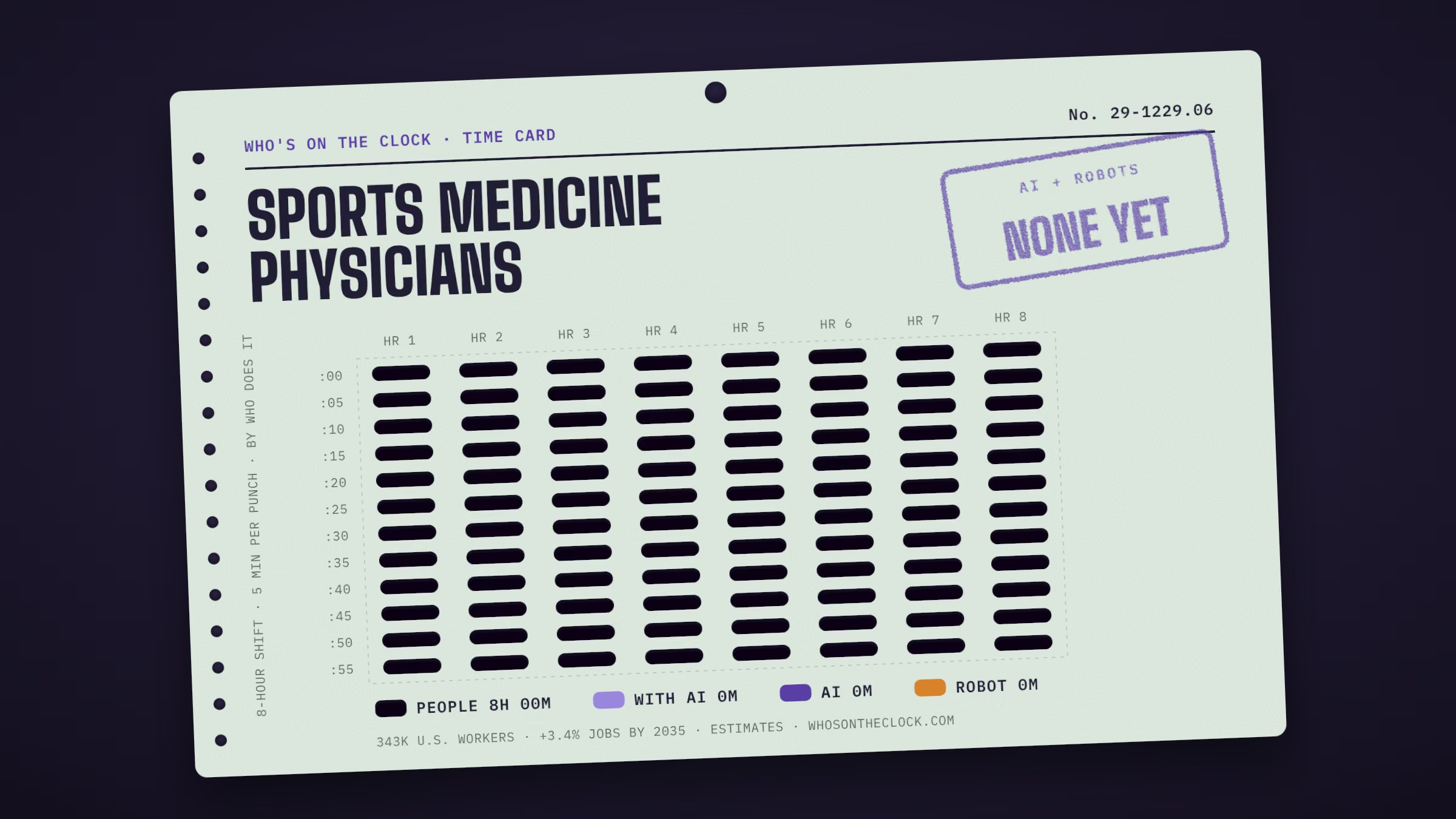
Diagnose, treat, and help prevent injuries that occur during sporting events, athletic training, and physical activities.
Time card
Untick tasks you don't do, or set your own times.
| Mine | Task, by time spent | Human | With AI | AI | Robot |
|---|---|---|---|---|---|
Diagnose or treat disorders of the musculoskeletal system.1h 50m a shift · No AI or robot evidence foundWhy this label?This is physical work, and no robot has been shown doing it yet. How labels work | |||||
Record athletes' medical care information, and maintain medical records.43m a shift · No AI or robot evidence foundWhy this label?No AI use or robot deployment showed up for this task in our data. That isn't proof it's safe; it may just be rare in the data. How labels work | |||||
Record athletes' medical histories, and perform physical examinations.38m a shift · No AI or robot evidence foundWhy this label?This is physical work, and no robot has been shown doing it yet. How labels work | |||||
Examine, evaluate and treat athletes who have been injured or who have medical problems such as exercise-induced asthma.38m a shift · No AI or robot evidence foundWhy this label?This is physical work, and no robot has been shown doing it yet. How labels work | |||||
Order and interpret the results of laboratory tests and diagnostic imaging procedures.34m a shift · No AI or robot evidence foundWhy this label?No AI use or robot deployment showed up for this task in our data. That isn't proof it's safe; it may just be rare in the data. How labels work | |||||
Attend games and competitions to provide evaluation and treatment of activity-related injuries or medical conditions.29m a shift · No AI or robot evidence foundWhy this label?This is physical work, and no robot has been shown doing it yet. How labels work | |||||
Coordinate sports care activities with other experts, including specialty physicians and surgeons, athletic trainers, physical therapists, or coaches.24m a shift · No AI or robot evidence foundWhy this label?No AI use or robot deployment showed up for this task in our data. That isn't proof it's safe; it may just be rare in the data. How labels work | |||||
Provide education and counseling on illness and injury prevention.19m a shift · No AI or robot evidence foundWhy this label?No AI use or robot deployment showed up for this task in our data. That isn't proof it's safe; it may just be rare in the data. How labels work | |||||
Examine and evaluate athletes prior to participation in sports activities to determine level of physical fitness or predisposition to injuries.14m a shift · No AI or robot evidence foundWhy this label?This is physical work, and no robot has been shown doing it yet. How labels work | |||||
Participate in continuing education activities to improve and maintain knowledge and skills.14m a shift · No AI or robot evidence foundWhy this label?No AI use or robot deployment showed up for this task in our data. That isn't proof it's safe; it may just be rare in the data. How labels work | |||||
Supervise the rehabilitation of injured athletes.14m a shift · No AI or robot evidence foundWhy this label?This is physical work, and no robot has been shown doing it yet. How labels work | |||||
Advise against injured athletes returning to games or competition if resuming activity could lead to further injury.10m a shift · No AI or robot evidence foundWhy this label?No AI use or robot deployment showed up for this task in our data. That isn't proof it's safe; it may just be rare in the data. How labels work | |||||
Inform coaches, trainers, or other interested parties regarding the medical conditions of athletes.10m a shift · No AI or robot evidence foundWhy this label?No AI use or robot deployment showed up for this task in our data. That isn't proof it's safe; it may just be rare in the data. How labels work | |||||
Refer athletes for specialized consultation, physical therapy, or diagnostic testing.10m a shift · No AI or robot evidence foundWhy this label?No AI use or robot deployment showed up for this task in our data. That isn't proof it's safe; it may just be rare in the data. How labels work | |||||
Prescribe medications for the treatment of athletic-related injuries.10m a shift · No AI or robot evidence foundWhy this label?No AI use or robot deployment showed up for this task in our data. That isn't proof it's safe; it may just be rare in the data. How labels work | |||||
Conduct research in the prevention or treatment of injuries or medical conditions related to sports and exercise.10m a shift · No AI or robot evidence foundWhy this label?No AI use or robot deployment showed up for this task in our data. That isn't proof it's safe; it may just be rare in the data. How labels work | |||||
Evaluate and manage chronic pain conditions.10m a shift · No AI or robot evidence foundWhy this label?This is physical work, and no robot has been shown doing it yet. How labels work | |||||
Advise athletes, trainers, or coaches to alter or cease sports practices that are potentially harmful.5m a shift · No AI or robot evidence foundWhy this label?No AI use or robot deployment showed up for this task in our data. That isn't proof it's safe; it may just be rare in the data. How labels work | |||||
Inform athletes about nutrition, hydration, dietary supplements, or uses and possible consequences of medication.5m a shift · No AI or robot evidence foundWhy this label?No AI use or robot deployment showed up for this task in our data. That isn't proof it's safe; it may just be rare in the data. How labels work | |||||
Develop and test procedures for dealing with emergencies during practices or competitions.5m a shift · No AI or robot evidence foundWhy this label?No AI use or robot deployment showed up for this task in our data. That isn't proof it's safe; it may just be rare in the data. How labels work | |||||
Advise coaches, trainers, or physical therapists on the proper use of exercises and other therapeutic techniques, and alert them to potentially dangerous practices.5m a shift · No AI or robot evidence foundWhy this label?No AI use or robot deployment showed up for this task in our data. That isn't proof it's safe; it may just be rare in the data. How labels work | |||||
Observe and evaluate athletes' mental well-being.5m a shift · No AI or robot evidence foundWhy this label?No AI use or robot deployment showed up for this task in our data. That isn't proof it's safe; it may just be rare in the data. How labels work | |||||
Select and prepare medical equipment or medications to be taken to athletic competition sites.5m a shift · Robots only in factory cellsWhy this label?Robots have done this only in factory setups built around the machine, so it stays Human for sports medicine physicians. How labels work | |||||
Prescribe orthotics, prosthetics, and adaptive equipment.5m a shift · No AI or robot evidence foundWhy this label?No AI use or robot deployment showed up for this task in our data. That isn't proof it's safe; it may just be rare in the data. How labels work | |||||
Develop and prescribe exercise programs, such as off-season conditioning regimens.5m a shift · No AI or robot evidence foundWhy this label?No AI use or robot deployment showed up for this task in our data. That isn't proof it's safe; it may just be rare in the data. How labels work | |||||
Advise athletes on ways that substances, such as herbal remedies, could affect drug testing results.5m a shift · No AI or robot evidence foundWhy this label?No AI use or robot deployment showed up for this task in our data. That isn't proof it's safe; it may just be rare in the data. How labels work | |||||
Provide coaches and therapists with assistance in selecting and fitting protective equipment.time not estimated · No AI or robot evidence foundWhy this label?No AI use or robot deployment showed up for this task in our data. That isn't proof it's safe; it may just be rare in the data. How labels work |