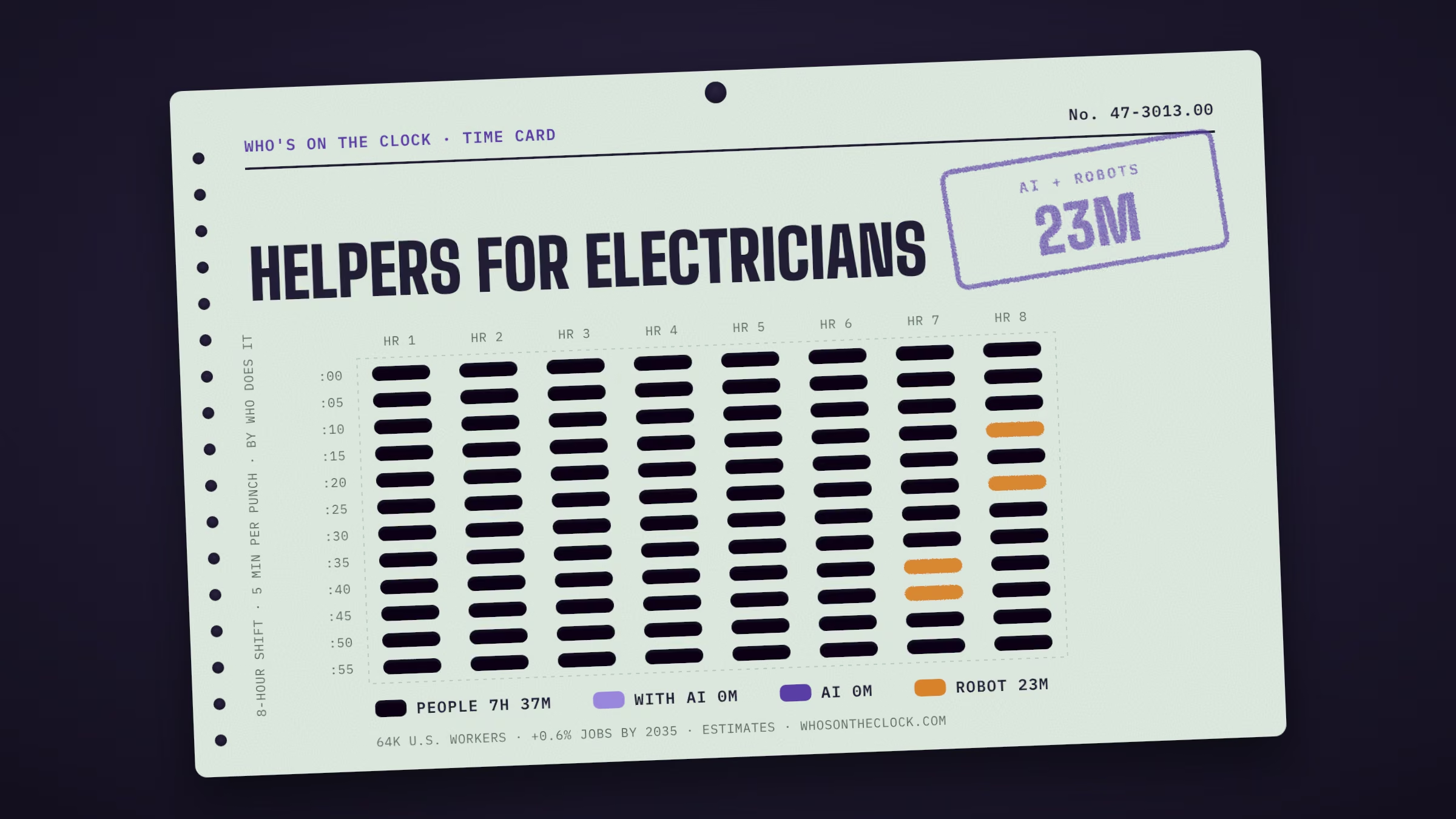
Help electricians by performing duties requiring less skill. Duties include using, supplying, or holding materials or tools, and cleaning work area and equipment.
Time card
Untick tasks you don't do, or set your own times.
| Mine | Task, by time spent | Human | With AI | AI | Robot |
|---|---|---|---|---|---|
Drill holes and pull or push wiring through openings, using hand and power tools.59m a shift · No AI or robot evidence foundWhy this label?This is physical work, and no robot has been shown doing it yet. How labels work | |||||
Measure, cut, and bend wire and conduit, using measuring instruments and hand tools.47m a shift · Robots only in factory cellsWhy this label?Robots have done this only in factory setups built around the machine, so it stays Human for helpers for electricians. How labels work | |||||
Perform semi-skilled and unskilled laboring duties related to the installation, maintenance and repair of a wide variety of electrical systems and equipment.41m a shift · Robots only in factory cellsWhy this label?Robots have done this only in factory setups built around the machine, so it stays Human for helpers for electricians. How labels work | |||||
Transport tools, materials, equipment, and supplies to work site by hand, handtruck, or heavy, motorized truck.41m a shift · Robots only in factory cellsWhy this label?Robots have done this only in factory setups built around the machine, so it stays Human for helpers for electricians. How labels work | |||||
Strip insulation from wire ends, using wire stripping pliers, and attach wires to terminals for subsequent soldering.35m a shift · Robots only in factory cellsWhy this label?Robots have done this only in factory setups built around the machine, so it stays Human for helpers for electricians. How labels work | |||||
Maintain tools, vehicles, and equipment and keep parts and supplies in order.35m a shift · Robots only in factory cellsWhy this label?Robots have done this only in factory setups built around the machine, so it stays Human for helpers for electricians. How labels work | |||||
Clean work area and wash parts.35m a shift · Robots only in factory cellsWhy this label?Robots have done this only in factory setups built around the machine, so it stays Human for helpers for electricians. How labels work | |||||
Thread conduit ends, connect couplings, and fabricate and secure conduit support brackets, using hand tools.35m a shift · Robots only in factory cellsWhy this label?Robots have done this only in factory setups built around the machine, so it stays Human for helpers for electricians. How labels work | |||||
String transmission lines or cables through ducts or conduits, under the ground, through equipment, or to towers.23m a shift · No AI or robot evidence foundWhy this label?This is physical work, and no robot has been shown doing it yet. How labels work | |||||
Examine electrical units for loose connections and broken insulation and tighten connections, using hand tools.12m a shift · Robots only in factory cellsWhy this label?Robots have done this only in factory setups built around the machine, so it stays Human for helpers for electricians. How labels work | |||||
Disassemble defective electrical equipment, replace defective or worn parts, and reassemble equipment, using hand tools.12m a shift · Robots only in factory cellsWhy this label?Robots have done this only in factory setups built around the machine, so it stays Human for helpers for electricians. How labels work | |||||
Construct controllers and panels, using power drills, drill presses, taps, saws, and punches.12m a shift · Robots only in factory cellsWhy this label?Robots have done this only in factory setups built around the machine, so it stays Human for helpers for electricians. How labels work | |||||
Dig trenches or holes for installation of conduit or supports.12m a shift · Robots deployed · e.g. Built Robotics AI Guidance System / Exosystem on excavatorsWhy this label?Marked Robot because Built Robotics AI Guidance System / Exosystem on excavators (in real use) has done this task in a real workplace. It shows a robot can do it somewhere, not that most helpers for electricians work alongside one. How labels work | |||||
Raise, lower, or position equipment, tools, and materials, using hoist, hand line, or block and tackle.12m a shift · Robots only in factory cellsWhy this label?Robots have done this only in factory setups built around the machine, so it stays Human for helpers for electricians. How labels work | |||||
Erect electrical system components and barricades, and rig scaffolds, hoists, and shoring.12m a shift · Robots only in factory cellsWhy this label?Robots have done this only in factory setups built around the machine, so it stays Human for helpers for electricians. How labels work | |||||
Trace out short circuits in wiring, using test meter.6m a shift · Robots only in factory cellsWhy this label?Robots have done this only in factory setups built around the machine, so it stays Human for helpers for electricians. How labels work | |||||
Install copper-clad ground rods, using a manual post driver.6m a shift · Robots deployed · e.g. Built Robotics RPD 35 / RPS 25 autonomous piling systemWhy this label?Marked Robot because Built Robotics RPD 35 / RPS 25 autonomous piling system (in real use) has done this task in a real workplace. It shows a robot can do it somewhere, not that most helpers for electricians work alongside one. How labels work | |||||
Bolt component parts together to form tower assemblies, using hand tools.6m a shift · Robots only in factory cellsWhy this label?Robots have done this only in factory setups built around the machine, so it stays Human for helpers for electricians. How labels work | |||||
Trim trees and clear undergrowth along right-of-way.6m a shift · Robots deployed · e.g. Swap Robotics solar robotics platformWhy this label?Marked Robot because Swap Robotics solar robotics platform (in real use) has done this task in a real workplace. It shows a robot can do it somewhere, not that most helpers for electricians work alongside one. How labels work | |||||
Requisition materials, using warehouse requisition or release forms.6m a shift · No AI or robot evidence foundWhy this label?No AI use or robot deployment showed up for this task in our data. That isn't proof it's safe; it may just be rare in the data. How labels work | |||||
Solder electrical connections, using soldering iron.6m a shift · Robots only in factory cellsWhy this label?Robots have done this only in factory setups built around the machine, so it stays Human for helpers for electricians. How labels work | |||||
Paint a variety of objects related to electrical functions.6m a shift · No AI or robot evidence foundWhy this label?This is physical work, and no robot has been shown doing it yet. How labels work | |||||
Break up concrete, using airhammer, to facilitate installation, construction, or repair of equipment.6m a shift · Robots only in factory cellsWhy this label?Robots have done this only in factory setups built around the machine, so it stays Human for helpers for electricians. How labels work | |||||
Operate heavy equipment, such as backhoes.6m a shift · Robots only in factory cellsWhy this label?Robots have done this only in factory setups built around the machine, so it stays Human for helpers for electricians. How labels work | |||||
Operate cutting torches and welding equipment, while working with conduit and metal components to construct devices associated with electrical functions.6m a shift · Robots only in factory cellsWhy this label?Robots have done this only in factory setups built around the machine, so it stays Human for helpers for electricians. How labels work |