Will AI replace recreational vehicle service technicians?
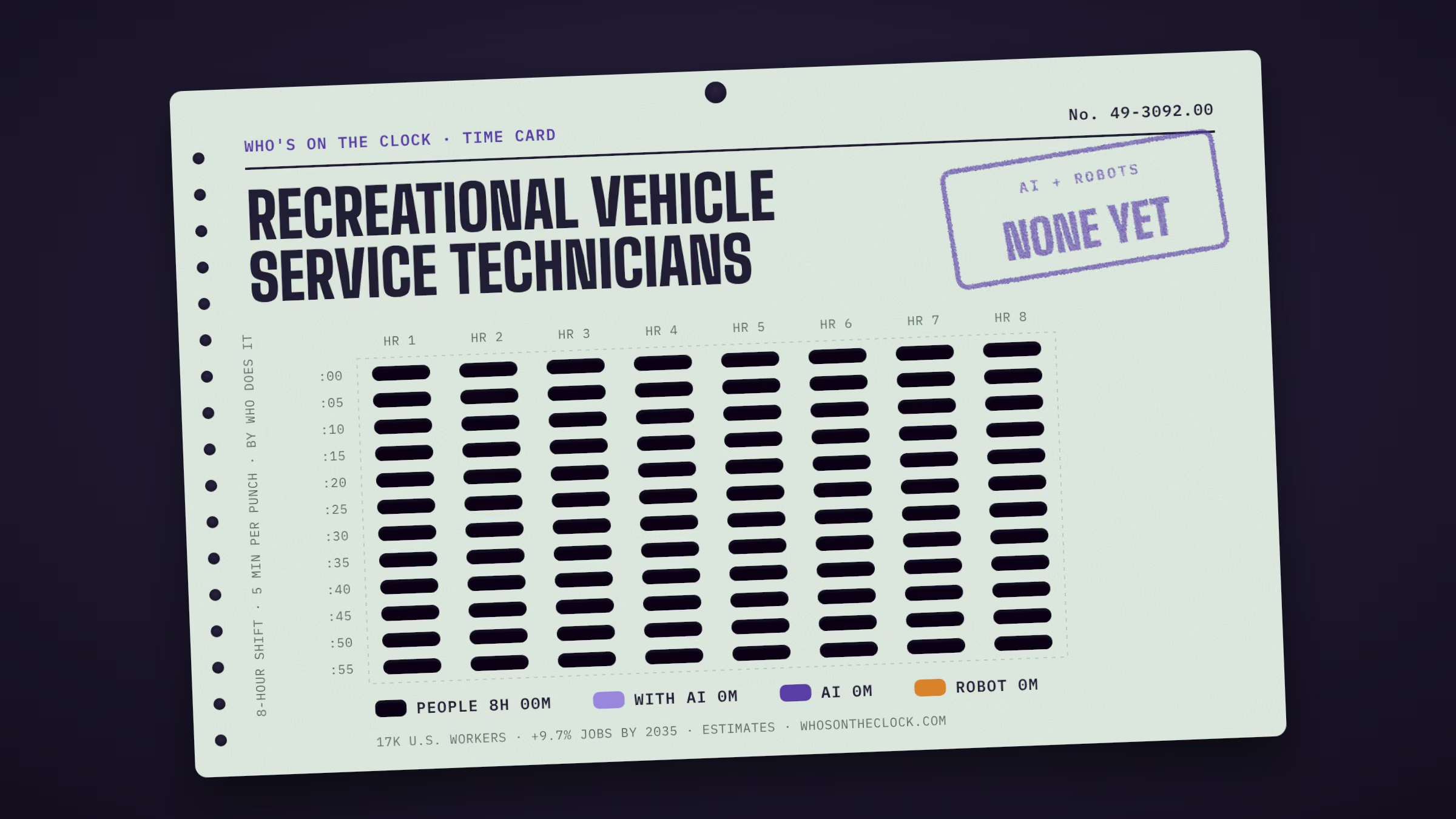
Not on current evidence. Less than 30 minutes of a typical shift goes to tasks that AI or robots are doing today. The other 8h (100%) stays with people. Separately, BLS expects about 9.7% more of these jobs by 2035 (all jobs: +3.5%).
⤢ Full sizeEach mark is 5 minutes of a typical shift for recreational vehicle service technicians, colored by who does that task today. Estimates from O*NET tasks and Anthropic Economic Index data. How it's made
Diagnose, inspect, adjust, repair, or overhaul recreational vehicles including travel trailers. May specialize in maintaining gas, electrical, hydraulic, plumbing, or chassis/towing systems as well as repairing generators, appliances, and interior components. Includes workers who perform customized van conversions.
Time card
Untick tasks you don't do, or set your own times.
Mine
Task, by time spent
Human
With AI
AI
Robot
Inspect recreational vehicles to diagnose problems and perform necessary adjustment, repair, or overhaul.1h 11m a shift · No AI or robot evidence found
Locate and repair frayed wiring, broken connections, or incorrect wiring, using ohmmeters, soldering irons, tape, or hand tools.53m a shift · No AI or robot evidence found
Diagnose and repair furnace or air conditioning systems.47m a shift · No AI or robot evidence found
List parts needed, estimate costs, and plan work procedures, using parts lists, technical manuals, or diagrams.41m a shift · No AI or robot evidence found
Repair plumbing or propane gas lines, using caulking compounds and plastic or copper pipe.36m a shift · No AI or robot evidence found
Confer with customers, read work orders, or examine vehicles needing repair to determine the nature and extent of damage.36m a shift · No AI or robot evidence found
Repair leaks with caulking compound or replace pipes, using pipe wrenches.36m a shift · No AI or robot evidence found
Remove damaged exterior panels, and repair and replace structural frame members.36m a shift · No AI or robot evidence found
Examine or test operation of parts or systems to ensure completeness of repairs.30m a shift · Robots only in factory cells
Connect electrical systems to outside power sources, and activate switches to test the operation of appliances or light fixtures.18m a shift · No AI or robot evidence found
Inspect, repair, or replace brake systems.18m a shift · No AI or robot evidence found
Explain proper operation of vehicle systems to customers.18m a shift · No AI or robot evidence found
Connect water hoses to inlet pipes of plumbing systems, and test operation of toilets or sinks.12m a shift · No AI or robot evidence found
Reset hardware, using chisels, mallets, and screwdrivers.12m a shift · Robots only in factory cells
Open and close doors, windows, or drawers to test their operation, trimming edges to fit, as necessary.12m a shift · Robots only in factory cells
Refinish wood surfaces on cabinets, doors, moldings, or floors, using power sanders, putty, spray equipment, brushes, paints, or varnishes.6m a shift · No AI or robot evidence found
Seal open sides of modular units to prepare them for shipment, using polyethylene sheets, nails, and hammers.time not estimated · No AI or robot evidence found
On the floor
No company news tracked for this job yet. New stories are added as they happen.
Ask the clock
Will AI replace recreational vehicle service technicians?
Not on current evidence. Less than 30 minutes of a typical shift goes to tasks that AI or robots are doing today. The other 8h (100%) stays with people. Separately, BLS expects about 9.7% more of these jobs by 2035 (all jobs: +3.5%).
What can AI already do for recreational vehicle service technicians?
None of this job's tasks show regular AI use yet. That can mean the work is hands-on or in person, or simply that it rarely comes up in AI usage data.
Where do robots fit in?
Not in workplaces like this one, based on a 2026 review of robot deployments. 3 more tasks have only been done in factory setups built around the machine, so they stay with people here. For 12 physical tasks, no robot has shown it can do the work yet.
What still needs a person?
8h of a typical shift, or 100%, goes to tasks with no AI or robot evidence yet. No AI usage or robot deployment has shown up for these so far. The biggest:
Inspect recreational vehicles to diagnose problems and perform necessary adjustment, repair, or overhaul. (1h 11m a shift)
Locate and repair frayed wiring, broken connections, or incorrect wiring, using ohmmeters, soldering irons, tape, or hand tools. (53m a shift)
Diagnose and repair furnace or air conditioning systems. (47m a shift)
List parts needed, estimate costs, and plan work procedures, using parts lists, technical manuals, or diagrams. (41m a shift)
Repair plumbing or propane gas lines, using caulking compounds and plastic or copper pipe. (36m a shift)
Why is that work hard to automate?
Much of it comes down to where and how the work happens. In-person, hands-on and high-stakes work is where AI and robots have made the least headway so far. In the official O*NET survey of people in this job:
84% spend more than half the day on their feet
75% talk face to face with others every day
62% spend more than half the day walking or moving
Are employers still hiring recreational vehicle service technicians?
On Indeed, job postings in the Installation & Maintenance sector are at 118% of their February 2020 level (all U.S. postings: 104%), up 4.1% from a year earlier, as of Oct 9, 2026. BLS separately expects about 2,200 openings a year in this job through 2035. Across all U.S. postings, 7.3% now mention AI skills. Sector postings cover more than this one job and move for many reasons besides AI.
How much do recreational vehicle service technicians make?
The median pay is about $52,000 a year ($25.00 an hour), 2% above the median for all U.S. jobs ($50,980). Most people in this job earn between $36,120 and $77,960 a year; that range covers the middle 80%. Pay figures are from BLS, May 2025, and vary a lot by state and employer. Pick a state to compare:
Is this job growing or shrinking?
BLS projects growth of 9.7% from 2025 to 2035, compared with 3.5% growth for all jobs. That's about 19,000 jobs in 2035. It expects about 2,200 openings a year, mostly from people retiring or changing careers. These projections don't single out AI as a cause.
How many recreational vehicle service technicians are there in the U.S.?
About 17,000 people in the U.S., roughly 0.01% of all workers (BLS, May 2025). That makes it the 572nd largest of the 796 jobs on this site. BLS expects about 19,000 in 2035.
What training do recreational vehicle service technicians need?
The most common requirement is less than a high school diploma: about 46% of people in the job said so in the official O*NET survey. O*NET rates the job at level 2 of 5 for preparation, which usually means: high school diploma, some training. Requirements vary by state and employer, especially for licensed work.
What should I learn to stay ahead of AI?
These come from the job's official skill ratings and from the tasks that AI and robots touch least today. Building them keeps you strong in the parts of the work that still need a person:
Skills that matter more here than in most jobs: Repairing, Troubleshooting, Equipment Selection, Equipment Maintenance
Get strong at the parts of the job that stay with people (listed above), which take 8h of a typical shift
Tools employers list: Facebook, Microsoft Excel, Microsoft Office software, Microsoft Word
What new tasks are recreational vehicle service technicians taking on?
Yes. Occupational experts recently added these to the official task list, a sign of how the work itself is shifting. New tasks aren't rated for AI or robots yet:
Inspect and install lights, such as headlights and taillights.
What other jobs could recreational vehicle service technicians move into?
These use similar skills. Matches come from 109 official ratings of skills, knowledge and work activities, and each needs the same or less preparation unless the official list relates the jobs directly:
Motorboat Mechanics and Service Technicians (0m touched, $58k median pay)
Bus and Truck Mechanics and Diesel Engine Specialists (0m touched, $62k median pay)
Outdoor Power Equipment and Other Small Engine Mechanics (0m touched, $48k median pay)
Rail Car Repairers (0m touched, $68k median pay)
Riggers (0m touched, $63k median pay)
How solid are these numbers?
Each task carries its own evidence label. For this job: 17 with no AI or robot evidence found. The minutes per task are estimates, not measured hours, and "no evidence" doesn't prove a task is safe.
Tools in demand
Facebook
Microsoft Excel
Microsoft Office software
Microsoft Word
Also called
ATV Tech (All-Terrain Vehicle Technician), Certified RV Technician (Certified Recreational Vehicle Technician), Custom Van Converter, Global Vehicle Technician (Global Vehicle Tech), Hitch Technician (Hitch Tech), Mobile Service RV Technician (Mobile Service Recreational Vehicle Technician), Mobile Van Technician (Mobile Van Tech), Motor Home Technician (Motor Home Tech), RV Body Mechanic (Recreational Vehicle Body Mechanic), RV Mechanic (Recreational Vehicle Mechanic), RV Repair Technician (Recreational Vehicle Repair Technician), RV Repairer (Recreational Vehicle Repairer), RV Service Technician (Recreational Vehicle Service Technician), RV Servicer (Recreational Vehicle Servicer)