Will AI replace rotary drill operators, oil and gas?

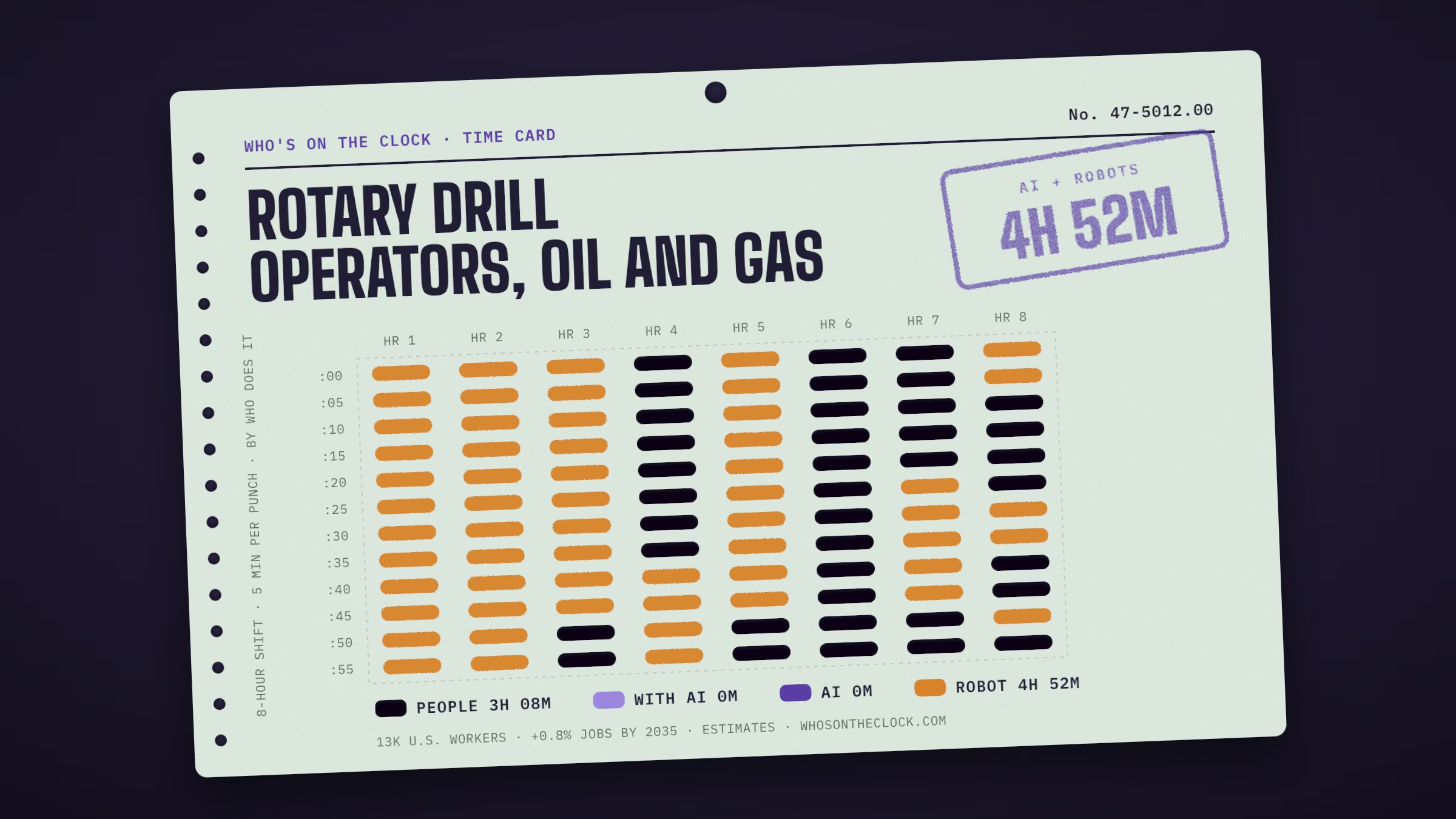
The biggest change here is physical: systems like Pason Electronic AutoDriller / AC AutoDriller have done tasks such as “Observe pressure gauge and move throttles and levers to control the speed of rotary tables” in real workplaces, about 4h 52m of a typical shift. Only 3h 8m of the shift has no AI or robot evidence. BLS expects about 0.8% more of these jobs by 2035.

Time card for rotary drill operators, oil and gas showing a typical 8-hour shift: 3h 8m done by people, 4h 52m by robots.
Each mark is 5 minutes of a typical shift for rotary drill operators, oil and gas, colored by who does that task today. Estimates from O*NET tasks and Anthropic Economic Index data. How it's made

Home / Construction / Rotary Drill Operators, Oil and Gas

Set up or operate a variety of drills to remove underground oil and gas, or remove core samples for testing during oil and gas exploration.

Time card

Untick tasks you don't do, or set your own times.
MineTask, by time spentHumanWith AIAIRobot
Observe pressure gauge and move throttles and levers to control the speed of rotary tables, and to regulate pressure of tools at bottoms of boreholes.1h 51m a shift · Robots deployed · e.g. Pason Electronic AutoDriller / AC AutoDriller
Why this label?Marked Robot because Pason Electronic AutoDriller / AC AutoDriller (in real use) has done this task in a real workplace. It shows a robot can do it somewhere, not that most rotary drill operators, oil and gas work alongside one. How labels work
Push levers and brake pedals to control gasoline, diesel, electric, or steam draw works that lower and raise drill pipes and casings in and out of wells.1h a shift · Robots deployed · e.g. Nabors PACE-R801 (Canrig robotics + Smart Suite/SmartROS)
Why this label?Marked Robot because Nabors PACE-R801 (Canrig robotics + Smart Suite/SmartROS) (in real use) has done this task in a real workplace. It shows a robot can do it somewhere, not that most rotary drill operators, oil and gas work alongside one. How labels work
Direct rig crews in drilling and other activities, such as setting up rigs and completing or servicing wells.51m a shift · No AI or robot evidence found
Why this label?No AI use or robot deployment showed up for this task in our data. That isn't proof it's safe; it may just be rare in the data. How labels work
Connect sections of drill pipe, using hand tools and powered wrenches and tongs.34m a shift · Robots deployed · e.g. Canrig Red Zone Robotics (RZR) Rig Floor Module on Nabors rig X29 (SmartROS)
Why this label?Marked Robot because Canrig Red Zone Robotics (RZR) Rig Floor Module on Nabors rig X29 (SmartROS) (in real use) has done this task in a real workplace. It shows a robot can do it somewhere, not that most rotary drill operators, oil and gas work alongside one. How labels work
Maintain and adjust machinery to ensure proper performance.34m a shift · Robots deployed · e.g. AutoSlide
Why this label?Marked Robot because AutoSlide (in real use) has done this task in a real workplace. It shows a robot can do it somewhere, not that most rotary drill operators, oil and gas work alongside one. How labels work
Train crews, and introduce procedures to make drill work more safe and effective.26m a shift · No AI or robot evidence found
Why this label?No AI use or robot deployment showed up for this task in our data. That isn't proof it's safe; it may just be rare in the data. How labels work
Maintain records of footage drilled, location and nature of strata penetrated, materials and tools used, services rendered, and time required.26m a shift · No AI or robot evidence found
Why this label?No AI use or robot deployment showed up for this task in our data. That isn't proof it's safe; it may just be rare in the data. How labels work
Monitor progress of drilling operations, and select and change drill bits according to the nature of strata, using hand tools.26m a shift · Robots only in factory cells
Why this label?Robots have done this only in factory setups built around the machine, so it stays Human for rotary drill operators, oil and gas. How labels work
Repair or replace defective parts of machinery, such as rotary drill rigs, water trucks, air compressors, and pumps, using hand tools.21m a shift · No AI or robot evidence found
Why this label?This is physical work, and no robot has been shown doing it yet. How labels work
Start and examine operation of slush pumps to ensure circulation and consistency of drilling fluid or mud in well.17m a shift · Robots deployed · e.g. Fully automated land drilling rig (rig robotics plus process automation)
Why this label?Marked Robot because Fully automated land drilling rig (rig robotics plus process automation) (in real use) has done this task in a real workplace. It shows a robot can do it somewhere, not that most rotary drill operators, oil and gas work alongside one. How labels work
Line drilled holes with pipes, and install all necessary hardware, to prepare new wells.13m a shift · Robots deployed · e.g. Canrig Red Zone Robotics (RZR) Rig Floor Module on Nabors rig X29
Why this label?Marked Robot because Canrig Red Zone Robotics (RZR) Rig Floor Module on Nabors rig X29 (in real use) has done this task in a real workplace. It shows a robot can do it somewhere, not that most rotary drill operators, oil and gas work alongside one. How labels work
Count sections of drill rod to determine depths of boreholes.9m a shift · No AI or robot evidence found
Why this label?No AI use or robot deployment showed up for this task in our data. That isn't proof it's safe; it may just be rare in the data. How labels work
Weigh clay, and mix with water and chemicals to make drilling mud.9m a shift · Robots deployed · e.g. NOV automated drilling fluid / mud-mixing system (Valhall WIP)
Why this label?Marked Robot because NOV automated drilling fluid / mud-mixing system (Valhall WIP) (in real use) has done this task in a real workplace. It shows a robot can do it somewhere, not that most rotary drill operators, oil and gas work alongside one. How labels work
Clean and oil pulleys, blocks, and cables.9m a shift · Robots only in factory cells
Why this label?Robots have done this only in factory setups built around the machine, so it stays Human for rotary drill operators, oil and gas. How labels work
Bolt together pump and engine parts, and connect tanks and flow lines.9m a shift · Robots only in factory cells
Why this label?Robots have done this only in factory setups built around the machine, so it stays Human for rotary drill operators, oil and gas. How labels work
Position and prepare truck-mounted derricks at drilling areas specified on field maps.9m a shift · Robots deployed · e.g. Epiroc SmartROC D65 MKII (autonomous, LinkOA/CAP)
Why this label?Marked Robot because Epiroc SmartROC D65 MKII (autonomous, LinkOA/CAP) (in real use) has done this task in a real workplace. It shows a robot can do it somewhere, not that most rotary drill operators, oil and gas work alongside one. How labels work
Locate and recover lost or broken bits, casings, and drill pipes from wells, using special tools.4m a shift · No AI or robot evidence found
Why this label?This is physical work, and no robot has been shown doing it yet. How labels work
Remove core samples during drilling to determine the nature of the strata being drilled.4m a shift · No AI or robot evidence found
Why this label?This is physical work, and no robot has been shown doing it yet. How labels work
Cap wells with packers, or turn valves, to regulate outflow of oil from wells.4m a shift · Robots deployed · e.g. Dynamic Annular Pressure Control (DAPC) automated choke manifold
Why this label?Marked Robot because Dynamic Annular Pressure Control (DAPC) automated choke manifold (in real use) has done this task in a real workplace. It shows a robot can do it somewhere, not that most rotary drill operators, oil and gas work alongside one. How labels work
Plug observation wells, and restore sites.4m a shift · Robots only in factory cells
Why this label?Robots have done this only in factory setups built around the machine, so it stays Human for rotary drill operators, oil and gas. How labels work

Clock history

  1. 4h 52m touchedFirst published: O*NET 30.1, Anthropic Economic Index (2025 usage and September 2026 robot study), BLS May 2025

When new data changes this clock, the date, the new numbers and the reason are logged here. Company news alone never moves the clock.

On the floor

No company news tracked for this job yet. New stories are added as they happen.

Ask the clock

Will AI replace rotary drill operators, oil and gas?

Some tasks are already being done by AI or machines; the rest still needs a person. About 4h 52m of a typical shift is made up of tasks that AI or robots have done on their own in real use somewhere. That doesn't mean those hours are automated in a typical workplace. The other 3h 8m (39%) stays with people. Separately, BLS expects about 0.8% more of these jobs by 2035 (all jobs: +3.5%).

What can AI already do for rotary drill operators, oil and gas?

None of this job's tasks show regular AI use yet. That can mean the work is hands-on or in person, or simply that it rarely comes up in AI usage data.

Where do robots fit in?

For some tasks, yes. Robots have done 9 of this job's tasks in workplaces like this one, about 4h 52m of a typical shift. 4 more tasks have only been done in factory setups built around the machine, so they stay with people here. For 3 physical tasks, no robot has shown it can do the work yet.

  • Observe pressure gauge and move throttles and levers to control the speed of rotary tables, and to regulate pressure of tools at bottoms of boreholes. (1h 51m a shift; e.g. Pason Electronic AutoDriller / AC AutoDriller, in use)
  • Push levers and brake pedals to control gasoline, diesel, electric, or steam draw works that lower and raise drill pipes and casings in and out of wells. (1h a shift; e.g. Nabors PACE-R801 (Canrig robotics + Smart Suite/SmartROS), in use)
  • Connect sections of drill pipe, using hand tools and powered wrenches and tongs. (34m a shift; e.g. Canrig Red Zone Robotics (RZR) Rig Floor Module on Nabors rig X29 (SmartROS), in use)
  • Maintain and adjust machinery to ensure proper performance. (34m a shift; e.g. AutoSlide, in use)
What still needs a person?

3h 8m of a typical shift, or 39%, goes to tasks with no AI or robot evidence yet. No AI usage or robot deployment has shown up for these so far. The biggest:

  • Direct rig crews in drilling and other activities, such as setting up rigs and completing or servicing wells. (51m a shift)
  • Train crews, and introduce procedures to make drill work more safe and effective. (26m a shift)
  • Maintain records of footage drilled, location and nature of strata penetrated, materials and tools used, services rendered, and time required. (26m a shift)
  • Monitor progress of drilling operations, and select and change drill bits according to the nature of strata, using hand tools. (26m a shift)
  • Repair or replace defective parts of machinery, such as rotary drill rigs, water trucks, air compressors, and pumps, using hand tools. (21m a shift)
Why is that work hard to automate?

Much of it comes down to where and how the work happens. In-person, hands-on and high-stakes work is where AI and robots have made the least headway so far. In the official O*NET survey of people in this job:

  • 99% work at arm's length or closer to other people
  • 97% work outdoors in all weather every day
  • 95% carry high or very high responsibility for other workers' safety
Are employers still hiring rotary drill operators, oil and gas?

On Indeed, job postings in the Construction sector are at 129% of their February 2020 level (all U.S. postings: 104%), up 6.4% from a year earlier, as of Oct 9, 2026. BLS separately expects about 1,100 openings a year in this job through 2035. Across all U.S. postings, 7.3% now mention AI skills. Sector postings cover more than this one job and move for many reasons besides AI.

How much do rotary drill operators, oil and gas make?

The median pay is about $67,890 a year ($32.64 an hour), 33% above the median for all U.S. jobs ($50,980). Most people in this job earn between $47,010 and $101,860 a year; that range covers the middle 80%. Pay figures are from BLS, May 2025, and vary a lot by state and employer. Pick a state to compare:

Is this job growing or shrinking?

BLS projects growth of 0.8% from 2025 to 2035, compared with 3.5% growth for all jobs. That's about 13,000 jobs in 2035. It expects about 1,100 openings a year, mostly from people retiring or changing careers. These projections don't single out AI as a cause.

How many rotary drill operators, oil and gas are there in the U.S.?

About 13,000 people in the U.S., roughly 0.01% of all workers (BLS, May 2025). That makes it the 633rd largest of the 796 jobs on this site. BLS expects about 13,000 in 2035.

What training do rotary drill operators, oil and gas need?

The most common requirement is less than a high school diploma: about 31% of people in the job said so in the official O*NET survey. O*NET rates the job at level 2 of 5 for preparation, which usually means: high school diploma, some training. Requirements vary by state and employer, especially for licensed work.

What should I learn to stay ahead of AI?

These come from the job's official skill ratings and from the tasks that AI and robots touch least today. Building them keeps you strong in the parts of the work that still need a person:

  • Skills that matter more here than in most jobs: Operation and Control, Repairing, Equipment Maintenance, Operations Monitoring
  • Get strong at the parts of the job that stay with people (listed above), which take 3h 8m of a typical shift
  • Tools employers list: Microsoft Excel, Microsoft Office software, Microsoft Word, Python, Salesforce software
What other jobs could rotary drill operators, oil and gas move into?

These use similar skills, with less of a typical shift touched by AI or robots. Matches come from 109 official ratings of skills, knowledge and work activities, and each needs the same or less preparation unless the official list relates the jobs directly:

  • Helpers for Extraction Workers (2h 29m touched, $48k median pay)
  • Rail-Track Laying and Maintenance Equipment Operators (2h 31m touched, $70k median pay)
  • Service Unit Operators, Oil and Gas (2h 52m touched, $58k median pay)
  • Earth Drillers (3h 38m touched, $60k median pay)
  • Wellhead Pumpers (2h 47m touched, $70k median pay)
How solid are these numbers?

Each task carries its own evidence label. For this job: 9 with robots in real deployments, 11 with no AI or robot evidence found. The minutes per task are estimates, not measured hours, and "no evidence" doesn't prove a task is safe.

Tools in demand

  • Python
  • Salesforce software
  • SAP software

Plus everyday office tools: Microsoft Excel, Microsoft Office software, Microsoft Word.

Also called

Blast Driller, Cable Driller, Cable Tool Driller, Cable Tool Operator, Clean Out Driller, Core Drill Operator, Core Driller, Daylight Driller, Derrickhand, Directional Drill Operator, Directional Driller, Drill Hand, Drill Operator, Driller