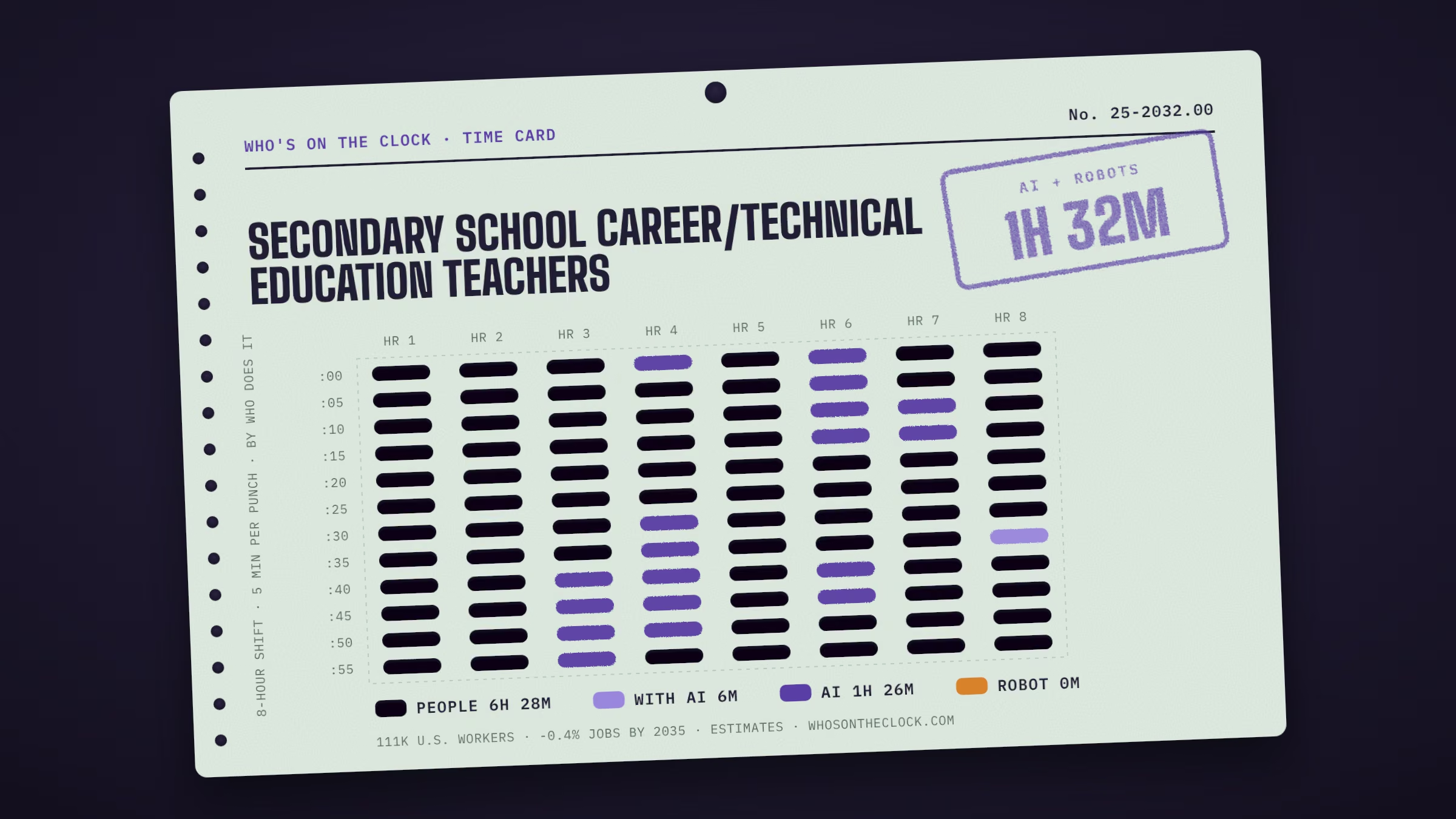
Teach occupational, vocational, career, or technical subjects to students at the secondary school level.
Time card
Untick tasks you don't do, or set your own times.
| Mine | Task, by time spent | Human | With AI | AI | Robot |
|---|---|---|---|---|---|
Instruct students individually and in groups, using various teaching methods, such as lectures, discussions, and demonstrations.1h 20m a shift · No AI or robot evidence foundWhy this label?No AI use or robot deployment showed up for this task in our data. That isn't proof it's safe; it may just be rare in the data. How labels work | |||||
Instruct students in the knowledge and skills required in a specific occupation or occupational field, using a systematic plan of lectures, discussions, audio-visual presentations, and laboratory, shop, and field studies.57m a shift · No AI or robot evidence foundWhy this label?This is physical work, and no robot has been shown doing it yet. How labels work | |||||
Prepare materials and classroom for class activities.23m a shift · No AI or robot evidence foundWhy this label?This is physical work, and no robot has been shown doing it yet. How labels work | |||||
Observe and evaluate students' performance, behavior, social development, and physical health.23m a shift · Observed in AI useWhy this label?Marked AI because this task shows up regularly in real AI conversations (Anthropic Economic Index, 2025 usage), and in most of them AI does the task on its own rather than helping a person. Many workplaces may not use AI for it at all. How labels work | |||||
Instruct and monitor students in the use and care of equipment and materials to prevent injury and damage.23m a shift · No AI or robot evidence foundWhy this label?This is physical work, and no robot has been shown doing it yet. How labels work | |||||
Plan and conduct activities for a balanced program of instruction, demonstration, and work time that provides students with opportunities to observe, question, and investigate.23m a shift · Observed in AI useTypical AI request: about 3h 58m alone, 35m with AIWhy this label?Marked AI because this task shows up regularly in real AI conversations (Anthropic Economic Index, 2025 usage), and in most of them AI does the task on its own rather than helping a person. Many workplaces may not use AI for it at all. How labels work | |||||
Assign and grade class work and homework.23m a shift · No AI or robot evidence foundWhy this label?No AI use or robot deployment showed up for this task in our data. That isn't proof it's safe; it may just be rare in the data. How labels work | |||||
Establish and enforce rules for behavior and procedures for maintaining order among students.17m a shift · No AI or robot evidence foundWhy this label?No AI use or robot deployment showed up for this task in our data. That isn't proof it's safe; it may just be rare in the data. How labels work | |||||
Maintain accurate and complete student records as required by law, district policy, and administrative regulations.17m a shift · No AI or robot evidence foundWhy this label?No AI use or robot deployment showed up for this task in our data. That isn't proof it's safe; it may just be rare in the data. How labels work | |||||
Prepare, administer, and grade tests and assignments to evaluate students' progress.17m a shift · Observed in AI useTypical AI request: about 6h 19m alone, 51m with AIWhy this label?Marked AI because this task shows up regularly in real AI conversations (Anthropic Economic Index, 2025 usage), and in most of them AI does the task on its own rather than helping a person. Many workplaces may not use AI for it at all. How labels work | |||||
Sponsor extracurricular activities, such as clubs, student organizations, and academic contests.17m a shift · No AI or robot evidence foundWhy this label?No AI use or robot deployment showed up for this task in our data. That isn't proof it's safe; it may just be rare in the data. How labels work | |||||
Use computers, audio-visual aids, and other equipment and materials to supplement presentations.11m a shift · Observed in AI useTypical AI request: about 8h 11m alone, 28m with AIWhy this label?Marked AI because this task shows up regularly in real AI conversations (Anthropic Economic Index, 2025 usage), and in most of them AI does the task on its own rather than helping a person. Many workplaces may not use AI for it at all. How labels work | |||||
Confer with parents or guardians, other teachers, counselors, and administrators to resolve students' behavioral and academic problems.11m a shift · No AI or robot evidence foundWhy this label?No AI use or robot deployment showed up for this task in our data. That isn't proof it's safe; it may just be rare in the data. How labels work | |||||
Plan and supervise work-experience programs in businesses, industrial shops, and school laboratories.11m a shift · No AI or robot evidence foundWhy this label?No AI use or robot deployment showed up for this task in our data. That isn't proof it's safe; it may just be rare in the data. How labels work | |||||
Prepare objectives and outlines for courses of study, following curriculum guidelines or requirements of states and schools.11m a shift · Observed in AI useTypical AI request: about 3h 59m alone, 38m with AIWhy this label?Marked AI because this task shows up regularly in real AI conversations (Anthropic Economic Index, 2025 usage), and in most of them AI does the task on its own rather than helping a person. Many workplaces may not use AI for it at all. How labels work | |||||
Select, order, store, issue, and inventory classroom equipment, materials, and supplies.11m a shift · Robots only in factory cellsWhy this label?Robots have done this only in factory setups built around the machine, so it stays Human for secondary school career/technical education teachers. How labels work | |||||
Attend staff meetings and serve on committees, as required.11m a shift · No AI or robot evidence foundWhy this label?No AI use or robot deployment showed up for this task in our data. That isn't proof it's safe; it may just be rare in the data. How labels work | |||||
Establish clear objectives for all lessons, units, and projects, and communicate those objectives to students.6m a shift · No AI or robot evidence foundWhy this label?No AI use or robot deployment showed up for this task in our data. That isn't proof it's safe; it may just be rare in the data. How labels work | |||||
Guide and counsel students with adjustments, academic problems, or special academic interests.6m a shift · No AI or robot evidence foundWhy this label?No AI use or robot deployment showed up for this task in our data. That isn't proof it's safe; it may just be rare in the data. How labels work | |||||
Enforce all administration policies and rules governing students.6m a shift · No AI or robot evidence foundWhy this label?No AI use or robot deployment showed up for this task in our data. That isn't proof it's safe; it may just be rare in the data. How labels work | |||||
Provide students with disabilities with assistive devices, supportive technology, and assistance accessing facilities, such as restrooms.6m a shift · No AI or robot evidence foundWhy this label?This is physical work, and no robot has been shown doing it yet. How labels work | |||||
Prepare students for later grades by encouraging them to explore learning opportunities and to persevere with challenging tasks.6m a shift · No AI or robot evidence foundWhy this label?No AI use or robot deployment showed up for this task in our data. That isn't proof it's safe; it may just be rare in the data. How labels work | |||||
Plan and supervise class projects, field trips, visits by guest speakers or other experiential activities, and guide students in learning from those activities.6m a shift · No AI or robot evidence foundWhy this label?No AI use or robot deployment showed up for this task in our data. That isn't proof it's safe; it may just be rare in the data. How labels work | |||||
Keep informed about trends in education and subject matter specialties.6m a shift · No AI or robot evidence foundWhy this label?No AI use or robot deployment showed up for this task in our data. That isn't proof it's safe; it may just be rare in the data. How labels work | |||||
Meet with other professionals to discuss individual students' needs and progress.6m a shift · No AI or robot evidence foundWhy this label?No AI use or robot deployment showed up for this task in our data. That isn't proof it's safe; it may just be rare in the data. How labels work | |||||
Prepare and implement remedial programs for students requiring extra help.6m a shift · No AI or robot evidence foundWhy this label?No AI use or robot deployment showed up for this task in our data. That isn't proof it's safe; it may just be rare in the data. How labels work | |||||
Meet with parents and guardians to discuss their children's progress and to determine priorities for their children and their resource needs.6m a shift · No AI or robot evidence foundWhy this label?No AI use or robot deployment showed up for this task in our data. That isn't proof it's safe; it may just be rare in the data. How labels work | |||||
Place students in jobs, or make referrals to job placement services.6m a shift · No AI or robot evidence foundWhy this label?No AI use or robot deployment showed up for this task in our data. That isn't proof it's safe; it may just be rare in the data. How labels work | |||||
Collaborate with other teachers and administrators in the development, evaluation, and revision of secondary school programs.6m a shift · Observed in AI useWhy this label?Marked With AI because people regularly use AI to help with this task in real conversations (Anthropic Economic Index, 2025 usage), but AI doesn't usually finish it alone. How labels work | |||||
Attend professional meetings, educational conferences, and teacher training workshops to maintain and improve professional competence.6m a shift · No AI or robot evidence foundWhy this label?No AI use or robot deployment showed up for this task in our data. That isn't proof it's safe; it may just be rare in the data. How labels work | |||||
Confer with other staff members to plan and schedule lessons promoting learning, following approved curricula.6m a shift · No AI or robot evidence foundWhy this label?No AI use or robot deployment showed up for this task in our data. That isn't proof it's safe; it may just be rare in the data. How labels work | |||||
Prepare reports on students and activities as required by administration.6m a shift · No AI or robot evidence foundWhy this label?No AI use or robot deployment showed up for this task in our data. That isn't proof it's safe; it may just be rare in the data. How labels work | |||||
Perform administrative duties, such as school library assistance, hall and cafeteria monitoring, and bus loading and unloading.6m a shift · No AI or robot evidence foundWhy this label?This is physical work, and no robot has been shown doing it yet. How labels work |