Will AI replace secondary school special education teachers?

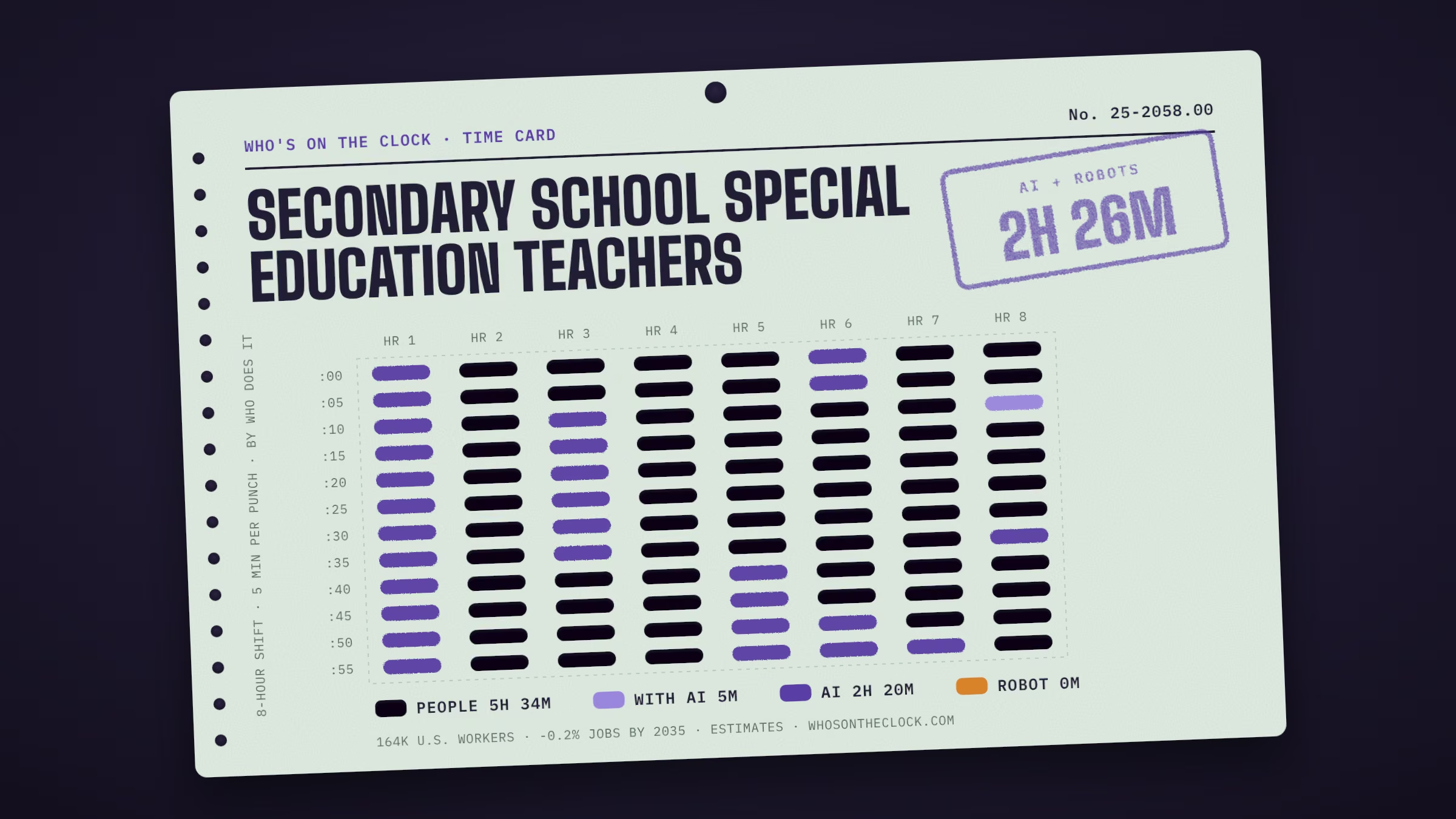
Parts of the job are being automated. About 2h 20m of an 8-hour shift goes to tasks that AI or robots already do largely on their own. The rest still needs a person. The breakdown: 5m done by people with AI help, 2h 20m that AI mostly does alone. The other 5h 34m (70%) stays with people. Separately, BLS expects about 0.2% fewer of these jobs by 2035 (all jobs: +3.5%).

Time card for secondary school special education teachers showing a typical 8-hour shift: 5h 34m done by people, 5m done by people with AI, 2h 20m by AI.
Each mark is 5 minutes of a typical shift for secondary school special education teachers, colored by who does that task today. Estimates from O*NET tasks and Anthropic Economic Index data. How it's made

Home / Education / Secondary School Special Education Teachers

Teach academic, social, and life skills to secondary school students with learning, emotional, or physical disabilities. Includes teachers who specialize and work with students who are blind or have visual impairments; students who are deaf or have hearing impairments; and students with intellectual disabilities.

Time card

Untick tasks you don't do, or set your own times.
MineTask, by time spentHumanWith AIAIRobot
Instruct through lectures, discussions, and demonstrations in one or more subjects, such as English, mathematics, or social studies.59m a shift · Observed in AI use
Maintain accurate and complete student records, and prepare reports on children and activities, as required by laws, district policies, and administrative regulations.38m a shift · No AI or robot evidence found
Develop and implement strategies to meet the needs of students with a variety of handicapping conditions.27m a shift · No AI or robot evidence found
Observe and evaluate students' performance, behavior, social development, and physical health.27m a shift · Observed in AI use
Establish and enforce rules for behavior and policies and procedures to maintain order among students.16m a shift · No AI or robot evidence found
Confer with parents, administrators, testing specialists, social workers, or other professionals to develop individual educational plans (IEPs) for students' educational, physical, and social development.16m a shift · No AI or robot evidence found
Employ special educational strategies and techniques during instruction to improve the development of sensory- and perceptual-motor skills, language, cognition, and memory.16m a shift · No AI or robot evidence found
Prepare materials and classrooms for class activities.16m a shift · Robots only in factory cells
Teach socially acceptable behavior, employing techniques such as behavior modification and positive reinforcement.16m a shift · No AI or robot evidence found
Modify the general education curriculum for students with disabilities, based upon a variety of instructional techniques and technologies.16m a shift · No AI or robot evidence found
Meet with other professionals to discuss individual students' needs and progress.16m a shift · No AI or robot evidence found
Plan and conduct activities for a balanced program of instruction, demonstration, and work time that provides students with opportunities to observe, question, and investigate.16m a shift · Observed in AI useTypical AI request: about 3h 58m alone, 35m with AI
Prepare, administer, and grade tests and assignments to evaluate students' progress.16m a shift · Observed in AI useTypical AI request: about 6h 19m alone, 51m with AI
Establish clear objectives for all lessons, units, and projects, and communicate those objectives to students.11m a shift · No AI or robot evidence found
Confer with parents or guardians, other teachers, counselors, and administrators to resolve students' behavioral and academic problems.11m a shift · No AI or robot evidence found
Teach personal development skills, such as goal setting, independence, and self-advocacy.11m a shift · No AI or robot evidence found
Guide and counsel students with adjustments, academic problems, or special academic interests.11m a shift · No AI or robot evidence found
Use computers, audio-visual aids, and other equipment and materials to supplement presentations.11m a shift · Observed in AI useTypical AI request: about 8h 11m alone, 28m with AI
Meet with parents and guardians to discuss their children's progress and to determine priorities for their children and their resource needs.11m a shift · No AI or robot evidence found
Instruct students in daily living skills required for independent maintenance and self-sufficiency, such as hygiene, safety, and food preparation.11m a shift · No AI or robot evidence found
Attend professional meetings, educational conferences, and teacher training workshops to maintain and improve professional competence.11m a shift · No AI or robot evidence found
Attend staff meetings and serve on committees, as required.11m a shift · No AI or robot evidence found
Prepare students for later grades by encouraging them to explore learning opportunities and to persevere with challenging tasks.5m a shift · No AI or robot evidence found
Confer with other staff members to plan and schedule lessons promoting learning, following approved curricula.5m a shift · No AI or robot evidence found
Coordinate placement of students with special needs into mainstream classes.5m a shift · No AI or robot evidence found
Prepare objectives and outlines for courses of study, following curriculum guidelines or requirements of states and schools.5m a shift · Observed in AI useTypical AI request: about 3h 59m alone, 38m with AI
Monitor teachers and teacher assistants to ensure that they adhere to inclusive special education program requirements.5m a shift · No AI or robot evidence found
Provide assistive devices, supportive technology, and assistance accessing facilities, such as restrooms.5m a shift · No AI or robot evidence found
Collaborate with other teachers and administrators in the development, evaluation, and revision of secondary school programs.5m a shift · Observed in AI use
Administer standardized ability and achievement tests, and interpret results to determine students' strengths and needs.5m a shift · No AI or robot evidence found
Prepare for assigned classes, and show written evidence of preparation upon request of immediate supervisors.5m a shift · No AI or robot evidence found
Meet with parents and guardians to provide guidance in using community resources and to teach skills for dealing with students' impairments.5m a shift · No AI or robot evidence found
Plan and supervise class projects, field trips, visits by guest speakers, or other experiential activities, and guide students in learning from those activities.5m a shift · No AI or robot evidence found
Provide additional instruction in vocational areas.5m a shift · Observed in AI useTypical AI request: about 3h 23m alone, 46m with AI
Instruct and monitor students in the use and care of equipment and materials to prevent injuries and damage.5m a shift · No AI or robot evidence found
Perform administrative duties, such as school library assistance, hall and cafeteria monitoring, and bus loading and unloading.5m a shift · No AI or robot evidence found
Sponsor extracurricular activities, such as clubs, student organizations, and academic contests.5m a shift · No AI or robot evidence found
Select, store, order, issue, and inventory classroom equipment, materials, and supplies.5m a shift · No AI or robot evidence found
Provide interpretation and transcription of regular classroom materials through Braille and sign language.time not estimated · No AI or robot evidence found
Visit schools to tutor students with sensory impairments and to consult with teachers regarding students' special needs.time not estimated · No AI or robot evidence found

On the floor

  1. 57% of special education teachers used AI to help with IEPs

    A Center for Democracy and Technology survey found 57% of licensed special education teachers used AI to help with IEPs or 504 plans in the 2024-2025 school year, up 18% from the year before.

    Disability Scoop

Ask the clock

Will AI replace secondary school special education teachers?

Parts of the job are being automated. About 2h 20m of an 8-hour shift goes to tasks that AI or robots already do largely on their own. The rest still needs a person. The breakdown: 5m done by people with AI help, 2h 20m that AI mostly does alone. The other 5h 34m (70%) stays with people. Separately, BLS expects about 0.2% fewer of these jobs by 2035 (all jobs: +3.5%).

What parts of the job can AI already do?

AI shows up regularly in 8 of 40 tasks, about 2h 26m of a typical shift. The biggest ones:

  • Instruct through lectures, discussions, and demonstrations in one or more subjects, such as English, mathematics, or social studies. (59m a shift, AI mostly does it alone)
  • Observe and evaluate students' performance, behavior, social development, and physical health. (27m a shift, AI mostly does it alone)
  • Plan and conduct activities for a balanced program of instruction, demonstration, and work time that provides students with opportunities to observe, question, and investigate. (16m a shift, AI mostly does it alone)
  • Prepare, administer, and grade tests and assignments to evaluate students' progress. (16m a shift, AI mostly does it alone)
  • Use computers, audio-visual aids, and other equipment and materials to supplement presentations. (11m a shift, AI mostly does it alone)
Can a robot do this job?

Not in workplaces like this one, based on a 2026 review of robot deployments. 1 more task has only been done in factory setups built around the machine, so it stays with people here. For 6 physical tasks, no robot has shown it can do the work yet.

What parts of the job are still done by people?

5h 34m of a typical shift, or 70%, goes to tasks with no AI or robot evidence yet. No AI usage or robot deployment has shown up for these so far. The biggest:

  • Maintain accurate and complete student records, and prepare reports on children and activities, as required by laws, district policies, and administrative regulations. (38m a shift)
  • Develop and implement strategies to meet the needs of students with a variety of handicapping conditions. (27m a shift)
  • Establish and enforce rules for behavior and policies and procedures to maintain order among students. (16m a shift)
  • Confer with parents, administrators, testing specialists, social workers, or other professionals to develop individual educational plans (IEPs) for students' educational, physical, and social development. (16m a shift)
  • Employ special educational strategies and techniques during instruction to improve the development of sensory- and perceptual-motor skills, language, cognition, and memory. (16m a shift)
Why does a person still do this work?

Part of the answer is the setting, not just the tasks. Work that is in person, hands on or high stakes is where AI and robots have made the least headway so far. In the official O*NET survey of people in this job:

  • 99% are in constant contact with other people
  • 91% work at arm's length or closer to other people
  • 89% handle conflict at least once a week
What are companies actually doing?

We track 1 sourced company move that affects this job. Most recent:

  • Nov 18, 2025: 57% of special education teachers used AI to help with IEPs (Widespread)
How much time does AI save on this job's tasks?

For the 5 tasks in this job where AI shows up and timing data exists, a typical request takes about 3h 59m for a person alone and about 38m with AI. These are Claude's own estimates from real conversations in April and May 2026 (Anthropic Economic Index). They describe single requests, not whole workdays, and time saved on a task doesn't mean jobs are cut. The biggest gaps:

  • Use computers, audio-visual aids, and other equipment and materials to supplement presentations (about 8h 11m alone, 28m with AI)
  • Prepare, administer, and grade tests and assignments to evaluate students' progress (about 6h 19m alone, 51m with AI)
  • Plan and conduct activities for a balanced program of instruction, demonstration, and work time that provides students with opportunities to observe, question, and investigate (about 3h 58m alone, 35m with AI)
Are employers still hiring for this job?

On Indeed, job postings in the Education & Instruction sector are at 107% of their February 2020 level (all U.S. postings: 104%), down 9.5% from a year earlier, as of Oct 9, 2026. BLS separately expects about 10,000 openings a year in this job through 2035. Across all U.S. postings, 7.3% now mention AI skills. Sector postings cover more than this one job and move for many reasons besides AI.

How much do secondary school special education teachers make?

The median pay is about $74,260 a year, 46% above the median for all U.S. jobs ($50,980). Most people in this job earn between $49,800 and $109,100 a year; that range covers the middle 80%. Pay figures are from BLS, May 2025, and vary a lot by state and employer. Pick a state to compare:

Is this job growing or shrinking?

BLS projects a decline of 0.2% from 2025 to 2035, compared with 3.5% growth for all jobs. That's about 165,000 jobs in 2035. Even so, it expects about 10,000 openings a year, mostly from people retiring or changing careers. These projections don't single out AI as a cause.

How many people do this job?

About 164,000 people in the U.S., roughly 0.11% of all workers (BLS, May 2025). That makes it the 198th largest of the 796 jobs on this site. BLS expects about 165,000 in 2035.

What do you need to become one?

The most common requirement is a bachelor's degree: about 42% of people in the job said so in the official O*NET survey. O*NET rates the job at level 4 of 5 for preparation, which usually means: bachelor's degree. Requirements vary by state and employer, especially for licensed work.

What should I learn to stay ahead?

These come from the job's official skill ratings and from the tasks that AI and robots touch least today. Building them keeps you strong in the parts of the work that still need a person:

  • Skills that matter more here than in most jobs: Learning Strategies, Instructing, Time Management, Coordination
  • Get strong at the parts of the job that stay with people (listed above), which take 5h 34m of a typical shift
  • Tools employers list: Microsoft Outlook, Microsoft Excel, Adobe Acrobat, Adobe Illustrator, Adobe InDesign
  • Learn to use AI well on the tasks where it already shows up in this job (listed above)
Are there new tasks in this job?

Yes. Occupational experts recently added these to the official task list, a sign of how the work itself is shifting. New tasks aren't rated for AI or robots yet:

  • Monitor students using personal electronics or school-issued technology.
What similar jobs could I move into?

These use similar skills, with less of a typical shift touched by AI or robots. Matches come from 109 official ratings of skills, knowledge and work activities, and each needs the same or less preparation unless the official list relates the jobs directly:

  • Elementary School Special Education Teachers (1h 1m touched, $67k median pay)
  • Kindergarten Teachers (54m touched, $63k median pay)
  • Elementary School Teachers (1h 29m touched, $64k median pay)
  • Middle School Career/Technical Education Teachers (1h 29m touched, $65k median pay)
  • Secondary School Career/Technical Education Teachers (1h 32m touched, $66k median pay)
How solid are these numbers?

Each task carries its own evidence label. For this job: 8 observed in real AI use, 32 with no AI or robot evidence found. The minutes per task are estimates, not measured hours, and "no evidence" doesn't prove a task is safe.

Tools in demand

  • Microsoft Outlook
  • Microsoft Excel
  • Adobe Acrobat
  • Adobe Illustrator
  • Adobe InDesign
  • Adobe Photoshop
  • Facebook
  • Microsoft Access

Also called

Blind Teacher, Braille Teacher, Cross-Categorical SPED Teacher (Cross-Categorical Special Education Teacher), Deaf Teacher, Education Specialist, Emotional Disability Special Education Teacher (ED SPED Teacher), Emotionally Impaired Teacher, Exceptional Children's Teacher (EC Teacher), Exceptional Student Education Teacher (ESE Teacher), HS SPED Teacher (High School Special Education Teacher), Handicapped Teacher, Hearing Impaired Teacher, High School Learning Support Teacher, High School Teacher