Will AI replace social and community service managers?

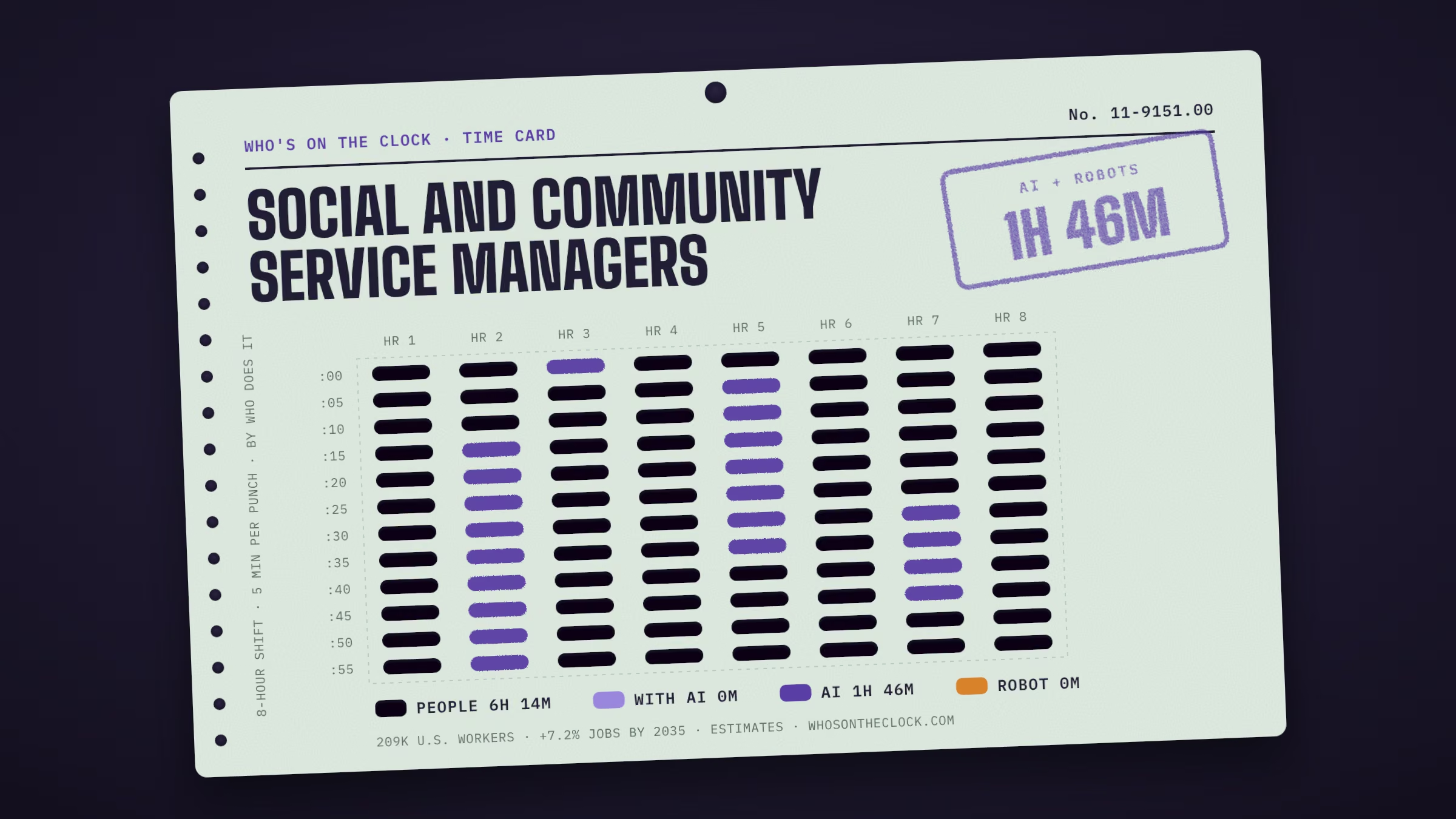
AI already handles some of this work on its own in real use, for tasks like “Prepare and maintain records and reports, such as budgets”. That's 1h 46m of a typical shift; 6h 14m still has no AI or robot evidence. BLS expects about 7.2% more of these jobs by 2035.

Time card for social and community service managers showing a typical 8-hour shift: 6h 14m done by people, 1h 46m by AI.
Each mark is 5 minutes of a typical shift for social and community service managers, colored by who does that task today. Estimates from O*NET tasks and Anthropic Economic Index data. How it's made

Home / Management / Social and Community Service Managers

Plan, direct, or coordinate the activities of a social service program or community outreach organization. Oversee the program or organization's budget and policies regarding participant involvement, program requirements, and benefits. Work may involve directing social workers, counselors, or probation officers.

Time card

Untick tasks you don't do, or set your own times.
MineTask, by time spentHumanWith AIAIRobot
Direct activities of professional and technical staff members and volunteers.1h 13m a shift · No AI or robot evidence found
Why this label?No AI use or robot deployment showed up for this task in our data. That isn't proof it's safe; it may just be rare in the data. How labels work
Prepare and maintain records and reports, such as budgets, personnel records, or training manuals.50m a shift · Observed in AI useTypical AI request: about 6h 58m alone, 35m with AI
Why this label?Marked AI because this task shows up regularly in real AI conversations (Anthropic Economic Index, 2025 usage), and in most of them AI does the task on its own rather than helping a person. Many workplaces may not use AI for it at all. How labels work
Establish and oversee administrative procedures to meet objectives set by boards of directors or senior management.39m a shift · No AI or robot evidence found
Why this label?No AI use or robot deployment showed up for this task in our data. That isn't proof it's safe; it may just be rare in the data. How labels work
Provide direct service and support to individuals or clients, such as handling a referral for child advocacy issues, conducting a needs evaluation, or resolving complaints.39m a shift · No AI or robot evidence found
Why this label?No AI use or robot deployment showed up for this task in our data. That isn't proof it's safe; it may just be rare in the data. How labels work
Establish and maintain relationships with other agencies and organizations in community to meet community needs and to ensure that services are not duplicated.39m a shift · No AI or robot evidence found
Why this label?No AI use or robot deployment showed up for this task in our data. That isn't proof it's safe; it may just be rare in the data. How labels work
Evaluate the work of staff and volunteers to ensure that programs are of appropriate quality and that resources are used effectively.34m a shift · Observed in AI use
Why this label?Marked AI because this task shows up regularly in real AI conversations (Anthropic Economic Index, 2025 usage), and in most of them AI does the task on its own rather than helping a person. Many workplaces may not use AI for it at all. How labels work
Plan and administer budgets for programs, equipment, and support services.34m a shift · No AI or robot evidence found
Why this label?No AI use or robot deployment showed up for this task in our data. That isn't proof it's safe; it may just be rare in the data. How labels work
Direct fundraising activities and the preparation of public relations materials.28m a shift · No AI or robot evidence found
Why this label?No AI use or robot deployment showed up for this task in our data. That isn't proof it's safe; it may just be rare in the data. How labels work
Participate in the determination of organizational policies regarding such issues as participant eligibility, program requirements, and program benefits.22m a shift · No AI or robot evidence found
Why this label?No AI use or robot deployment showed up for this task in our data. That isn't proof it's safe; it may just be rare in the data. How labels work
Recruit, interview, and hire or sign up volunteers and staff.22m a shift · No AI or robot evidence found
Why this label?No AI use or robot deployment showed up for this task in our data. That isn't proof it's safe; it may just be rare in the data. How labels work
Research and analyze member or community needs to determine program directions and goals.22m a shift · Observed in AI use
Why this label?Marked AI because this task shows up regularly in real AI conversations (Anthropic Economic Index, 2025 usage), and in most of them AI does the task on its own rather than helping a person. Many workplaces may not use AI for it at all. How labels work
Implement and evaluate staff, volunteer, or community training programs.22m a shift · No AI or robot evidence found
Why this label?No AI use or robot deployment showed up for this task in our data. That isn't proof it's safe; it may just be rare in the data. How labels work
Act as consultants to agency staff and other community programs regarding the interpretation of program-related federal, state, and county regulations and policies.17m a shift · No AI or robot evidence found
Why this label?No AI use or robot deployment showed up for this task in our data. That isn't proof it's safe; it may just be rare in the data. How labels work
Speak to community groups to explain and interpret agency purposes, programs, and policies.17m a shift · No AI or robot evidence found
Why this label?No AI use or robot deployment showed up for this task in our data. That isn't proof it's safe; it may just be rare in the data. How labels work
Analyze proposed legislation, regulations, or rule changes to determine how agency services could be impacted.11m a shift · No AI or robot evidence found
Why this label?No AI use or robot deployment showed up for this task in our data. That isn't proof it's safe; it may just be rare in the data. How labels work
Represent organizations in relations with governmental and media institutions.11m a shift · No AI or robot evidence found
Why this label?No AI use or robot deployment showed up for this task in our data. That isn't proof it's safe; it may just be rare in the data. How labels work

Clock history

  1. 1h 46m touchedFirst published: O*NET 30.1, Anthropic Economic Index (2025 usage and September 2026 robot study), BLS May 2025

When new data changes this clock, the date, the new numbers and the reason are logged here. Company news alone never moves the clock.

On the floor

  1. Rolling outNoMo Foundation
    Philadelphia nonprofits use AI assistants for intake and eligibility

    NoMo Foundation built an assistant that checks program eligibility, and Campaign for Working Families built one that handles intake forms and booking at any hour.

    Technical.ly

Ask the clock

Will AI replace social and community service managers?

Unlikely, though parts of the work are changing. About 1h 46m of an 8-hour shift goes to tasks touched by AI working on its own. The other 6h 14m (78%) stays with people. Separately, BLS expects about 7.2% more of these jobs by 2035 (all jobs: +3.5%).

What can AI already do for social and community service managers?

AI shows up regularly in 3 of 16 tasks, about 1h 46m of a typical shift. The biggest ones:

  • Prepare and maintain records and reports, such as budgets, personnel records, or training manuals. (50m a shift, AI mostly does it alone)
  • Evaluate the work of staff and volunteers to ensure that programs are of appropriate quality and that resources are used effectively. (34m a shift, AI mostly does it alone)
  • Research and analyze member or community needs to determine program directions and goals. (22m a shift, AI mostly does it alone)
What still needs a person?

6h 14m of a typical shift, or 78%, goes to tasks with no AI or robot evidence yet. No AI usage or robot deployment has shown up for these so far. The biggest:

  • Direct activities of professional and technical staff members and volunteers. (1h 13m a shift)
  • Establish and oversee administrative procedures to meet objectives set by boards of directors or senior management. (39m a shift)
  • Provide direct service and support to individuals or clients, such as handling a referral for child advocacy issues, conducting a needs evaluation, or resolving complaints. (39m a shift)
  • Establish and maintain relationships with other agencies and organizations in community to meet community needs and to ensure that services are not duplicated. (39m a shift)
  • Plan and administer budgets for programs, equipment, and support services. (34m a shift)
Why is that work hard to automate?

Much of it comes down to where and how the work happens. In-person, hands-on and high-stakes work is where AI and robots have made the least headway so far. In the official O*NET survey of people in this job:

  • 94% talk face to face with others every day
  • 74% say dealing with the public is very or extremely important
  • 72% are in constant contact with other people
What are companies actually doing?

We track 1 sourced company move that affects this job. Most recent:

  • Jan 15, 2025: Philadelphia nonprofits use AI assistants for intake and eligibility (Rolling out)
How much time does AI save on these tasks?

For the 1 task in this job where AI shows up and timing data exists, a typical request takes about 6h 58m for a person alone and about 35m with AI. These are Claude's own estimates from real conversations in April and May 2026 (Anthropic Economic Index). They describe single requests, not whole workdays, and time saved on a task doesn't mean jobs are cut. The biggest gaps:

  • Prepare and maintain records and reports, such as budgets, personnel records, or training manuals (about 6h 58m alone, 35m with AI)
Are employers still hiring social and community service managers?

On Indeed, job postings in the Community & Social Service sector are at 105% of their February 2020 level (all U.S. postings: 104%), down 6.2% from a year earlier, as of Oct 9, 2026. BLS separately expects about 19,000 openings a year in this job through 2035. Across all U.S. postings, 7.3% now mention AI skills. Sector postings cover more than this one job and move for many reasons besides AI.

How much do social and community service managers make?

The median pay is about $80,390 a year ($38.65 an hour), 58% above the median for all U.S. jobs ($50,980). Most people in this job earn between $53,150 and $132,260 a year; that range covers the middle 80%. Pay figures are from BLS, May 2025, and vary a lot by state and employer. Pick a state to compare:

Is this job growing or shrinking?

BLS projects growth of 7.2% from 2025 to 2035, compared with 3.5% growth for all jobs. That's about 248,000 jobs in 2035. It expects about 19,000 openings a year, mostly from people retiring or changing careers. These projections don't single out AI as a cause.

How many social and community service managers are there in the U.S.?

About 209,000 people in the U.S., roughly 0.13% of all workers (BLS, May 2025). That makes it the 167th largest of the 796 jobs on this site. BLS expects about 248,000 in 2035.

What training do social and community service managers need?

The most common requirement is a bachelor's degree: about 50% of people in the job said so in the official O*NET survey. O*NET rates the job at level 4 of 5 for preparation, which usually means: bachelor's degree. Requirements vary by state and employer, especially for licensed work.

What should I learn to stay ahead of AI?

These come from the job's official skill ratings and from the tasks that AI and robots touch least today. Building them keeps you strong in the parts of the work that still need a person:

  • Skills that matter more here than in most jobs: Management of Personnel Resources, Time Management, Service Orientation, Systems Evaluation
  • Get strong at the parts of the job that stay with people (listed above), which take 6h 14m of a typical shift
  • Tools employers list: Microsoft Office software, Microsoft Access, Microsoft Excel, Microsoft Outlook, Microsoft PowerPoint
  • Learn to use AI well on the tasks where it already shows up in this job (listed above)
What other jobs could social and community service managers move into?

These use similar skills, with less of a typical shift touched by AI or robots. Matches come from 109 official ratings of skills, knowledge and work activities, and each needs the same or less preparation unless the official list relates the jobs directly:

  • Human Resources Managers (0m touched, $149k median pay)
  • Medical and Health Services Managers (31m touched, $124k median pay)
  • Lodging Managers (1h 2m touched, $69k median pay)
  • Loss Prevention Managers (23m touched, $142k median pay)
  • Education and Childcare Administrators, Preschool and Daycare (43m touched, $59k median pay)
How solid are these numbers?

Each task carries its own evidence label. For this job: 3 observed in real AI use, 13 with no AI or robot evidence found. The minutes per task are estimates, not measured hours, and "no evidence" doesn't prove a task is safe.

Tools in demand

  • Microsoft Access
  • Microsoft Project

Plus everyday office tools: Microsoft Office software, Microsoft Excel, Microsoft Outlook, Microsoft PowerPoint, Microsoft Word.

Also called

Adoption Services Manager, Adult Daycare Coordinator, Borough Coordinator, Case Manager, Case Services Manager, Casework Department Director, Casework Director, Casework Services Director, Child Welfare Director, Child Welfare Services Director, Children's Service Supervisor, Clinical Services Director, Club Manager, Community Center Director