Will AI replace subway and streetcar operators?

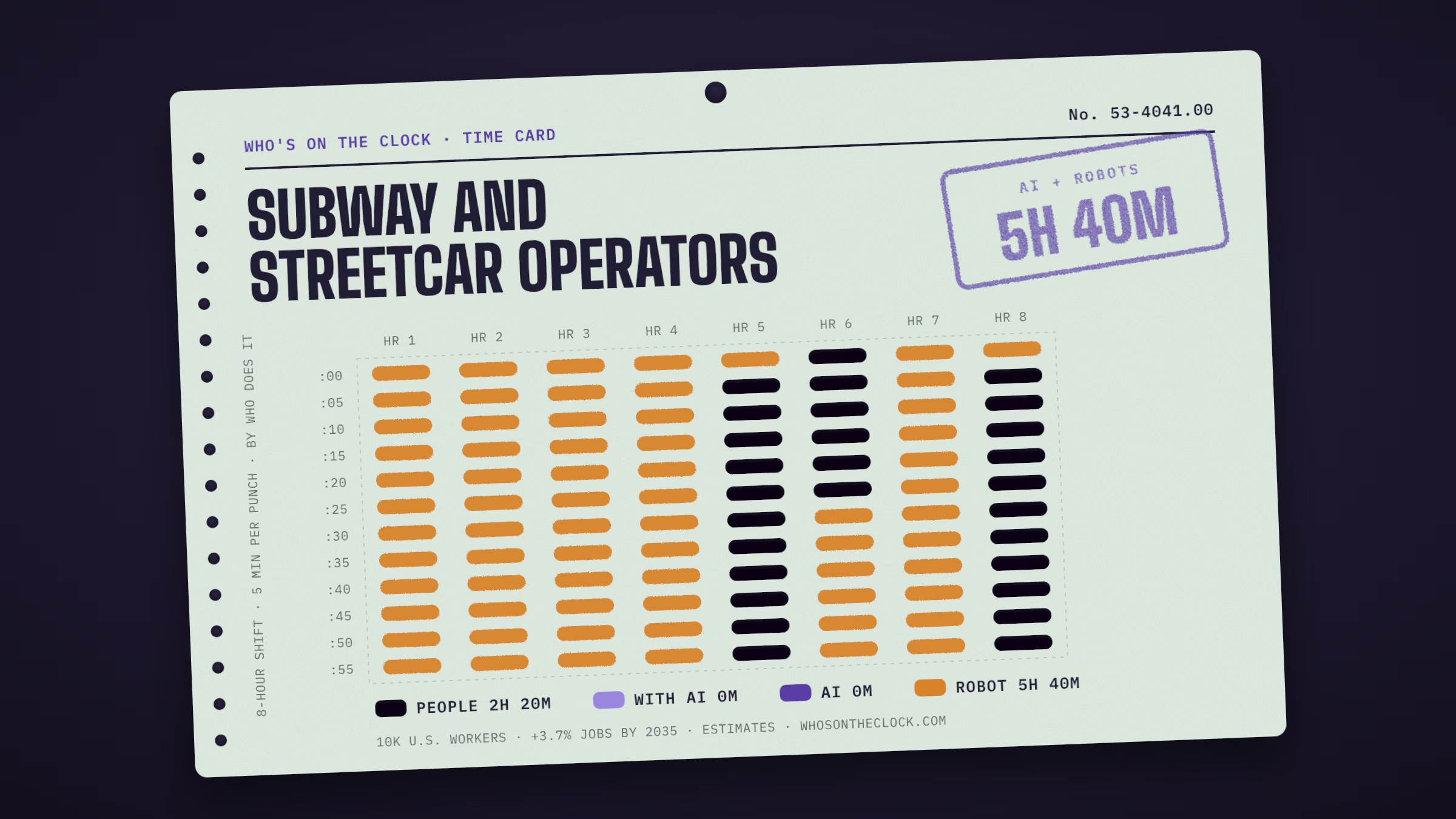
The biggest change here is physical: systems like Skyline, Hitachi Rail GoA4 automated metro have done tasks such as “Drive and control rail-guided public transportation, such as subways” in real workplaces, about 5h 40m of a typical shift. Only 2h 20m of the shift has no AI or robot evidence. BLS expects about 3.7% more of these jobs by 2035.

Time card for subway and streetcar operators showing a typical 8-hour shift: 2h 20m done by people, 5h 40m by robots.
Each mark is 5 minutes of a typical shift for subway and streetcar operators, colored by who does that task today. Estimates from O*NET tasks and Anthropic Economic Index data. How it's made

Home / Transportation & warehouse / Subway and Streetcar Operators

Operate subway or elevated suburban trains with no separate locomotive, or electric-powered streetcar, to transport passengers. May handle fares.

Time card

Untick tasks you don't do, or set your own times.
MineTask, by time spentHumanWith AIAIRobot
Drive and control rail-guided public transportation, such as subways, elevated trains, and electric-powered streetcars, trams, or trolleys, to transport passengers.4h 3m a shift · Robots deployed · e.g. Skyline (Honolulu rail transit), Hitachi Rail GoA4 automated metro
Why this label?Marked Robot because Skyline (Honolulu rail transit), Hitachi Rail GoA4 automated metro (in real use) has done this task in a real workplace. It shows a robot can do it somewhere, not that most subway and streetcar operators work alongside one. How labels work
Monitor lights indicating obstructions or other trains ahead and watch for car and truck traffic at crossings to stay alert to potential hazards.1h 25m a shift · No AI or robot evidence found
Why this label?No AI use or robot deployment showed up for this task in our data. That isn't proof it's safe; it may just be rare in the data. How labels work
Regulate vehicle speed and the time spent at each stop to maintain schedules.1h 1m a shift · Robots deployed · e.g. Copenhagen Metro (Metroselskabet / Hitachi Rail driverless CBTC)
Why this label?Marked Robot because Copenhagen Metro (Metroselskabet / Hitachi Rail driverless CBTC) (in real use) has done this task in a real workplace. It shows a robot can do it somewhere, not that most subway and streetcar operators work alongside one. How labels work
Operate controls to open and close transit vehicle doors.36m a shift · Robots deployed · e.g. Skyline (Honolulu), Hitachi Rail GoA4 driverless metro
Why this label?Marked Robot because Skyline (Honolulu), Hitachi Rail GoA4 driverless metro (in real use) has done this task in a real workplace. It shows a robot can do it somewhere, not that most subway and streetcar operators work alongside one. How labels work
Make announcements to passengers, such as notifications of upcoming stops or schedule delays.18m a shift · No AI or robot evidence found
Why this label?No AI use or robot deployment showed up for this task in our data. That isn't proof it's safe; it may just be rare in the data. How labels work
Report delays, mechanical problems, and emergencies to supervisors or dispatchers, using radios.12m a shift · No AI or robot evidence found
Why this label?No AI use or robot deployment showed up for this task in our data. That isn't proof it's safe; it may just be rare in the data. How labels work
Greet passengers, provide information, and answer questions concerning fares, schedules, transfers, and routings.12m a shift · No AI or robot evidence found
Why this label?No AI use or robot deployment showed up for this task in our data. That isn't proof it's safe; it may just be rare in the data. How labels work
Complete reports, including shift summaries and incident or accident reports.6m a shift · No AI or robot evidence found
Why this label?No AI use or robot deployment showed up for this task in our data. That isn't proof it's safe; it may just be rare in the data. How labels work
Attend meetings on driver and passenger safety to learn ways in which job performance might be affected.6m a shift · No AI or robot evidence found
Why this label?No AI use or robot deployment showed up for this task in our data. That isn't proof it's safe; it may just be rare in the data. How labels work
Direct emergency evacuation procedures.time not estimated · No AI or robot evidence found
Why this label?This is physical work, and no robot has been shown doing it yet. How labels work

Clock history

  1. 5h 40m touchedFirst published: O*NET 30.1, Anthropic Economic Index (2025 usage and September 2026 robot study), BLS May 2025

When new data changes this clock, the date, the new numbers and the reason are logged here. Company news alone never moves the clock.

On the floor

No company news tracked for this job yet. New stories are added as they happen.

Ask the clock

Will AI replace subway and streetcar operators?

Some tasks are already being done by AI or machines; the rest still needs a person. About 5h 40m of a typical shift is made up of tasks that AI or robots have done on their own in real use somewhere. That doesn't mean those hours are automated in a typical workplace. The other 2h 20m (29%) stays with people. Separately, BLS expects about 3.7% more of these jobs by 2035 (all jobs: +3.5%).

What can AI already do for subway and streetcar operators?

None of this job's tasks show regular AI use yet. That can mean the work is hands-on or in person, or simply that it rarely comes up in AI usage data.

Where do robots fit in?

For some tasks, yes. Robots have done 3 of this job's tasks in workplaces like this one, about 5h 40m of a typical shift. For 1 physical task, no robot has shown it can do the work yet.

  • Drive and control rail-guided public transportation, such as subways, elevated trains, and electric-powered streetcars, trams, or trolleys, to transport passengers. (4h 3m a shift; e.g. Skyline (Honolulu rail transit), Hitachi Rail GoA4 automated metro, in use)
  • Regulate vehicle speed and the time spent at each stop to maintain schedules. (1h 1m a shift; e.g. Copenhagen Metro (Metroselskabet / Hitachi Rail driverless CBTC), in use)
  • Operate controls to open and close transit vehicle doors. (36m a shift; e.g. Skyline (Honolulu), Hitachi Rail GoA4 driverless metro, in use)
What still needs a person?

2h 20m of a typical shift, or 29%, goes to tasks with no AI or robot evidence yet. No AI usage or robot deployment has shown up for these so far. The biggest:

  • Monitor lights indicating obstructions or other trains ahead and watch for car and truck traffic at crossings to stay alert to potential hazards. (1h 25m a shift)
  • Make announcements to passengers, such as notifications of upcoming stops or schedule delays. (18m a shift)
  • Report delays, mechanical problems, and emergencies to supervisors or dispatchers, using radios. (12m a shift)
  • Greet passengers, provide information, and answer questions concerning fares, schedules, transfers, and routings. (12m a shift)
  • Complete reports, including shift summaries and incident or accident reports. (6m a shift)
Why is that work hard to automate?

Much of it comes down to where and how the work happens. In-person, hands-on and high-stakes work is where AI and robots have made the least headway so far. In the official O*NET survey of people in this job:

  • 97% use their hands on tools, objects or controls more than half the time
  • 82% say dealing with the public is very or extremely important
  • 77% carry high or very high responsibility for other workers' safety
How much do subway and streetcar operators make?

The median pay is about $86,380 a year ($41.53 an hour), 69% above the median for all U.S. jobs ($50,980). Most people in this job earn between $55,180 and $90,140 a year; that range covers the middle 80%. Pay figures are from BLS, May 2025, and vary a lot by state and employer. Pick a state to compare:

Is this job growing or shrinking?

BLS projects growth of 3.7% from 2025 to 2035, compared with 3.5% growth for all jobs. That's about 11,000 jobs in 2035. It expects about 900 openings a year, mostly from people retiring or changing careers. These projections don't single out AI as a cause.

How many subway and streetcar operators are there in the U.S.?

About 10,000 people in the U.S., roughly 0.01% of all workers (BLS, May 2025). That makes it the 663rd largest of the 796 jobs on this site. BLS expects about 11,000 in 2035.

What training do subway and streetcar operators need?

The most common requirement is a high school diploma: about 87% of people in the job said so in the official O*NET survey. O*NET rates the job at level 2 of 5 for preparation, which usually means: high school diploma, some training. Requirements vary by state and employer, especially for licensed work.

What should I learn to stay ahead of AI?

These come from the job's official skill ratings and from the tasks that AI and robots touch least today. Building them keeps you strong in the parts of the work that still need a person:

  • Skills that matter more here than in most jobs: Operation and Control, Operations Monitoring, Service Orientation, Active Listening
  • Get strong at the parts of the job that stay with people (listed above), which take 2h 20m of a typical shift
  • Tools employers list: Microsoft Office software
What other jobs could subway and streetcar operators move into?

These use similar skills, with less of a typical shift touched by AI or robots. Matches come from 109 official ratings of skills, knowledge and work activities, and each needs the same or less preparation unless the official list relates the jobs directly:

  • Railroad Brake, Signal, and Switch Operators and Locomotive Firers (1h 4m touched, $69k median pay)
  • School Bus Drivers (2h 56m touched, $48k median pay)
  • Locomotive Engineers (3h 20m touched, $81k median pay)
  • Railroad Conductors and Yardmasters (34m touched, $78k median pay)
How solid are these numbers?

Each task carries its own evidence label. For this job: 3 with robots in real deployments, 7 with no AI or robot evidence found. The minutes per task are estimates, not measured hours, and "no evidence" doesn't prove a task is safe.

Tools in demand

Mostly everyday office tools: Microsoft Office software. The job's skills matter more than any specific software.

Also called

Combined Rail Operator, Electric Motorman, Elevated Motorman, Light Rail Operator, Light Rail Train Operator, Light Rail Transit Operator, Light Rail Vehicle Operator (LRV Operator), Monorail Operator, Motor Operator, Rail Operator, Rail Transit Operator, Rapid Transit Operator (RTO), Service Vehicle Operator, Shuttle Route Vehicle Operator