Will AI replace locomotive engineers?

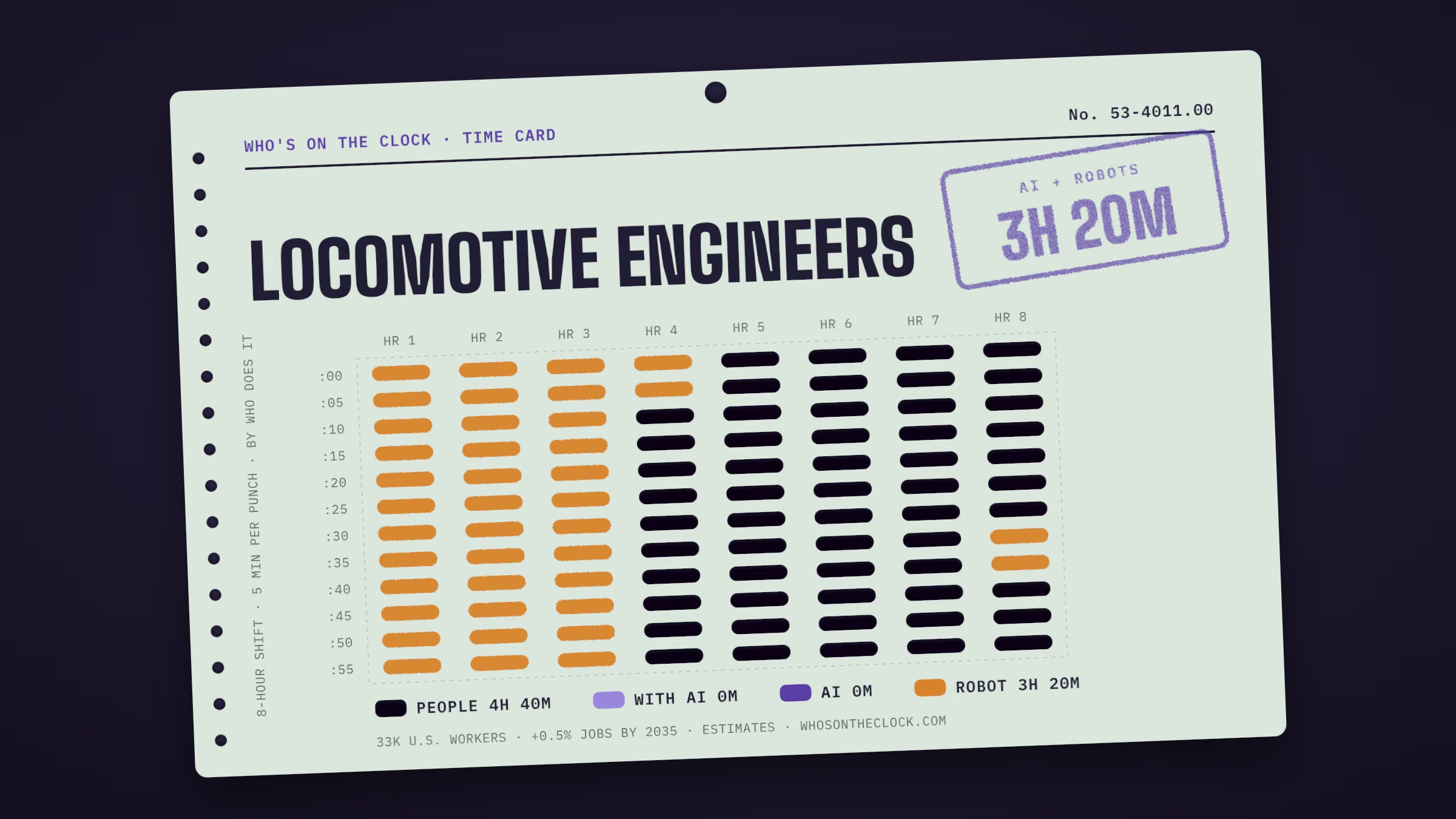
The biggest change here is physical: systems like AutoHaul have done tasks such as “Operate locomotives to transport freight or passengers between stations or to assemble or disassemble trains within rail yards” in real workplaces, about 3h 20m of a typical shift. Most of the rest, 4h 40m, has no AI or robot evidence. BLS expects about 0.5% more of these jobs by 2035.

Time card for locomotive engineers showing a typical 8-hour shift: 4h 40m done by people, 3h 20m by robots.
Each mark is 5 minutes of a typical shift for locomotive engineers, colored by who does that task today. Estimates from O*NET tasks and Anthropic Economic Index data. How it's made

Home / Transportation & warehouse / Locomotive Engineers

Drive electric, diesel-electric, steam, or gas-turbine-electric locomotives to transport passengers or freight. Interpret train orders, electronic or manual signals, and railroad rules and regulations.

Time card

Untick tasks you don't do, or set your own times.
MineTask, by time spentHumanWith AIAIRobot
Operate locomotives to transport freight or passengers between stations or to assemble or disassemble trains within rail yards.1h 46m a shift · Robots deployed · e.g. AutoHaul (Rio Tinto / Hitachi Rail STS)
Why this label?Marked Robot because AutoHaul (Rio Tinto / Hitachi Rail STS) (in real use) has done this task in a real workplace. It shows a robot can do it somewhere, not that most locomotive engineers work alongside one. How labels work
Receive starting signals from conductors and use controls such as throttles or air brakes to drive electric, diesel-electric, steam, or gas turbine-electric locomotives.1h 24m a shift · Robots deployed · e.g. AutoHaul (Rio Tinto / Hitachi Rail STS, Wabtec onboard controller)
Why this label?Marked Robot because AutoHaul (Rio Tinto / Hitachi Rail STS, Wabtec onboard controller) (in real use) has done this task in a real workplace. It shows a robot can do it somewhere, not that most locomotive engineers work alongside one. How labels work
Observe tracks to detect obstructions.1h 3m a shift · No AI or robot evidence found
Why this label?No AI use or robot deployment showed up for this task in our data. That isn't proof it's safe; it may just be rare in the data. How labels work
Interpret train orders, signals, or railroad rules and regulations that govern the operation of locomotives.53m a shift · No AI or robot evidence found
Why this label?No AI use or robot deployment showed up for this task in our data. That isn't proof it's safe; it may just be rare in the data. How labels work
Confer with conductors or traffic control center personnel via radiophones to issue or receive information concerning stops, delays, or oncoming trains.42m a shift · No AI or robot evidence found
Why this label?No AI use or robot deployment showed up for this task in our data. That isn't proof it's safe; it may just be rare in the data. How labels work
Monitor gauges or meters that measure speed, amperage, battery charge, or air pressure in brake lines or in main reservoirs.42m a shift · No AI or robot evidence found
Why this label?No AI use or robot deployment showed up for this task in our data. That isn't proof it's safe; it may just be rare in the data. How labels work
Inspect locomotives to verify adequate fuel, sand, water, or other supplies before each run or to check for mechanical problems.21m a shift · No AI or robot evidence found
Why this label?This is physical work, and no robot has been shown doing it yet. How labels work
Call out train signals to assistants to verify meanings.16m a shift · No AI or robot evidence found
Why this label?No AI use or robot deployment showed up for this task in our data. That isn't proof it's safe; it may just be rare in the data. How labels work
Prepare reports regarding any problems encountered, such as accidents, signaling problems, unscheduled stops, or delays.16m a shift · No AI or robot evidence found
Why this label?No AI use or robot deployment showed up for this task in our data. That isn't proof it's safe; it may just be rare in the data. How labels work
Check to ensure that brake examination tests are conducted at shunting stations.11m a shift · No AI or robot evidence found
Why this label?No AI use or robot deployment showed up for this task in our data. That isn't proof it's safe; it may just be rare in the data. How labels work
Inspect locomotives after runs to detect damaged or defective equipment.11m a shift · Robots deployed · e.g. E-Check (camera arch + MUFIG mobile underfloor unit + E-Check cobots)
Why this label?Marked Robot because E-Check (camera arch + MUFIG mobile underfloor unit + E-Check cobots) (in real use) has done this task in a real workplace. It shows a robot can do it somewhere, not that most locomotive engineers work alongside one. How labels work
Respond to emergency conditions or breakdowns, following applicable safety procedures and rules.5m a shift · No AI or robot evidence found
Why this label?This is physical work, and no robot has been shown doing it yet. How labels work
Check to ensure that documentation, such as procedure manuals or logbooks, are in the driver's cab and available for staff use.5m a shift · No AI or robot evidence found
Why this label?No AI use or robot deployment showed up for this task in our data. That isn't proof it's safe; it may just be rare in the data. How labels work
Monitor train loading procedures to ensure that freight or rolling stock are loaded or unloaded without damage.5m a shift · Robots only in factory cells
Why this label?Robots have done this only in factory setups built around the machine, so it stays Human for locomotive engineers. How labels work

Clock history

  1. 3h 20m touchedFirst published: O*NET 30.1, Anthropic Economic Index (2025 usage and September 2026 robot study), BLS May 2025

When new data changes this clock, the date, the new numbers and the reason are logged here. Company news alone never moves the clock.

On the floor

No company news tracked for this job yet. New stories are added as they happen.

Ask the clock

Will AI replace locomotive engineers?

Some tasks are already being done by AI or machines; the rest still needs a person. About 3h 20m of a typical shift is made up of tasks that AI or robots have done on their own in real use somewhere. That doesn't mean those hours are automated in a typical workplace. The other 4h 40m (58%) stays with people. Separately, BLS expects about 0.5% more of these jobs by 2035 (all jobs: +3.5%).

What can AI already do for locomotive engineers?

None of this job's tasks show regular AI use yet. That can mean the work is hands-on or in person, or simply that it rarely comes up in AI usage data.

Where do robots fit in?

For some tasks, yes. Robots have done 3 of this job's tasks in workplaces like this one, about 3h 20m of a typical shift. 1 more task has only been done in factory setups built around the machine, so it stays with people here. For 2 physical tasks, no robot has shown it can do the work yet.

  • Operate locomotives to transport freight or passengers between stations or to assemble or disassemble trains within rail yards. (1h 46m a shift; e.g. AutoHaul (Rio Tinto / Hitachi Rail STS), in use)
  • Receive starting signals from conductors and use controls such as throttles or air brakes to drive electric, diesel-electric, steam, or gas turbine-electric locomotives. (1h 24m a shift; e.g. AutoHaul (Rio Tinto / Hitachi Rail STS, Wabtec onboard controller), in use)
  • Inspect locomotives after runs to detect damaged or defective equipment. (11m a shift; e.g. E-Check (camera arch + MUFIG mobile underfloor unit + E-Check cobots), in use)
What still needs a person?

4h 40m of a typical shift, or 58%, goes to tasks with no AI or robot evidence yet. No AI usage or robot deployment has shown up for these so far. The biggest:

  • Observe tracks to detect obstructions. (1h 3m a shift)
  • Interpret train orders, signals, or railroad rules and regulations that govern the operation of locomotives. (53m a shift)
  • Confer with conductors or traffic control center personnel via radiophones to issue or receive information concerning stops, delays, or oncoming trains. (42m a shift)
  • Monitor gauges or meters that measure speed, amperage, battery charge, or air pressure in brake lines or in main reservoirs. (42m a shift)
  • Inspect locomotives to verify adequate fuel, sand, water, or other supplies before each run or to check for mechanical problems. (21m a shift)
Why is that work hard to automate?

Much of it comes down to where and how the work happens. In-person, hands-on and high-stakes work is where AI and robots have made the least headway so far. In the official O*NET survey of people in this job:

  • 100% carry high or very high responsibility for other workers' safety
  • 89% use their hands on tools, objects or controls more than half the time
  • 85% work in very hot or cold conditions at least weekly
How much do locomotive engineers make?

The median pay is about $81,410 a year ($39.14 an hour), 60% above the median for all U.S. jobs ($50,980). Most people in this job earn between $60,680 and $109,220 a year; that range covers the middle 80%. Pay figures are from BLS, May 2025, and vary a lot by state and employer. Pick a state to compare:

Is this job growing or shrinking?

BLS projects growth of 0.5% from 2025 to 2035, compared with 3.5% growth for all jobs. That's about 28,000 jobs in 2035. It expects about 2,000 openings a year, mostly from people retiring or changing careers. These projections don't single out AI as a cause.

How many locomotive engineers are there in the U.S.?

About 33,000 people in the U.S., roughly 0.02% of all workers (BLS, May 2025). That makes it the 458th largest of the 796 jobs on this site. BLS expects about 28,000 in 2035.

What training do locomotive engineers need?

The most common requirement is a high school diploma: about 68% of people in the job said so in the official O*NET survey. O*NET rates the job at level 2 of 5 for preparation, which usually means: high school diploma, some training. Requirements vary by state and employer, especially for licensed work.

What should I learn to stay ahead of AI?

These come from the job's official skill ratings and from the tasks that AI and robots touch least today. Building them keeps you strong in the parts of the work that still need a person:

  • Skills that matter more here than in most jobs: Operation and Control, Operations Monitoring, Monitoring, Active Listening
  • Get strong at the parts of the job that stay with people (listed above), which take 4h 40m of a typical shift
  • Tools employers list: Microsoft Excel, Microsoft Word
What other jobs could locomotive engineers move into?

These use similar skills. Matches come from 109 official ratings of skills, knowledge and work activities, and each needs the same or less preparation unless the official list relates the jobs directly:

  • Railroad Brake, Signal, and Switch Operators and Locomotive Firers (1h 4m touched, $69k median pay)
  • Rail Yard Engineers, Dinkey Operators, and Hostlers (3h 38m touched, $61k median pay)
  • Subway and Streetcar Operators (5h 40m touched, $86k median pay)
How solid are these numbers?

Each task carries its own evidence label. For this job: 3 with robots in real deployments, 11 with no AI or robot evidence found. The minutes per task are estimates, not measured hours, and "no evidence" doesn't prove a task is safe.

Tools in demand

Mostly everyday office tools: Microsoft Excel, Microsoft Word. The job's skills matter more than any specific software.

Also called

Diesel Engine Operator, Diesel Engineer, Diesel Locomotive Engineer, Engine Pilot, Engineer, Engineman, Freight Engineer, Fuel Pilot Engineer, Locomotive Engineer, Locomotive Operator, Lokie Driver, Lokie Engineer, Motor Driver, Motor Operator