Will AI replace survey researchers?

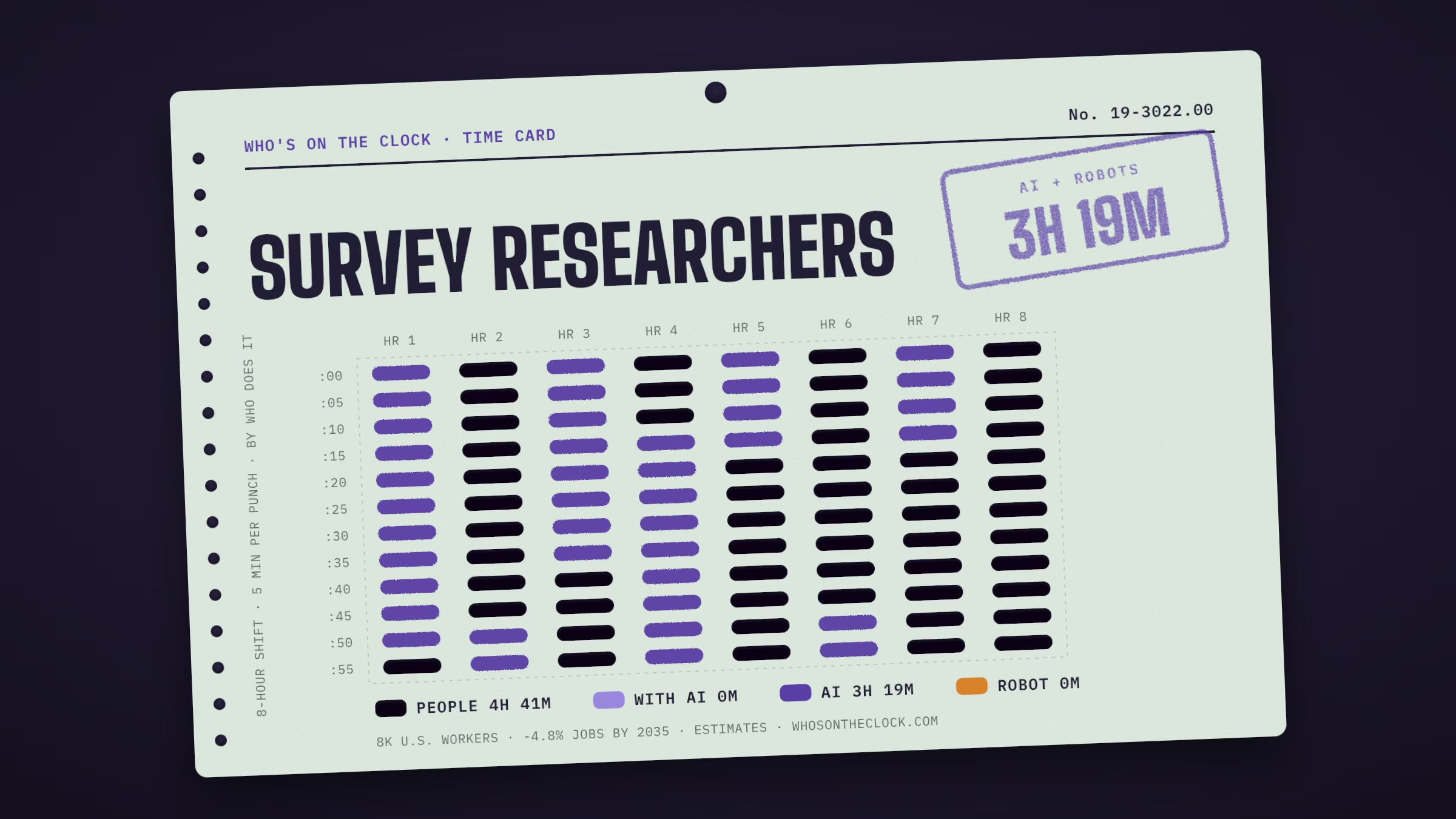
AI already handles some of this work on its own in real use, for tasks like “Prepare and present summaries and analyses of survey data”. That's 3h 19m of a typical shift; 4h 41m still has no AI or robot evidence. BLS expects about 4.8% fewer of these jobs by 2035.

Time card for survey researchers showing a typical 8-hour shift: 4h 41m done by people, 3h 19m by AI.
Each mark is 5 minutes of a typical shift for survey researchers, colored by who does that task today. Estimates from O*NET tasks and Anthropic Economic Index data. How it's made

Home / Science / Survey Researchers

Plan, develop, or conduct surveys. May analyze and interpret the meaning of survey data, determine survey objectives, or suggest or test question wording. Includes social scientists who primarily design questionnaires or supervise survey teams.

Time card

Untick tasks you don't do, or set your own times.
MineTask, by time spentHumanWith AIAIRobot
Prepare and present summaries and analyses of survey data, including tables, graphs, and fact sheets that describe survey techniques and results.53m a shift · Observed in AI useTypical AI request: about 12h 16m alone, 35m with AI
Why this label?Marked AI because this task shows up regularly in real AI conversations (Anthropic Economic Index, 2025 usage), and in most of them AI does the task on its own rather than helping a person. Many workplaces may not use AI for it at all. How labels work
Determine and specify details of survey projects, including sources of information, procedures to be used, and the design of survey instruments and materials.53m a shift · No AI or robot evidence found
Why this label?No AI use or robot deployment showed up for this task in our data. That isn't proof it's safe; it may just be rare in the data. How labels work
Analyze data from surveys, old records, or case studies, using statistical software.53m a shift · Observed in AI use
Why this label?Marked AI because this task shows up regularly in real AI conversations (Anthropic Economic Index, 2025 usage), and in most of them AI does the task on its own rather than helping a person. Many workplaces may not use AI for it at all. How labels work
Support, plan, and coordinate operations for single or multiple surveys.35m a shift · No AI or robot evidence found
Why this label?No AI use or robot deployment showed up for this task in our data. That isn't proof it's safe; it may just be rare in the data. How labels work
Review, classify, and record survey data in preparation for computer analysis.35m a shift · Observed in AI use
Why this label?Marked AI because this task shows up regularly in real AI conversations (Anthropic Economic Index, 2025 usage), and in most of them AI does the task on its own rather than helping a person. Many workplaces may not use AI for it at all. How labels work
Conduct surveys and collect data, using methods such as interviews, questionnaires, focus groups, market analysis surveys, public opinion polls, literature reviews, and file reviews.29m a shift · Observed in AI useTypical AI request: about 1h 5m alone, 8m with AI
Why this label?Marked AI because this task shows up regularly in real AI conversations (Anthropic Economic Index, 2025 usage), and in most of them AI does the task on its own rather than helping a person. Many workplaces may not use AI for it at all. How labels work
Consult with clients to identify survey needs and specific requirements, such as special samples.29m a shift · No AI or robot evidence found
Why this label?No AI use or robot deployment showed up for this task in our data. That isn't proof it's safe; it may just be rare in the data. How labels work
Monitor and evaluate survey progress and performance, using sample disposition reports and response rate calculations.29m a shift · No AI or robot evidence found
Why this label?No AI use or robot deployment showed up for this task in our data. That isn't proof it's safe; it may just be rare in the data. How labels work
Collaborate with other researchers in the planning, implementation, and evaluation of surveys.29m a shift · No AI or robot evidence found
Why this label?No AI use or robot deployment showed up for this task in our data. That isn't proof it's safe; it may just be rare in the data. How labels work
Conduct research to gather information about survey topics.29m a shift · Observed in AI use
Why this label?Marked AI because this task shows up regularly in real AI conversations (Anthropic Economic Index, 2025 usage), and in most of them AI does the task on its own rather than helping a person. Many workplaces may not use AI for it at all. How labels work
Direct and review the work of staff members, including survey support staff and interviewers who gather survey data.29m a shift · No AI or robot evidence found
Why this label?No AI use or robot deployment showed up for this task in our data. That isn't proof it's safe; it may just be rare in the data. How labels work
Produce documentation of the questionnaire development process, data collection methods, sampling designs, and decisions related to sample statistical weighting.29m a shift · No AI or robot evidence found
Why this label?No AI use or robot deployment showed up for this task in our data. That isn't proof it's safe; it may just be rare in the data. How labels work
Direct updates and changes in survey implementation and methods.18m a shift · No AI or robot evidence found
Why this label?No AI use or robot deployment showed up for this task in our data. That isn't proof it's safe; it may just be rare in the data. How labels work
Write proposals to win new projects.18m a shift · No AI or robot evidence found
Why this label?No AI use or robot deployment showed up for this task in our data. That isn't proof it's safe; it may just be rare in the data. How labels work
Write training manuals to be used by survey interviewers.6m a shift · No AI or robot evidence found
Why this label?No AI use or robot deployment showed up for this task in our data. That isn't proof it's safe; it may just be rare in the data. How labels work
Hire and train recruiters and data collectors.6m a shift · No AI or robot evidence found
Why this label?No AI use or robot deployment showed up for this task in our data. That isn't proof it's safe; it may just be rare in the data. How labels work

Clock history

  1. 3h 19m touchedFirst published: O*NET 30.1, Anthropic Economic Index (2025 usage and September 2026 robot study), BLS May 2025

When new data changes this clock, the date, the new numbers and the reason are logged here. Company news alone never moves the clock.

On the floor

  1. Rolling outYouGov
    YouGov launches AI-moderated interviews for research studies

    YouGov Voices lets survey respondents opt into an AI conversation that asks follow-up questions, then summarises themes. It is available in the UK, the US and Australia.

    Research Live

Ask the clock

Will AI replace survey researchers?

Some tasks are already being done by AI or machines; the rest still needs a person. About 3h 19m of a typical shift is made up of tasks that AI or robots have done on their own in real use somewhere. That doesn't mean those hours are automated in a typical workplace. The other 4h 41m (59%) stays with people. Separately, BLS expects about 4.8% fewer of these jobs by 2035 (all jobs: +3.5%).

What can AI already do for survey researchers?

AI shows up regularly in 5 of 16 tasks, about 3h 19m of a typical shift. The biggest ones:

  • Prepare and present summaries and analyses of survey data, including tables, graphs, and fact sheets that describe survey techniques and results. (53m a shift, AI mostly does it alone)
  • Analyze data from surveys, old records, or case studies, using statistical software. (53m a shift, AI mostly does it alone)
  • Review, classify, and record survey data in preparation for computer analysis. (35m a shift, AI mostly does it alone)
  • Conduct surveys and collect data, using methods such as interviews, questionnaires, focus groups, market analysis surveys, public opinion polls, literature reviews, and file reviews. (29m a shift, AI mostly does it alone)
  • Conduct research to gather information about survey topics. (29m a shift, AI mostly does it alone)
What still needs a person?

4h 41m of a typical shift, or 59%, goes to tasks with no AI or robot evidence yet. No AI usage or robot deployment has shown up for these so far. The biggest:

  • Determine and specify details of survey projects, including sources of information, procedures to be used, and the design of survey instruments and materials. (53m a shift)
  • Support, plan, and coordinate operations for single or multiple surveys. (35m a shift)
  • Consult with clients to identify survey needs and specific requirements, such as special samples. (29m a shift)
  • Monitor and evaluate survey progress and performance, using sample disposition reports and response rate calculations. (29m a shift)
  • Collaborate with other researchers in the planning, implementation, and evaluation of surveys. (29m a shift)
Why is that work hard to automate?

Much of it comes down to where and how the work happens. In-person, hands-on and high-stakes work is where AI and robots have made the least headway so far. In the official O*NET survey of people in this job:

  • 81% say dealing with the public is very or extremely important
What are companies actually doing?

We track 1 sourced company move that affects this job. Most recent:

  • Sep 17, 2026: YouGov launches AI-moderated interviews for research studies (Rolling out)
How much time does AI save on these tasks?

For the 2 tasks in this job where AI shows up and timing data exists, a typical request takes about 6h 40m for a person alone and about 21m with AI. These are Claude's own estimates from real conversations in April and May 2026 (Anthropic Economic Index). They describe single requests, not whole workdays, and time saved on a task doesn't mean jobs are cut. The biggest gaps:

  • Prepare and present summaries and analyses of survey data, including tables, graphs, and fact sheets that describe survey techniques and results (about 12h 16m alone, 35m with AI)
  • Conduct surveys and collect data, using methods such as interviews, questionnaires, focus groups, market analysis surveys, public opinion polls, literature reviews, and file reviews (about 1h 5m alone, 8m with AI)
Are employers still hiring survey researchers?

On Indeed, job postings in the Social Science sector are at 126% of their February 2020 level (all U.S. postings: 104%), down 6.7% from a year earlier, as of Oct 9, 2026. BLS separately expects about 600 openings a year in this job through 2035. Across all U.S. postings, 7.3% now mention AI skills. Sector postings cover more than this one job and move for many reasons besides AI.

How much do survey researchers make?

The median pay is about $69,460 a year ($33.40 an hour), 36% above the median for all U.S. jobs ($50,980). Most people in this job earn between $39,260 and $130,860 a year; that range covers the middle 80%. Pay figures are from BLS, May 2025, and vary a lot by state and employer. Pick a state to compare:

Is this job growing or shrinking?

BLS projects a decline of 4.8% from 2025 to 2035, compared with 3.5% growth for all jobs. That's about 9,300 jobs in 2035. Even so, it expects about 600 openings a year, mostly from people retiring or changing careers. These projections don't single out AI as a cause.

How many survey researchers are there in the U.S.?

About 8,290 people in the U.S., roughly 0.01% of all workers (BLS, May 2025). That makes it the 688th largest of the 796 jobs on this site. BLS expects about 9,300 in 2035.

What training do survey researchers need?

The most common requirement is a bachelor's degree: about 50% of people in the job said so in the official O*NET survey. O*NET rates the job at level 5 of 5 for preparation, which usually means: graduate degree. Requirements vary by state and employer, especially for licensed work.

What should I learn to stay ahead of AI?

These come from the job's official skill ratings and from the tasks that AI and robots touch least today. Building them keeps you strong in the parts of the work that still need a person:

  • Skills that matter more here than in most jobs: Mathematics, Writing, Critical Thinking, Speaking
  • Get strong at the parts of the job that stay with people (listed above), which take 4h 41m of a typical shift
  • Tools employers list: Tableau, SAS, R, Python, Microsoft Word
  • Learn to use AI well on the tasks where it already shows up in this job (listed above)
What other jobs could survey researchers move into?

These use similar skills, with less of a typical shift touched by AI or robots. Matches come from 109 official ratings of skills, knowledge and work activities, and each needs the same or less preparation unless the official list relates the jobs directly:

  • Epidemiologists (19m touched, $87k median pay)
  • Industrial-Organizational Psychologists (1h 51m touched, $194k median pay)
  • Statisticians (2h 34m touched, $106k median pay)
How solid are these numbers?

Each task carries its own evidence label. For this job: 5 observed in real AI use, 11 with no AI or robot evidence found. The minutes per task are estimates, not measured hours, and "no evidence" doesn't prove a task is safe.

Tools in demand

  • Tableau
  • SAS
  • R
  • Python

Plus everyday office tools: Microsoft Word, Microsoft PowerPoint, Microsoft Office software, Microsoft Excel.

Also called

Analytic Methodologist, Bilingual Field Interviewer, Data Analyst, Data Collection Specialist, Data Collector, Field Collector, Field Data Collector, Field Interviewer, Field Representative, Interviewer, Market Survey Representative, Pollster, Proctor, Research Associate