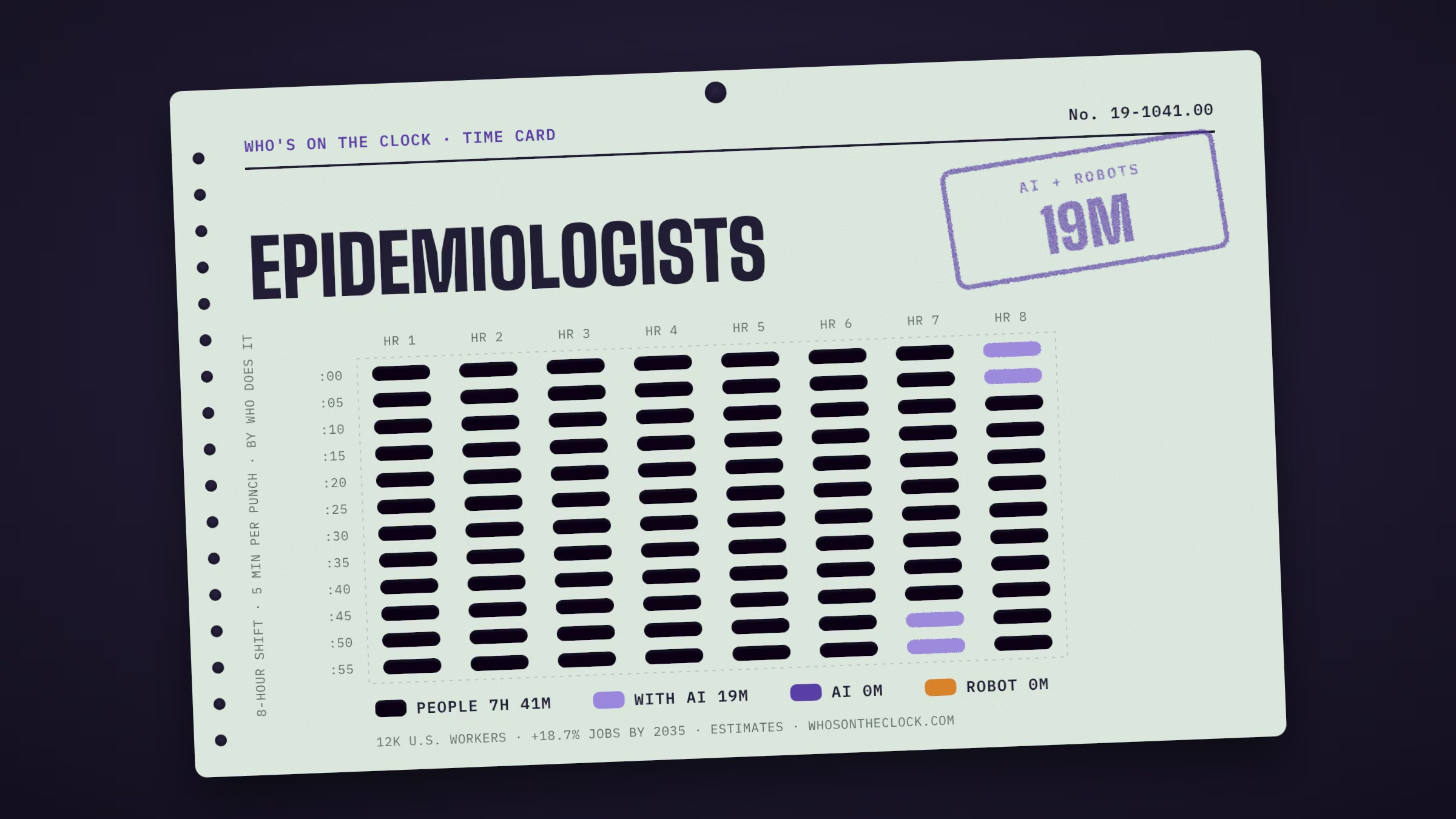
Not on current evidence. Less than 30 minutes of a typical shift goes to tasks that AI or robots are doing today. The other 7h 41m (96%) stays with people. Separately, BLS expects about 18.7% more of these jobs by 2035 (all jobs: +3.5%).
⤢ Full sizeEach mark is 5 minutes of a typical shift for epidemiologists, colored by who does that task today. Estimates from O*NET tasks and Anthropic Economic Index data. How it's made
Investigate and describe the determinants and distribution of disease, disability, or health outcomes. May develop the means for prevention and control.
Time card
Untick tasks you don't do, or set your own times.
Mine
Task, by time spent
Human
With AI
AI
Robot
Oversee public health programs, including statistical analysis, health care planning, surveillance systems, and public health improvement.1h 9m a shift · No AI or robot evidence found
Communicate research findings on various types of diseases to health practitioners, policy makers, and the public.56m a shift · No AI or robot evidence found
Investigate diseases or parasites to determine cause and risk factors, progress, life cycle, or mode of transmission.56m a shift · No AI or robot evidence found
Monitor and report incidents of infectious diseases to local and state health agencies.44m a shift · No AI or robot evidence found
Plan and direct studies to investigate human or animal disease, preventive methods, and treatments for disease.44m a shift · No AI or robot evidence found
Provide expertise in the design, management and evaluation of study protocols and health status questionnaires, sample selection, and analysis.44m a shift · No AI or robot evidence found
Educate healthcare workers, patients, and the public about infectious and communicable diseases, including disease transmission and prevention.31m a shift · No AI or robot evidence found
Write articles for publication in professional journals.25m a shift · No AI or robot evidence found
Write grant applications to fund epidemiologic research.19m a shift · No AI or robot evidence found
Plan, administer and evaluate health safety standards and programs to improve public health, conferring with health department, industry personnel, physicians, and others.19m a shift · No AI or robot evidence found
Consult with and advise physicians, educators, researchers, government health officials and others regarding medical applications of sciences, such as physics, biology, and chemistry.19m a shift · Observed in AI useTypical AI request: about 3h alone, 22m with AI
Supervise professional, technical, and clerical personnel.19m a shift · No AI or robot evidence found
Conduct research to develop methodologies, instrumentation, and procedures for medical application, analyzing data and presenting findings.12m a shift · No AI or robot evidence found
Teach principles of medicine and medical and laboratory procedures to physicians, residents, students, and technicians.12m a shift · No AI or robot evidence found
Identify and analyze public health issues related to foodborne parasitic diseases and their impact on public policies, scientific studies, or surveys.6m a shift · No AI or robot evidence found
Prepare and analyze samples to study effects of drugs, gases, pesticides, or microorganisms on cell structure and tissue.6m a shift · Robots only in factory cells
On the floor
No company news tracked for this job yet. New stories are added as they happen.
Ask the clock
Will AI replace epidemiologists?
Not on current evidence. Less than 30 minutes of a typical shift goes to tasks that AI or robots are doing today. The other 7h 41m (96%) stays with people. Separately, BLS expects about 18.7% more of these jobs by 2035 (all jobs: +3.5%).
What parts of the job can AI already do?
AI shows up regularly in 1 of 16 tasks, about 19m of a typical shift. The biggest ones:
Consult with and advise physicians, educators, researchers, government health officials and others regarding medical applications of sciences, such as physics, biology, and chemistry. (19m a shift, people use AI to help)
Can a robot do this job?
Not in workplaces like this one, based on a 2026 review of robot deployments. 1 more task has only been done in factory setups built around the machine, so it stays with people here.
What parts of the job are still done by people?
7h 41m of a typical shift, or 96%, goes to tasks with no AI or robot evidence yet. No AI usage or robot deployment has shown up for these so far. The biggest:
Oversee public health programs, including statistical analysis, health care planning, surveillance systems, and public health improvement. (1h 9m a shift)
Communicate research findings on various types of diseases to health practitioners, policy makers, and the public. (56m a shift)
Investigate diseases or parasites to determine cause and risk factors, progress, life cycle, or mode of transmission. (56m a shift)
Monitor and report incidents of infectious diseases to local and state health agencies. (44m a shift)
Plan and direct studies to investigate human or animal disease, preventive methods, and treatments for disease. (44m a shift)
Why does a person still do this work?
Part of the answer is the setting, not just the tasks. Work that is in person, hands on or high stakes is where AI and robots have made the least headway so far. In the official O*NET survey of people in this job:
67% talk face to face with others every day
63% say dealing with the public is very or extremely important
How much time does AI save on this job's tasks?
For the 1 task in this job where AI shows up and timing data exists, a typical request takes about 3h for a person alone and about 22m with AI. These are Claude's own estimates from real conversations in April and May 2026 (Anthropic Economic Index). They describe single requests, not whole workdays, and time saved on a task doesn't mean jobs are cut. The biggest gaps:
Consult with and advise physicians, educators, researchers, government health officials and others regarding medical applications of sciences, such as physics, biology, and chemistry (about 3h alone, 22m with AI)
Are employers still hiring for this job?
On Indeed, job postings in the Scientific Research & Development sector are at 84% of their February 2020 level (all U.S. postings: 104%), up 19.9% from a year earlier, as of Oct 9, 2026. BLS separately expects about 800 openings a year in this job through 2035. Across all U.S. postings, 7.3% now mention AI skills. Sector postings cover more than this one job and move for many reasons besides AI.
How much do epidemiologists make?
The median pay is about $87,220 a year ($41.93 an hour), 71% above the median for all U.S. jobs ($50,980). Most people in this job earn between $61,270 and $138,800 a year; that range covers the middle 80%. Pay figures are from BLS, May 2025, and vary a lot by state and employer. Pick a state to compare:
Is this job growing or shrinking?
BLS projects growth of 18.7% from 2025 to 2035, compared with 3.5% growth for all jobs. That's about 15,000 jobs in 2035. It expects about 800 openings a year, mostly from people retiring or changing careers. These projections don't single out AI as a cause.
How many people do this job?
About 12,000 people in the U.S., roughly 0.01% of all workers (BLS, May 2025). That makes it the 641st largest of the 796 jobs on this site. BLS expects about 15,000 in 2035.
What do you need to become one?
The most common requirement is a master's degree: about 67% of people in the job said so in the official O*NET survey. O*NET rates the job at level 5 of 5 for preparation, which usually means: graduate degree. Requirements vary by state and employer, especially for licensed work.
What should I learn to stay ahead?
These come from the job's official skill ratings and from the tasks that AI and robots touch least today. Building them keeps you strong in the parts of the work that still need a person:
Skills that matter more here than in most jobs: Science, Systems Evaluation, Systems Analysis, Judgment and Decision Making
Get strong at the parts of the job that stay with people (listed above), which take 7h 41m of a typical shift
Tools employers list: SAS, R, Microsoft PowerPoint, Microsoft Office software, Microsoft Excel
Learn to use AI well on the tasks where it already shows up in this job (listed above)
Are there new tasks in this job?
Yes. Occupational experts recently added these to the official task list, a sign of how the work itself is shifting. New tasks aren't rated for AI or robots yet:
Teach epidemiology to students in public health programs.
What similar jobs could I move into?
These use similar skills. Matches come from 109 official ratings of skills, knowledge and work activities, and each needs the same or less preparation unless the official list relates the jobs directly:
Preventive Medicine Physicians (0m touched, $266k median pay)
Geneticists (3h 37m touched, $99k median pay)
Survey Researchers (3h 19m touched, $69k median pay)
Industrial-Organizational Psychologists (1h 51m touched, $194k median pay)
How solid are these numbers?
Each task carries its own evidence label. For this job: 1 observed in real AI use, 15 with no AI or robot evidence found. The minutes per task are estimates, not measured hours, and "no evidence" doesn't prove a task is safe.