Will AI replace pressers, textile, garment, and related materials?

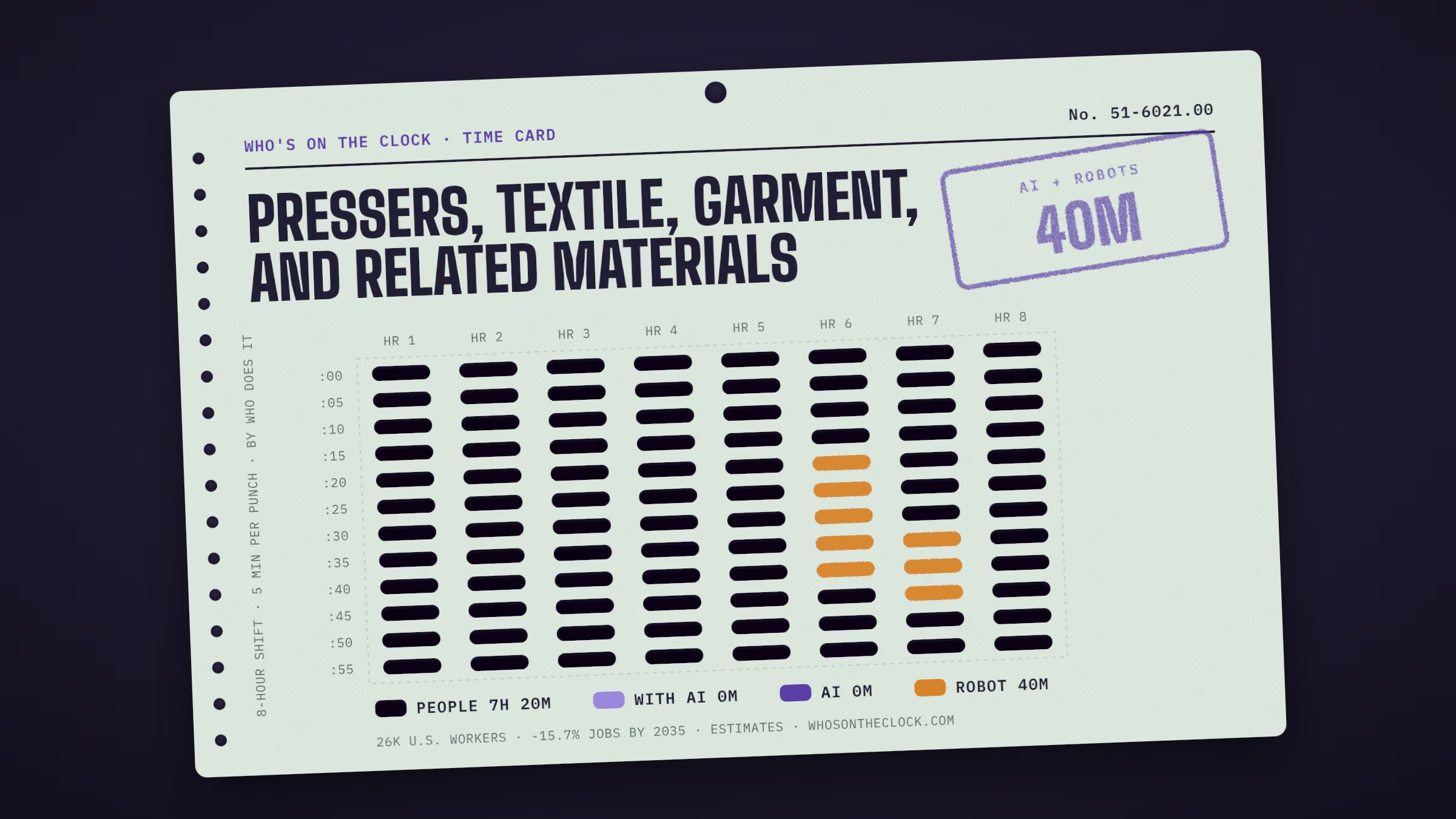
Not replace, but it is changing the job. About 40m of an 8-hour shift goes to tasks touched by robots. The other 7h 20m (92%) stays with people. Separately, BLS expects about 15.7% fewer of these jobs by 2035 (all jobs: +3.5%).

Time card for pressers, textile, garment, and related materials showing a typical 8-hour shift: 7h 20m done by people, 40m by robots.
Each mark is 5 minutes of a typical shift for pressers, textile, garment, and related materials, colored by who does that task today. Estimates from O*NET tasks and Anthropic Economic Index data. How it's made

Home / Production & factory / Pressers, Textile, Garment, and Related Materials

Press or shape articles by hand or machine.

Time card

Untick tasks you don't do, or set your own times.
MineTask, by time spentHumanWith AIAIRobot
Operate steam, hydraulic, or other pressing machines to remove wrinkles from garments and flatwork items, or to shape, form, or patch articles.2h 5m a shift · Robots only in factory cells
Finish pants, jackets, shirts, skirts and other dry-cleaned and laundered articles, using hand irons.46m a shift · Robots only in factory cells
Position materials such as cloth garments, felt, or straw on tables, dies, or feeding mechanisms of pressing machines, or on ironing boards or work tables.46m a shift · No AI or robot evidence found
Hang, fold, package, and tag finished articles for delivery to customers.39m a shift · Robots only in factory cells
Remove finished pieces from pressing machines and hang or stack them for cooling, or forward them for additional processing.39m a shift · Robots only in factory cells
Straighten, smooth, or shape materials to prepare them for pressing.26m a shift · Robots only in factory cells
Lower irons, rams, or pressing heads of machines into position over material to be pressed.26m a shift · Robots deployed · e.g. Flat-bed (carousel/magazine) fusing presses
Push and pull irons over surfaces of articles to smooth or shape them.20m a shift · Robots only in factory cells
Identify and treat spots on garments.13m a shift · No AI or robot evidence found
Clean and maintain pressing machines, using cleaning solutions and lubricants.13m a shift · Robots only in factory cells
Activate and adjust machine controls to regulate temperature and pressure of rollers, ironing shoes, or plates, according to specifications.13m a shift · Robots deployed · e.g. Kannegiesser SmartLaundry / central program control (X6, SmartConnect ironer lines)
Finish pleated garments, determining sizes of pleats from evidence of old pleats or from work orders, using machine presses or hand irons.7m a shift · No AI or robot evidence found
Shrink, stretch, or block articles by hand to conform to original measurements, using forms, blocks, and steam.7m a shift · Robots only in factory cells
Finish fancy garments such as evening gowns and costumes, using hand irons to produce high quality finishes.7m a shift · No AI or robot evidence found
Slide material back and forth over heated, metal, ball-shaped forms to smooth and press portions of garments that cannot be satisfactorily pressed with flat pressers or hand irons.7m a shift · Robots only in factory cells
Select appropriate pressing machines, based on garment properties such as heat tolerance.7m a shift · No AI or robot evidence found
Spray water over fabric to soften fibers when not using steam irons.7m a shift · Robots only in factory cells
Moisten materials to soften and smooth them.7m a shift · Robots only in factory cells
Use covering cloths to prevent equipment from damaging delicate fabrics.7m a shift · Robots only in factory cells
Examine and measure finished articles to verify conformance to standards, using measuring devices such as tape measures and micrometers.7m a shift · Robots only in factory cells
Brush materials made of suede, leather, or felt to remove spots or to raise and smooth naps.7m a shift · No AI or robot evidence found
Select, install, and adjust machine components, including pressing forms, rollers, and guides, using hoists and hand tools.7m a shift · Robots only in factory cells
Press ties on small pressing machines.time not estimated · Robots only in factory cells
Block or shape knitted garments after cleaning.time not estimated · Robots only in factory cells
Finish velvet garments by steaming them on bucks of hot-head presses or steam tables, and brushing pile (nap) with handbrushes.time not estimated · No AI or robot evidence found
Measure fabric to specifications, cut uneven edges with shears, fold material, and press it with an iron to form a heading.time not estimated · Robots only in factory cells
Insert heated metal forms into ties and touch up rough places with hand irons.time not estimated · Robots only in factory cells
Sew ends of new material to leaders or to ends of material in pressing machines, using sewing machines.time not estimated · Robots only in factory cells

On the floor

No company news tracked for this job yet. New stories are added as they happen.

Ask the clock

Will AI replace pressers, textile, garment, and related materials?

Not replace, but it is changing the job. About 40m of an 8-hour shift goes to tasks touched by robots. The other 7h 20m (92%) stays with people. Separately, BLS expects about 15.7% fewer of these jobs by 2035 (all jobs: +3.5%).

What parts of the job can AI already do?

None of this job's tasks show regular AI use yet. That can mean the work is hands-on or in person, or simply that it rarely comes up in AI usage data.

Can a robot do this job?

For some tasks, yes. Robots have done 2 of this job's tasks in workplaces like this one, about 40m of a typical shift. 19 more tasks have only been done in factory setups built around the machine, so they stay with people here. For 6 physical tasks, no robot has shown it can do the work yet.

  • Lower irons, rams, or pressing heads of machines into position over material to be pressed. (26m a shift; e.g. Flat-bed (carousel/magazine) fusing presses, in use)
  • Activate and adjust machine controls to regulate temperature and pressure of rollers, ironing shoes, or plates, according to specifications. (13m a shift; e.g. Kannegiesser SmartLaundry / central program control (X6, SmartConnect ironer lines), in use)
What parts of the job are still done by people?

7h 20m of a typical shift, or 92%, goes to tasks with no AI or robot evidence yet. No AI usage or robot deployment has shown up for these so far. The biggest:

  • Operate steam, hydraulic, or other pressing machines to remove wrinkles from garments and flatwork items, or to shape, form, or patch articles. (2h 5m a shift)
  • Finish pants, jackets, shirts, skirts and other dry-cleaned and laundered articles, using hand irons. (46m a shift)
  • Position materials such as cloth garments, felt, or straw on tables, dies, or feeding mechanisms of pressing machines, or on ironing boards or work tables. (46m a shift)
  • Hang, fold, package, and tag finished articles for delivery to customers. (39m a shift)
  • Remove finished pieces from pressing machines and hang or stack them for cooling, or forward them for additional processing. (39m a shift)
Why does a person still do this work?

Part of the answer is the setting, not just the tasks. Work that is in person, hands on or high stakes is where AI and robots have made the least headway so far. In the official O*NET survey of people in this job:

  • 85% spend more than half the day on their feet
  • 77% use their hands on tools, objects or controls more than half the time
Are employers still hiring for this job?

On Indeed, job postings in the Production & Manufacturing sector are at 124% of their February 2020 level (all U.S. postings: 104%), up 12.6% from a year earlier, as of Oct 9, 2026. BLS separately expects about 2,200 openings a year in this job through 2035. Across all U.S. postings, 7.3% now mention AI skills. Sector postings cover more than this one job and move for many reasons besides AI.

How much do pressers, textile, garment, and related materials make?

The median pay is about $35,060 a year ($16.85 an hour), 31% below the median for all U.S. jobs ($50,980). Most people in this job earn between $27,180 and $43,050 a year; that range covers the middle 80%. Pay figures are from BLS, May 2025, and vary a lot by state and employer. Pick a state to compare:

Is this job growing or shrinking?

BLS projects a decline of 15.7% from 2025 to 2035, compared with 3.5% growth for all jobs. That's about 22,000 jobs in 2035. Even so, it expects about 2,200 openings a year, mostly from people retiring or changing careers. These projections don't single out AI as a cause.

How many people do this job?

About 26,000 people in the U.S., roughly 0.02% of all workers (BLS, May 2025). That makes it the 500th largest of the 796 jobs on this site. BLS expects about 22,000 in 2035.

What do you need to become one?

The most common requirement is less than a high school diploma: about 59% of people in the job said so in the official O*NET survey. O*NET rates the job at level 1 of 5 for preparation, which usually means: little or no preparation. Requirements vary by state and employer, especially for licensed work.

What should I learn to stay ahead?

These come from the job's official skill ratings and from the tasks that AI and robots touch least today. Building them keeps you strong in the parts of the work that still need a person:

  • Skills that matter more here than in most jobs: Operation and Control
  • Get strong at the parts of the job that stay with people (listed above), which take 7h 20m of a typical shift
  • Tools employers list: Microsoft Excel, Microsoft Word
What similar jobs could I move into?

These use similar skills, with less of a typical shift touched by AI or robots. Matches come from 109 official ratings of skills, knowledge and work activities, and each needs the same or less preparation unless the official list relates the jobs directly:

  • Hand Sewers (0m touched, $36k median pay)
  • Quarry Rock Splitters (0m touched, $49k median pay)
How solid are these numbers?

Each task carries its own evidence label. For this job: 2 with robots in real deployments, 26 with no AI or robot evidence found. The minutes per task are estimates, not measured hours, and "no evidence" doesn't prove a task is safe.

Tools in demand

  • Microsoft Excel
  • Microsoft Word

Also called

All-Around Presser, Armhole Presser, Automatic Presser, Blocker, Boarder, Bobbin Presser, Brim Presser, Buffing Wheel Presser, Bulk Folder, Calender Machine Operator, Clothes Ironer, Clothes Presser, Clothing Presser, Coat Presser