Will AI replace telephone operators?

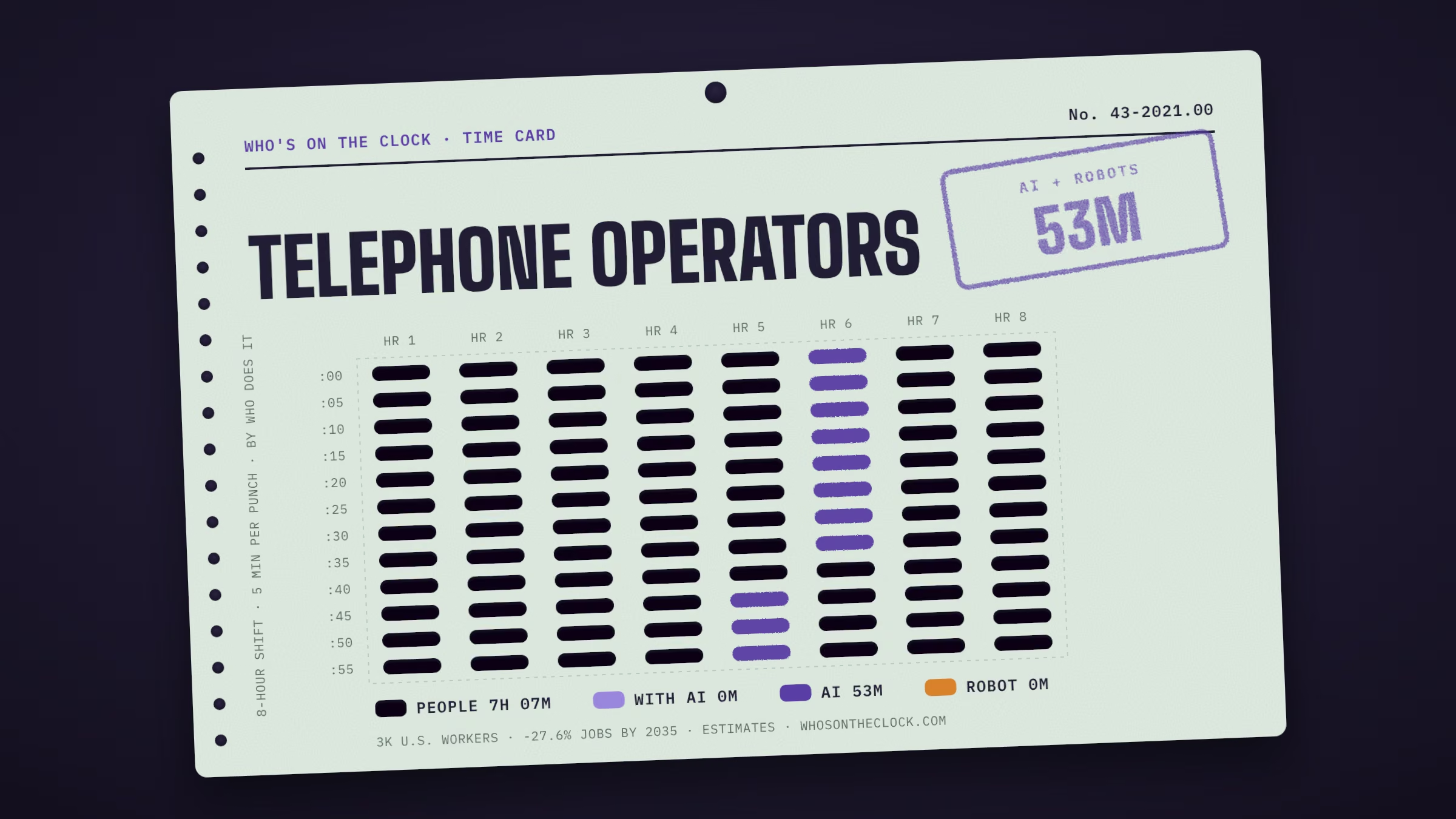
AI already handles some of this work on its own in real use, for tasks like “Perform clerical duties such as typing, proofreading, and sorting mail”. That's 53m of a typical shift; 7h 7m still has no AI or robot evidence. BLS expects about 27.6% fewer of these jobs by 2035.

Time card for telephone operators showing a typical 8-hour shift: 7h 7m done by people, 53m by AI.
Each mark is 5 minutes of a typical shift for telephone operators, colored by who does that task today. Estimates from O*NET tasks and Anthropic Economic Index data. How it's made

Home / Office & admin / Telephone Operators

Provide information by accessing alphabetical, geographical, or other directories. Assist customers with special billing requests, such as charges to a third party and credits or refunds for incorrectly dialed numbers or bad connections. May handle emergency calls and assist children or people with physical disabilities to make telephone calls.

Time card

Untick tasks you don't do, or set your own times.
MineTask, by time spentHumanWith AIAIRobot
Operate telephone switchboards and systems to advance and complete connections, including those for local, long distance, pay telephone, mobile, person-to-person, and emergency calls.2h 12m a shift · No AI or robot evidence found
Why this label?No AI use or robot deployment showed up for this task in our data. That isn't proof it's safe; it may just be rare in the data. How labels work
Listen to customer requests, referring to alphabetical or geographical directories to answer questions and provide telephone information.1h 32m a shift · No AI or robot evidence found
Why this label?No AI use or robot deployment showed up for this task in our data. That isn't proof it's safe; it may just be rare in the data. How labels work
Observe signal lights on switchboards, and dial or press buttons to make connections.1h 6m a shift · No AI or robot evidence found
Why this label?No AI use or robot deployment showed up for this task in our data. That isn't proof it's safe; it may just be rare in the data. How labels work
Perform clerical duties such as typing, proofreading, and sorting mail.53m a shift · Observed in AI use
Why this label?Marked AI because this task shows up regularly in real AI conversations (Anthropic Economic Index, 2025 usage), and in most of them AI does the task on its own rather than helping a person. Many workplaces may not use AI for it at all. How labels work
Operate paging systems or other systems of bells or buzzers to notify recipients of incoming calls.33m a shift · No AI or robot evidence found
Why this label?No AI use or robot deployment showed up for this task in our data. That isn't proof it's safe; it may just be rare in the data. How labels work
Update directory information.20m a shift · No AI or robot evidence found
Why this label?No AI use or robot deployment showed up for this task in our data. That isn't proof it's safe; it may just be rare in the data. How labels work
Offer special assistance to persons such as those who are unable to dial or who are in emergency situations.20m a shift · No AI or robot evidence found
Why this label?No AI use or robot deployment showed up for this task in our data. That isn't proof it's safe; it may just be rare in the data. How labels work
Suggest and check alternate spellings, locations, or listing formats to customers lacking details or complete information.13m a shift · No AI or robot evidence found
Why this label?No AI use or robot deployment showed up for this task in our data. That isn't proof it's safe; it may just be rare in the data. How labels work
Provide relay service for users who are deaf or hard of hearing.13m a shift · No AI or robot evidence found
Why this label?No AI use or robot deployment showed up for this task in our data. That isn't proof it's safe; it may just be rare in the data. How labels work
Keep records of calls placed and received, and of related toll charges.13m a shift · No AI or robot evidence found
Why this label?No AI use or robot deployment showed up for this task in our data. That isn't proof it's safe; it may just be rare in the data. How labels work
Monitor automated systems for placing collect calls and intervene for a callers needing assistance.7m a shift · No AI or robot evidence found
Why this label?No AI use or robot deployment showed up for this task in our data. That isn't proof it's safe; it may just be rare in the data. How labels work
Interrupt busy lines if an emergency warrants.7m a shift · No AI or robot evidence found
Why this label?No AI use or robot deployment showed up for this task in our data. That isn't proof it's safe; it may just be rare in the data. How labels work
Provide assistance for customers with special billing requests.7m a shift · No AI or robot evidence found
Why this label?No AI use or robot deployment showed up for this task in our data. That isn't proof it's safe; it may just be rare in the data. How labels work
Promote company products, services, and savings plans when appropriate.7m a shift · No AI or robot evidence found
Why this label?No AI use or robot deployment showed up for this task in our data. That isn't proof it's safe; it may just be rare in the data. How labels work

Clock history

  1. 53m touchedFirst published: O*NET 30.1, Anthropic Economic Index (2025 usage and September 2026 robot study), BLS May 2025

When new data changes this clock, the date, the new numbers and the reason are logged here. Company news alone never moves the clock.

On the floor

No company news tracked for this job yet. New stories are added as they happen.

Ask the clock

Will AI replace telephone operators?

Unlikely, though parts of the work are changing. About 53m of an 8-hour shift goes to tasks touched by AI working on its own. The other 7h 7m (89%) stays with people. Separately, BLS expects about 27.6% fewer of these jobs by 2035 (all jobs: +3.5%).

What can AI already do for telephone operators?

AI shows up regularly in 1 of 14 tasks, about 53m of a typical shift. The biggest ones:

  • Perform clerical duties such as typing, proofreading, and sorting mail. (53m a shift, AI mostly does it alone)
Where do robots fit in?

Not in workplaces like this one, based on a 2026 review of robot deployments. 1 more task has only been done in factory setups built around the machine, so it stays with people here.

What still needs a person?

7h 7m of a typical shift, or 89%, goes to tasks with no AI or robot evidence yet. No AI usage or robot deployment has shown up for these so far. The biggest:

  • Operate telephone switchboards and systems to advance and complete connections, including those for local, long distance, pay telephone, mobile, person-to-person, and emergency calls. (2h 12m a shift)
  • Listen to customer requests, referring to alphabetical or geographical directories to answer questions and provide telephone information. (1h 32m a shift)
  • Observe signal lights on switchboards, and dial or press buttons to make connections. (1h 6m a shift)
  • Operate paging systems or other systems of bells or buzzers to notify recipients of incoming calls. (33m a shift)
  • Update directory information. (20m a shift)
Why is that work hard to automate?

Much of it comes down to where and how the work happens. In-person, hands-on and high-stakes work is where AI and robots have made the least headway so far. In the official O*NET survey of people in this job:

  • 100% are in constant contact with other people
  • 96% say dealing with the public is very or extremely important
  • 82% talk face to face with others every day
How much do telephone operators make?

The median pay is about $41,740 a year ($20.07 an hour), 18% below the median for all U.S. jobs ($50,980). Most people in this job earn between $31,510 and $62,950 a year; that range covers the middle 80%. Pay figures are from BLS, May 2025, and vary a lot by state and employer. Pick a state to compare:

Is this job growing or shrinking?

BLS projects a decline of 27.6% from 2025 to 2035, compared with 3.5% growth for all jobs. That's about 2,500 jobs in 2035. Even so, it expects about 200 openings a year, mostly from people retiring or changing careers. These projections don't single out AI as a cause.

How many telephone operators are there in the U.S.?

About 3,430 people in the U.S., roughly 0.00% of all workers (BLS, May 2025). That makes it the 749th largest of the 796 jobs on this site. BLS expects about 2,500 in 2035.

What training do telephone operators need?

The most common requirement is a high school diploma: about 98% of people in the job said so in the official O*NET survey. O*NET rates the job at level 2 of 5 for preparation, which usually means: high school diploma, some training. Requirements vary by state and employer, especially for licensed work.

What should I learn to stay ahead of AI?

These come from the job's official skill ratings and from the tasks that AI and robots touch least today. Building them keeps you strong in the parts of the work that still need a person:

  • Skills that matter more here than in most jobs: Service Orientation, Speaking, Active Listening, Social Perceptiveness
  • Get strong at the parts of the job that stay with people (listed above), which take 7h 7m of a typical shift
  • Tools employers list: Microsoft Office software, Microsoft Excel, Microsoft Outlook, Microsoft PowerPoint, Microsoft Windows
  • Learn to use AI well on the tasks where it already shows up in this job (listed above)
What other jobs could telephone operators move into?

These use similar skills. Matches come from 109 official ratings of skills, knowledge and work activities, and each needs the same or less preparation unless the official list relates the jobs directly:

  • Receptionists and Information Clerks (3h 40m touched, $38k median pay)
  • Switchboard Operators (4h 7m touched, $39k median pay)
  • General Office Clerks (4h 30m touched, $45k median pay)
How solid are these numbers?

Each task carries its own evidence label. For this job: 1 observed in real AI use, 13 with no AI or robot evidence found. The minutes per task are estimates, not measured hours, and "no evidence" doesn't prove a task is safe.

Tools in demand

Mostly everyday office tools: Microsoft Office software, Microsoft Excel, Microsoft Outlook, Microsoft PowerPoint, Microsoft Windows, Microsoft Word. The job's skills matter more than any specific software.

Also called

411 Directory Assistance Operator (411 Directory Assistance Op), Central Office Operator (CO Op), Change Number Operator (Change Number Op), Charge Operator (Charge Op), Communications Operator (Communications Op), Customer Service Assistant, Directory Assistance Operator (Directory Assistance Op), Directory Operator (Directory Op), Emergency Operator (Emergency Op), Information Operator (Information Op), Information Specialist, Inward Toll Operator (Inward Toll Op), Live Source Operator (Live Source Op), Local Operator (Local Op)