Will AI replace receptionists and information clerks?
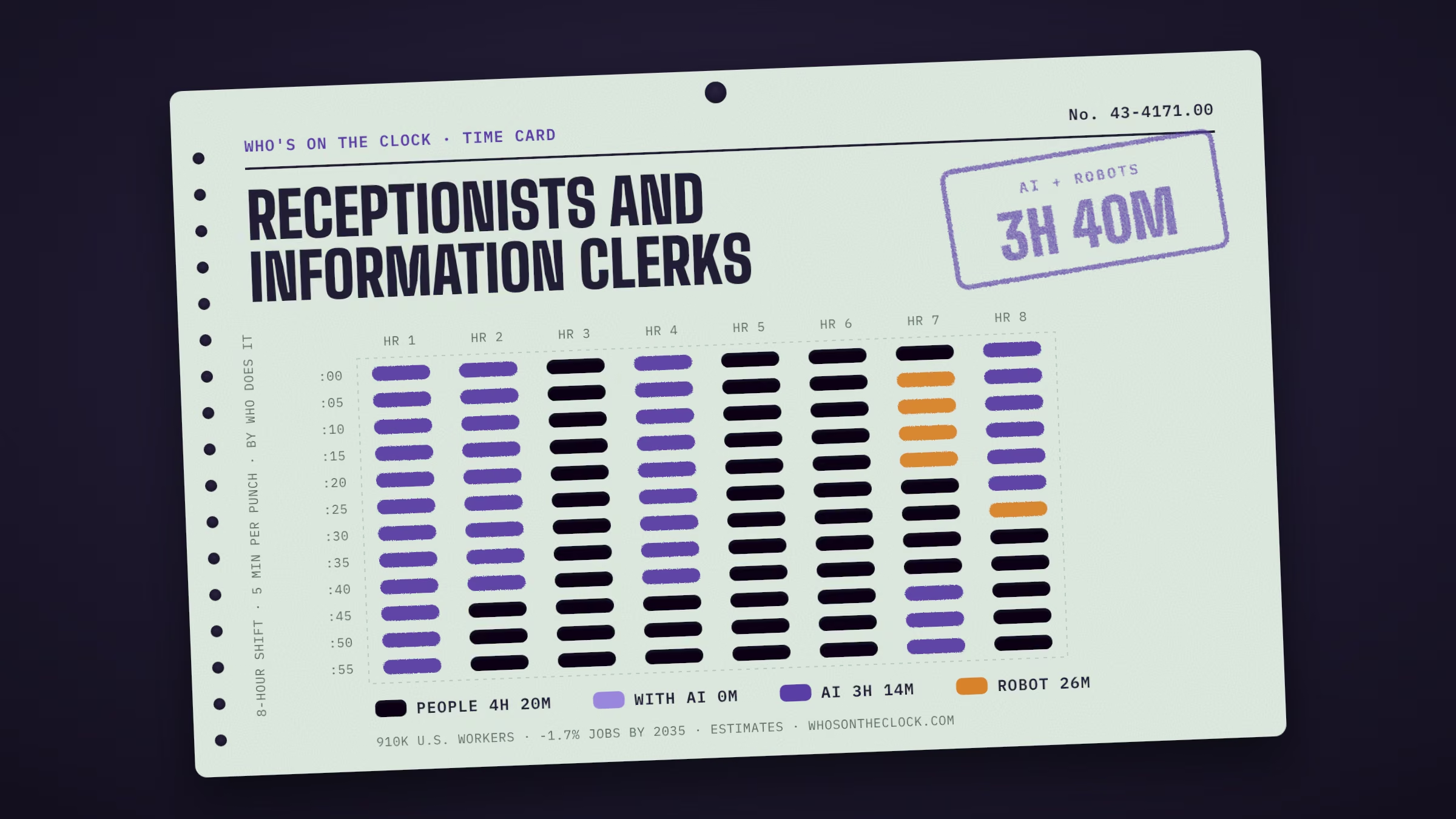
Some tasks are already handled by AI or machines; the rest still needs a person. About 3h 40m of an 8-hour shift goes to tasks that AI or robots largely take over. The breakdown: 3h 13m that AI mostly does alone, 26m that robots have done in real workplaces. The other 4h 20m (54%) stays with people. Separately, BLS expects about 1.7% fewer of these jobs by 2035 (all jobs: +3.5%).
⤢ Full sizeEach mark is 5 minutes of a typical shift for receptionists and information clerks, colored by who does that task today. Estimates from O*NET tasks and Anthropic Economic Index data. How it's made
Answer inquiries and provide information to the general public, customers, visitors, and other interested parties regarding activities conducted at establishment and location of departments, offices, and employees within the organization.
Time card
Untick tasks you don't do, or set your own times.
Mine
Task, by time spent
Human
With AI
AI
Robot
Operate telephone switchboard to answer, screen, or forward calls, providing information, taking messages, or scheduling appointments.1h 47m a shift · Observed in AI use
Greet persons entering establishment, determine nature and purpose of visit, and direct or escort them to specific destinations.1h 13m a shift · No AI or robot evidence found
Schedule appointments and maintain and update appointment calendars.47m a shift · Observed in AI useTypical AI request: about 1h 12m alone, 15m with AI
Provide information about establishment, such as location of departments or offices, employees within the organization, or services provided.40m a shift · No AI or robot evidence found
File and maintain records.33m a shift · Robots only in factory cells
Perform administrative support tasks, such as proofreading, transcribing handwritten information, or operating calculators or computers to work with pay records, invoices, balance sheets, or other documents.33m a shift · No AI or robot evidence found
Transmit information or documents to customers, using computer, mail, or facsimile machine.27m a shift · No AI or robot evidence found
Collect, sort, distribute, or prepare mail, messages, or courier deliveries.20m a shift · Robots only in factory cells
Hear and resolve complaints from customers or the public.13m a shift · Observed in AI useTypical AI request: about 1h 16m alone, 26m with AI
Analyze data to determine answers to questions from customers or members of the public.13m a shift · Observed in AI useTypical AI request: about 5h 38m alone, 45m with AI
Process and prepare memos, correspondence, travel vouchers, or other documents.13m a shift · Observed in AI useTypical AI request: about 1h 49m alone, 25m with AI
Perform duties, such as taking care of plants or straightening magazines to maintain lobby or reception area.7m a shift · Robots deployed · e.g. Moxi mobile manipulator
Calculate and quote rates for tours, stocks, insurance policies, or other products or services.7m a shift · No AI or robot evidence found
Keep a current record of staff members' whereabouts and availability.7m a shift · No AI or robot evidence found
Schedule space or equipment for special programs and prepare lists of participants.7m a shift · No AI or robot evidence found
Enroll individuals to participate in programs and notify them of their acceptance.7m a shift · No AI or robot evidence found
Take orders for merchandise or materials and send them to the proper departments to be filled.7m a shift · No AI or robot evidence found
Intermountain automates 44% of repetitive patient calls with AI agents
Intermountain Health uses Hyro AI agents with Salesforce Agentforce Health to automate scheduling and other routine access tasks. It reports 44% of repetitive calls automated and call abandonment cut 85%.
WellSpan's AI voice agent handles over 160,000 patient calls a month
WellSpan Health expanded its partnership with Hippocratic AI. Its voice agent, Ana, answers inbound calls, schedules primary care visits and answers common questions. WellSpan says the goal is to ease administrative work for its teams.
Pudu plans a robot-run hotel with robot reception and check-in
Pudu Robotics is managing a hotel on the Shenzhen-Zhongshan Link where robots will handle reception and check-in. Public trials with a limited number of rooms start in late 2026, with opening planned for 2027.
Zocdoc launches Zo, an AI phone assistant that books patient appointments
Zocdoc launched Zo, an AI assistant that answers patient scheduling calls around the clock. Practices pay $2 for each appointment Zo schedules on its own.
Will AI replace receptionists and information clerks?
Some tasks are already handled by AI or machines; the rest still needs a person. About 3h 40m of an 8-hour shift goes to tasks that AI or robots largely take over. The breakdown: 3h 13m that AI mostly does alone, 26m that robots have done in real workplaces. The other 4h 20m (54%) stays with people. Separately, BLS expects about 1.7% fewer of these jobs by 2035 (all jobs: +3.5%).
What parts of the job can AI already do?
AI shows up regularly in 5 of 18 tasks, about 3h 13m of a typical shift. The biggest ones:
Operate telephone switchboard to answer, screen, or forward calls, providing information, taking messages, or scheduling appointments. (1h 47m a shift, AI mostly does it alone)
Schedule appointments and maintain and update appointment calendars. (47m a shift, AI mostly does it alone)
Hear and resolve complaints from customers or the public. (13m a shift, AI mostly does it alone)
Analyze data to determine answers to questions from customers or members of the public. (13m a shift, AI mostly does it alone)
Process and prepare memos, correspondence, travel vouchers, or other documents. (13m a shift, AI mostly does it alone)
Where do robots fit in?
For some tasks, yes. Robots have done 2 of this job's tasks in workplaces like this one, about 26m of a typical shift. 2 more tasks have only been done in factory setups built around the machine, so they stay with people here.
Receive payment and record receipts for services. (20m a shift; e.g. Clearwave patient check-in kiosk, in use)
Perform duties, such as taking care of plants or straightening magazines to maintain lobby or reception area. (7m a shift; e.g. Moxi mobile manipulator, in use)
What parts of the job are still done by people?
4h 20m of a typical shift, or 54%, goes to tasks with no AI or robot evidence yet. No AI usage or robot deployment has shown up for these so far. The biggest:
Greet persons entering establishment, determine nature and purpose of visit, and direct or escort them to specific destinations. (1h 13m a shift)
Provide information about establishment, such as location of departments or offices, employees within the organization, or services provided. (40m a shift)
File and maintain records. (33m a shift)
Perform administrative support tasks, such as proofreading, transcribing handwritten information, or operating calculators or computers to work with pay records, invoices, balance sheets, or other documents. (33m a shift)
Transmit information or documents to customers, using computer, mail, or facsimile machine. (27m a shift)
Why does a person still do this work?
Part of the answer is the setting, not just the tasks. Work that is in person, hands on or high stakes is where AI and robots have made the least headway so far. In the official O*NET survey of people in this job:
88% are in constant contact with other people
78% say dealing with the public is very or extremely important
77% talk face to face with others every day
What are companies actually doing?
We track 4 sourced company moves that affect this job. Most recent:
Jul 31, 2026: Intermountain automates 44% of repetitive patient calls with AI agents (Rolling out)
Jul 30, 2026: WellSpan's AI voice agent handles over 160,000 patient calls a month (Rolling out)
Jun 29, 2026: Pudu plans a robot-run hotel with robot reception and check-in (Plan)
How much time does AI save on this job's tasks?
For the 4 tasks in this job where AI shows up and timing data exists, a typical request takes about 1h 33m for a person alone and about 26m with AI. These are Claude's own estimates from real conversations in April and May 2026 (Anthropic Economic Index). They describe single requests, not whole workdays, and time saved on a task doesn't mean jobs are cut. The biggest gaps:
Analyze data to determine answers to questions from customers or members of the public (about 5h 38m alone, 45m with AI)
Process and prepare memos, correspondence, travel vouchers, or other documents (about 1h 49m alone, 25m with AI)
Schedule appointments and maintain and update appointment calendars (about 1h 12m alone, 15m with AI)
Are employers still hiring for this job?
On Indeed, job postings in the Administrative Assistance sector are at 96% of their February 2020 level (all U.S. postings: 104%), up 0.6% from a year earlier, as of Oct 9, 2026. BLS separately expects about 105,000 openings a year in this job through 2035. Across all U.S. postings, 7.3% now mention AI skills. Sector postings cover more than this one job and move for many reasons besides AI.
How much do receptionists and information clerks make?
The median pay is about $38,010 a year ($18.27 an hour), 25% below the median for all U.S. jobs ($50,980). Most people in this job earn between $28,760 and $49,950 a year; that range covers the middle 80%. Pay figures are from BLS, May 2025, and vary a lot by state and employer. Pick a state to compare:
Is this job growing or shrinking?
BLS projects a decline of 1.7% from 2025 to 2035, compared with 3.5% growth for all jobs. That's about 932,000 jobs in 2035. Even so, it expects about 105,000 openings a year, mostly from people retiring or changing careers. These projections don't single out AI as a cause.
How many people do this job?
About 910,000 people in the U.S., roughly 0.59% of all workers (BLS, May 2025). That makes it the 42nd largest of the 796 jobs on this site. BLS expects about 932,000 in 2035.
What do you need to become one?
The most common requirement is a high school diploma: about 49% of people in the job said so in the official O*NET survey. O*NET rates the job at level 2 of 5 for preparation, which usually means: high school diploma, some training. Requirements vary by state and employer, especially for licensed work.
What should I learn to stay ahead?
These come from the job's official skill ratings and from the tasks that AI and robots touch least today. Building them keeps you strong in the parts of the work that still need a person:
Skills that matter more here than in most jobs: Service Orientation, Speaking, Active Listening, Social Perceptiveness
Get strong at the parts of the job that stay with people (listed above), which take 4h 20m of a typical shift
Tools employers list: Microsoft Word, Microsoft Outlook, Microsoft Office software, Microsoft Excel, Google Docs
Learn to use AI well on the tasks where it already shows up in this job (listed above)
Are there new tasks in this job?
Yes. Occupational experts recently added these to the official task list, a sign of how the work itself is shifting. New tasks aren't rated for AI or robots yet:
Enter and update databases of contact information, such as names, addresses, and phone numbers.
What similar jobs could I move into?
These use similar skills, with less of a typical shift touched by AI or robots. Matches come from 109 official ratings of skills, knowledge and work activities, and each needs the same or less preparation unless the official list relates the jobs directly:
Telephone Operators (53m touched, $42k median pay)
Court, Municipal, and License Clerks (1h 28m touched, $49k median pay)
Word Processors and Typists (2h 21m touched, $49k median pay)
Medical Secretaries and Administrative Assistants (3h 4m touched, $46k median pay)
How solid are these numbers?
Each task carries its own evidence label. For this job: 5 observed in real AI use, 2 with robots in real deployments, 11 with no AI or robot evidence found. The minutes per task are estimates, not measured hours, and "no evidence" doesn't prove a task is safe.
Tools in demand
Microsoft Word
Microsoft Outlook
Microsoft Office software
Microsoft Excel
Google Docs
Intuit QuickBooks
Microsoft PowerPoint
Microsoft Windows
Also called
Appointment Clerk, Appointment Scheduler, Appointment Setter, Automobile Club Information Clerk (Auto Club Info Clerk), Bilingual Receptionist, Call Center Agent, Call Center Operator, Call Center Representative (Call Center Rep), Call Taker, Clerk Specialist, Clinic Receptionist, Customer Care Representative (CCR), Dental Receptionist, ER Clerk (Emergency Room Clerk)