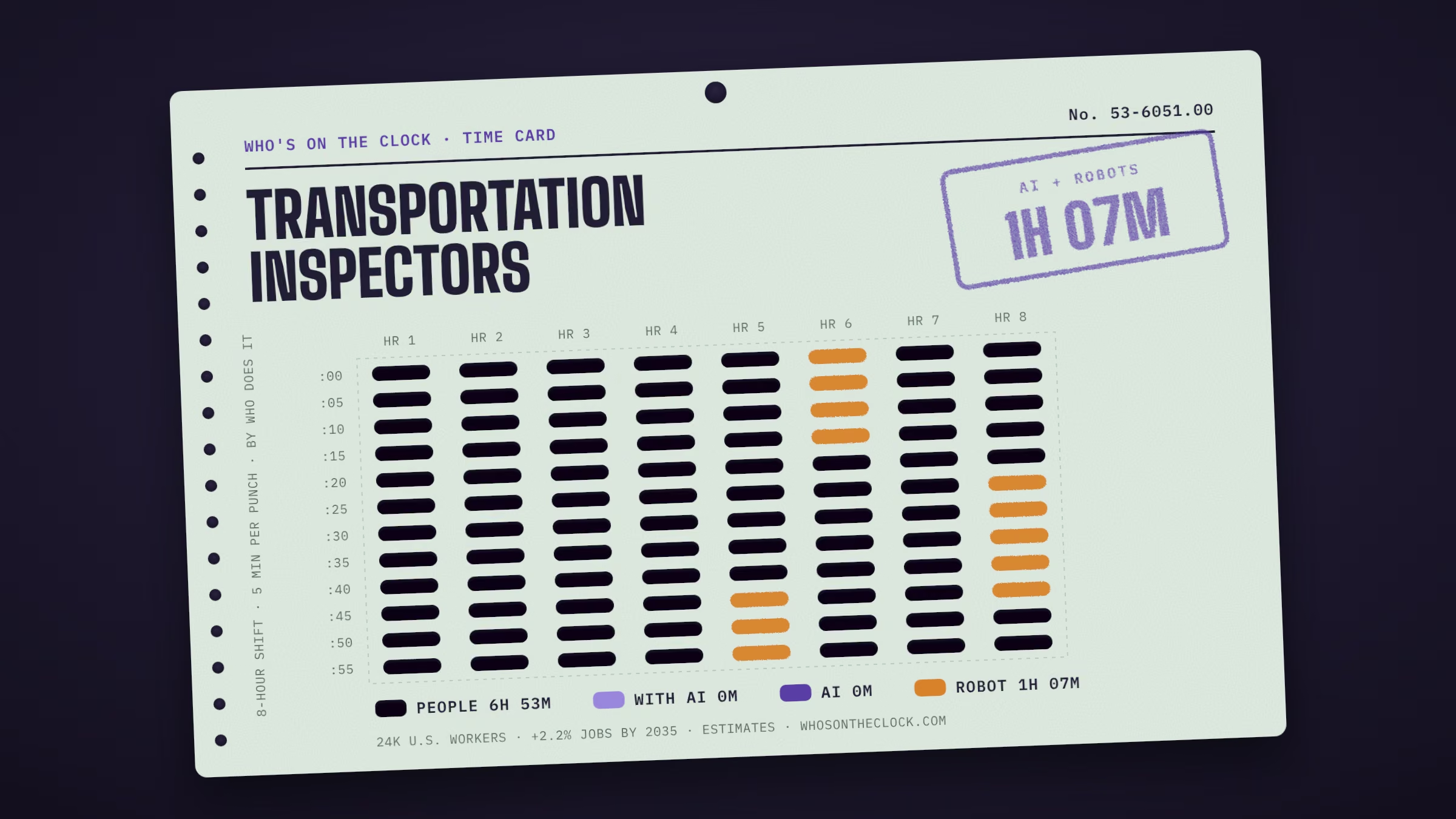
Inspect equipment or goods in connection with the safe transport of cargo or people. Includes rail transportation inspectors, such as freight inspectors, rail inspectors, and other inspectors of transportation vehicles not elsewhere classified.
Time card
Untick tasks you don't do, or set your own times.
| Mine | Task, by time spent | Human | With AI | AI | Robot |
|---|---|---|---|---|---|
Prepare and submit reports after completion of freight shipments.1h 13m a shift · No AI or robot evidence foundWhy this label?No AI use or robot deployment showed up for this task in our data. That isn't proof it's safe; it may just be rare in the data. How labels work | |||||
Inspect loaded cargo, cargo lashed to decks or in storage facilities, and cargo handling devices to determine compliance with health and safety regulations and need for maintenance.1h 1m a shift · Robots only in factory cellsWhy this label?Robots have done this only in factory setups built around the machine, so it stays Human for transportation inspectors. How labels work | |||||
Inspect shipments to ensure that freight is securely braced and blocked.49m a shift · No AI or robot evidence foundWhy this label?This is physical work, and no robot has been shown doing it yet. How labels work | |||||
Record details about freight conditions, handling of freight, and any problems encountered.49m a shift · No AI or robot evidence foundWhy this label?No AI use or robot deployment showed up for this task in our data. That isn't proof it's safe; it may just be rare in the data. How labels work | |||||
Observe loading of freight to ensure that crews comply with procedures.49m a shift · No AI or robot evidence foundWhy this label?This is physical work, and no robot has been shown doing it yet. How labels work | |||||
Visually inspect cargo for damage upon arrival or discharge.36m a shift · Robots deployed · e.g. VISY ADDS (Automatic Damage Detection System)Why this label?Marked Robot because VISY ADDS (Automatic Damage Detection System) (in real use) has done this task in a real workplace. It shows a robot can do it somewhere, not that most transportation inspectors work alongside one. How labels work | |||||
Determine cargo transportation capabilities by reading documents that set forth cargo loading and securing procedures, capacities, and stability factors.30m a shift · No AI or robot evidence foundWhy this label?No AI use or robot deployment showed up for this task in our data. That isn't proof it's safe; it may just be rare in the data. How labels work | |||||
Recommend remedial procedures to correct any violations found during inspections.24m a shift · No AI or robot evidence foundWhy this label?No AI use or robot deployment showed up for this task in our data. That isn't proof it's safe; it may just be rare in the data. How labels work | |||||
Advise crews in techniques of stowing dangerous and heavy cargo.18m a shift · No AI or robot evidence foundWhy this label?No AI use or robot deployment showed up for this task in our data. That isn't proof it's safe; it may just be rare in the data. How labels work | |||||
Direct crews to reload freight or to insert additional bracing or packing as necessary.18m a shift · No AI or robot evidence foundWhy this label?No AI use or robot deployment showed up for this task in our data. That isn't proof it's safe; it may just be rare in the data. How labels work | |||||
Calculate gross and net tonnage, hold capacities, volumes of stored fuel and water, cargo weights, and vessel stability factors, using mathematical formulas.18m a shift · No AI or robot evidence foundWhy this label?No AI use or robot deployment showed up for this task in our data. That isn't proof it's safe; it may just be rare in the data. How labels work | |||||
Notify workers of any special treatment required for shipments.12m a shift · No AI or robot evidence foundWhy this label?No AI use or robot deployment showed up for this task in our data. That isn't proof it's safe; it may just be rare in the data. How labels work | |||||
Check temperatures and humidities of shipping and storage areas to ensure that they are at appropriate levels to protect cargo.12m a shift · Robots deployed · e.g. DEEP Robotics X20/X30 and Lynx M20 quadrupedsWhy this label?Marked Robot because DEEP Robotics X20/X30 and Lynx M20 quadrupeds (in real use) has done this task in a real workplace. It shows a robot can do it somewhere, not that most transportation inspectors work alongside one. How labels work | |||||
Measure heights and widths of loads to ensure they will pass over bridges or through tunnels on scheduled routes.12m a shift · Robots deployed · e.g. Railroad wayside defect detectors (high/wide and shifted-load detectors)Why this label?Marked Robot because Railroad wayside defect detectors (high/wide and shifted-load detectors) (in real use) has done this task in a real workplace. It shows a robot can do it somewhere, not that most transportation inspectors work alongside one. How labels work | |||||
Read draft markings to determine depths of vessels in water.6m a shift · Robots deployed · e.g. OMC International real-time air draft measurement system (RIEGL VZ-2000i LiDAR)Why this label?Marked Robot because OMC International real-time air draft measurement system (RIEGL VZ-2000i LiDAR) (in real use) has done this task in a real workplace. It shows a robot can do it somewhere, not that most transportation inspectors work alongside one. How labels work | |||||
Post warning signs on vehicles containing explosives or flammable or radioactive materials.6m a shift · Robots only in factory cellsWhy this label?Robots have done this only in factory setups built around the machine, so it stays Human for transportation inspectors. How labels work | |||||
Measure vessels' holds and depths of fuel and water in tanks, using sounding lines and tape measures.6m a shift · Robots only in factory cellsWhy this label?Robots have done this only in factory setups built around the machine, so it stays Human for transportation inspectors. How labels work |