Will AI replace software developers?

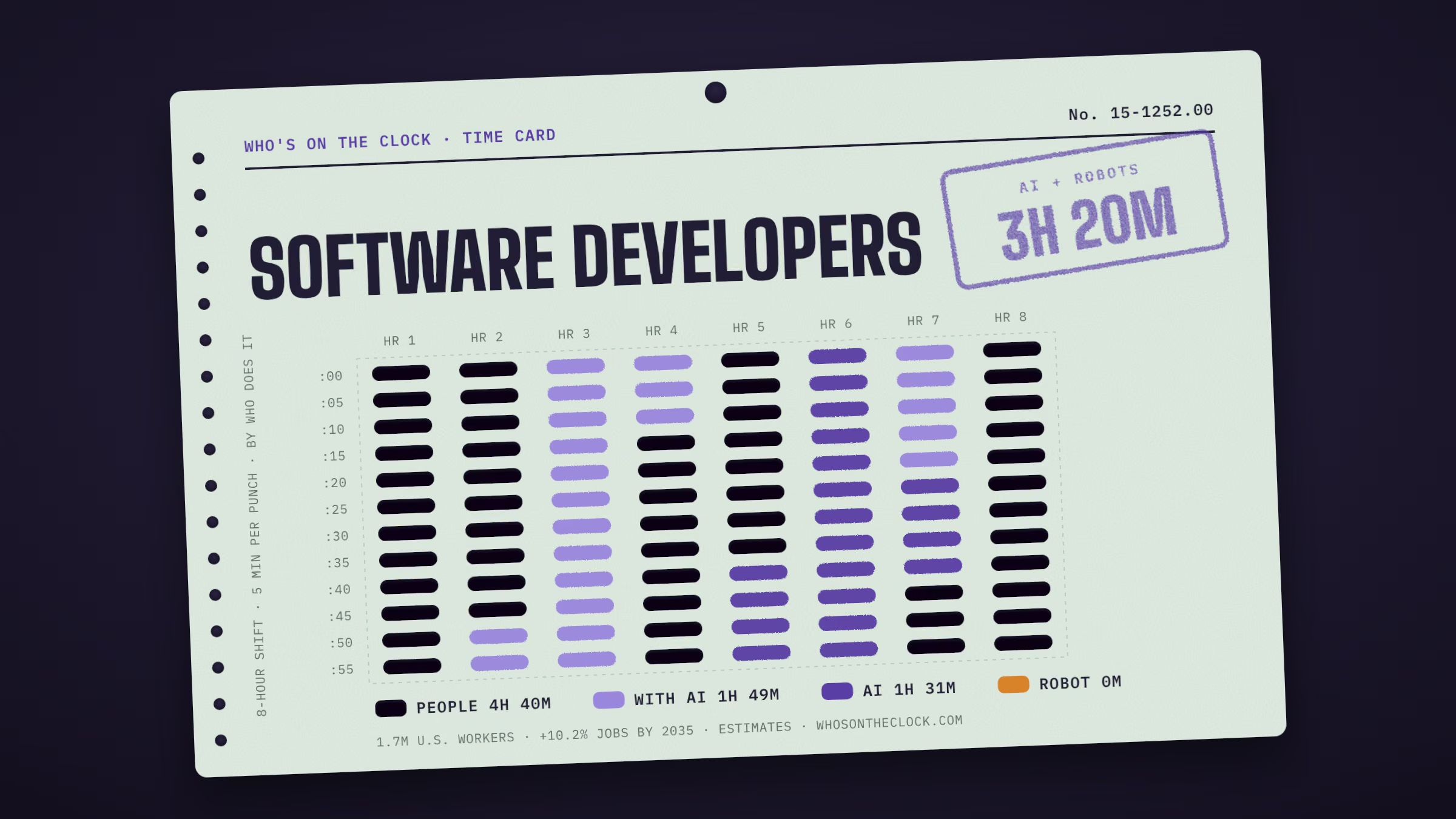
Not replace, but it is changing the job. About 3h 20m of an 8-hour shift goes to tasks touched by AI that people use as a helper. The breakdown: 1h 49m done by people with AI help, 1h 31m that AI mostly does alone. The other 4h 40m (58%) stays with people. Separately, BLS expects about 10.2% more of these jobs by 2035 (all jobs: +3.5%).

Time card for software developers showing a typical 8-hour shift: 4h 40m done by people, 1h 49m done by people with AI, 1h 31m by AI.
Each mark is 5 minutes of a typical shift for software developers, colored by who does that task today. Estimates from O*NET tasks and Anthropic Economic Index data. How it's made

Home / Computers & math / Software Developers

Research, design, and develop computer and network software or specialized utility programs. Analyze user needs and develop software solutions, applying principles and techniques of computer science, engineering, and mathematical analysis. Update software or enhance existing software capabilities. May work with computer hardware engineers to integrate hardware and software systems, and develop specifications and performance requirements. May maintain databases within an application area, working individually or coordinating database development as part of a team.

Time card

Untick tasks you don't do, or set your own times.
MineTask, by time spentHumanWith AIAIRobot
Design, develop and modify software systems, using scientific analysis and mathematical models to predict and measure outcomes and consequences of design.1h 49m a shift · No AI or robot evidence found
Modify existing software to correct errors, adapt it to new hardware, or upgrade interfaces and improve performance.1h 26m a shift · Observed in AI useTypical AI request: about 4h 58m alone, 41m with AI
Develop or direct software system testing or validation procedures, programming, or documentation.46m a shift · No AI or robot evidence found
Confer with systems analysts, engineers, programmers and others to design systems and to obtain information on project limitations and capabilities, performance requirements and interfaces.40m a shift · No AI or robot evidence found
Analyze user needs and software requirements to determine feasibility of design within time and cost constraints.29m a shift · Observed in AI useTypical AI request: about 11h 18m alone, 58m with AI
Prepare reports or correspondence concerning project specifications, activities, or status.23m a shift · Observed in AI useTypical AI request: about 4h 13m alone, 51m with AI
Analyze information to determine, recommend, and plan installation of a new system or modification of an existing system.23m a shift · Observed in AI useTypical AI request: about 9h 51m alone, 58m with AI
Consult with customers or other departments on project status, proposals, or technical issues, such as software system design or maintenance.23m a shift · Observed in AI useTypical AI request: about 5h 11m alone, 55m with AI
Store, retrieve, and manipulate data for analysis of system capabilities and requirements.17m a shift · Observed in AI useTypical AI request: about 7h 17m alone, 40m with AI
Confer with data processing or project managers to obtain information on limitations or capabilities for data processing projects.17m a shift · No AI or robot evidence found
Monitor functioning of equipment to ensure system operates in conformance with specifications.17m a shift · No AI or robot evidence found
Coordinate installation of software system.17m a shift · No AI or robot evidence found
Supervise and assign work to programmers, designers, technologists, technicians, or other engineering or scientific personnel.11m a shift · No AI or robot evidence found
Determine system performance standards.6m a shift · No AI or robot evidence found
Supervise the work of programmers, technologists and technicians and other engineering and scientific personnel.6m a shift · No AI or robot evidence found
Obtain and evaluate information on factors such as reporting formats required, costs, or security needs to determine hardware configuration.6m a shift · No AI or robot evidence found
Train users to use new or modified equipment.6m a shift · No AI or robot evidence found

On the floor

  1. ForecastStanford Digital Economy Lab
    Stanford study finds 19% employment gap for young workers in AI-exposed jobs

    Using ADP payroll data through June 2026, the study finds employment of workers aged 22 to 25 in AI-exposed occupations is 19% below where it would be otherwise. The decline comes mainly from reduced hiring, and experienced workers show no comparable gap.

    Stanford Digital Economy Lab

  2. WidespreadIndeed Hiring Lab
    Software developer postings rise 15% on Indeed but remain below pre-pandemic

    Indeed data show software development postings up 15% since late February 2025 while overall postings fell 7%, though still about 27.5% below pre-pandemic levels. Dice reported software development postings down 22% from 2025, and 71% of the Indeed increase was for senior roles.

    CIO

  3. AnnouncedWix
    Wix buys Base44, an AI tool that builds apps from plain language

    Wix paid about $80 million up front for Base44, plus earn-outs through 2029. Base44 lets people build software and apps by describing them in plain language, with the chat handling databases, login and deployment.

    Nasdaq (Wix press release)

  4. Rolling outMicrosoft
    Software engineers were over 40% of Microsoft's Washington layoffs

    Microsoft cut about 6,000 workers, including roughly 2,000 in Washington. Software engineers made up more than 40% of the Washington cuts, the largest single category.

    Fortune

  5. Rolling outMicrosoft
    Microsoft says 20% to 30% of its code is written by AI

    CEO Satya Nadella said 20% to 30% of code in Microsoft's repositories was written by software. The week before, Google CEO Sundar Pichai said AI generates more than 30% of Google's code.

    TechCrunch

  6. PlanSalesforce
    Salesforce says it will hire no new engineers in 2025

    CEO Marc Benioff said Salesforce would not hire any new engineers in 2025. He cited a 30% productivity increase in engineering from AI tools.

    The Register

Ask the clock

Will AI replace software developers?

Not replace, but it is changing the job. About 3h 20m of an 8-hour shift goes to tasks touched by AI that people use as a helper. The breakdown: 1h 49m done by people with AI help, 1h 31m that AI mostly does alone. The other 4h 40m (58%) stays with people. Separately, BLS expects about 10.2% more of these jobs by 2035 (all jobs: +3.5%).

What parts of the job can AI already do?

AI shows up regularly in 6 of 17 tasks, about 3h 20m of a typical shift. The biggest ones:

  • Analyze user needs and software requirements to determine feasibility of design within time and cost constraints. (29m a shift, AI mostly does it alone)
  • Prepare reports or correspondence concerning project specifications, activities, or status. (23m a shift, AI mostly does it alone)
  • Analyze information to determine, recommend, and plan installation of a new system or modification of an existing system. (23m a shift, AI mostly does it alone)
  • Store, retrieve, and manipulate data for analysis of system capabilities and requirements. (17m a shift, AI mostly does it alone)
  • Modify existing software to correct errors, adapt it to new hardware, or upgrade interfaces and improve performance. (1h 26m a shift, people use AI to help)
What parts of the job are still done by people?

4h 40m of a typical shift, or 58%, goes to tasks with no AI or robot evidence yet. No AI usage or robot deployment has shown up for these so far. The biggest:

  • Design, develop and modify software systems, using scientific analysis and mathematical models to predict and measure outcomes and consequences of design. (1h 49m a shift)
  • Develop or direct software system testing or validation procedures, programming, or documentation. (46m a shift)
  • Confer with systems analysts, engineers, programmers and others to design systems and to obtain information on project limitations and capabilities, performance requirements and interfaces. (40m a shift)
  • Confer with data processing or project managers to obtain information on limitations or capabilities for data processing projects. (17m a shift)
  • Monitor functioning of equipment to ensure system operates in conformance with specifications. (17m a shift)
What are companies actually doing?

We track 6 sourced company moves that affect this job. Most recent:

  • Aug 12, 2026: Stanford study finds 19% employment gap for young workers in AI-exposed jobs (Forecast)
  • Jul 13, 2026: Software developer postings rise 15% on Indeed but remain below pre-pandemic (Widespread)
  • Jun 18, 2025: Wix buys Base44, an AI tool that builds apps from plain language (Announced)
How much time does AI save on this job's tasks?

For the 6 tasks in this job where AI shows up and timing data exists, a typical request takes about 6h 14m for a person alone and about 53m with AI. These are Claude's own estimates from real conversations in April and May 2026 (Anthropic Economic Index). They describe single requests, not whole workdays, and time saved on a task doesn't mean jobs are cut. The biggest gaps:

  • Analyze user needs and software requirements to determine feasibility of design within time and cost constraints (about 11h 18m alone, 58m with AI)
  • Analyze information to determine, recommend, and plan installation of a new system or modification of an existing system (about 9h 51m alone, 58m with AI)
  • Store, retrieve, and manipulate data for analysis of system capabilities and requirements (about 7h 17m alone, 40m with AI)
Are employers still hiring for this job?

On Indeed, job postings in the Software Development sector are at 78% of their February 2020 level (all U.S. postings: 104%), up 21.5% from a year earlier, as of Oct 9, 2026. BLS separately expects about 95,000 openings a year in this job through 2035. Across all U.S. postings, 7.3% now mention AI skills. Sector postings cover more than this one job and move for many reasons besides AI.

How much do software developers make?

The median pay is about $135,980 a year ($65.38 an hour), 167% above the median for all U.S. jobs ($50,980). Most people in this job earn between $82,460 and $214,670 a year; that range covers the middle 80%. Pay figures are from BLS, May 2025, and vary a lot by state and employer.

Is this job growing or shrinking?

BLS projects growth of 10.2% from 2025 to 2035, compared with 3.5% growth for all jobs. That's about 1.9 million jobs in 2035. It expects about 95,000 openings a year, mostly from people retiring or changing careers. These projections don't single out AI as a cause.

How many people do this job?

About 1.7 million people in the U.S., roughly 1.1% of all workers (BLS, May 2025). That makes it the 16th largest of the 796 jobs on this site. BLS expects about 1.9 million in 2035.

What do you need to become one?

The most common requirement is a bachelor's degree: about 85% of people in the job said so in the official O*NET survey. O*NET rates the job at level 4 of 5 for preparation, which usually means: bachelor's degree. Requirements vary by state and employer, especially for licensed work.

What should I learn to stay ahead?

These come from the job's official skill ratings and from the tasks that AI and robots touch least today. Building them keeps you strong in the parts of the work that still need a person:

  • Skills that matter more here than in most jobs: Programming, Technology Design, Operations Analysis, Systems Analysis
  • Get strong at the parts of the job that stay with people (listed above), which take 4h 40m of a typical shift
  • Tools employers list: TypeScript, Structured query language SQL, Spring Framework, Spring Boot, React
  • Learn to use AI well on the tasks where it already shows up in this job (listed above)
What similar jobs could I move into?

These use similar skills. Matches come from 109 official ratings of skills, knowledge and work activities, and each needs the same or less preparation unless the official list relates the jobs directly:

  • Data Warehousing Specialists (6h 24m touched, $140k median pay)
  • Web Developers (4h 59m touched, $93k median pay)
  • Database Administrators (3h 35m touched, $105k median pay)
  • Database Architects (5h touched, $140k median pay)
  • Software Quality Assurance Analysts and Testers (3h 26m touched, $104k median pay)
How solid are these numbers?

Each task carries its own evidence label. For this job: 6 observed in real AI use, 11 with no AI or robot evidence found. The minutes per task are estimates, not measured hours, and "no evidence" doesn't prove a task is safe.

Tools in demand

  • TypeScript
  • Structured query language SQL
  • Spring Framework
  • Spring Boot
  • React
  • Python
  • PostgreSQL
  • Oracle Java

Also called

AI Specialist (Artificial Intelligence Specialist), Application Analyst, Application Architect, Application Developer, Application Engineer, Application Integration Engineer, Application Integrator, Application Programmer, Application Software Engineering IT Specialist (Application Software Engineering Information Technology Specialist), Application Support Engineer, Application Systems Analyst, Application Systems Architect, Beta Tester, Business Application Developer